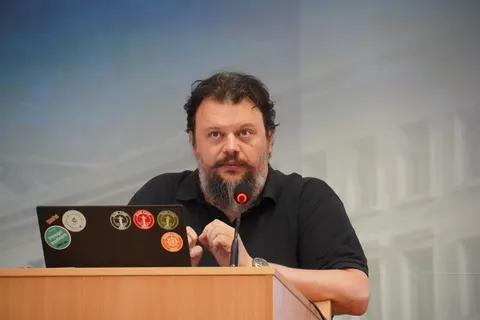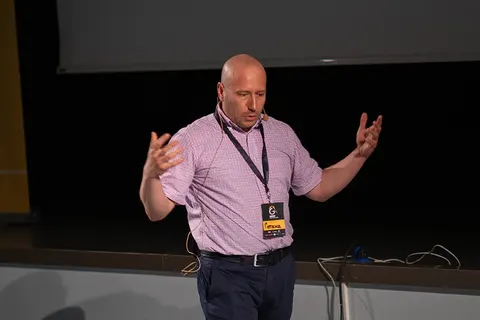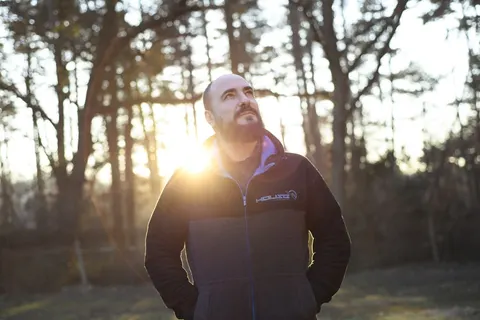
He is a programmer, an astrophysicist with scientific publications and… the drummer of a rock band. A Renaissance man, only from the digital age.
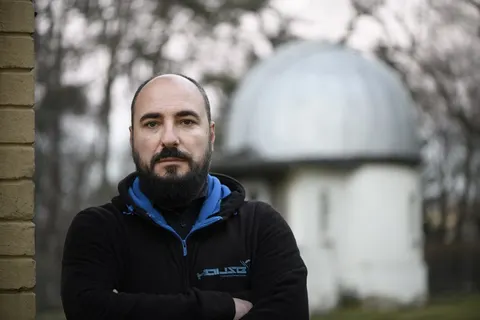
We have so many topics to discuss with Chief Assistant Professor Orlin Stanchev, a programmer at Kin + Carta, a lecturer at Sofia University St. Kliment Ohridski, an explorer of distant galaxies and the drummer of the band ALI. Let's not waste any time!
How are new stars born in the sky, in science, in music?
We will head out into deep space to learn how artificial intelligence can help us get to know the universe. We will talk about how new technologies are fundamentally changing the paradigm of science. We will look for what music, science and programming have in common.
Last but not least, we will reflect on aliens and on artificial general intelligence. Which one is coming first? Which one should we worry about more?
Lift-off! 9, 8, 7….
– Aliens or artificial general intelligence—which do you think we are more likely to see soon?
– A very interesting question! I think the pragmatic answer is obvious, at least to me. Both quests are extremely topical today, but in a historical context the search for extraterrestrial intelligence has been going on for longer. We can easily get a sense of how fast each of the two searches is developing. The curve of accumulating new knowledge and new areas of application is definitely much steeper for AI than for the search for contact with alien civilizations.
If we extrapolate into the future, I think we will definitely see the foundations laid for an artificial general intelligence, one that can learn to perform any intellectual task, sooner than we discover alien civilizations.
Most people would say the search for extraterrestrial intelligence is more exciting, but let's not underestimate AI.
The changes could be drastic, with no less of an impact than finding evidence of intelligent alien civilizations.
– Which of the two should we worry about more?
– If we start from the presumption that AI—general though it may be—is something we will understand and control, then perhaps we should worry more about the aliens. On the other hand, we are much less likely to see aliens than general AI, so we should probably be more careful with the “monster” right in front of us.
– What do you think are the most beautiful objects in the sky?
– For me, it's galaxies. Physically speaking, they are objects whose study involves almost the whole of astrophysics. Gigantic structures with a diverse morphology, shaped by the complex dynamics of stars and the interstellar medium and by their complex evolution.
The most beautiful are the spiral galaxies; everyone has seen stunning images of them. But behind that beauty lie a number of questions and challenges for physics. How does the spiral structure form in them? What mechanisms keep it stable? Is it connected to the dynamics of the stars? And what is the role of the black holes at their centers?
Elliptical galaxies don't enjoy the same popularity, perhaps because they lack those beautiful spiral structures. But they are far from uninteresting—quite the opposite. Why is there no star formation going on in them? Why do they contain so little interstellar gas? Actually, it turns out there is more than expected, and yet there are no active processes of new stars being born… More interesting and important questions that outline the main tasks of astrophysics.
For me, at least, aesthetic beauty is not enough. Putting together the puzzle defined by all those important questions adds a substantial beauty
in a more complex sense.
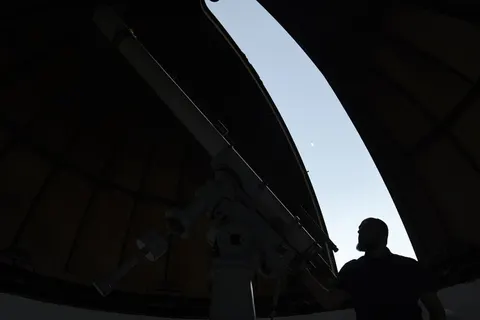
– What is the focus of your research?
– As part of the star formation theory group at the Department of Astronomy at Sofia University, we study
extremely interesting objects in the galaxy—giant molecular clouds. That is exactly where stars are born.
The group's research covers a variety of areas, from studying the overall structure of the molecular clouds in our galaxy to examining their morphology. We look for the link between their formation and the early evolution of the galaxy. We are interested in questions such as: what is the density distribution in molecular regions? What is the balance of energies in them? How is that related to their fragmentation and the formation of denser regions? It's an important question, because it is precisely these structures that are associated with the birth of new stars. What algorithms and software can we use to identify and analyze such structures when processing 2D and 3D images?
I take part in projects with colleagues from the universities of Cologne, Munich and Heidelberg. I also bring this work to the thesis students I advise or supervise.
– What are the biggest breakthroughs made so far with the help of machine learning in this field of science?
– We can already boast many successful applications. One breakthrough is the classification of astronomical objects. Machine learning is extremely useful here for analyzing large volumes of data quickly and efficiently.
We have ever more powerful and precise instruments for observing space. They generate colossal data sets that no human could physically process. It's no coincidence that phenomena like “citizen science” are thriving in astronomy. Take the Galaxy Zoo project, which began with the far-from-easy task of classifying a large set of galaxies by morphology. The platform is designed so that anyone can join in fairly easily, by looking at real images and following specific steps and classification criteria.
For now, the human brain is very good at this task, and to pass that experience on to the “machine,” enough data needs to be accumulated.
This achieved a unique symbiosis between the human and the machine, because people feed the neural network and it learns to classify galaxies. The concept was later extended to a whole range of tasks.
– What other important tasks can we use them for?
– For instance, discovering planets outside the solar system. Machine learning methods play an important role in the data analysis that allows exoplanets around distant stars to be detected.
Another area is identifying so-called gravitational lenses—a phenomenon in which the gravity of a massive object, such as a galaxy, distorts and amplifies the light from an object behind it. This can help detect dark matter and yield additional data on the structure and makeup of galaxies and galaxy clusters.
The analysis of numerical models and computer simulations in astrophysics is another field where machine learning is a huge help. More than ever, we can use this powerful resource to play out millions of different scenarios.
– How far has artificial intelligence made its way into a field like astrophysics?
– It encompasses disciplines and tools that have long been part of science, but what makes the qualitative leap toward using AI as a whole, rather than just individual tools of it, is the colossal volume of data modern science works with. That
makes things entirely different; it calls for a change in the whole paradigm.
The exponential growth of data inevitably brings growing complexity of information. In recent decades, astronomy has seen a shift from small data sets to entire data streams. We owe this to the rapid development of large-scale scientific and observational programs involving automated and robotic telescopes.
But because new data is generated so quickly—about 25 zettabytes a year, that's around 10²¹ bytes!—much of it remains hidden from humanity.
This dramatic growth demands a shift from hypothesis-driven science to data-driven science. To the three paradigms of science we know—experiment, analytical theory and numerical modeling—a fourth is added: data-driven science.
The applications of AI are extremely diverse—
from searching for planets outside the solar system and detecting and classifying objects,
to analyzing data from gravitational wave detectors, determining the redshift of galaxies and generating synthetic data for training and validating various algorithms.
– What is the most exciting astronomical news that machine learning algorithms could “announce” to us?
– The most exciting thing is that we can't predict exactly what grand thing they will “announce”; surprises can come from anywhere.
The refinement of models that use ever larger data sets suggests that we may, surprisingly quickly, gain new knowledge about the fundamental laws, patterns and relationships between the characteristics of complex systems, processes and phenomena in astrophysics and cosmology.
The “hot spots” we see on the horizon are the study of gravitational waves,
the search for planets outside the solar system and the study of the origin and evolution of galaxies.
– How can more people who program turn to science, given that it almost always comes with a lower financial standard?
– Yes, it's no secret that an academic career doesn't provide the standard of living one can get in other professions. But we live in dynamic times, in which the old definitions of roles and professions seem to be blurring more and more.
Many scientific tasks require numerical models and computer simulations. On top of that, the data science deals with comes in colossal volumes, which calls for ever more innovative tools.
So people who program could join in perfectly well on scientific tasks that require programming, preparing, cleaning and filtering data—in short, working with large data sets and applying various analytical algorithms. Of course, doing science involves more than that, but today it is an inseparable part of the process.
One place where programming and science come together to solve shared problems is the INSAIT institute in Sofia. I hope more and more centers like it emerge, so that the potential of young, ambitious and educated people can be put to use.
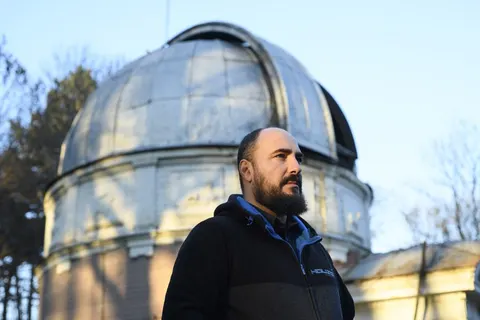
– I really hope so too; INSAIT is a major event we are only beginning to appreciate!
In your view… do science, programming and music have anything in common?
– At first glance they are quite different, but there is something that unites them. I think they are part of a larger whole. Separate
elements of one picture, aspects of what we humans have been “given” to understand, master, feel or experience.
If you want to understand more and more about the world, nature, technology and life in general, you will touch on all three, to a greater or lesser degree. Only then will you gain some sense of the whole.
On the other hand, there is a stereotype in society that if you do music, say, there's no way you can do anything in programming or science… I don't know where such thinking comes from; we can see plenty of examples that disprove it.
I believe that
science, programming and music all involve a strong creative process. If you truly want to pursue any of them, the creative element is a must.
The rest is acquiring the knowledge and techniques to realize your ideas. And there's one more thing that unites them: the dedication it takes to achieve something.
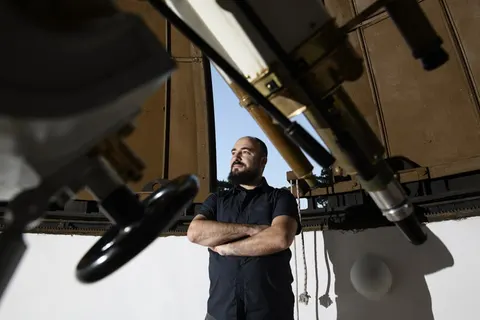
– How did music come into your life?
– As kids, my brother Yavor and I took trumpet lessons at the music school in Vidin, and our older brother Plamen studied clarinet. Those were wonderful years of learning and growing; the three of us encountered all kinds of musical styles, from classical to folk.
Even back then I realized music is a strange thing. On the one hand, it's like any other subject you study at school. There's theory, there's learning, but on the other hand there's something mysterious, perhaps in the way you apply what you've learned. When you perform on stage, even though you follow the score, you make decisions and do things you never practiced beforehand.
You make mistakes, but you also do things you didn't expect you could. At the same time, you feel you're conveying a message. That you're telling the audience something… There's no exact algorithm.
Then I drifted away from music somewhat; Yavor and I started studying physics and chemistry, while our big brother was already studying architecture abroad. Alongside his lectures, Yavor kept playing trumpet with the Shumen Philharmonic, and later he also took up the drums.
The drums didn't grab me at all, while my brother kept getting better. Only later, when I had already started working in astrophysics, did I decide to give it a go, purely for fun, and… I realized he had been right all along when he said
how relaxing, enriching and at the same time satisfying it is to play this instrument.
I took up drumming as a hobby, and with colleagues from the astrophysics department at Sofia University, where I was already working, we formed a rock band. We played quite a few concerts in Sofia clubs; those were exciting years. Later I became the drummer of ALI; we have several singles and many concerts behind us. Right now we're working on our first album.
– What do you think about the use of artificial intelligence to generate music?
– AI, by definition, is a set of algorithms, tools and methods that machines use to imitate human behavior, thinking, decision-making, even the creative process.
I think the revolution happening before our eyes is obvious to everyone. In a broader historical context,
the rapid development of AI and its applications is something entirely new for human civilization.
It raises interesting questions and poses fundamental challenges, ethical ones, for example. But I don't think it's something we can't handle.
When it comes to generating music, artists, musicians and people in the music business hold a whole spectrum of views. For some, it's a quick and easy way to create a musical product. For others, it's nothing like the mystery of the human creative process, because there is no single recipe or formula there. For still others, music generation raises pragmatic questions such as copyright. Either way, it's a fact, and it's up to us how wisely we make use of this technology. In my view, AI can be quite useful as an aid in the creative process.
There is one more aspect, related to the human role. Artificial intelligence is developing extremely fast before our eyes, “feeding” on more and more data. Then it tries to imitate our behavior, our creative process, to perform human roles. So the genesis of AI is us…
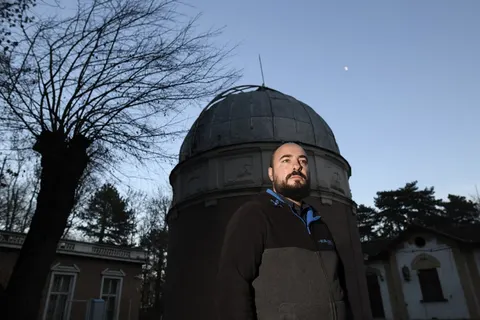
– Your weaknesses are astronomy and rock. Aren't these fields that were fashionable a few decades ago and are now in the shadow of others?
– An interesting question. My weaknesses, overall, are science, technology and music. I'm happy I've managed to touch all three—and I keep doing it—and that broadens my worldview every day. I realized that, for me, astrophysics is among the most interesting fields of science. Maybe because it brings together so much from physics, mathematics and even chemistry… Actually, the various scientific fields are, more or less, our own human invention, created in our attempt to structure knowledge and the search for the patterns and codes of nature.
Music is a whole other universe. It
lets you express yourself in a way that, I think, you can't with anything else.
You could say astrophysics is in the shadow of other fashionable scientific fields—computer science, artificial intelligence, genetics—but it isn't at all hard to find its solid links to all of them.
Astrophysics and music, in my view, will always be modern and relevant. I even think there's no need to talk about how important they are…