Two IT people sat down… to talk about communication. Technologies change; the people who use them don't. Why does a programmer with 20 years of experience insist that the most important skill in his profession is understanding people? And what does that have to do with hate on social media and with artificial intelligence?
Kaloyan Tsvetkov is a programmer with more than 20 years of experience and co-host of the reborn cult podcast Mikrofon i mishka (Microphone and Mouse). With him we discuss:
- Why is understanding people the most important skill a programmer develops over the years?
- What makes people hate, and how do our own bubbles divide us instead of bringing us together?
- Why does no villain think he's a villain, and how should we respond to a comment that hurts us?
- What will artificial intelligence change in the way we communicate, and why are soft skills becoming the most important ones?
- Why should people come first—both on the team and in the family?
– When I invited you to talk, you suggested communication as the topic… Pretty unexpected, I admit—after all, we're both technology people—although of course the subject excites me enormously. Why did you choose it?
– I noticed a long time ago, and artificial intelligence has made it even clearer, that technologies change, but the thing that doesn't change about them is the people who use them.
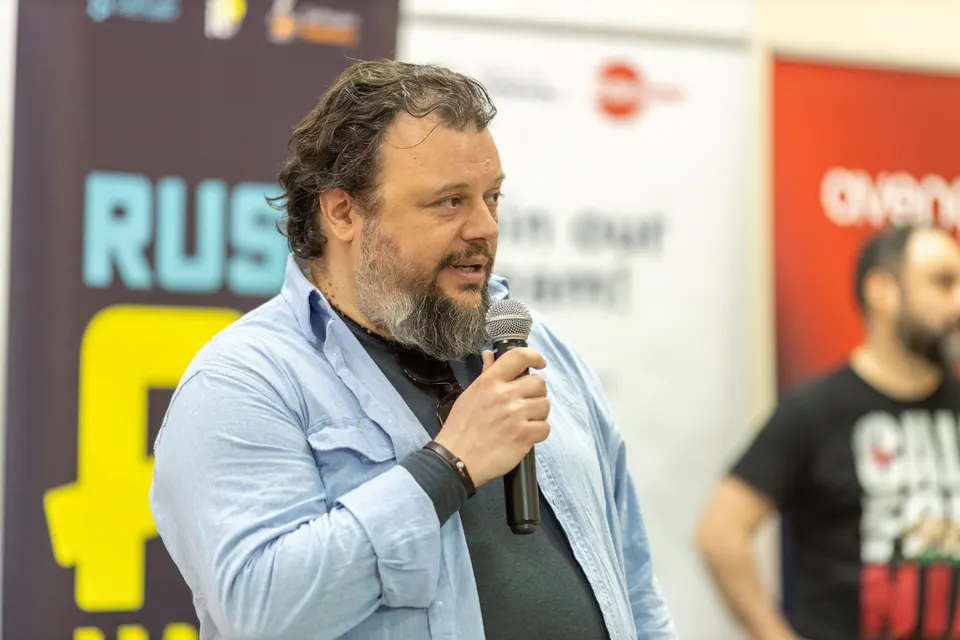
A few years ago I gave a talk at a conference, and they introduced me: “Kaloyan is a programmer with 20 years of experience.” So what? Those 20 years are not relevant at all right now. Twenty years of experience means Lili Ivanova, the seemingly ageless queen of Bulgarian pop, and I were building sandcastles in the sandbox next to the pyramids. It just doesn't mean anything. But
what is the skill you actually develop over the years? It's working with other people.
And how do you work well with other people? When you start to understand them. We're not talking about tolerating, we're not talking about sympathy. Once you understand how something works, you sense more quickly that if there's a conflict, it isn't personal, and if someone does something, it's driven by insecurities or fears.
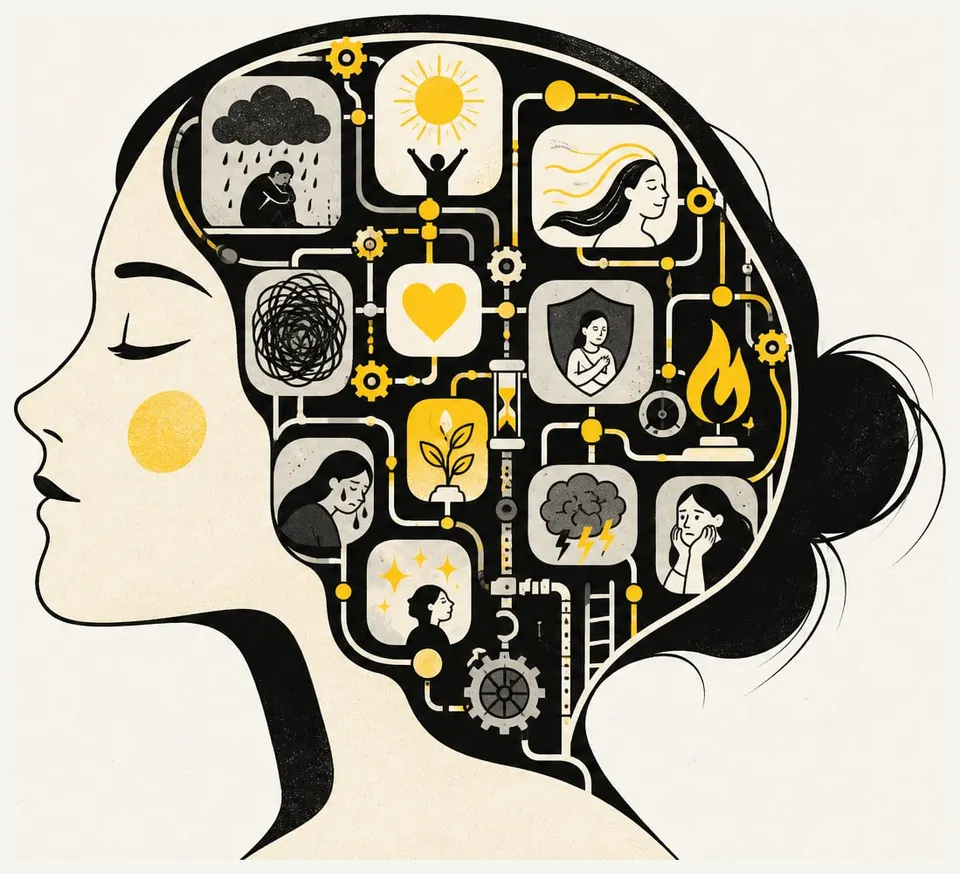
A lot of things can be explained that way. And that's the useful part. That's why I ended my talk like this: “people first,” and one more thing—the logic of emotions. Because look how the two are set against each other—logic and emotions.
But in fact emotions explain the logic behind a great many actions.
– I'm a journalist who became a programmer after thirty. And this skill—communicating with people and trying to understand them, without which I couldn't do my job as a journalist—turns out to be extremely useful to me as a programmer too, which I would never have expected while I was outside IT.
– In IT, in the tech world, the English term is “introvert”; in Bulgarian someone used to translate it as задръстеняк (zadrastenyak, roughly “clogged-up dork”). We, the people in our trade, are more closed off on the whole, because the work is cognitive, mental, all in your head. You have to concentrate to get it done. This kind of work attracts more people who are like that—they withdraw into themselves, think more—and communication is generally harder for them.
And since communication is harder for them, they have less experience at it and, I'd say, less emotional maturity, at least in the early stages of their careers.
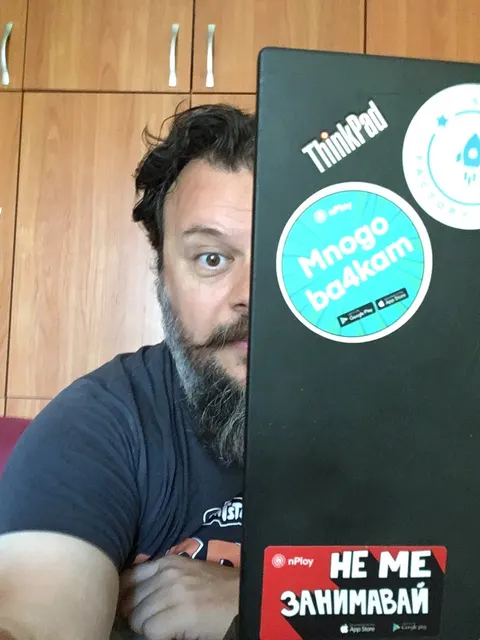
Once you've worked at a company for even five or six months, you see that you're not working alone on some branch or in some room—there are other people, you talk, you do things, someone promises you something and doesn't deliver, you promise something and can't get it done. Those things finish building you, they develop you.
It's not that the IT world lacks this; people just learn it from experience, not from a book. It's not something you can read or have someone tell you: do this, this and this. An acquaintance of mine used to joke that there's no “Communication for Dummies”—it's all done through practice.
You have to have gone through these things, to have felt them. As programmers we learn it whether we like it or not, because there's no other way.
– But as a society, if we scale up a little, there's no way to learn it. Hate has been a very big topic for me ever since I started this site. Communicating on social media has turned us into embittered people who constantly split over the latest “big issue” and don't listen to each other.
– Why? As Hari and Vasi say—let's explore it. What makes people hate? First, I want to mention Mark Manson's book The Subtle Art of Not Giving a F*ck. One of its main points is that people get angry and irritated by things that are important to them. We're not saying those things are right or objectively important, just that people feel them that way. People hate when a topic that matters to them is touched, when they feel unheard, when they think their side isn't represented in the argument, or when they carry some old trauma—someone didn't listen to them, didn't pay attention to them. Now that you have the platform of the internet in front of everyone who reads your posts and comments, why not use it and say what you think?
Filter bubbles help here too, because they amplify it: you surround yourself with people who think like you, and everyone else is an idiot. You make
much less effort to try to understand the other point of view, or at least to respect it.
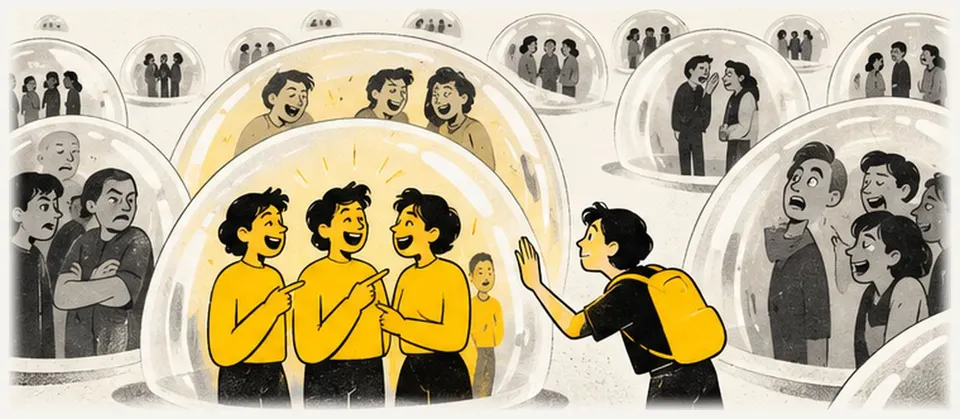
I'm of the opinion that I'm not smarter than anyone else. Sometimes people look like idiots to me too. But if I know I'm not smarter, I ought to ask myself: what don't I know that they know? What don't I see that they see? Because I'm convinced they're not idiots. In the end, it's again a question of how you perceive the other people you communicate with.
It isn't easy, because we're all selfish to varying degrees. For example, when you're a parent and you remember what it was like to be a child, what the turning point is: when you become a father, suddenly you're responsible for someone else. Maybe to some extent if you had a younger brother or sister, but children are selfish in a very instinctive way, because they're at the center of the world—of their parents, their grandparents, their school. And maybe only when a parent finds himself in that situation does he realize the world doesn't revolve around him and start looking at things differently. At least that's my analysis. It may seem flippant, but…
– Not at all, I really like the comparison. I'm living it right now: I'm watching Malcolm in the Middle for the second time, after a 25-year break, and this time I'm watching it with my sons. Back then it was funny to me from the kids' point of view; now it's funny from the parents' point of view.
– Alexander Kondov has been your guest. Not long ago, on his YouTube channel about books, he made a video in which he says that
it makes no sense for school to make you read books describing feelings you've never experienced.
The nostalgia of Nemili-nedragi (Unloved and Unwanted), Ivan Vazov's novella about homesick Bulgarian revolutionaries in exile, means nothing to you when you're in school. But when you graduate, go off to study, separate from your family and friends, feel those feelings—and then read it years later, you understand why these classics are classics. You understand what's valuable in them. You simply can't appreciate them when you don't have the experience.
And that's the most important thing: at 15, say, you have the brains and you're physically developed like a mature 30-year-old. What's the difference? Fifteen years of experience, fifteen years of life. Your brain has the capacity, but it doesn't have the experience to fill it with, so you can make good judgments about what's valuable and what's important. How hard things in life are—or, on the other hand, that other things that look terribly hard aren't so frightening at all.
– But what can we do so that more people have this attitude—that they're not the smartest and everyone else isn't an idiot? With parenthood, you gradually grow into these things. How can we make it more widespread among people who communicate online—learning to listen to the other person and respect them?
– I don't know. On the whole I'm not a fan of mass approaches, because everyone wants to save the world somehow. How do we reach as many people as possible with the effort and resources we have? In many cases you only need to save one person. To pay attention to just one person. Or simply to be an example for others. The fact that
you don't act like a hater toward the haters, but instead try to have the two basic qualities of every parent—curiosity and patience.
You treat everyone you meet and talk with that way. They may fray your nerves, you may reach the end of your patience, but when you treat someone with respect, they very rarely have a reason to behave the opposite way toward you. You may start out without respect, because you're arguing and he's on the opposite side. But explore and understand why he holds that opinion.
Whether we like it or not, we all have plenty of stereotypes and assumptions about the other side, simply because that's how we've judged them—by their looks, by the avatar on their social profile, by something else.
– Is there any situation at all in which we don't have such stereotypes?
– Let me give you just one example. Charles Duhigg put out a book, Supercommunicators. He recycled a few things, but one of the chapters talks about the gun debate in the United States. It's a very polarizing topic: there's no one in the middle, everyone is either “yes” or “no.” And he describes an experiment there. You have to understand that many of the people who support guns aren't the bloodthirsty types they're made out to be. For many people, owning a gun gives them security—in their home, for themselves. They themselves were traumatized by some earlier story in which they felt helpless, and they believe a gun can help them. That's why they hold on so stubbornly and don't want to give it up. Maybe not all of them, but some have a quite rational explanation. Again, there's a logic of emotions.
And for the people who are against guns, things are pretty obvious: if they've suffered the painful loss of someone close to a gun that seemingly ended up in the wrong hands and was misused. Again, there's logic, there's an explanation. You don't have to agree with either side. Just
understand why they think the way they do, where their opinion comes from. And only then try to find some kind of solution.
– Very often, including with guns, it turns out that people group together and fight over fifteen different things on which they're on opposite sides. It somehow becomes natural: in this case, Republicans and Democrats are roughly for and against guns. Or in the Bulgarian context we see it even more clearly—the two extreme camps; I don't even need to name them. How does that happen if the motivation lies in personal experience?
– I believe the camps aren't the same; it only looks that way from the outside. For every person, experience is based on what they've lived through. If you look from a distance, you see they overlap to some degree, but not 100%—there are discrepancies.
And in Bulgaria, whichever party you approach, you'll find people who have a rational explanation for themselves of why they're there. Most often the explanation is that they either want or don't want a change from everything so far, and the first group is usually larger. Everyone has an explanation for why they support one party or politician or another. Very often it's not “for” but “against”: “I don't like the old, I want to choose something different, something new.”
– Yes, from some other angle almost all of us are for some form of change. We even explain it in roughly the same words, even though we're on different sides of the “barricade.” We don't want corruption, we want a working justice system. I've never heard anyone say they don't want that.
– And that's where the conversation breaks apart. I don't want corruption either. Why does corruption happen? Because we humans are weak-willed creatures who, when temptation comes, give in very easily, or have some other reason. It's certainly not just one reason—there are many. But again: why? It happens, it's not pleasant—why does it happen? I'm convinced that even people who take bribes, who are corrupt, don't feel like the villains of the story. They justify themselves: “Look, I'm in a tough situation, I've lived so badly, everybody does it, why shouldn't I?” They find an inner explanation, they rationalize it somehow.
And again we come back to the idea that there are no villains. You shouldn't approach people with the assumption that someone is bad and has done something bad.
Yes, outside the moral and ethical standards—stealing, hitting, killing someone—which were formulated long ago. But for everything else you have to try to understand the other person, to look for their motivation.
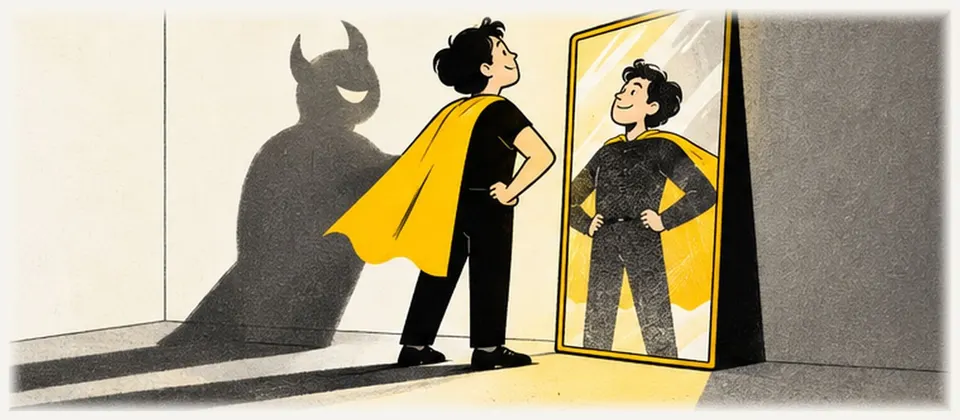
An acquaintance once wrote on Facebook: no villain thinks he's a villain. Everyone thinks they're doing something in the name of something else, and if sacrifices are needed, they're ready to make them. Very often those sacrifices aren't theirs but at someone else's expense. But their inner dialogue says: “I'm doing something, why don't they understand me? Why are they against the things I want to do?”
That's where the rest of the hate comes from. If you're not for one of the political parties, you're a paid troll. Because people can't imagine someone rationally holding the opinion they're expressing, and the only explanation they have is that the person is being paid. Well, what if they sincerely believe it? Is that so complicated or hard? People believe all sorts of things. Why shouldn't political orientation be one of them?
– I agree, especially now that the foundations of what political conversation even contains have been washed away. We're far from the ideas of left and right, conservative and liberal; in many ways they've even swapped places.
– You and I are among the children of democracy, the generation that grew up after 1989, and we were raised on this left and right. The traditional division is liberal and conservative; today it's populist and conservative. The word “populist” goes back to ancient Rome: people who carry out what the masses want, and those who believe there are rules that, however hard they are to follow, must be respected, because our values rest on them and not on what the crowd wants. In recent years conservatism has perhaps been successful because it has become more populist, which is such a huge irony.
– Yes, it's a paradox, because it makes the whole paradigm meaningless. When was the last time you caught yourself being prejudiced against someone or some idea and demonizing them, and then realized you'd been wrong?
– It happens regularly. Unfortunately, instinct is very fast. Instinct is something you do without thinking. Especially in person, if someone says something I consider stupid. Over the years I've been trying not to, but some caustic, ironic comment will come out immediately. And then I come to my senses: “Wait, I don't know this person.” Or the opposite: “I've known this person so long, we've talked, I know him. The way he's saying it seems strange and stupid to me, but there must be a reason.” “Sorry, my mouth is faster than my head. Tell me anyway what you mean. Let's see what you were trying to say.”
For me it's easier on the internet, because you have control. There's no need to write right away; you can think it over while you're typing and tell yourself: “Hold on, hold on, I'm writing complete nonsense. This person is different—ask him whether your assumptions are right.”
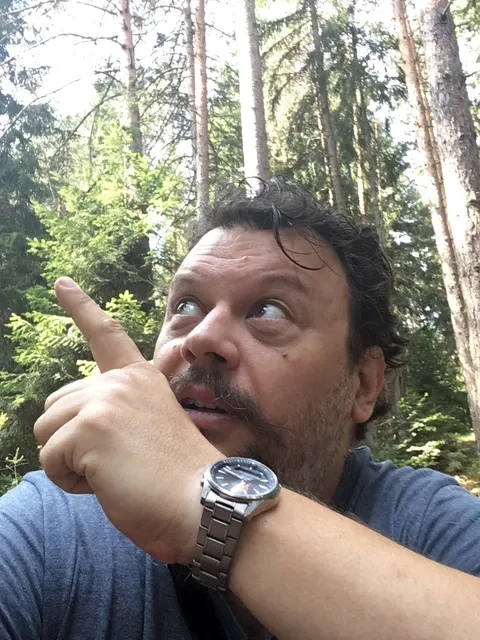
It happens all the time. I'm not a robot. We're all human, we have our own fears and emotions, we have all the baggage we carry from before, and there's no way not to react emotionally sometimes.
Let me give an example. It was a few years ago, but I remember it because it made a very bad impression on me. When you're younger, you care about how you look, who likes you, things like that. When you get older, you see that those things are trifles; the most important thing is for the kids and the family to be healthy, everything else is secondary. But I have a speech impediment—I've had it all my life. Over the years I've been trying to control it a little better, but every now and then it kicks in again. Nothing I can do; I'm used to it.
Years ago a man came to us for a job. We didn't hire him because he wasn't prepared. I didn't tell him, “You're dumb, you don't understand anything.” I told him, “You have gaps to fill; prepare and come back if you want; at this stage you can't do it.” Years later, in a LinkedIn comment thread where we were discussing that back when there weren't enough people for the IT industry, the best bet was to train them yourself, this man wrote something along the lines of “wwwelll, wwwhen thththere…” He was imitating my speech. “When there were programmers, why didn't you hire them?”
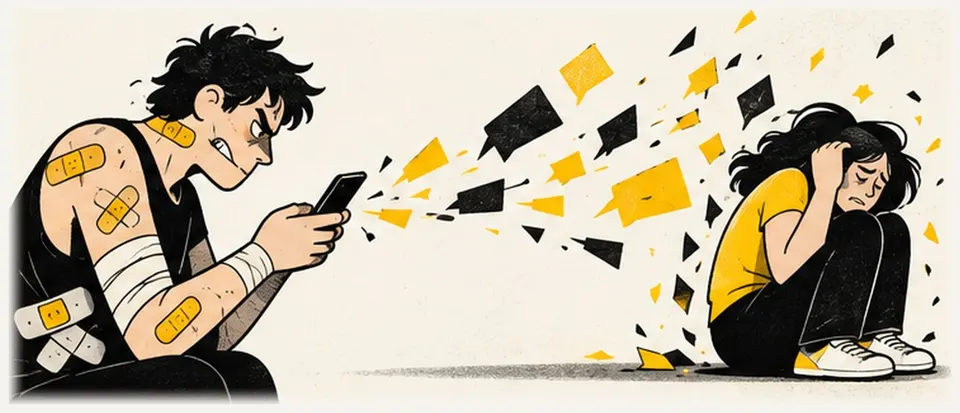
You see red, you go crazy. I'd treated this man absolutely decently ten years before. We were classmates at university, we know each other. And he writes this thing, which is super childish and gets under my skin. Now I know I should have outgrown it, but in that moment I got angry and blocked him everywhere.
Once more time passed and I calmed down, I understood that this man had been hurt in some way. It's obvious. People have to be psychopaths to hurt others for no reason. There's a saying:
hurt people hurt people.
– All right, and how do you think AI will change communication? It always agrees, it always adapts to your point of view, unless you work some magic to make it evil. I think it will deepen the problem of difficult communication and of understanding the other person even further.
– I've thought a lot about this—where the two things overlap, AI and the fact that you have to know people better, be emotionally mature and understand what's happening on the other side. I came to the conclusion that soft skills, the skills of working with other people, will become the hard skills of the future. Because
most of the work will be done by AI, and then all that's left for you will be this—working with other people.
AI, or whatever other technologies come along with it in the future, will solve a large part of the technical problems we've had so far. And then communicating with other people will become even more important; there will be more of it. There'll be nowhere to run except to talk to others. We're talking about work, about life, everywhere.
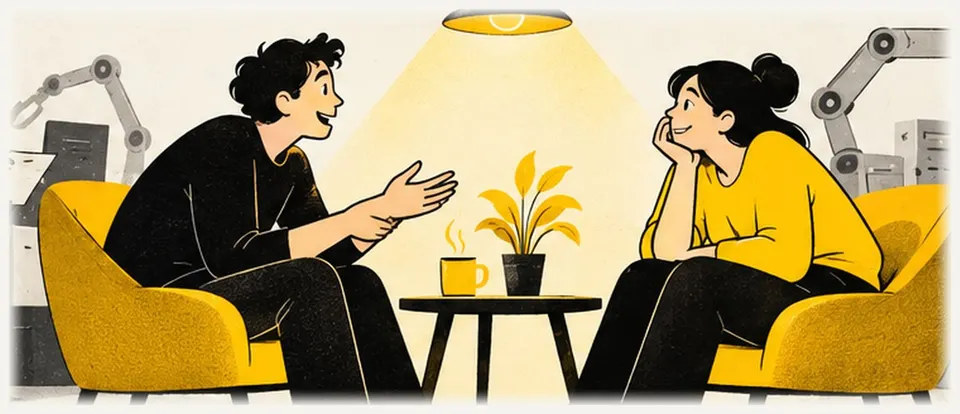
As for AI constantly agreeing with us, the companies themselves have started to realize it's not good. But it's not something they could have foreseen when the first such models came out. I doubt anyone said: I absolutely must make it agree with people. That same Mark Manson released something like that in his own app, an AI assistant, but set up so that it doesn't agree—the opposite, it constantly challenges you. And still, it's a tool. People will find ways to use it better.
One of the ways I use it is by giving it personas. For example: “Imagine you're Georgi Karamanev, we're going to have an interview in which we'll talk about ‘there are no villains’ and ‘the logic of emotions.’ What questions would you ask me?” Its analysis was brilliant.
– That doesn't surprise me; I made myself a digital double too, and I'm lucky enough to have more than 500 of my own articles online for it to go by. Now time will tell whether that's an advantage or a drawback.
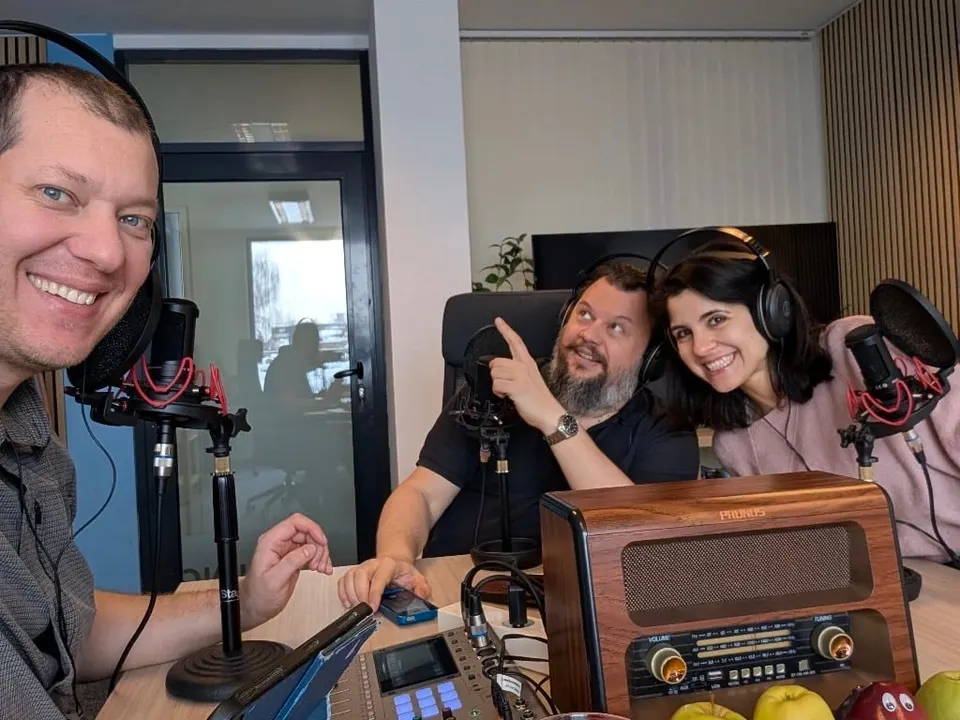
– We have to have faith in the younger generation: whatever problems there are, they'll solve them themselves, just as perhaps someone once believed in us.
No one knew, when the internet was starting, or later social media, what challenges there would be.
Both with the way people express themselves and with online bullying. We didn't know these things in advance. Not that they're solved, but we're trying to do what we can. And if we've come this far as humanity, there's no reason—at least I'm an optimist—for the future not to be bright, and our children will cope with whatever they encounter and do there. That's why I'm not afraid of these things. In general—whether it's a minus or a plus, something will happen. Most of us will be fine; some people will keep their heads down, and others will be bolder and experiment, to see where the limits of the possible are.

Two things in life are certain: we'll make mistakes and we'll die.
And that, maybe, is part of the logic of emotions. It's something inherited from school—that mistakes mean punishment gets built into you as an instinct, starting in kindergarten. There they test you: if you don't know—a bad grade. And again, as we grow up, we understand: making mistakes isn't scary. In fact, let's make more mistakes. As long as they're not fatal—losing your health, hurting another person. If you offend someone, you'll apologize. There's always something you can do.
To understand each other better, we have to be braver. Fear of mistakes is fear. To defeat it, you have to be brave.
Also, to have trust, to hand out trust. Not only to receive it, but to give it. I'll let you do something without knowing you'll manage it. I'm not reckless, I'm brave. And I trust you that even if you don't manage, you'll put in the effort, or if not—you'll ask for help. This works tremendously well when applied at work. Trust makes people feel good, like a team.
– And the next step, I think, is learning somehow to rejoice in other people's successes—sincerely. It's quite fulfilling when you finally manage it. Thank you from the bottom of my heart; ten years ago I wouldn't have believed two programmers could have a conversation like this. It was truly thought-provoking, and someday we'll continue it.