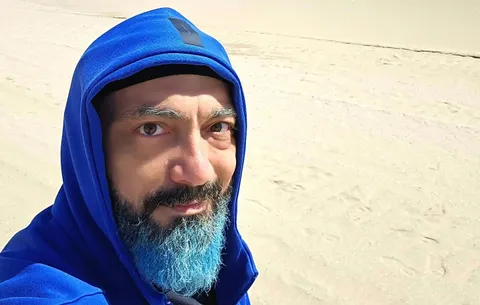
“In December I turn 63. I have seen a lot and lived through a lot. Instead of growing fewer, the problems keep multiplying. I've had two strokes, a malignant tumor and more. In those hard moments there was always one person beside me who, again and again, got me back on my feet and even gave me wings. That person is my wife, Toni. A few days ago I spontaneously wrote down my feelings for her in a few lines. Since I'm neither a musician nor a singer, I turned them into a song with the help of artificial intelligence.”
Powerful stories keep happening in the digital world—because of it, thanks to it or in spite of it. And just as our relationships as people quietly change with the development of technology, there are also those universal plots that survive through time and are reborn with new shades, new details and new inspiration.
More and more often, stories vanish into the feed, unnoticed in the rush of scrolling, of the news of the day. Do we have the time and the frame of mind to look for them? To settle in and read, to get carried away by them, while we hurry on, absorbed in the latest topic of the day?
This is a story about a love that came not very early, but just in time. About the luck and happiness of finding your person. About the dreams we put off, though we shouldn't. About the strength not to give up, even in the hardest moments and in the face of the toughest challenges. At least as long as you have the strongest support of all, that of the person beside you.
We Fall As We Walk
Chavdar Mihaylov looks like a lanky man, and his mind races, online or off. We have to talk over the internet for our chat. The day before, he had once again opened Dir.bg, a Bulgarian news portal, to read the news from Bulgaria—so he could get angry at it, as he puts it—but he stumbled upon the Digital Stories survey on where artificial intelligence is taking us. He decided to fill it in and added something of his own—the very lines with which this story began. And I got curious to learn more. For all of us to dive into his story and look for the lessons in it. Not so much about artificial intelligence as about the human, the universal.
“When I look at my story, I see that it really isn't a standard one. And, of course, an old saying fits it very well: it doesn't matter what happened, what matters is how you tell it,” Chavdar smiles.
His biography is the classic plot of the transition, Bulgaria's passage from communism to democracy. He graduated from the vocational school of photography, then earned a university degree in the same field, and the search for a better future led him to Germany… and so did love.
He was sent there for a training placement, where he fell for a girl from a mixed marriage of a Bulgarian man and a German woman.
Good Bye, Lenin!
It is 1989, change is in the air, and Chavdar, just back home, feels cramped. He starts hatching plans to get to America through Canada. One evening he goes to a friend, a waiter at the Novotel hotel in Sofia, and asks him for a loan of 2,000 leva, the Bulgarian currency, to buy the ticket he dreams of. Everything is worked out; the next day he is to pick up the money and arrange his departure… when the doorbell rings.
It is his student sweetheart from Germany. “She arrives and says, ‘I can't live without you.’ You know how these stories go, right? And I thought it over. ‘All right.’ We tried to live in Bulgaria, but it didn't work out. We lived with my parents, my brother and his family—nine people in a bedroom, a living room and a kitchen. For six months we tried to make something happen, to get an apartment. But we realized it wasn't going to work, and we applied to go back to the GDR.”
So instead of the United States, our hero ends up in Germany. By the time they get the papers, though, they no longer need them: November 9, 1989, has come, the Berlin Wall has fallen, and a week later Chavdar and his wife begin their life in the newly united country.
I'd Write a Book of Poems, I'd Dedicate a Verse to You
There he works as a television cameraman, then he is invited to be a freelance photojournalist for an agency whose pictures are used by the biggest German media. He likes the work—they give him equipment to listen in on the police, the ambulance service and the fire brigade, so if anything important happens, he is first at the epicenter.
He gets so good at it that he sleeps with an earpiece in his ear and, from the tone of a conversation he overhears, quickly judges when there is reason to head to the next scene of the crime. He often gets there before the police and the doctors and captures all kinds of human dramas. He says it was then that he formed his main principle in life—above all, to do no one harm. If he is going to cover horrifying events and situations, it will be with delicacy and respect for the victims. At a terrible crash in which children died, for instance, he took a photo that became well known—a little doll lying next to the spilled blood. It was precisely this delicacy, however, that put an end to the job.
Chavdar comes upon a horrific crash. A young man on a motorcycle tried to get around a truck, but the driver didn't see him and swept him away. “I was there even before the ambulance, and I tried to calm the driver, who was in a very bad state. It was summer, hot, and I photographed the blood evaporating, steam rising, only the shoe visible, and behind it the motorcycle and the truck. I immediately call my boss and tell her where I am and what I've shot. And she replies, ‘Shoot his face.’ How can I shoot his face? That's inhuman. ‘If you won't, you're fired!’ And that was that.”
Lisa and Lottie
Every cloud has a silver lining—the Bulgarian chooses to change course and turns to an entirely different field. By an irony of fate, today he works for a company that makes parts for some of the most advanced cars, although he himself knows nothing about automobiles—he tells them apart by color, not by make. Even so, he creates parts for Formula 1 cars and for Koenigsegg, the Swedish carmaker that builds some of the fastest cars in the world. Chavdar has been in the business for 20 years now, designing the molds from which the complex carbon parts are made, and he has made a name for himself.
While all this is happening, one love fades away. He and his wife have a daughter, but little by little they feel themselves drifting apart. They start quarreling over everyday matters and quickly decide the time has come to part.
“The divorce came so suddenly, and afterward I had no idea what I was going to do, I didn't even have anywhere to live. I hastily bought a house on a loan, but in the end I managed to pay it off, and I'm still there today.”
Chavdar greets his 40th birthday alone, unprepared for the new challenges. He tries dating, but quickly gives up, because he realizes it won't be easy to come across someone he gets along with. “I forced myself to meet a few women, and it just doesn't work. It doesn't click! You have to see whether you fit, how the other person thinks.”
And then, most unexpectedly, the most important thing happens: he finds love with a capital L, and entirely by chance.
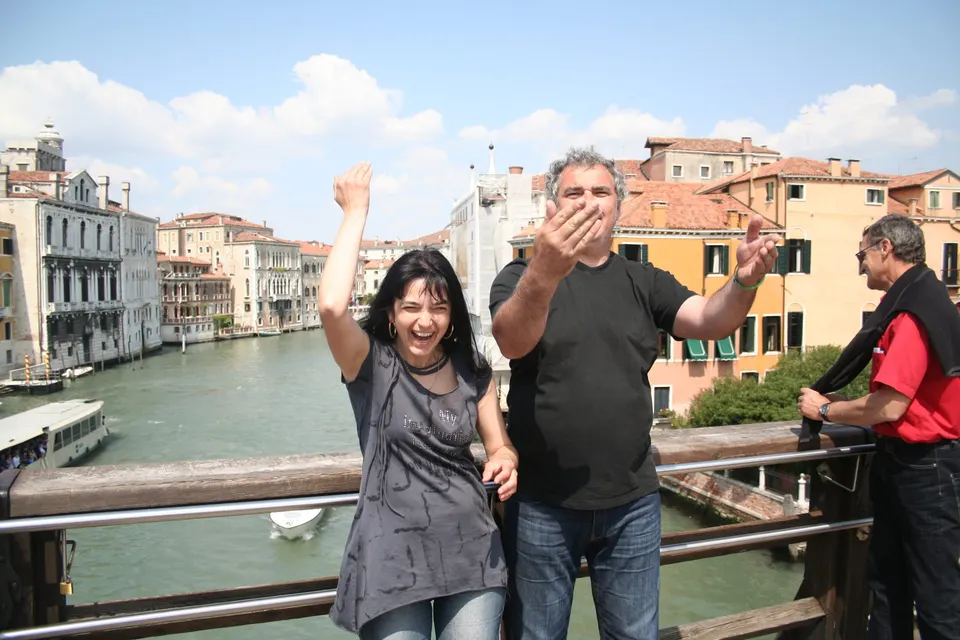
Montagues, Capulets and Gincheto
Chavdar is in Bulgaria to see his relatives. He tells his mother he feels lonely, that he wasn't ready for the life of a divorced middle-aged man…
“And she exclaimed, ‘Never mind, it happens. Look at poor Toni, she has problems too, she got divorced too.’ Which Toni? It turned out to be the niece of her best friend. When we were young, they had deliberately not wanted to introduce us—I had a notorious reputation for spending all my time in bars. ‘Why, Toni is Gincheto's niece.’ ‘How would I know Gincheto has a niece, why didn't you introduce us?’ ‘We were hiding her from you. Toni is an intelligent girl, a land surveyor.’
I got curious, but my mother wouldn't give me her number. A week later I remembered again and asked her, ‘Say, you know, I haven't called Gincheto in a long time, do you have her number?’ I rang Aunt Ginka and went straight to the point: ‘Give me your niece's number.’ She read it out to me, I called, and we got talking on the phone. At first it was about who had what problems…”
Then the problems lead to solutions. Chavdar finds things in common to talk about with Gincheto's niece. They get talking, and before long he invites her to his new homeland.
There, things don't go smoothly.
It is 2007. Chavdar has invited Toni in December so they can tour the Christmas markets… but that is also the season when his company works hardest on the new cars for the Formula 1 teams… “I talk to my boss and tell him I have to go to the airport, a girl is waiting for me. ‘There's work here, you can't, you have to finish it.’ I somehow manage, I leave, I head for the airport… traffic jam. I was 10 minutes late, I had no time to buy flowers… A complete fiasco!” he smiles.
But then things take off like a fairy tale. And, you know, they lived happily ever after…
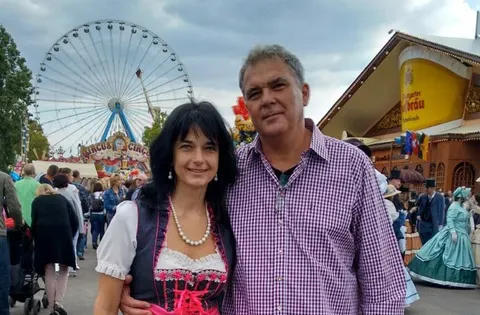
Life Is Beautiful
The main problem with fairy tales is that they end. We see the resolution, but were Beauty and the handsomely transformed Beast happy as a family too? Which of the two did the dishes? And what about Snow White and the prince? Did the seven little kids ever finish college?
As for Chavdar and Toni, their happiness is complete. For a few months they talk on the phone, and they see each other in the summer in Bulgaria. And then comes the moment when he invites her to try living together in Germany… Long and happy years go by, and the two of them savor their late love. A few years ago Chavdar was also delighted to become a grandfather, courtesy of the daughter from his first marriage…
But then, as was clear from the start of this Digital Story, came the illnesses.
A stroke. Chavdar is lucky that it happens early in the morning; the doctors come quickly and save him. A second stroke a few months later… “And I'm one of those real men,” he says, never losing his smile. “When something hurts, I lie down at once and don't budge. Toni has to be beside me and ask me five times an hour how I am. I was lucky the strokes weren't severe, but she was the one who saved me. She looked after me constantly. Even when I got back on my feet, she was always beside me, and she still is.”
A few more months later comes another grave diagnosis. Prostate cancer. A quick operation follows, and for a long time he doesn't know whether the tumor is malignant; three months have to pass before he gets an appointment to see a doctor. Then comes hip surgery…
“Medical students could learn from me, I have every kind of problem.”

Angelinka
Love has many dimensions, you'll agree. Since it is there, and it shows, even when we start talking about strokes and hip joints. “Toni is always running around me. We even have a vineyard here, we're going to sell it now, and she works more than I do…”
We come to artificial intelligence. Here we won't interfere—neither I nor ChatGPT—and we'll let Chavdar tell the ending of this long and, to me, beautiful story himself.
“One evening, after two beers and three shots of rakia, I was thinking about my two strokes, the malignant tumor and the upcoming hip surgery. Then some thoughts came to me that didn't rhyme very well, but looked like a poem.
I can't stop thinking about you. Your eyes shine like stars. Your whisper in the night is like a melody… I'm crazy about you…
When I saw you, I didn't know you would bring me love! Now I can't and won't part from you. I love to lose myself in your love…
Love brought you into my life. I can't take any other road… I don't want to live without you anymore, I love you… come… let's fly…
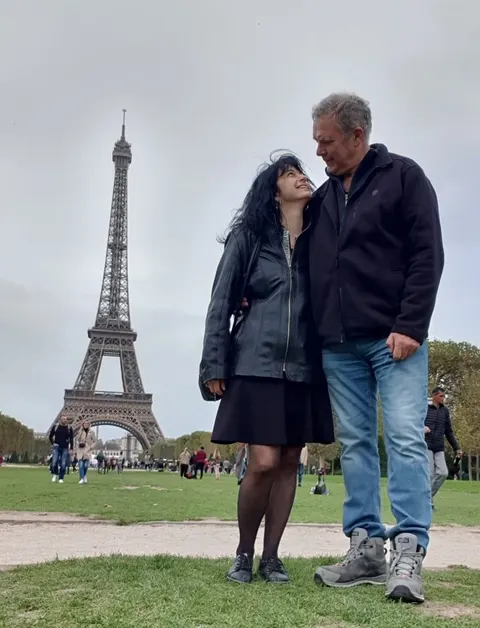
Oh, How Hard It Is to Be in Love at 40
Maybe there comes a moment when we get used to each other and stop noticing many things we used to see. Love starts to fade and everyday life sets in; less time is set aside for the two of us. But then situations come along, as with my illnesses, when you see that the person comes back and is beside you. And then you realize that this is the right person, and somehow you have to tell them: ‘Thank you.’ To show that you see them.
It was important for me to thank my wife; what she does is not something that can be taken for granted.
The next day I read about Suno and tried it right away. This artificial intelligence can turn my text into a song, adding a melody and a voice. I was happy it gave me that chance, because I can't play any instrument and I sing off-key. Finding the right melody with the right voice wasn't that easy, but after a week and 35 suggestions from Suno, I finally got a song I like.

Some people think they have to meet the person who will be beside them when they're young. But you never know. I was simply lucky, and so was she. We understand each other, we suit each other. She gives the orders, I keep quiet. When it gets to be too much, I boil over, but we get along very well…”
Cyrano de GPT
When the aches and pains begin, Chavdar decides it is time to fulfill some long-postponed dreams. His first task is to make a list:
-
Write a book
-
Publish a children's book for his two grandchildren
-
Write a song
-
Go to the Maldives with Toni
-
Make a wood-carved chair
-
Fix up his old bicycle
-
Buy the drone he dreamed of as a photographer
-
See the Great Wall of China
“Stuff like that, things I want to happen to me before I kick the bucket. And one by one, from time to time, everything is happening.”
This year, for Easter, he makes the children's book for his grandchildren. Two little bears bearing their names—Oliver and Mila—get up early and go outside. One of them sees that the bunny has hidden the eggs; they find them and go to the rabbit. Chavdar writes the text, and the pictures are the work of ChatGPT.
“It helped me. I'm very proud of these drawings of the little bears, because they're mine, nobody else has the same ones. This little book is one of a kind for the kids, and they loved it. That was my first encounter with the creativity of artificial intelligence. But in my opinion it isn't creative—people are. AI helps exactly people like me, who can't sing, draw or make music, but have the desire to create something, to make it and be happy about it.”
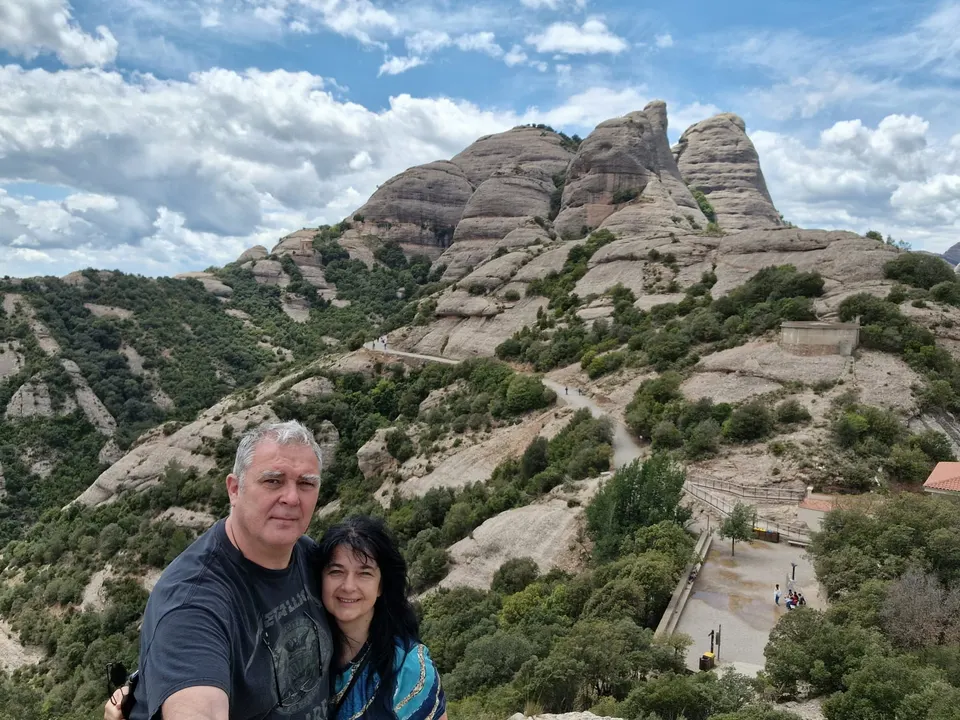
Wear Your New Clothes, Boys
Little by little he ticks off other items on the list. Our conversation was postponed a bit because he and Toni were in the Maldives. The long-promised drone takes flight too.
“I already had all these dreams at 18. But you never have time, you keep pushing them aside, you always find a reason why you can't get them done, those small personal goals,” says Chavdar. Whereas today he has time, direction and love. And “künstliche Intelligenz”—AI, one of the few foreign words that sneak into his colorful Bulgarian.
“You should do these things earlier, because when you get old, everything gets harder… Before that, there's family, children, work… you have no time for dreams. You're happy when you get home and can sit down for a while to rest. But now I'm looking forward to retiring, to being lucky enough to live a little as a pensioner, so I can finish my list.
If someone gives you a candle, light it. Don't keep it in the corner, waiting, as a keepsake that someone gave it to you, that it has an inscription on it. Just let it burn so you can see it. Because you'll be gone and you won't see it burn. You have to live your life, to enjoy it…”
Love in the Time of Cholera
“The Captain looked at Fermina Daza and saw on her eyelashes the first glimmer of wintry frost. Then he looked at Florentino Ariza, his invincible power, his intrepid love, and he was overwhelmed by the belated suspicion that it is life, more than death, that has no limits.
‘And how long do you think we can keep up this goddamn coming and going?’ he asked.
Florentino Ariza had kept his answer ready for fifty-three years, seven months, and eleven days and nights.
‘Forever,’ he said.”
If these last lines mean nothing to you, yet you have read Chavdar Mihaylov's story this far, we definitely recommend asking ChatGPT who Florentino Ariza is.
Sometimes the end of a story comes before its beginning. Sometimes destiny knows its business, but at other times it seems so absorbed in its own feed on its favorite social network that it is nowhere to be found. Yet there will always be these stories. To remind us what being human is, who a person is and what love is. They will be there in the age of artificial intelligence too, I am sure. They will be there even after it.