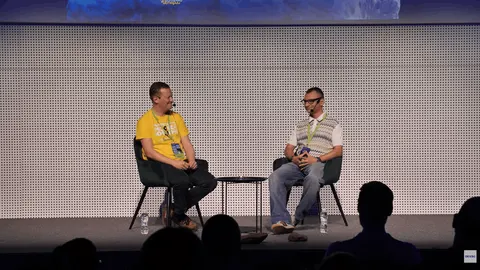
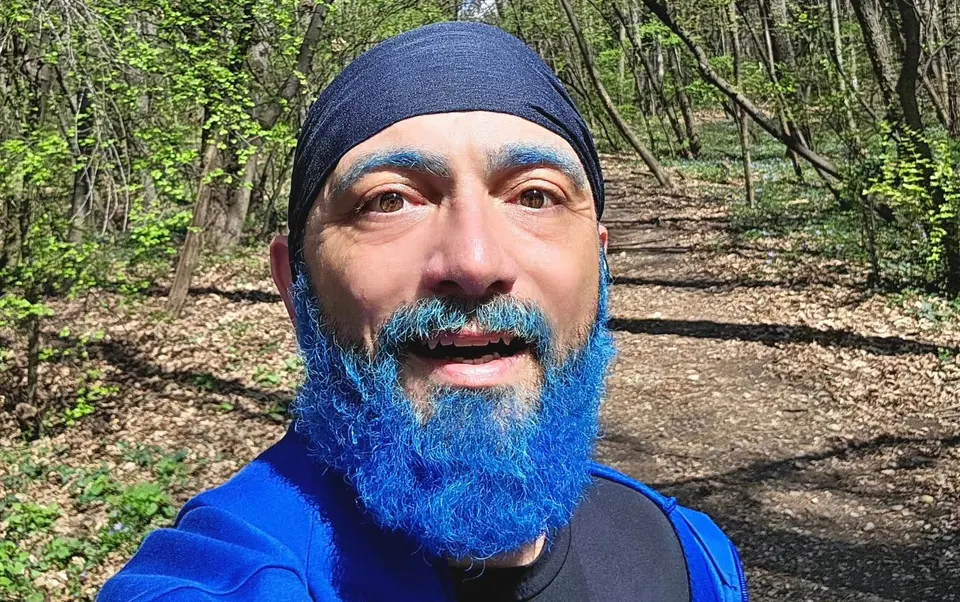
Adrien loves to run. And when he runs, he really runs—down the entrepreneurial road, and in a real marathon too. But most of all, he runs against stereotypes. See him once and you'll remember him; I don't even need to tell you which detail of his signature look will stick.
He is worth remembering for another reason, too: his story offers inspiration of the genuine kind. Adrien has lived in Sofia for 18 years, runs a successful video game company that gives work to Bulgarians, has adopted a Bulgarian girl and has gathered plenty of digital stories to tell us.
A Moment from a Fairy Tale
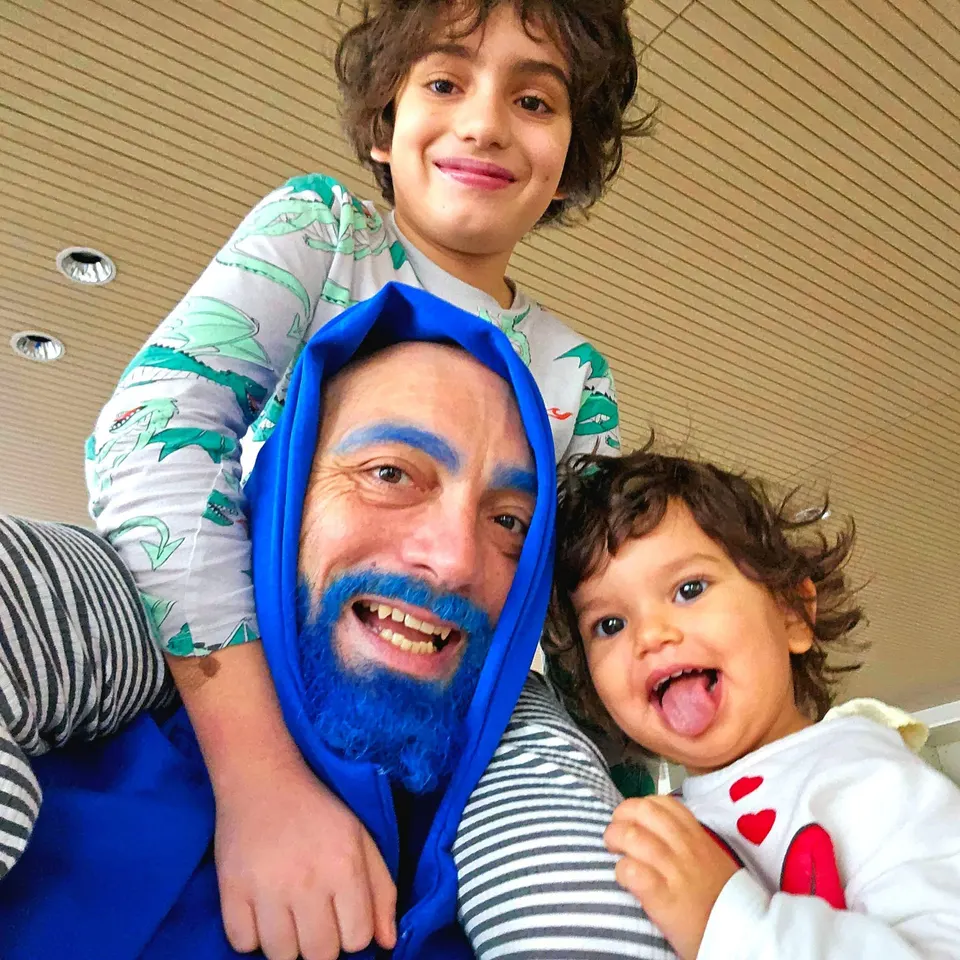
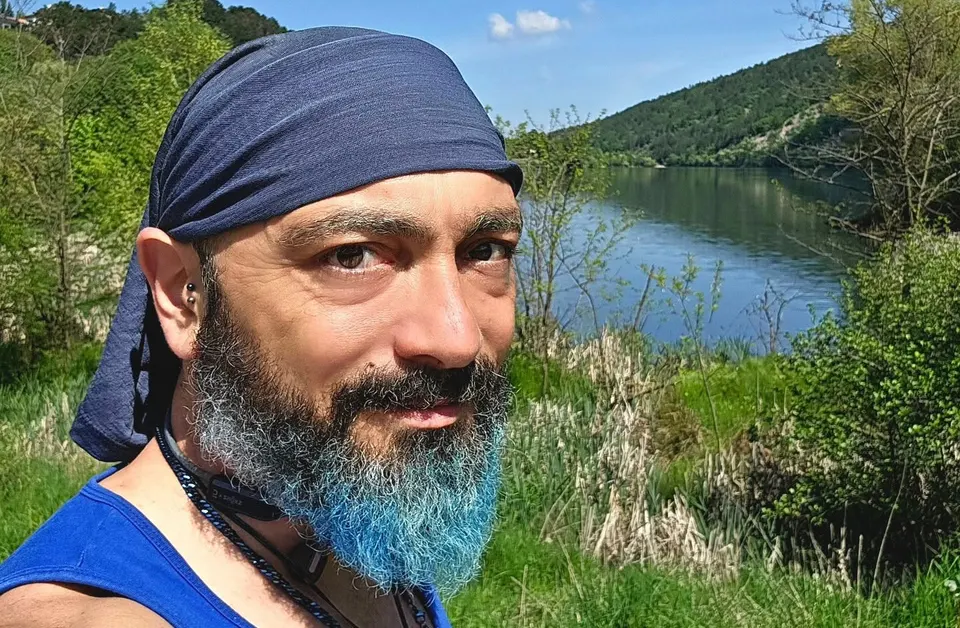
The question of where the color of his beard comes from is unavoidable. He has been asked it hundreds of times and has long had an answer ready—more than one, in fact. “There are many answers to that question, but the short one goes: so that I'll be remembered.”
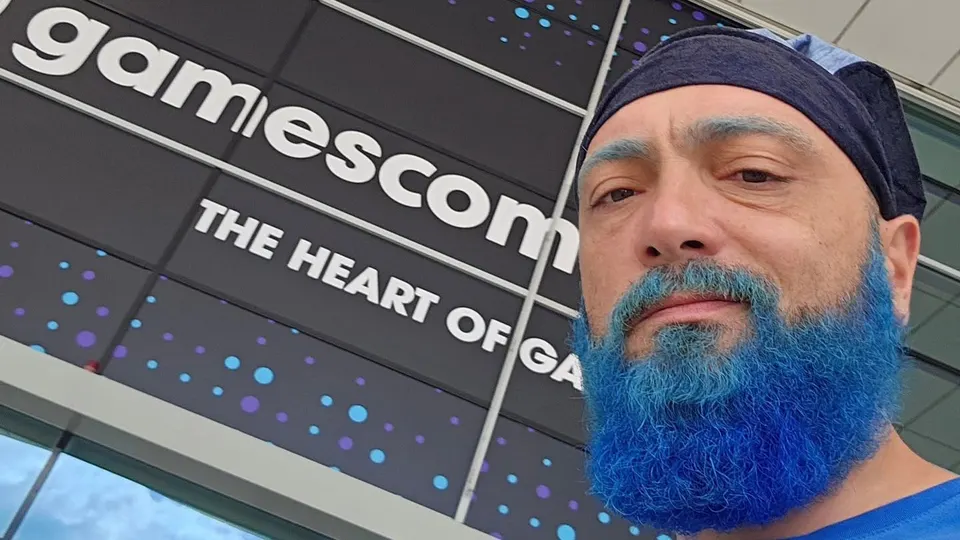
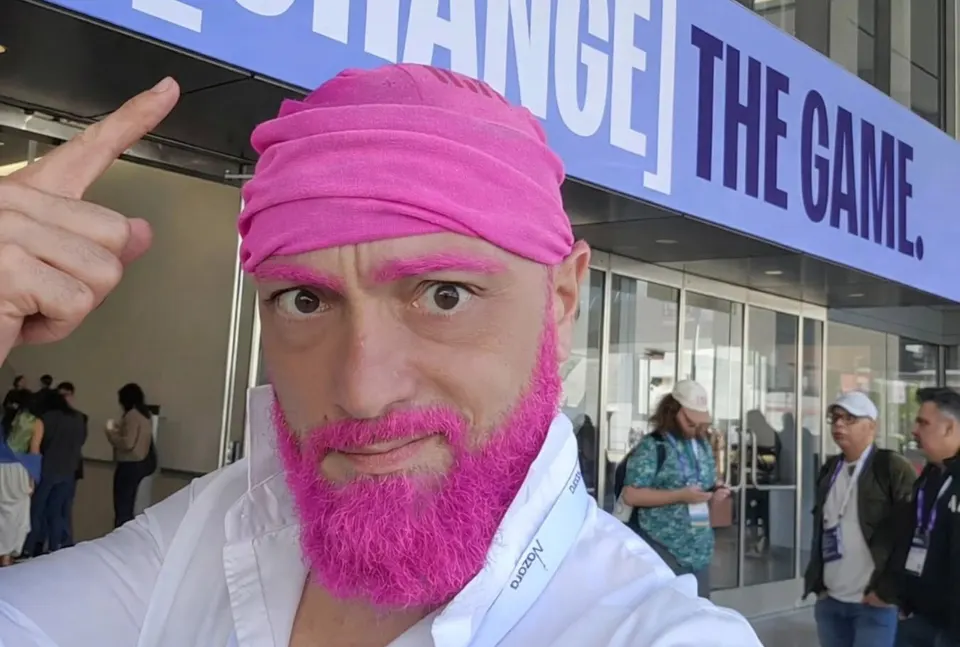
In a few weeks he'll be in Cologne for the biggest professional gaming event in the world. This year 400,000 visitors are expected, between 50,000 and 70,000 of them industry people. “There's no way to remember that many people—you'll remember a few hundred. But if you stand out, there's a very good chance they'll remember precisely you. Maybe we don't memorize names right away, or the context. But the moment you meet someone, you immediately feel it: I like this person, or I don't. That's the first categorization, the one that helps us survive.”
So the blue beard is not a whim but a tool. And a way to stand out in the crowd.
Adrien didn't start with blue. First came red suits and jackets, then a blond beard, a green one and a purple one. Each version provoked feedback, which Adrien carefully analyzed.
“I think this is version 3 of my brand marketing by now. Just wait for the next ones!”
They Greet You by Your Beard
And yet… Isn't Bluebeard a fairy-tale character—the work of Charles Perrault's pen, though fully worthy of Stephen King's?
In the tale he is a serial killer who takes the lives of his wives one after another, locks their corpses in a secret room and forbids the next wife to open the door. It is one of the darkest texts in European folklore. But not according to Adrien, who reads it quite differently.
“All of that is fake news. The man in the fairy tale is the real victim!” The Frenchman is prepared for this question too, and he is adamant that the last wife deceived her husband. She called her brothers to kill him and take his money. There were no witnesses. People said he was the bad guy, but no evidence was ever presented.
“No verdict. No arguments. Nothing. Do you think that's fair?”
The sentence was carried out by the relatives, the money was pocketed by the relatives, and not a single institution appears anywhere in the story. Rather a thought-provoking subject, given how justice tends to be regarded in our part of the world.
“Bluebeard was misunderstood and deceived.”

Bad Press
Almost without noticing, we arrive at the subject of prejudice, and the blue beard turns out to be a fascinating social experiment as well. According to Adrien, people react to it differently everywhere in the world, and quite tellingly. In London they call out that he looks great. In Paris they accuse him of being a drug addict. In Germany, for some reason, they decide he must be from Berlin. In San Francisco cars stop in the middle of the street so the drivers can shout their approval. In Japan people are frightened, but… very politely. In Thailand everyone wants a selfie with him.
And in Sofia? “People here are a little scared of me, too. They look at me but say nothing. It isn't hostility, it's quiet astonishment—somehow they're just not used to difference.”
Adrien is a Frenchman of Italian descent, a man who takes bright colors as something natural, something he finds missing here. “You walk into Zara in Milan or in Rome and see a men's collection full of color. You walk into Zara in Sofia—same chain, same year, same season. And everything is gray. Don't stand out, don't make an impression. Whatever you do, just don't draw attention.”
Orange Is the Sky
In his view, the reasons for this attitude of ours are historical. Over the years, people who stood out were persecuted, and it goes all the way back to the Ottoman Empire and the notorious idea of the bowed head, from the old Bulgarian proverb that the sword does not cut a head that bows. It reaches the 1990s, with the mutri—the thickset racketeers of Bulgaria's post-communist decade—the mafia and the message the state of the time sent to its own population. “Don't trust the institutions. Everything is rigged. Justice doesn't exist. If you stand out, you'll get screwed. Be discreet. Mind your own business. The game is rigged anyway, because everyone knows someone who knows someone, and you don't know anyone. So keep quiet.”
“Maybe that was true 30 years ago, but it isn't anymore. I'm not an expert, but I've been here a long time, and I think the government and the institutions are a bit cleaner. The problem is that the software has stayed the same while the hardware has changed,” Adrien says. “People are still running the operating system they grew up with. Don't stand out, the system is rigged, you're not part of it, live your life in your own corner.”
Secret Paths
It is precisely this mindset, he believes, that leads to the outdated idea that “if you're smart and have no connections, leave. Start a career in the UK, in Germany, in France. And don't come back.”
Which makes it all the more curious that in his case exactly the opposite happened. As Adrien puts it, he left France for exactly the same reasons Bulgarians leave Bulgaria. “I felt I didn't have the connections in government or in business.”
His parents are art teachers, now retired. His grandparents were farmers. He earned his diploma from a good business school, but saw no prospects in his homeland and looked abroad.
He left in 2005. Torn between Italy and the Middle East, he chose… not the most adventurous option, but Brussels. There he founded his first company and discovered something about himself that would define the next twenty years. “When we started working, we needed a lot of energy. I could feel it. And Brussels doesn't give you energy, it drains it.”
The winter of 2007 was when his patience ran out. The business had taken off, but nothing else was right. “There were roughly six months in which I saw the sun on three days. The rest of the time it was night until 10 a.m., then gray or rain all day.”
Sun and Low Taxes
– these are the two factors Adrien judged most important in choosing his next home. The list included Cyprus and Malta; Bulgaria wasn't on it until friends who also made video games in Sofia called and invited him to take a look at the country.
Adrien came in June 2008 and saw that there was both sun and low taxes here. In Bulgaria he found professional success and love alike. He met his future wife, who is Portuguese. Their son Atlas was born here in 2014, and in 2023 they adopted a girl named Aloha, a little Bulgarian.
Over these 18 years, he says, beyond the taxes and the sun, a great deal has changed. Today he has friends in Portugal, Spain and France who complain that they earn less than they would in Sofia. “Not everyone, of course, but for IT people the scene in Sofia is excellent. And not only that—the infrastructure in Sofia is great, after all: the metro, the trams, the buses, the big boulevards. It's actually pretty good, and yet here we're always complaining.”
So Mysterious and Tender
“I'm not forced to stay in Bulgaria. I can move wherever I like. But since I'm here, it means I've decided to stay.”
One of the things that won him over is the mountain. “You think: damn, I have this problem, I'm having trouble with this employee, I have something to sort out with the kids. Then you look at Vitosha and tell yourself: this mountain has been here for a billion years and will be here for another billion. I'm so small. What I do matters, and at the same time it doesn't. That relaxes me.”
Of course, he is far from liking everything here, and the list of problems begins with higher education. “Its level is very low, and as an employer that annoys me. I have 45 people, and every year I need new people coming out of university. Most of them aren't qualified at all, and we have to start from zero.”
The second problem is the way Bulgaria “sells” itself abroad. Every campaign to attract investors begins and ends with the 10 percent flat tax, and in his view that is a message aimed at the wrong audience.
Human Capital
“If you want to attract Mercedes, Volkswagen, Tesla, Google—the biggest ones—they don't care about taxes. The big players ask something else: how many people can they hire? Can they find 10,000? More like 20,000. That's the main problem—there simply aren't the people.” Adrien felt it most keenly when his business took off and his team had to grow from 30 people to 80. It turned out that the market simply didn't have enough experienced professionals.
At the same time, he believes, we have enormous potential as engineers—we're strong at everything to do with hardware and software; with math, physics and chemistry; with logic and organization. Everything in the world of the pragmatic.
“But the rest is missing—marketing, creativity. It's not that there are no creative people in Bulgaria. That's not it; lots of creative people work at my company. It's just that this kind of talent is considerably rarer, at least in my experience.”
Run, Adrien
We began with running. Since 2015, Adrien has trained for an hour a day, at least six days a week. He started as a way to cope with stress, and not long ago he finished his first full marathon—in Sofia.
That explains why he isn't afraid even… of artificial intelligence, the obligatory topic of any conversation with someone from the tech industry. The Frenchman makes video games and has been reading science fiction for as long as he can remember. He encountered the classic dystopias at just 8.
“Everything happening right now has been coming for 100 years. Yes, at some point computers will become smart. Yes, at some point robots will do all sorts of things. We've been talking to Siri for more than 10 years; it's just become a lot more successful now with ChatGPT. We knew we'd get there, and still there are so many next steps I can't wait for us to take. Right now AI is at once extremely smart and remarkably dumb. It's still very far from launching rockets to Mars. For the moment I can't even get it to process a few simple spreadsheets intelligently enough.”
For Bulgaria, though, AI is a huge opportunity that we must seize wisely. Simply because we are living through a demographic catastrophe, we are shrinking, and our way forward runs through better productivity.
“What I really miss is people being used to difference. In the end, you need someone to drive that bus. And we don't have enough people to do it, because everyone wants to be a Python programmer. We don't have much of another solution.”
“The Baltic states are a wonderful example. They had many structural problems and bet on digitizing the state—today they are leaders in e-government. If we look to the future, with more and more automation and robotization, I don't think it's an advantage for a country like China to have 1.5 billion people.”
Good Luck!
The last question is about his favorite Bulgarian word, and the answer comes without a second's hesitation.
“Успех” (uspeh, “success” or “good luck”).
Because it sounds good to him, but above all because it contains sounds that simply don't exist in French. It was one of those barricades he had to storm syllable by syllable. Along with “всичко” (vsichko, “everything”) and “чудесно” (chudesno, “wonderful”).
“Most often it's aesthetics—a dyed beard as self-expression, a subcultural sign or the result of a bet. Another option is a role: theater, cosplay or a reference to Perrault's Bluebeard. It's rarely involuntary.” That's what Claude told me when I asked why someone might have a blue beard. Yes, it's rarely involuntary, and I'd be curious to learn the details of such a story.
“Differences are what make us interesting,” Adrien smiles. I think so too. It's getting harder and harder to be different, original, unconventional. But also more and more important, and more and more valuable. I'm a little sorry I don't have a beard, but I'll think of something else… or I'll ask Claude. What about you?