What does it mean to be an eccentric today? Can fate smile on you when you swim against the current and the stereotypes?
This digital story is about two people separated by several generations and united by their love of Bulgaria and its folklore. One eccentric, who left a corporate career to devote himself to his beloved art, tells us about the last years of another eccentric, a man who held dozens of characters inside him. A musician, a maker of musical instruments, a sage, a priest and… even Santa Claus.
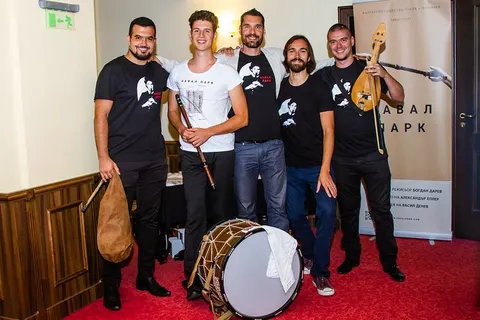
Bogdan Darev is the director of the film Kaval Park, named after the kaval, the long wooden shepherd's flute of Bulgarian folk music. For almost two hours he presents the surreal figure of Alexander Eppler, an American of Russian descent and a Bulgarian at heart. Together we'll look for the threads that tie meaningful stories together. The luck and the curse of being an eccentric in this ever more uniform earthly world.
Come On, Grandpa, Blow the Kaval
Bogdan left Bulgaria at just 14. He lived in Greece for three years, and two weeks before he came of age he found himself on the other side of the Atlantic—in Seattle. The boy flew with his younger sister and, as he puts it himself, he grew up suddenly somewhere during the flight, because he had to become responsible, to support himself and her in the fierce environment of the Wild West.
He boarded the plane to the Promised Land as a metalhead. He would come back to Sofia Airport a full 23 years later as a passionate lover of Bulgarian folk music, determined to rediscover and tell the story of his bond with his homeland.
How does a metamorphosis like that happen? How do you get to today, when the director travels around villages and small towns to screen his film about another man in love with all things Bulgarian? While preparing to move back to Bulgaria with his family…
Jump, Kalinka
As Bogdan says, the years of carefree youth simply never happened for him. He and his sister ended up in the United States and unexpectedly found themselves completely alone. Their father never managed to adapt to life there, and their mother was barred from entering the country for nine years in a row.
Bogdan learned to fight. He took whatever work came his way, and with hard work and stubbornness he kept moving forward along the path he had chosen. Gradually he and his sister found their place and even put together their own version of the famous American dream. In 2008 he was on the verge of getting his own restaurant and securing the income he had dreamed of. He had a fiancée, Erika, an American from a good family, who couldn't wait for him to succeed so the two of them could get married…
Until one evening—he remembers it vividly to this day—the two of them were riding in the car. “And Erika said, ‘Oh, I can't wait to see you in a tie, with your own restaurant.’ I was in the back seat and my stomach turned. My soul said from within, ‘This isn't going to happen, this path isn't for you.’ I quit my job and walked away from serious financial opportunities, which is not at all typical for an immigrant,” Bogdan recalls.
He decided it was time to do what his heart told him. His great love was cinema, and he devoted himself to it entirely. He started learning the craft, making small directing projects…
When I Was a Little Shepherd
A little later he discovered another great passion. Until 2008 he had contact with Bulgarians only once a week, when they played soccer. Just as often he spoke Bulgarian on the phone with his mother, who sent him books by her favorite writer, Yana Yazova, a Bulgarian novelist and poet of the interwar years. Beyond that, he rarely exchanged the odd message with other Bulgarians in shlyokavitsa, the Bulgarian-in-Latin-letters typical of the time. I find it hard to believe as I listen to his correct, colorful Bulgarian, with almost no trace of three decades across the ocean.
Around that time Bogdan met a lovely girl. Maria was Bulgarian, but for months the two of them talked in English before it occurred to them that there was a better option. Today they are a family, and together with his stepdaughter the three of them are making plans to move to Bulgaria for good soon.
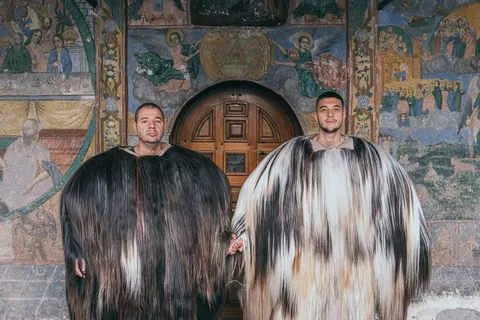
Of course, this change didn't come all at once. A big role was played by something that surprised even him: a fascination with our folklore. In 2010 the Bulgarian community in Seattle and Americans who value our traditions organized a big festival, with folk groups performing and kuker masks—the shaggy costumes of the Bulgarian winter mummers—being made. “That's what awakened this attitude in me toward Bulgarian things, toward the language and the folklore,” Bogdan remembers. “Especially when I started dancing. In the horo, the Bulgarian circle dance, you take with one hand and give with the other. I'm interested in Eastern philosophies, and it became fascinating to me how these messages are encoded in our folklore—the taking and giving, and so many other symbols.”
The Ninth Hole
Bogdan had left corporate work behind and earned his living as a building manager, which gave him enough time for filmmaking. He worked on projects for nonprofit organizations.
Then came the moment when he returned to Bulgaria and made the film There, in which he showed the country as he saw it 23 years later.
When the production was finished, he traveled with it and presented it to Bulgarian communities across America, visiting 17 cities. “I met many Bulgarians from the diaspora and saw how deep the emigrant's wound is,” the director recalls. He created the website Return to help people come back to themselves, to one another, to the memory of their ancestors.
Meanwhile, another remarkable encounter had taken place.
It was 2011, and Bogdan and his wife were helping organize a Christmas concert for the Bulgarian kids in Seattle. They really wanted to invite live musicians, but… there was no one who could play our native instruments. “We just couldn't find anyone, until some Americans who loved our folklore told me, ‘There's this eccentric who lives in West Seattle, he plays the kaval beautifully, but he'll ask you for a lot of money.’”
A Kaval Plays in the Meadow
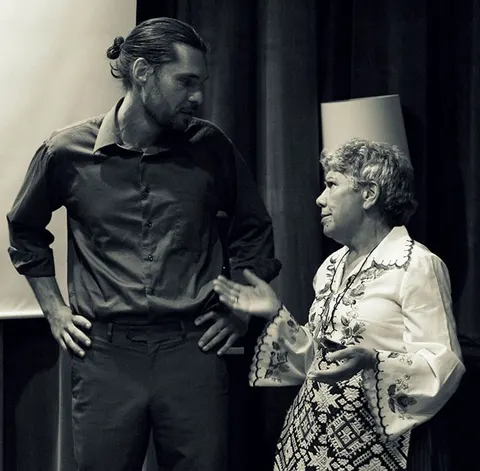
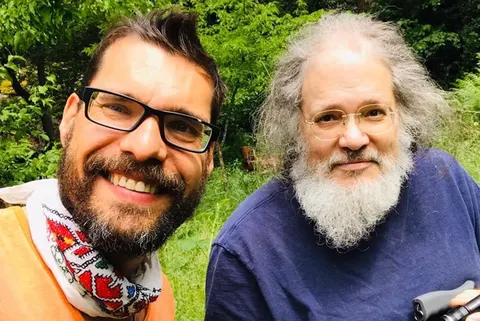
Bogdan had nothing to lose, so he went to see this man… who turned out to be a real Santa Claus. Magnetic, radiant, in love with all things Bulgarian. Alexander Eppler, an extraordinarily colorful figure, would later become the protagonist of the film Kaval Park.
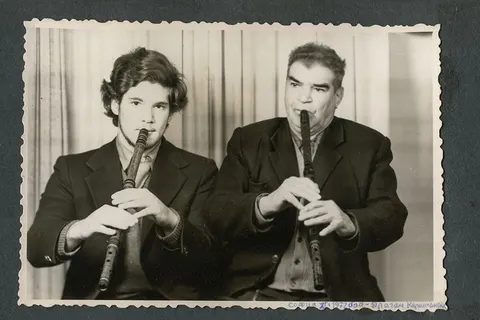
The American Alexander Eppler came to Bulgaria at just 16 and had the good fortune to learn the kaval from the best, studying authentic Bulgarian melodies with Nikola Ganchev and Dragan Karapchanski. He would go on to play them his whole life in every corner of the world, along with two other instruments unusual for the West—the cimbalom and the balalaika.
“Santa Claus” gladly agreed to play for the Bulgarian children. He wouldn't take any payment, and he created an unforgettable celebration.
A little later the idea ripened. The musician Vasil Denev, who also lives in Seattle, had long been pitching Eppler's story to Bulgarian television channels, but met no response. Somehow the idea fell into place when he brought it to Bogdan. The director had just finished his half-hour film This Granny, and decided to try with Alexander Eppler too. “Why not quickly shoot another half-hour film?” he told himself.
Dear Traveler
Things quickly changed. Shooting the film took three years, and editing and finishing it took as many again. It grew to almost two hours, passing through Chicago, San Diego, Harmanli and Plovdiv.
Alexander Eppler turned out to be a many-layered personality with endless stories, exquisite Bulgarian and countless roles. He is… and what not besides—if you're lucky enough to see the film, you'll see for yourself.
At the time the protagonist was of advanced age and seriously ill, and no one knew whether they would make it to the end. “I followed him for hours with the camera in Seattle. You never know what he'll tell you, where the story will start from,” Bogdan recalls. They talked about life and death; among everything else, Eppler was also a priest.
“A Bulgarian shouldn't seek recognition from abroad and from other foreigners for being Bulgarian and for what he has,” the film's protagonist says. That is precisely one of the director's main messages. “I want a sense of humanity to remain, a sense that we're all connected to each other. That we shouldn't look west or east for someone to come and fix us or show us how we should love Bulgaria.”
Iliya Built a Cell
Symbolically, the film premiered in Koprivshtitsa, a picturesque mountain town that is a shrine of the Bulgarian National Revival, and afterward the film and its author toured countless small towns. You can find out where the next chances to see it will be on the project's website.
Because of the screenings, Bogdan stayed in Bulgaria longer than ever before, and that further catalyzed his wish to come back.
But why is it that people like Bogdan and Alexander, who in one way or another are outsiders to our environment, find it easier to appreciate the good sides of life in Bulgaria and our traditions?
“Yes, I see the notorious grumbling, but if you go abroad, you'll find you can grumble there too,” the director replies. “As soon as I arrived, I was shocked by the extreme division in the capital, Washington—white people on one side, Black people on the other. And today in Seattle, you go to something like South Park and a third of it is full of homeless people's tents. This is the city of Microsoft, of Amazon, of mammoth companies, while people have lost hope. There I definitely don't have the sense of safety I have walking at 11 p.m. along the Main Street in Plovdiv.”
A Call to Return
What does he think are the best qualities of Bulgarians?
“One of the strongest is the ability to create, whether in IT or in art. Bulgarians know how to do it, and it's time they started creating their own lives and their own reality. Another very important quality is the bond with the land—it's encoded in us and there's no escaping it. And also a quality some consider negative: Bulgarians are stubborn. I think that's a good thing. Just as a child wants to do things its own way, that's how a path gets cleared in the hardest of times.”
“Many people tell me to live here for a while first, and then we'll talk. There comes a moment when you have to decide for yourself where you can be useful, where you can give—in the US or in Bulgaria—and I choose here,” Bogdan says as we part.
“I'm living in a kind of dream, some life story of my own, and I'm very grateful for it. I keep thinking how important it is not to kill the dreams in children, to encourage them to dream.”
How will his story continue?
Kaval Park premieres in Sofia on December 9, at the Cinema House.
More information here.