Did you know that automated translation systems are at work all around us? That a huge share of administrative and commercial texts are translated into every language by artificial intelligence, and the job of humans is to check and correct them?
They are no longer even called “translators” but “post-editors.”
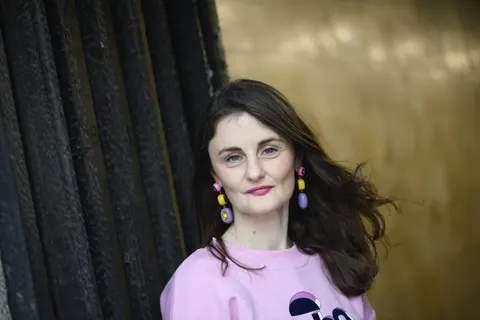
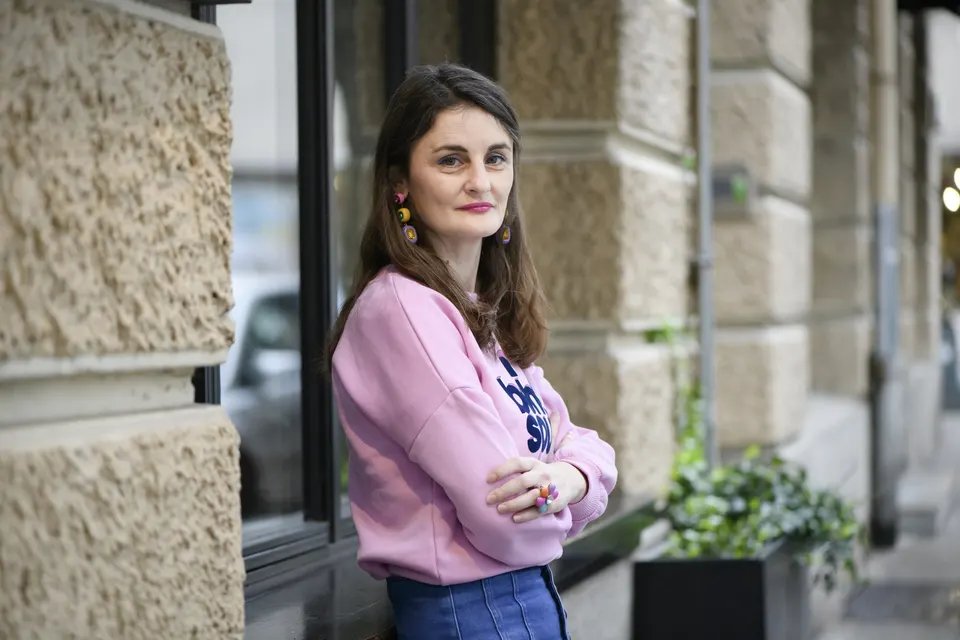
You know Rada Gankova from her visit a year ago, when we talked about our withered talent for coining words. About the ease with which we adopt words like “еърфрайер” (erfrayer, a straight borrowing of “air fryer”), when once upon a time we were original enough to invent “чушкопек” (chushkopek, “pepper roaster,” the Bulgarian countertop oven for roasting peppers). Today we will talk about her main work—translation—and the way the arrival of artificial intelligence is changing it.
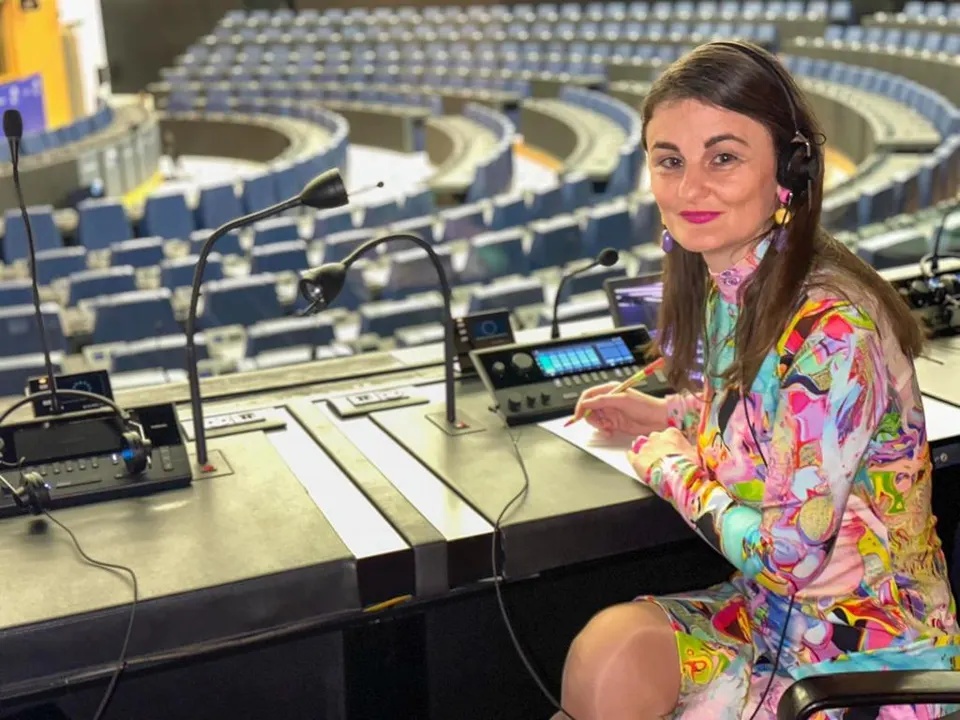
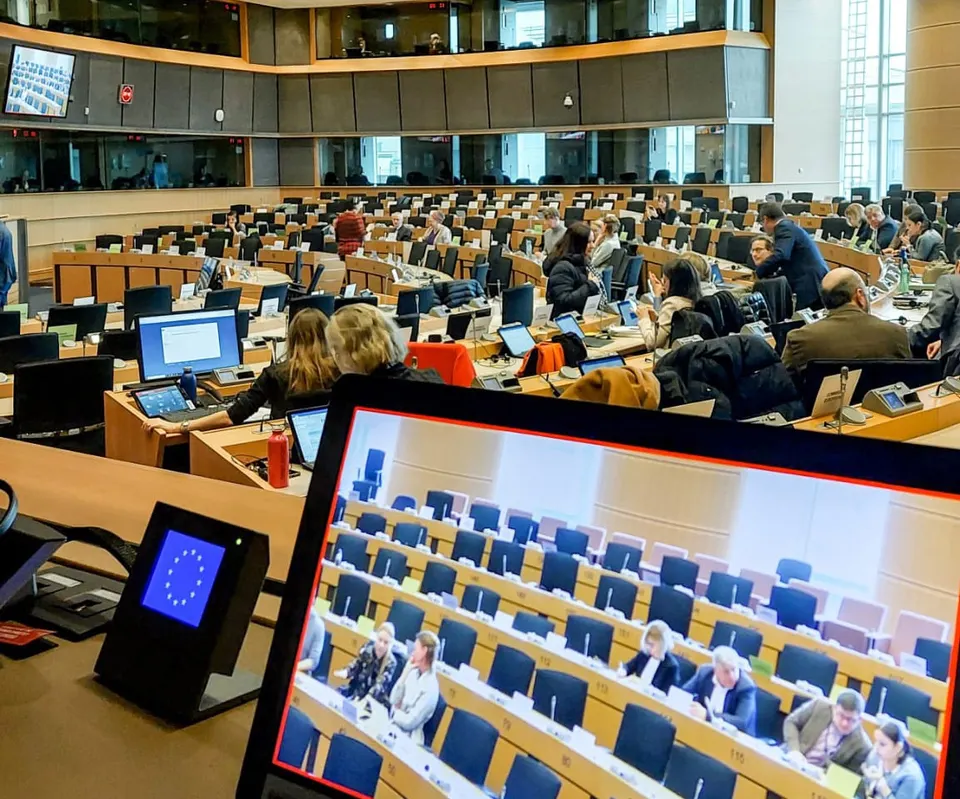
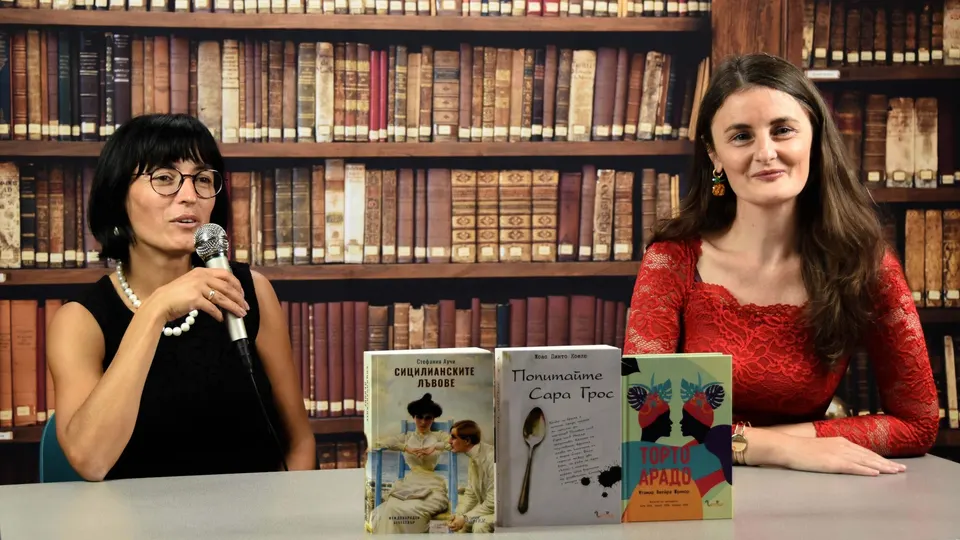
Rada is a translator and interpreter in the EU capital, Brussels, and teaches Bulgarian to people who translate from our language into other European languages. She also translates fiction, with a special interest in Latin American authors—thanks to her, Bulgarian readers have the books of Sofía Segovia, Itamar Vieira Junior (shortlisted for this year’s Booker), José de Alencar and Sophie Goldberg.
She has dreamed of being a translator since childhood and speaks English, Spanish, Portuguese and French. She founded the Bulgarian book club in Brussels, The Pillow Book.
Now that people have become post-editors for the algorithms… is the encounter with post-truth somewhere around here too? Will artificial intelligence play the role of the Babel fish, or will it build a new Babel?
– I understand that in the EU capital automated translation is used more and more widely…
– We have been translating administrative and commercial texts with the help of technology for a long time. Specialized translation has long since stopped being what it was—you receive the original and write the translation on a blank page. In most cases
we receive the original and a machine-translated text, which we edit. This activity is called “post-editing.”
Some colleagues put “translator and post-editor” on their business cards, because it is a sought-after skill.
It used to be easy to blame the translators. Whenever someone failed to understand or misinterpreted something, they would say, “The translator didn’t translate it well.” Things are different now.
– Can you tell us some interesting examples?
– The most striking and best-known case was during Brexit. The agreement is a hefty document, more than 500 pages, translated into 22 European languages. Before that there was another document, called the “White Paper,” for which German speakers mocked the British. The British newspaper The Independent wrote that
this “White Paper” had been translated into very poor German, with grammatical errors, and that the language was old-fashioned and sounded archaic.
One journalist even declared it a “national humiliation” for the British. Here we forget one very important detail—this text was not translated by a human but by a machine. There may have been human editing afterwards, but we don’t know how much time the editor in question had, or what was expected of them—whether to check fidelity to the original or simply to smooth out the German. We can speculate about the conditions under which this text was translated, but one thing is clear—the circumstances and methods of work today are different, and
our output is the result of interaction with that of artificial intelligence.
– Why “post-editors” and not simply “editors”?
– These terms appeared in the 1980s, at the dawn of machine translation, when people talked about pre-editing and post-editing. The first is preparing the text before it is fed to the machine, the second is the processing afterwards.
– Is there any regulation of where automated systems may and may not be used?
– No, our relationship with artificial intelligence in translation is not entirely clear or legally regulated. What about copyright, for example, or unfair competition? Who holds the copyright when part of our intellectual work is done by AI? There was a lot of buzz around a Japanese writer who announced she had written part of her book with ChatGPT. Does she get the royalties for those five percent? Well, it’s the same with translation.
A few days ago The Guardian wrote that many translators have less work because of AI and expect to be negatively affected. The article also mentions the consequences of post-editing, which is not easier work for translators—on the contrary, the post-editor has to be very vigilant, because the algorithms can mislead them.
From the same article: according to a survey among members of the Society of Authors—writers, screenwriters, illustrators and translators—94 percent say they want to be paid and credited when their work is used to develop artificial intelligence. That is exactly why updating the legislation is urgent, to ensure the tools are developed and used ethically and lawfully.
In March this year the EU adopted the world’s first regulation on AI. All these legislative changes aim to regulate how we interact and work with artificial intelligence.
– True, but many very big questions remain open. Meanwhile, circumstances are changing fast. Is that the case in the world of translation too—are professional translators already losing work because of the algorithms?
– As I said, machines generate texts, but those texts are still not ready to be read unchecked. Sometimes it takes a long time to work out what exactly the “automated colleague” meant to write. The volume of work and the number of translators are the same.
But there is also one very pleasant effect of using algorithms, and that is that
people have started to value the translator’s work and the text that has been translated by natural intelligence and carries a soul.
– Really? I don’t see anything like that around me. And, as we discussed in the “Letters and Bytes” segment on The Library on BNT 1, Bulgarian National Television’s main channel, I think that for a huge share of our everyday needs the algorithms are already good enough translators.
Where do you see these trends heading? Because, with all the endless questions about whose jobs AI will take, it seems logical to me that in simultaneous interpreting it will very soon surpass humans in skill.
– The official beginning of simultaneous interpreting in its current form is associated with international organizations, and it became possible only after the invention of wired systems for transmitting human speech at the start of the 20th century. The development of artificial intelligence is considered a technological breakthrough that will also radically change interpreting.
During the pandemic we witnessed a boom in real-time translation systems, and the existing platforms were quickly improved. Interpreting machines rely on automatic speech recognition, machine translation and speech-to-text conversion.
For machine interpreting, where the human is replaced by a machine, I think we still have to wait. It is precisely in simultaneous interpreting that AI embarrasses itself most. If it copes reasonably well with written texts, with spoken ones it’s another story. I have received messages saying that
a given forum will not need interpreters because they will use AI.
And… guess what! It turns out that what the AI generates is incomprehensible, and the next time they hire people for the job.
Another example: in many places in the US, interpreting for refugees and migrants is done by machines. Sometimes with disastrous results.
– Still, I think this is changing fast, precisely because the models are getting better at each of the three steps. Converting voice to text and back, voice cloning—they have advanced impressively over the past year.
– It’s not that easy. Interpreting is bound up with the human voice, pronunciation, the particularities of each person’s speech. And our voice is unique, and when you listen to it, it can be very pleasant. Machines produce a voice that is standard, often stripped of emotion.
On the other hand, when machines translate speech, they have to take into account everyone’s individual pronunciation—one person has a speech impediment, another speaks with an accent like their grandmother’s, a third speaks in dialect… Machines haven’t yet figured out how to overcome this uniqueness and individuality. They manage, but they can’t yet produce a professional translation.
That’s as far as simultaneous interpreting goes, but
we also have to consider the use of AI across different languages.
The President of Argentina, Javier Milei, gave a speech at the international forum in Davos a few months ago. The speech was in Spanish, but a version also came out in which he speaks perfect English in his own voice—and it is neither a second recording nor dubbing. The audio was converted by the HeyGen platform, which can generate audio in another language, preserve the tone and timbre of the voice, and adjust the sound and the person’s lip movements so that it sounds and looks convincing.
The fact that we can keep the original voice and make it speak another language is a new era, especially in politics.
– Exactly! I think about this a lot too, although in my view it isn’t discussed enough in public—it will come up on the site soon. I suspect what the answer will be, but I can’t help asking… are you afraid the moment will come when translators are not needed at all?
– In some fields the risk isn’t great.
Translating fiction is creative work, and machines still don’t create; they only generate text content.
Algorithms cannot think metaphorically or figuratively; they are great literalists and have no sensitivity whatsoever. That is why the name “translatoids” caught on.
In the words of the Mexican poet Octavio Paz, “I do not say that literal translation is impossible, only that it is not translation.” For now, the automated translator is at the “literal translation” stage—word for word, not sense for sense.
– From your everyday experience… are automated translation systems getting better, or are they showing that they have hit their limit?
– Compared with ten years ago, they work many times better. I can’t predict how they will develop; some time has to pass so we can compare.
How to preserve the style, what the sentence structure will be, the use of tenses or synonyms… on these things progress is slow.
The human translator decides on the most suitable translation, and the software is their assistant, so they don’t waste time looking things up and digging through dictionaries.
– What are the biggest risks of automated translation? What is the biggest problem it could create?
– Standardized, soulless language.
A language that has no cultural coloring and does not express the way people have read the world is uninteresting, and that is exactly the kind of language machines create.
The stock production of phrases is the automated translator’s trademark, with English used as the basis. My observation is that, partly under the influence of the automated translator, many English expressions have entered Bulgarian—
“skeletons in the closet,” “red lines,” “hot potato,” “in someone else’s shoes,” “the elephant in the room”…
This in itself isn’t a problem, but such expressions reveal a people’s imagination, and our imagination is currently being leveled to that of English speakers.
The other problem is the “shlyokav” language—from shlyokavitsa, the slangy mix of Bulgarian and Latin letters. This Bulgarian-English hodgepodge in the media is a result of automated translation, though not only of it. There are thousands of examples; all you need to do is open a news site and you’ll see that everything is written this way. Over the past few weeks I’ve collected examples like
“non-profit bolnitsa” (hospital), “zhertvi na deepfake” (victims of deepfakes), “thriftvane” of furniture, “day mi malko space” (give me some space)…
All these words can be said in Bulgarian, but we covered that topic in the previous interview.
– And we will again! The topic is big and important. Which Bulgarian expression would surprise you if you saw it translated automatically into a foreign language?
– I have always thought that “неволя” (nevolya, misery, hardship) is one of the so-called untranslatable words. To my surprise, the “automated colleague” does a decent job with the folk tale about Nevolya, in which misery is a person who follows you everywhere. But that, again, is because she has no emotions and
does not perceive nevolya as a characteristically Bulgarian experience.
You can always find words to translate something, but the “untranslatable” is the emotional charge, the weight of a people’s psychology.
– Very interesting—for you the “colleague” is a she, while we keep talking about the “automatic translator” as a he…
– We are used to putting everything in the masculine. If you look at the introduction to our previous interview, you too say “Rada is a translator,” using the masculine form of the word, as Bulgarian does by default.
I refer to her in the feminine for two reasons—because that is what my colleagues call her, and because my colleagues are in fact mostly women. Translation is a heavily feminized profession, and purely statistically the automated translator is more likely to be a woman than a man.
– Well, I have a female journalist colleague who gets annoyed when I don’t call her “colleague” in the masculine. Everyone has plenty of examples of failed automated translation (not that it doesn’t happen with human translators). Do you have any that keep making you laugh?
– Oh, I could go on until tomorrow; the automated translator makes me laugh all the time. After all this time she still hasn’t learned that when something is said to be viral in the media, it doesn’t mean “virus-infected.” That tip is not just “a nozzle” but also “advice,” and that chair means “the chair of a meeting” in an institutional context, not “a piece of furniture,” as she translates it.
Turkey even had to change its name in English to Türkiye so it wouldn’t be confused with the bird…
– Which book would you never give to a translation algorithm?
– I wouldn’t give it a single literary text.
But the algorithm produces its weakest translations of science fiction and fantasy novels, because the key there is human imagination,
which creates whole new worlds, while machines imitate, repeat and copy what is already known.
– You say that literary translation remains a human bastion because it requires a much deeper knowledge of context. But couldn’t we train the algorithms in context too, even deeper and more layered than a human can grasp?
– You should ask computer scientists that question. For now, I see that algorithms can’t cope with polysemy or with context. If a word has ten meanings in the dictionary, the “automated colleague” picks one without regard to context. I think that remains her biggest problem. She also commits a lot of anachronisms, using in a translation a word that didn’t exist in the era of the work. It’s like mentioning a robot in a translation of a medieval text.
Last but not least, her vocabulary, despite access to all the world’s resources, is rather poor.
She doesn’t know how to build a bridge between cultures or how to translate an author’s neologisms.
Here are a few examples I collected for this interview. She can’t handle culture-specific realities: she translates “The Ingenious Hidalgo” as “the brilliant nobleman.”
She can’t handle polysemy: Molière’s Don Juan has French editions titled Dom Juan ou le festin de pierre. Here the automated translator fails to grasp the context and renders it as “Peter’s feast.” Pierre is indeed the name Pierre, but it also means “stone.” In this play it refers to a stone statue, but she isn’t that good at literature and doesn’t know how to avoid such a blunder.
In Sofía Segovia’s novel The Murmur of Bees, one of the characters is named Consuelo, which means “comfort,” and the automated translator translates the name.
In the same novel there was a “rebozo”—a large shawl that women in Mexico wrap themselves in but also use to carry their babies. Since today the English word “sling” is used for that meaning, that is how the algorithms translate it, but… the novel is set in 1921.
– Still, you talk about the colleague, but there are many different systems. I’m sure that if the goal were specifically literary translation, the algorithm’s creators could take it into account to a much greater degree.
What do you think of the idea of personalized translation? Wouldn’t it be wonderful for a person to have a personal AI translator that translates according to their taste, favorite style and vocabulary?
– I have nothing against personalized translators, but then we really do risk becoming Babel, and the point of standardizing the language is lost. There will be no way for the Bulgarian Academy of Sciences (BAN) to impose language rules, because the machines won’t follow them.
– A world in which BAN doesn’t impose the language rules is truly a terrible one. But precisely in this context, I think ChatGPT already writes considerably more correctly than a huge share of Bulgarians. Since we have more perfect editing and proofreading systems, why do we need to learn the rules?
– I also think that
ChatGPT writes more correctly than many people, and in every language at that
and this raises the question of the content and goals of education. We ought to start distinguishing between kinds of literacy. Today it can no longer be measured simply by whether we know when to write “а” or “ъ,” or the full or short form of the definite article.
– In the experiment I ran recently, ChatGPT made up some very beautiful dialect words from Bulgaria’s Northwest, and people really struggled to tell whether they were real. You and I talked about our atrophied word-making—couldn’t the algorithms help us invent new words and meanings?
– To be honest, I already rely on the algorithms, because I’m convinced that the only thing we know how to do is borrow from English.
How many words have we invented in the last 20 years? They’re all copied.
Remember the air fryer example from our previous conversation? That “erfrayer” has stuck; there are TV ads, there are even variations—“oil-free fryer,” written in Cyrillic! Advertising is a wide-open door through which many words come in, and that’s why I believe the people who make ads bear responsibility for which words take hold.
I ran an experiment with ChatGPT too: I gave it some English words we use and asked it to invent a Bulgarian word for each. For air fryer it suggested “въздушенфритюрник” (vazdushenfrityurnik, “air deep-fryer”). Not bad. I gave it “streaming platform” and it generated “поточна платформа” (potochna platforma, “flow platform”); for “mainstream” it coined “главентен” (glaventen), informing me that it had used the words “главен” (main) and “тенденция” (trend).
Of course, that doesn’t mean we will adopt these words. Words take hold through the media and public speech. Machines use our language and learn from it, but we don’t learn from them. At least for now…