“We need to talk and think about our language, about what it will look like and the state in which we will leave it as an inheritance to our children!”
How is our language changing, and are we growing careless with it? Why do we now accept foreign words uncritically instead of trying to explain them? Are all languages doomed to be gradually influenced and “swallowed” by English?
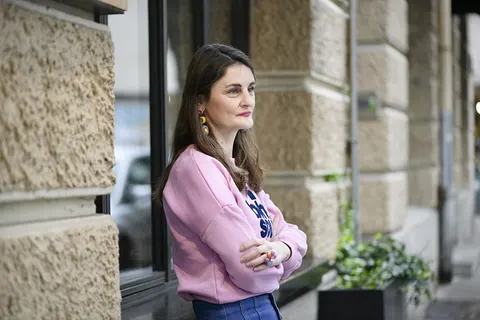
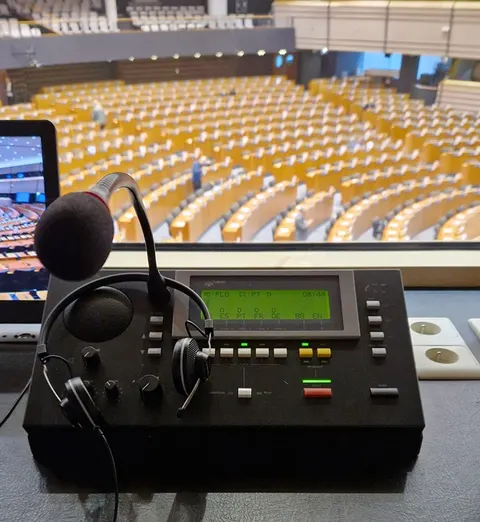
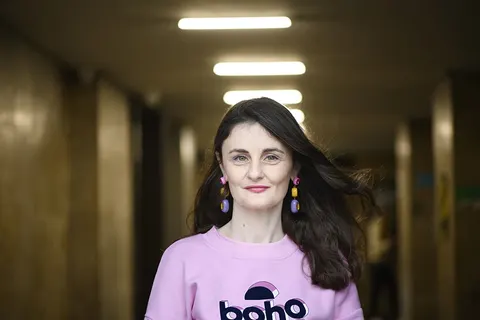
Rada Gankova works as a conference interpreter in Brussels. She has a particularly interesting view of the word and of our attitude toward it. In the capital of the EU she teaches Bulgarian to people who translate from our language into other European languages. For her own satisfaction, she also translates literature—thanks to her, the books of João Pinto Coelho, Itamar Vieira Junior and Sofía Segovia have come out in Bulgarian.
She has dreamed of being a translator since childhood, and she speaks English, Spanish, Portuguese and French. She is the founder of the Bulgarian book club in Brussels, The Pillow Book.
One article on her blog brought together the pepper roaster and the air fryer. What could they possibly have in common? The subject is very important: how our own attitude toward language is changing. We used to have imagination and, when needed, we “built” words, while today we take them ready-made, and so we leave them without logic or context. And what hope, then, for the world of AI, IT and high tech…
– What, in your view, makes the pepper roaster and the air fryer “collide” when it comes to the Bulgarian language?
– The chushkopek, the pepper roaster, is a purely Bulgarian household appliance, something of an emblem of the socialist era, a symbol of urbanization. When it was invented, it was registered under the prosaic name “PECHP-1,” but in everyday speech over the decades it has gone by various names—chushkopekarnik, piperkopek, chushkopechka… In short, the Bulgarian linguistic genius showed great inventiveness in coming up with words for this appliance, and not only for it.
Right now a new household appliance is in fashion, and it is establishing itself under its nice English name—eărfrayăr, the air fryer.
How do the two phenomena collide? For me they are telling of our attitude toward our own language and of our somewhat withered capacity for word-making.
We were once capable of inventing such expressive terms as chushkopek, and today we simply copy without thinking—eărfrayăr.
To me this shows a passive,
careless attitude toward our language, a lazy transfer, without reflecting on it or reworking it, without making the effort to forge our own equivalents or to show some inventiveness.
I'm no purist of the “scratch-light-little-stick” school—that mocking coinage once proposed in place of the borrowed word for “match.” I don't think language should be sealed in a capsule and kept from developing. Quite the opposite. There is no way it can stand apart from an ever-changing world and not reflect the novelties in our homes and our lives. It is perfectly logical for new words to appear.
But I do call on us to be more active and to think about our words.
Let's help the language a little, so it can find openings, develop, grow richer and modernize at the same time.
Incidentally, halfway between the pepper roaster and the air fryer sits the microwave oven, which arrived at a time when our linguistic sensitivity had not yet atrophied so much.
– After your post you received quite a few ideas for what to call the air fryer. Which were the freshest?
– A Scottish friend of mine suggested we adopt the abbreviation FGV, from fritjurnik s goresht vazduh, a hot-air fryer. The writer Yoanna Elmi jokingly proposed vazdurnik, a blend of “air” and “fryer.” I also got a suggestion that we say vazduhoparzh or vazduhoparzhek, roughly “air-fry” and “air-fryling.”
– Oh, I particularly like the last one, I hope it catches on. According to linguists, about 5,000 new words have entered Bulgarian over the last few decades, most of them borrowed from English. Is that a lot?
– Whether it's a little or a lot, I don't know, but I'm convinced they're necessary, because we can't avoid naming new phenomena. I even think there should be more, and that we, as native speakers, can help forge and domesticate words, not just parrot the English ones. It can hardly be that hard to come up with a word for hater, influencer, mainstream, in-house, outsourcing. But what happens is that the “import” goes very fast, faster than we can react, and so we take ready-made linguistic “products.”
– What lies behind this change in the language? Is it the technology that determines it, or the users?
– Technology will never stop developing, and thank God for that. Every time there is something new, a word has to appear for it. We have almost always borrowed words from the field of technology—for example radio, televizia (television), shtepsel (an electric plug, from German)—so why shouldn't we bring over bot and ransomware now?
Technology determines the appearance of new words, but not how we will integrate them into our language.
Sometimes we bring in foreign words haphazardly, and questions arise. How do we form the plural of blockchain? Blokcheyni or blokcheynove? With the English words that have taken root, we often hesitate over the endings, and the hesitation isn't only among native speakers—you can see it even across different editions of the dictionaries. Skriynshoti or skriynshotove for screenshots? Lokdauni or lokdaunove for lockdowns?
The hesitation isn't only about whether we have a feel for language and whether we're inventive. Here there ought to be
an institution playing an active role, setting clear norms, so that Bulgarians have a source to consult when in doubt.
– That's right, formally that is the job of the Bulgarian Academy of Sciences (BAS). But these days someone else does a good deal more of it. The most-read of the more than 200 Digital Stories so far is the interview with Pavlina Varbanova, creator of the site Kak se pishe (How Do You Spell It). How do you explain that people get so excited about a piece on literacy?
– I read that interview too, and I follow Pavlina Varbanova's page regularly. It's very useful. The success of her page shows that we need a reliable source to help us with the norms of the language and with resolving our doubts about spelling and punctuation. Especially now, when we write on social media and put our literacy on display… or our illiteracy.
– Foreign words come in especially fast in information technology. I can feel myself using them constantly, too, even though there are good, precise Bulgarian words for many of them. Once I told a friend I was in a kol—a call—and since kol means “stake” in Bulgarian, she asked whether Baba Iliytsa, the heroine of a poem by Ivan Vazov, the patriarch of Bulgarian literature, was there too. Why has this field in particular been so “swallowed” by English?
– English has acquired the status of a lingua franca for practical reasons—the flourishing of international institutions and business, globalization and mass tourism, but today above all, digitalization. It has taken hold in many spheres of our lives, but it really is most noticeable in technology.
Let me recall the first sentence of Bai Ganyo, Aleko Konstantinov's 1895 satire about the archetypal Bulgarian boor: “They helped Bai Ganyo pull the Agarene cloak off his shoulders, he threw a Belgian mantle over himself—and everyone said that Bai Ganyo was now a complete European.”
Many words for clothing came into Bulgarian from French when Bulgarians' clothes suddenly became Europeanized… Bluza, pantalon, pizhama, sutien, kolan, palto, manto… The word toalet, for an outfit, which we are now in turn replacing with the English autfit. Does anyone even notice these words today? A century ago, in fashion, French was what English is for technology today. I suspect that in half a century Bulgarians won't notice the words we are adopting now.
– What are your favorite Bulgarian words?
– All the ones where we were inventive and that are somehow eloquent in themselves: chorapogashtnik, pantyhose, literally “sock-trousers”; vazglavnitsa, a pillow, the thing you put under your head…
– Are there beautiful words that have been born in recent years?
– Honestly, the only ones that come to mind came from English. Some of them are nice, but I can't think of any Bulgarian creations.
Ah, I've thought of one… There is a word that has awakened the imagination of every nation, and that is klyomba, or maymunsko a—“monkey a,” the @ sign. Klyomba is an Old Bulgarian word meaning a badly written letter. Every language has a different word for it, and each nation's associations are more interesting than the last. Spanish, French and Portuguese have adopted an Arabic word for a unit of measure; Hungarian uses a word that means larva; Italian, snail; in Catalan they've recognized it as a traditional pastry whose shape resembles a coiled banitsa, the Bulgarian filo pie…
In short, I dream of us showing such originality with every concept!
– It would certainly be interesting for all of us if your dream came true. But is this lazy transfer of foreign words today a purely Bulgarian trait?
– It's hard for me to say. In France, new words come in from English as well. People are outraged, but they say them. Precisely because they're outraged, there is some public discussion, and the English words find French equivalents. Take spoiler. They used to use the English word, then they came up with their own—divulgâcher—people started hearing it on television and it became ubiquitous. In French you can say thriller, but also film à sensations; bestseller, but also succès de librairie. And to come back to the air fryer—in French it's friteuses à air chaud.
In Spain the approach is similar. The Royal Spanish Academy proposes Spanish words, but more often they are “forged” by the speakers themselves. For lifting, for example, they propose estiramiento; for hashtag, etiqueta; for gamification, ludificación.
In Lithuania they have a language commission and a language inspectorate, and the latter
has the right to fine people for public statements in bad Lithuanian.
They too used the English word afterparty. At one point the commission proposed saying dūzgės instead, an onomatopoeic word for the buzzing of bees. The proposal was first met with laughter, but today, two years on, Lithuanians have forgotten about the afterparty. And one more example. A few weeks ago, on their language page, a discussion appeared about the word kuražas, “courage” from French, which is cropping up more and more often, and they are debating what to do with it.
We need to talk and think about our language, about what it will look like and the state in which we will leave it as an inheritance to our children!
– How can this change? And is it really worth it?
– It matters a great deal how people speak on television and what gets written on news sites. Journalists are, in practice, the first ones responsible for importing foreign words. In the past that role was played by translators, but today the import of words depends more on journalists and on people who are active in the media.
– Alas, I'm not sure how much power journalism really has today; to a large extent it has abdicated its main role—to inform—let alone caring for the language… But let's change the subject. You write about the phenomenon of creolization, which is very interesting historically and then in today's context too. What is it? Is it really the logical future of Bulgarian as well?
– Creole languages arose in the 17th and 18th centuries as a result of the slave trade of the preceding centuries, and they were considered poor imitations of English, French, Portuguese and Spanish. Today they are independent, full-fledged languages, official in some countries, such as Haiti and Curaçao.
In linguistics, creolization is the name for the process in which a foreign language exerts too great an influence, linguistic structures become simplified, and many words come in without giving rise to related ones.
In my view, Bulgarian is far from creolization. We are simply seeing a loss of linguistic flexibility. When we take English verbs directly, they usually remain single-aspect—that is, they have no perfective form, and the full potential of the verb system doesn't unfold. What would the perfective of brandiram (to brand) or netuarkvam (to network) even sound like?
On the whole, the foreign words we import mostly have no derivatives; they remain orphans that struggle to fit into our grammar and don't produce related words.
– I can't skip another touchy question. Do you think it's time to abolish the rule on the full definite article—the one that makes Bulgarian masculine nouns take -ăt as subjects and -a everywhere else?
– Bulgarian has a very easy spelling system because it is a phonetic language. That is, what we pronounce is what we write. Compare it with French, for example. In French-speaking countries it takes children much longer to learn to read and write, because the spelling is harder and they learn many more rules. French radio broadcasts dictations for adults so they can keep their spelling sharp. We have it easy.
The few grammar rules we need to learn are where to write the full and where the short article, when to write brat mu (his brother) and when brat si (one's own brother), when kogo (whom) and when koy (who)… The rules we need to be minimally literate can be counted on your fingers.
The full-versus-short rule is the yardstick by which we measure the literacy of the people around us, especially on social media. At least, that's the function we've assigned to it.
If we abolish it, we'll have to pick something else to needle people who don't know it.
– You live in Brussels. Is Bulgarian different from a distance?
– What's different is our attitude. At least the Bulgarians I know abroad try not to say fastsiniran sam (I'm fascinated), sherwam (to share), dzhoynvam (to join). I think that's entirely natural. Language is bound up with our cultural belonging, and we cling to it when we're abroad, because we're afraid of losing our connection to our native culture.
– You also teach Bulgarian to foreigners. My grandmother lived in Bulgaria for 65 years, worked as a teacher and a journalist, and yet… you could always tell that Bulgarian wasn't her native language. Why is our language so hard?
– How could you tell? By her use of words and grammar, or by her accent? I'd bet it was a matter of accent. That's normal.
Grammar and words can be learned, but the tuning of your speech apparatus is always conditioned by the first language, or languages, we learned as children.
There are no easy languages, but I'll tell you which things in Bulgarian are hardest and give away that someone isn't a native speaker. First and foremost, the renarrative mood—the verb form for reporting things you didn't witness yourself. Even if they learn all the tenses and moods well, foreigners will always get the renarrative mood wrong. Also the verbal prefixes. In Bulgarian we have 14 verbal prefixes—that's nothing, other languages have them too—but ours have both a grammatical and a lexical function. We can even stack two prefixes: po-na-pisha, “write a little bit.” Or even three: po-iz-raz-hodih, “I took a few strolls about.”…
– Which typically Bulgarian words and phrases have unexpectedly given you trouble in translation?
– Yunak, the brave folk hero; prosveta, enlightenment in the National Revival sense; nevolya, hardship and misfortune rolled into one—those are difficult.
Languages aren't innocent; they carry values. The words laden with history, the ones that reflect our national psychology, are the hardest to translate.
I'll give you an example of the opposite, too—a word I think we could stop using in the modern context and leave only with its historical and social baggage. I don't like the word chirakuvam, to serve as an apprentice in the old craft-guild sense, at all, and I find it strange that it turns up in European documents. If it were up to me, we'd write something else.
We help words acquire value; it's up to us to change the ideas invested in them, too. For me this is connected with modernizing and updating the language, which in turn reflects the modernization of society, or is a precondition for it, depending on your point of view.
– I, on the other hand, really like the word chirakuvam, and I think everyone should conjugate this verb in the first person a few times in their life. But the best thing is when we talk about words, and it happens so rarely!
How has Bulgarian changed during the time you've been out of the country?
– For the better. When I lived and worked in Bulgaria, people wrote in shlyokavitsa, Bulgarian typed in Latin letters. Nobody uses that—let me call it, loosely, creole—alphabet anymore. People write to each other in our own letters. Again, this has to do with the development of technology. It used to be not so easy to install Cyrillic, and not all programs could always read it. That's in the past now.
And I think there is now much more awareness in our society of the hygiene of writing and speaking.
– Technology is advancing in more and more fields, and we talk about whose profession it will take away… Will there always be a need for translators?
– Technology is developing at breakneck speed, so it's possible that translators in the narrowest sense, as a profession, will disappear. But if we accept that
the translators are all of us who make words and create language every day, then there's no way we can disappear.
Machines will learn to combine words and carry them from one language to another, but someone has to create those words. And that someone is the people who speak the language. Languages are still the most human of creations…