Work in the software world has already changed fundamentally with the arrival of artificial intelligence. I don't believe anyone would dispute that, whether they see it as a good thing or a bad one, with enthusiasm or disgust, eager for the future or trying to stay in the past.
But how different are things, really, and how far will they go?
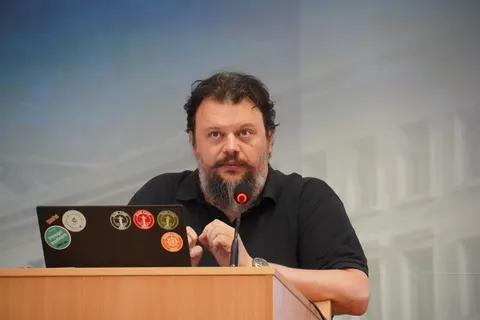
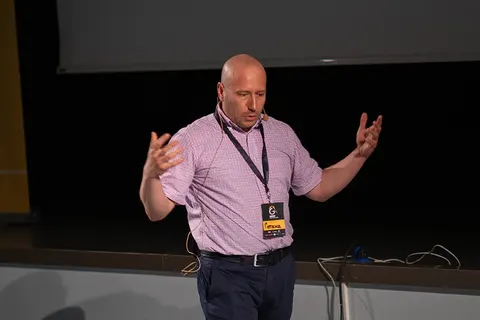
Djemal Ahmedov will show us the answers on November 29 at the conf.ai workshop. He will harness AI agents and get them working as an entire software team.
Before that, though, it's time to talk. About the chaotic present and the uncertain future of the software world in the years of advanced artificial intelligence. “We will always have a human in the process of building software,” says Djemal. Is that really so?
More about the guest
Djemal Ahmedov studied computer science in Southampton, in the UK, and started his career while still at university—first in a startup environment, then in the corporate world, where he worked on large projects in logistics and finance.
Over time he moved into more strategic and managerial roles—leading teams, designing scalable architectures and advising companies across industries, from energy and fintech to legal and educational organizations. During the COVID pandemic he moved to Amsterdam, then took a year off to travel and rethink his next steps.
Today, for the first time since his school years, he lives in Bulgaria and heads the engineering team at the innovation hub Checkatrade Labs, where he builds zero-to-one products—from concept to a real market. He is also actively involved in Conf.AI, an initiative that aims to help software engineers master and adopt the new possibilities artificial intelligence offers.
– Do you remember when and how artificial intelligence entered your work as a software engineer?
– The boom started exactly when I started traveling. And I got curious—things were changing very fast and people didn't understand it. I was just an observer, standing on the sidelines and reading about what was happening.
But when I came back and started working as a consultant for an English company, it got even more interesting and I began using it more, including with the team I work with. The whole idea of our department is to run experiments and build prototypes very quickly. To be able to see whether something will work as a business model, whether people like it at all and whether we'll find customers for it, and if so, to develop it.
Gradually other departments in the company began adopting these technologies too, guided by our experience. We had complete freedom and I started using all sorts of platforms. Right now the main ones are Cursor and Claude Code, but back then there were also VS Code extensions, Copilot. I began to find a kind of pattern in how they work and—no, rather, to look for the best ways to adopt them, not just in our team but in the company as a whole. I started giving talks and presentations on how to use what, and whether it was any use. That way, little by little, we built processes, and today the whole company works like this.

– This set of tools changed very quickly. Until a year ago the main approach was to copy a question into a chat, and at most Copilot would finish a line or two of code for you. Now there are countless platforms and agent-based tools that are fundamentally changing our work as programmers.
– That's true, things are building on each other quite fast, but at the same time not that fast. From the point of view of large language models, we're in a constant cycle. There are a few big players: Anthropic, OpenAI, Gemini, Grok, DeepSeek. One releases a new version, then the next one comes along, and the cycle keeps turning. The models get better, they can work with more and more context, and right after that the platforms that help us specifically with building software evolve too. They keep adding new ways for us to work with them.
At first they were more like assistants. They'd come in, help you with ideas, fill in the gaps, whereas now things are changing a lot—we see they're capable of more and more tasks on their own. They're useful to us, they contribute to our work, but their contribution becomes much bigger when we use them within a specific workflow.
When they're built into your daily work, that's when you see the real growth in productivity.
Especially in teams, where you have certain expectations and metrics and you can see what's happening. Amazon introduced something like this—they added a process driven by the project's specifications on their platform, which is also built on top of VS Code. It lets you plan carefully before you do anything. Cursor is doing the same thing right now—they added planning as a process.
But everything is heading in one direction—toward agents, and we see the same approach repeating itself.
Even if these tools are different, they start working in more or less the same way. That's very interesting.

– Then again, we see that a lot in our industry. In my own field, for example, front-end development, the three most popular frameworks look more and more alike.
Today, though, you teach—and successfully—how to apply AI tools to building software. Which technologies do you recommend right now? What should we programmers adopt?
– I'm someone who gets bored quickly and loves learning new technologies—that's why, for example, I went from the corporate world into consulting.
Today we see that technologies like JavaScript remain workable and efficient, and plenty of people use them. And even when there are new, more modern systems, they very often choose to use this family of technologies.
A lot depends on the project. To anyone who has just decided to become a programmer, I would tell them
to learn JavaScript, its main paradigms and concepts.

– Which AI tools do you use every day?
– Right now I mainly work with two. It's clear they stopped being just about helping us write code a long time ago. For orchestration I use Claude Code, extended with quite a few agents. At the project level I use Cursor more. I try to keep the two compatible, and I sync them so they work together.
– You mentioned efficiency. I talk to a lot of people about these topics, and most leaders in our industry say AI adds 5 to 10 percent. At the same time, in my own work I see us talking about efficiency gains of several times over. Not in every task, of course—say, when it comes to fixing bugs, it's considerably less. Where do you think the real figure lies?
– For me personally,
the efficiency these tools give you is around 30 percent.
That's still a lot! It gives you 30 percent of your time to be creative in your work or to focus on other parts of it.
You mentioned bugs. If you don't use AI, you see some error, you go and look for the code that's causing it. But now you have an agent that can go, find the error, and at the same time analyze and compare how it could be made to go away.
If you have even the simplest problem in a live environment, you can't reproduce it on your own computer. But now you have AI to help you.
With AI automation, especially for bugs, you can very easily automate and fix the small problems. Even if you have a beautifully working project that's 99.99 percent efficient, every next digit after the decimal point is harder and harder to add. But with the help of AI it's achieved very successfully.
Anywhere there's a signal that something isn't as expected, you can automate it: the agent goes, analyzes, and prepares a proposed code change that solves the problem. All you do is review it, test it and release it to the user.

– Are we close to the moment when we won't need to review the code artificial intelligence writes when it proposes an improvement?
– I don't think we're close, nor that we'll get there any time soon.
In March this year Anthropic's CEO said that in three to six months 90 percent of code would be written by AI. The months went by, and where did we get? Nowhere.
We will always have a human in the process of building software.
Yes, our work as engineers will change drastically. From where I stand, I can see it becoming more like the work of project managers. Your agents will be the ones you manage and orchestrate one way or another, but at the end of the day you'll still be tracking their work to make sure they've done it properly.
Honestly, that's exactly what I'm already doing now, even if it's not officially written into my role.
– Isn't there a danger that, little by little, we'll forget how to write and read code? Since we're not really writing it, we don't have to.
– I don't think so—to read that code, you have to understand it. Otherwise you won't let it into the project. There are probably people who do, but if I don't understand a piece of code, I'd never let it through. It might open up a vulnerability or simply not work the way it should.
That's precisely why, to work with tools like these in the first place, you really have to know your craft and understand how things work.
If I were someone just getting into programming right now, I'd first sit down and learn the basic paradigms, rules, fundamentals—how they work—master them and understand them as well as possible, before I started writing code with AI.
Yes, it will write it in two minutes, but if you don't know how it works and why it's done that way, sooner or later you'll have serious problems
In my case, if I have to build something new, an architecture for instance, I'd still use it as an assistant, to help me understand it as fully as possible so I can integrate it. That creative part I was talking about comes in at that point. From my own experience of using AI in my work, I'm learning more than I knew before.

– That happens too. You see things AI suggests to you that you didn't know could be done that way. But if we get to the classic question of recent years—look, I lost my job literally because of AI; my employers decided they didn't need that kind of specialist. Do you think this will happen more often? A 30 percent gain in efficiency can also be measured as 30 percent fewer programmers needed on a project. We're seeing a lot of layoffs—obviously there's the economic situation too, but demand has changed.
– Our role as engineers is evolving quite fast, no matter the specific field. And it will get even tougher, but
we always have to keep up with the fashion, as they say.
Most likely fewer people will be needed in certain departments, because at some point one engineer really will be doing work that used to take five to ten people. That's normal.
But more work will appear as well. Right now writing code is becoming incredibly accessible to lots of people. Even if they understand absolutely nothing, they build apps, but those apps will certainly have very serious problems.
Engineers will still be in demand; our skills just have to change.
If you don't grow along with the new generation of technologies, it will get harder and harder to find a job.
– But this has happened before, maybe just not quite this fast. Say, front-end development used to be just writing HTML and CSS; later that wasn't nearly enough.
– Absolutely, yes.

– If we're in that position—programmers who've fallen a bit behind and still haven't fully brought AI into our work—where do you think we should start? Do we need machine learning theory, or should we go straight to the actual tools?
– We don't need machine learning, which is rather nice. There's a pretty high level of abstraction over what we know today as AI—large language models. If you know how to use them properly, you'll manage very easily.
Where would I start? I'd look at how these AI tools work, but
there's a step before that which I think a lot of people skip these days—how to write effective prompts.
There are quite a few concepts and approaches to learn in order to start applying them correctly. But afterwards you can use them everywhere and you'll become much more effective at your job. Once you know them, you can sit down, experiment and see how much easier your work becomes.
– What should we never delegate to artificial intelligence?
– We have to be very careful about security. It's one of the biggest problems with the rapid rollout of AI automation. We know these AI tools follow certain security rules and restrictions, but it's still not wise to trust them too much.
We definitely have to be very careful not to send them personal and sensitive information. The good thing is that the tools themselves are gradually developing in that direction—they don't access files and resources where such content is supposed to be kept.
Of course we have to be careful, but I'm more in favor of the idea of sitting down and experimenting as much as possible, seeing what such a new technology can let you do. We shouldn't be startled, we shouldn't be afraid. Quite the opposite—it's interesting to do it.
Any engineer ought to be interested, in principle, in how things are developing, what the new concepts and add-ons we use are, where the limits of their capabilities lie. That's how you build.
In our work there's no way to grow if you're not curious and don't keep learning.

– Do you think we're close to the limits of these technologies? Maybe we've already reached some kind of plateau…
– I don't think it'll be soon; we can see these models getting more and more powerful. They're starting to understand more and more and to approach the idea of general AI. After that we may reach the singularity, but we'll see. Either way, for now the models keep advancing. The platforms we use in software development are evolving the same way.
Will we hit some technological obstacle that slows development down drastically? We can already see some. One of them is finding enough data to keep feeding the model so it can keep learning.
And another: will we have enough energy to power these machines so they run as well as possible? That's already a big problem. Sam Altman wanted to build a nuclear power plant specifically for the data centers. Apparently it won't happen in America, but they signed a deal with the United Arab Emirates, which will do it. They already use AI there to the max for just about everything. While we're still wondering what we can do with it, they already have it in absolutely every area.
– Are there things in this field you can't wait to see? Things AI isn't capable of yet but could be…
– I'm looking forward to reaching the moment of the singularity, when we'll have general AI and won't know what comes next.
As frightening as it is, it will be just as interesting,
because I think that's exactly when the big changes will begin. Innovation will take off; I expect to see things I've never imagined.
Otherwise, what I'm waiting for from a software perspective is a flawless personal assistant I can trust with everything. That general AI on my phone, solving every task I give it.
As an engineer I want everything to be efficient and as well organized as possible. If I'm doing something, I want to have absolutely all the options. So far, what I see is that it finds me, say, the most popular results, but it doesn't give me the full picture on some things unless I go back and ask again and again.

– When the singularity comes, I'll be happy to sit down and talk again. But what should people expect from the event you'll be leading?
– We'll have a new workshop that's quite advanced compared with previous editions. We won't just be playing with the tools themselves; we'll look at how to use them most effectively by building our own workflows. The idea is to create and automate, as far as possible, an AI engineering team. You have your own team that you work with in near-real conditions.
How will this work? The idea is for participants to try everything themselves, so they absorb it much more easily and deeply. Everyone will learn how to write their own agents and pick up new prompting techniques to use in their work.
We'll work individually but also in groups. Everyone will have to think about the problems they have at work, whether in planning, setting requirements, tasks, testing, code reviews—we'll cover quite a few areas. Once we know that, we'll see how to build agents that help us do our jobs more easily.
We'll go through the fundamental knowledge we'll need to build agents and then we'll build them. We'll also see something new—how to sync different platforms so they work together, for example Cursor and Claude Code. At the end there's a challenge for everyone: can we simulate an AI sprint with everything automated as much as possible?
At conf.ai we offer something else too—corporate workshops tailored to companies' specific needs. Because we see how AI can improve efficiency in different companies according to their needs—and not just for engineers. They can be aimed at project people, marketing specialists, business analysts, company managers. We also have a team that works on AI automation and helps in all kinds of areas, depending on what the business itself requires.