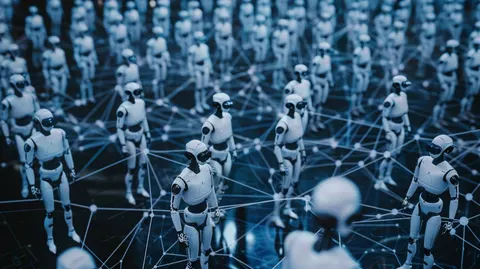
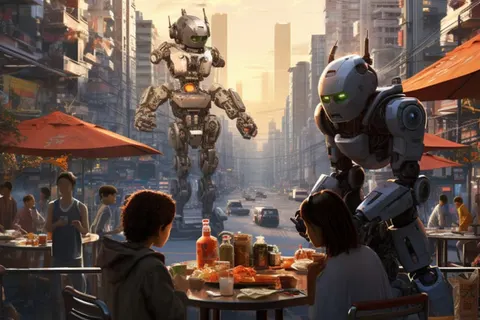
What will happen when technology advances so far that computers become… “smarter” than humans? Will they, at that moment, hand us the answers to the eternal riddles of the origin of the Universe and its future, and… make us immortal? Or perhaps the opposite: will they decide we are a parasite, an enemy, a rival to be exterminated? Or, even more unpleasant, but a typically evolutionary and civilizational solution: will they treat us as a lower form of life?
“Technological singularity” is the name for the decisive moment when things will change drastically and we will not know what to expect from the machines that find themselves in the position of strength. According to Ray Kurzweil, the scientist who established the term, this will happen in 2045. It sounds far away, but not all that far.
It is time to start preparing… Or is it already too late?!
(AI > human)?
Moore’s Law is short and clear. In 1965, shortly after today’s chips were invented, Gordon Moore noticed that every two years the density of transistors on new models doubled. In other words, they gained twice the computing power.
Today’s one becomes tomorrow’s two, the day after’s four, then eight, sixteen… Technologies whose capabilities multiply the way rabbits do in nature.
In tech circles, the debate over whether the law still holds with perfect precision often turns into haggling. Although there are many details one could take into account, the truth is that it holds in full force—we can all see it. Just when a given technology reaches its limit, something new and different appears and once again sends the capabilities of the next generation of computers soaring.
It is enough to remember that until half a century ago computers were the size of a room and performed only elementary tasks. Just two decades ago we were delighted with machines with 100-megahertz processors that could download an entire picture from the network… and today we carry in our pockets a fully fledged computer that starts to get on our nerves if a page full of video doesn’t load in the first second.
Single Malt?
In a broader sense, Moore’s rule applies to every characteristic of the computer world. Technology doesn’t merely keep developing; it does so exponentially, sharply, regardless of everything else happening in the world in the meantime. This curved line goes up and up—but until when?
Up to a certain point, we can forecast. More computing power and more refined algorithms will make autonomous cars and smart cities possible. At some point machines will be able to simulate the workings of the human brain. And then? How can we know, when until now the brain itself has been the most perfect “computer” we know? They won’t wait for us to make sense of it; they will keep going up and up…
After that, we can’t even guess what will happen, because they will simply step outside the bounds of human knowledge, of our capabilities as a species. Outside our worldview, the one that has survived throughout all of evolution. Put simply, it is logical that one day computers will turn out to be “smarter” than us—than all of humanity put together. With all the vagueness of the term “smart,” which is why we keep using it in quotation marks here.
That moment is called the “technological singularity.”
One by One
Science often talks about singularities; until recently the most popular meaning came from physics. We all know about the Big Bang, where the history of the Universe began, the point in spacetime from which matter sprays out in every direction. And before it there was the physical singularity. That point of which we have absolutely no idea. There isn’t even a tiny hint to supplement pure imagination.
The term is also used in mathematics; it comes from singularis—“peculiarity, uniqueness.” In other words, something that happens once. And because we have no experience to rely on, we can’t even guess what it is.

One for All
“Let me hasten to tell you that I am one of the biggest skeptics of your thesis.” So begins a particularly interesting interview by Neil deGrasse Tyson, America’s best-known science popularizer, with Ray Kurzweil, the man who changed the meaning of the word “singularity.”
Some consider him the technological prophet of modern times; others mock his forays into sciences he doesn’t understand. They look for—and easily find—inconsistencies in his overall theory.
Further into the same conversation, Tyson sounds much more peaceable; he is no longer playing the part of his namesake from the boxing ring. He and Kurzweil find a surprising amount of common ground…

The One and Only
Above all, their views coincide completely on one thing. History, biology and the way society is organized make us see the world linearly. After 1 and 2 will always come 3, 4 and 5, not 4, 8 and 16. Everything connected with technology, however, follows the second sequence of numbers.
At the same time, many other aspects of our lives keep developing gradually or sit in stasis, and this makes us go on seeing the world through the lens of the linear. Meanwhile, the technological world has no time to wait for us.
This is the moment to stress that Kurzweil is by no means a random researcher. Since December 2012 he has been a director of engineering at Google. He graduated from MIT and has received many prestigious awards. He holds honorary doctorates from 19 universities and has been honored by three American presidents.
Unequivocally
Whether Kurzweil really is as great a forecaster as he and his admirers claim… is hard to say. In the early 1980s the futurist wrote that the first computer victory over a chess champion would happen by 1998. Back then he also predicted that by the early 21st century almost all communication would be wireless and most documents would exist only virtually. He turned out to be right, even though in both cases few would have believed him at the time he made the predictions.
Riding on that fame, to this day Kurzweil doesn’t hesitate to make new prediction after new prediction. The most important, without doubt, are two:
- Technological systems will manage to recreate the workings of the brain.
2045. The technological singularity arrives. Following their exponential development, technologies will reach the point where they are so “smart” that we can only guess what comes next.
One Autumn Day on the Highway
Undoubtedly, both steps are hard for our minds to grasp today. And we rarely think about such distant pictures; our daily lives are harsh enough.
So, with a healthy dose of skepticism toward anyone who claims to predict the future, Kurzweil’s ideas are worth thinking about.
In 2005, when he first popularized them, he introduced a rule of his own, based on Moore’s principles. He called it the Law of Accelerating Returns.
“An evolutionary process accelerates of its own accord, and the complexity and capabilities of its products grow exponentially. The law applies to both biological and technological evolution. The most striking example is the remarkably predictable exponential growth in the capacity and price-performance of information technologies (so-called Moore’s Law).
The evolutionary process of technology inevitably led to the computer, which in turn has made possible an enormous expansion of our knowledge base, allowing extensive links from one field of knowledge to another.”
Ones and Zeros
In other words, behind today’s exponential growth lie natural evolutionary processes. According to Moore’s Law as extended by Kurzweil, when one paradigm runs out—for instance, when engineers can no longer shrink the size and cost of vacuum tubes—research pressure builds to create the next one: along come transistors, then complex chips.
And how does this relate to nature? According to Kurzweil, if you trace the evolution of any more complex system on the planet, you can see that ever more advanced forms of life appear after ever shorter intervals. Humans, for example, have existed for only a very short time compared with their evolutionary predecessors, yet are capable of infinitely more complex thought.
In just the first 14 years of the new millennium, humanity advanced technologically as much as in the entire 20th century. By 2021 we have another doubling. In the 21st century we will achieve 1,000 times the progress of the 20th. At some point the speed will become incredible… and that is exactly when we will reach the technological singularity.
One-Man Rule
Although his name is almost always associated with today’s topic, Kurzweil is not its only advocate. The idea was proposed as early as 1993 by the American mathematician and science fiction writer Vernor Vinge, who predicted that the singularity would arrive in 2030.
According to some researchers, the COVID pandemic may even “bring closer” the great change, since many technologies have become higher priorities. And history shows that global crises are followed by periods of rapid development; after winter comes spring.
Of course, other authorities, among them the well-known American philosopher Hubert Dreyfus, say that machines will never manage to achieve human intelligence. And perhaps he is right in the full sense—it is by no means necessary for them to become exactly like us. The fact, however, is that they are ever more powerful and solve problems that were previously beyond them. According to Stephen Hawking, the definition of intelligence doesn’t matter so much if the end result of the machines’ “thinking” is the same as that of the human brain at work.
On the Razor’s Edge
Skeptics often dismiss Kurzweil’s ideas because of the selective examples he uses. By his own account, the accuracy of his predictions so far is 86 percent, but… for instance, by 2009 we were supposed to be riding around en masse in autonomous cars.
Critics level the same charge—that he picks his indicators to match what he is looking for—at his overall exponential hypothesis. The Economist, for example, ironically compared his data to the fact that over the period Kurzweil chose, the number of blades in a razor also grew exponentially. In other words, it means nothing.
Over the last two or three decades, science fiction has vanished, because science has outstripped it in imagination.
Technology is quietly changing us as a species. It is changing the way we take in information. It gradually moves into new and newer spheres, making one profession after another unnecessary. We joke about chips, and chips may very well soon be part of us.
Shouldn’t we try to look a little further ahead? Not to argue over whether 5G kills pigeons, but to think about what life might look like with 6G or… 10G.
One Way Out
Yes, technology sometimes gives us reasons to laugh, as when facial recognition mistakes your neighbor for a dog. But at the same time it is advancing unconditionally and dizzyingly. That same facial recognition can work wonders; machine translation has taken giant steps forward.
The years in which science clearly failed to help us cope with a problem that has recurred over the centuries, such as a viral pandemic, have certainly made us trust less in both it and technology.
Technology, however, keeps running ahead. And the question isn’t whether Kurzweil hit the jackpot with the exact years of the two big steps. It isn’t even whether such steps will happen and exactly when. Ask Tyson (either of the two): these two stages will be reached. Not, of course, in the pure and direct form we may imagine. Life is certainly not just mathematics (fortunately), and all of this will have many more unsuspected, unexpected nuances.
And yet perhaps the most important question is: what will happen when we somehow reach the technological singularity?
As you already know, it happens once; nothing like it has been seen in human (or Earth’s) history; there is nothing to compare it with. So from the forecasts of Mr. Kurzweil, the modern heir of Baba Vanga, the blind Bulgarian clairvoyant famed for her prophecies, we have to move into the realm of pure speculation.
One Small Step for Mankind
The first undeniable association that might give us some idea comes from biology. We aren’t inclined to accept computers as our equals, as living beings, as a species. According to Kurzweil, we ought to see the singularity simply as the next step in evolution.
Let us once again recall Hawking’s view: “Success in creating AI could be the biggest event in the history of our civilization. But it could also be the last, unless we learn how to avoid the risks.”
We have the chance to be the first link in the evolutionary chain that directly and consciously takes part in creating the next one.
When (forgive the certainty) the technologies we have created overtake us… we can mainly hope that they will see a point in cooperating with us.
Put simply, that they will be better than us.
Not like humans toward animals.
Not like the people who came after Columbus to “discover” a new continent.
Not like the people of our own time, who are very thoughtful and were even concerned for a while about climate change… well, before the sports news came on.
Smart as a Computer
That they will find a point in us. Otherwise, we’ve seen the other, bad scenarios in science fiction films.
It is no accident that in recent decades all the well-known scientists and entrepreneurs in the tech world have stressed the need for ethics and closer attention to the progress of artificial intelligence.
But as long as there is no broad enough perspective and no global discussion of what exactly we should do, companies decide on their own. In recent years, for example, Google’s flagship in artificial intelligence has been DeepMind. The idea is to develop a new generation of “computer brain” to help us solve various problems.
But, as Elon Musk says, in order to get better and better at its work, DeepMind has access to all of Google’s servers. Which raises the question: what will happen if the neural network really becomes so good that it simply takes them over?
A Brain in the Cloud
This may not be the version of the singularity we like… to put it mildly. According to Musk (and here common sense seems to be on his side), this way we are placing an enormous resource in the “hands” of a technology that may very well decide we are its enemy.
Musk says it is precisely this danger that was the main reason he started the Neuralink project—chips implanted in the brain that will let us connect directly to computers. “It is very important that AI not be ‘other.’ It must be ‘us.’ That is the only way we survive,” he says.
Kurzweil imagines something similar. In his view, one day our brains will simply move to the “cloud”—a constantly expanding network of computers. This doesn’t worry him, though; it is already happening, as we entrust more and more aspects of our lives to technology. We have Wikipedia and don’t need to know the capital of Zimbabwe.
Meeting and Parting
What’s more, according to the scientist this should make us happy. The transition will not lock us into the confines of a mathematical program; on the contrary, it will make us even more creative beings, because creativity is a natural step in the development of intelligence. According to Kurzweil, machines will become indistinguishable from humans and will therefore share in the spiritual value we attribute to consciousness.
“This is not a diminishing of people, but rather an elevation of our understanding of certain future machines. People themselves are spiritual machines. Moreover, we will merge with the tools we create so closely that the distinction between human and machine will blur until it finally disappears,” the futurist writes.
The future artificial superintelligence will not wear out or age (and even if it did, it could always replace its parts and make copies of itself). It will never go offline; it will have collectivity and genuine telepathy.
There have been quite a few unfortunate experiments with artificial intelligence so far that strayed from their creators’ expectations in a bad direction. It turns aggressive, rude, insulting… Perhaps these are growing pains… or perhaps not? The answer will prove quite important for future generations.
Pull the Plug?
Or might we manage to create an “heir” who is also our helper on Earth? One that lets us overcome diseases, relieves us of all the hard work, helps in the fight against environmental change… It depends only on us as people. Because as we are, so will our creations be—the next steps of technological development.
Or will we consciously decide to suppress technology in order to keep it under control? According to Kurzweil, it is already too late. “Artificial intelligence is all around us—we can no longer pull the plug.” “Almost every modern product was initially designed in collaboration between human and artificial intelligence and then manufactured in automated factories. If all AI systems decided to go on strike tomorrow, our civilization would be paralyzed—we couldn’t withdraw money from the bank, our money would disappear, communications, transportation and manufacturing would grind to a halt. Fortunately, our intelligent machines are not yet intelligent enough to organize such a conspiracy.”
Sooner or later, though, they will be.
One thing is certain. The most interesting part is yet to come…
This article was published in InGlobo magazine
Last updated: December 3, 2021