

“O Romeo, Romeo! Wherefore art thou Romeo? Deny thy father and refuse thy name,” sighs Juliet from her window in Verona. “O, be some other name! What’s in a name?”
Simona uses AI every day and trains other people to use it for a living. A few months ago she and her husband-to-be, Steven, decided their family deserved a surname of its own. They asked ChatGPT… and picked one! They went through a lawyer, a prosecutor, a witness and a district court… and in the end they fulfilled Juliet’s dream. And yes, our story even has a very real Romeo.
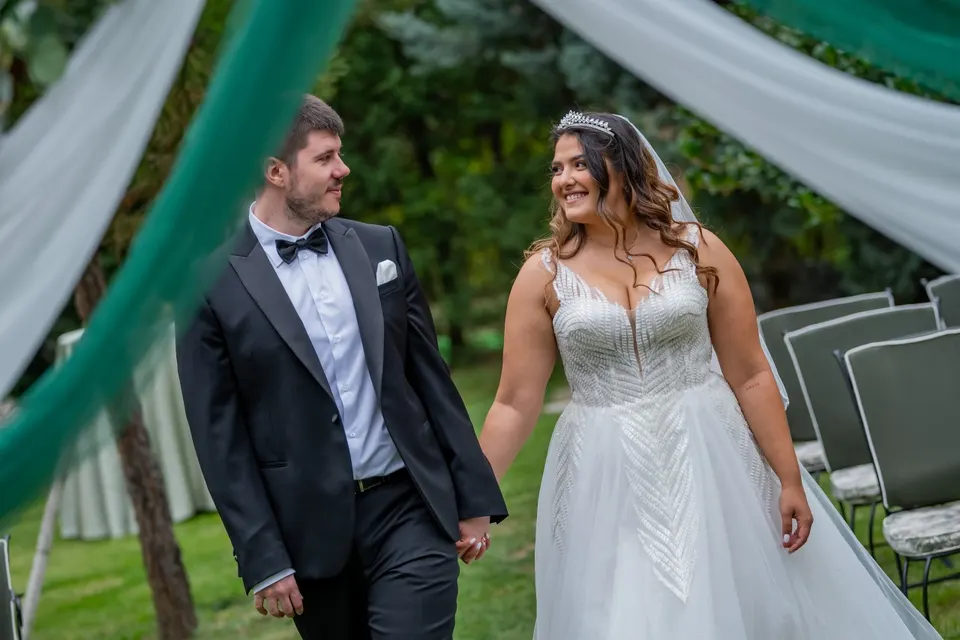
Let me introduce Simona Georgieva and Steven Rangelov, who very recently, with the invaluable help of artificial intelligence, became the Davini family!
Twelfth Night
A Friday in mid-October. On LinkedIn, where people more often brag about a shiny new job title, Simona wrote: “I’m going to Italy for 5 days and I can’t wait for my only view to be anything but a screen.” What caught my eye, though, came further down:
“Yes, I got married recently. No, he isn’t Italian. In fact, I’m going to Italy for the first time. Yes, the surname Davini is real and is now officially in my identity documents. No, it isn’t inherited from anyone. Yes, ChatGPT suggested it when we decided we wanted to create a surname of our own.”
I read it and… I was impressed, I was set thinking, and I admired the courage. I like my own surname so much that I’ve turned it into the domain of this site and into a registered trademark.
But then again… how good an idea is it to start over, with a surname all your own that your children and grandchildren will carry after you—and one suggested by ChatGPT, no less?
Aren’t we living in remarkable times?
As You Like It
The story begins years before the chatbot. Simona and Steven have been together for seven summers. “Two Gen Zs,” as she calls them in her post.
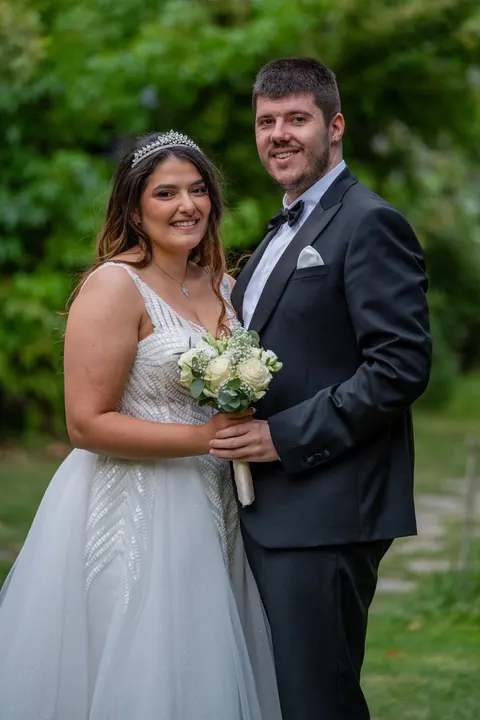
“We decided it on a whim a few years ago: why not change our surname, why not start one of our own?” she recalls. For a long time it remained just something to mull over, until they decided to get married. Then they figured it was time to discuss the new, shared surname more seriously. “Not because we don’t like our surnames. We just wanted to start something of our own, with its own history.”
The big decisions in life come unexpectedly. This one came in the middle of lunch.
“Totally on a whim, we decided to ask ChatGPT what our new surname should be,” Mrs. Davini smiles. The task was simple: she is Simona, he is Steven, and they need a surname that goes with both names.
The chatbot approached it like a conscientious clerk. It took what it had—her surname, Georgieva, and his, Rangelov—and started splicing them together. “It began making strange combinations of our real surnames that weren’t names at all, not even words,” Simona laughs. Just picture them. Georgelov? Rangieva?
The two changed the brief: they wanted real, existing surnames. And here the comedy of errors ends.
“Davini was one of the first it suggested. It grabbed our attention right away, we loved how it sounded, and we decided to go for it.”
Much Ado About Nothing
From there on, the two imagined the procedure would be easy. “We thought we’d just go to the municipality, fill in a form, and that would be it. We’d have a laugh and that’s all,” Simona recalls. “In fact we had to hire a lawyer, file a lawsuit, go to the courtroom—with the prosecutor, the judge, the lawyer—and we had to have a witness, too.”
When two people marry in Bulgaria, the Family Code gives them three options: each keeps their own surname, takes the other’s, or adds it to their own. A fourth, “we make up a new one,” does not exist.
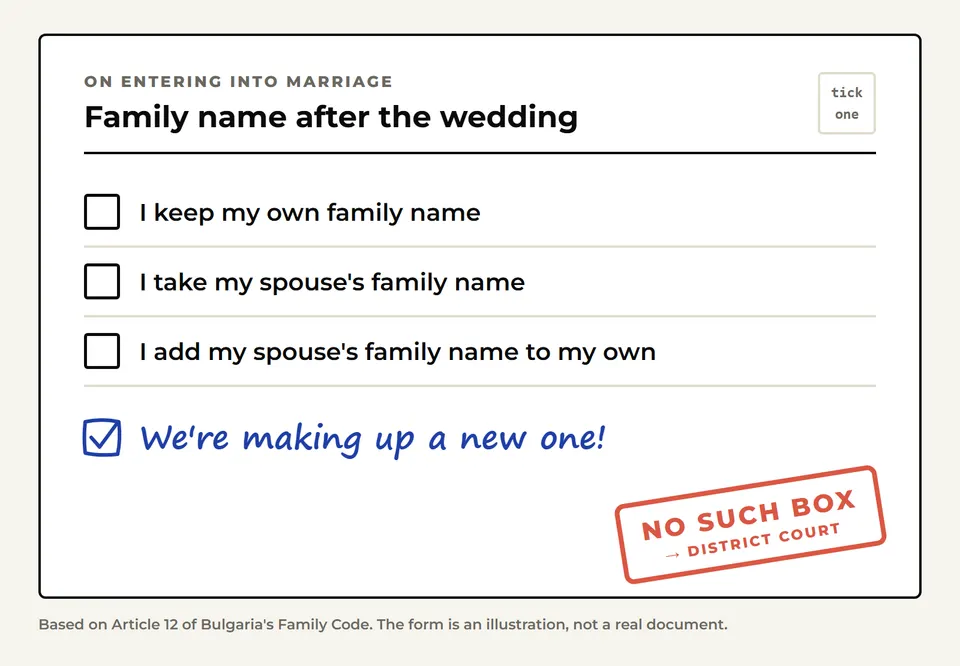
For a new surname the road is different, and it runs through the courts. The Civil Registration Act allows a name to be changed when it is “ridiculous, defamatory or socially unacceptable,” and also “when important circumstances require it.”
What exactly are “important circumstances”? Isn’t the wish of a young family precisely that?
“Judges, though, very often see it as some kind of pampered whim, a caprice,” she says. So the two worked out a whole strategy to make the change happen.
Measure for Measure
Steven’s registered address is in Pernik, a town just west of Sofia. The two asked around about what the judges there thought of such wishes, and… the answers weren’t encouraging. They decided to file the case for their new name in Breznik, a small town nearby, because it has only two judges.
To be or not to be Davini? In Breznik, the question has only two possible answers. Then again… not only in Breznik.
This is the moment for a detail I stumbled upon by chance. Well, all right… I confess: Claude stumbled upon it, when I asked it to dig into the subject. In Stefan Ilchev’s 1969 Rechnik na lichnite i familni imena u balgarite (Dictionary of Personal and Family Names among the Bulgarians), there is a male name, Davin, and a female one, Davina—dialect forms of Dafin and Dafina. Next to them stands the place where they were recorded.
Breznik.
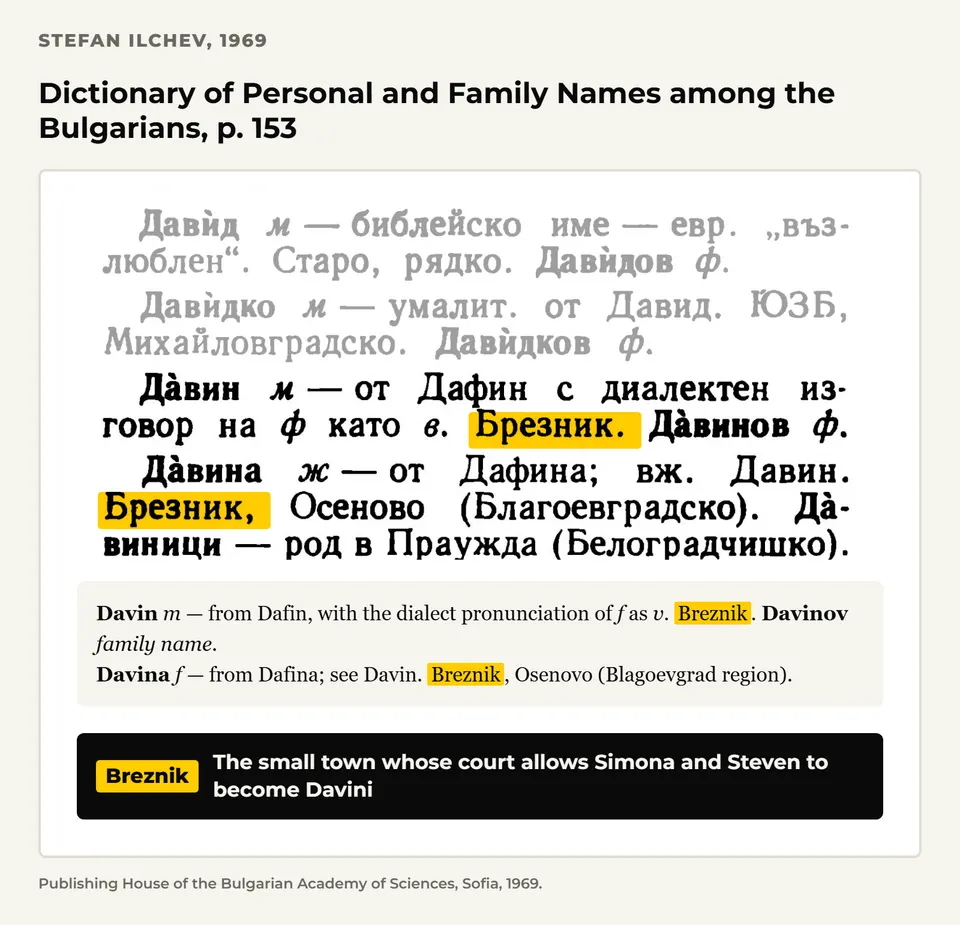
The chatbot suggested a surname from Tuscany. And the court that approves it sits in the little town where people once named their children Davin.
Could Shakespeare himself have dreamed up such a coincidence?
The Merchant of Venice
The case needed a witness, and the two chose the man who is now their kum—the best man at a Bulgarian wedding. He and Steven have known each other for years; they were roommates and colleagues. Everyone was relaxed. “They’ll just ask him two questions—what the surname is and why,” Simona says. “But it turned into a 15-minute interrogation. Because my husband’s father isn’t part of his life: why, for how long, how old he was when they divorced… Questions that even I can’t answer precisely.”
“We can’t just say: ChatGPT suggested it, we like this surname, and that’s that. We’re cool people, say yes,” Simona smiles. “The reason we put forward was that his grandmother’s name is Dafinka—that he’s taking his surname from her rather than from his grandfather, as Bulgarian tradition has it.”
It took time, but the result is a fact. And that’s why I’d like to give the floor to Simona, so she can tell us why this decision really matters.
“We want a family of our own, and at some point children. That’s where the conversation started a few years ago: why should our children carry this surname when we have no connection to that line? We’d be continuing a family tree that isn’t part of us.”
In Mr. Shakespeare’s play, Juliet also offers the reverse bargain: if he won’t, she will no longer be a Capulet.
Simona and Steven did both. He gave up Rangelov, she gave up Georgieva. Neither took the other’s name. They chose a third.
A Midsummer Night’s Dream
The whole change took them five months, though mostly spent waiting. But the course of true love never did run smooth—we know that from Shakespeare.
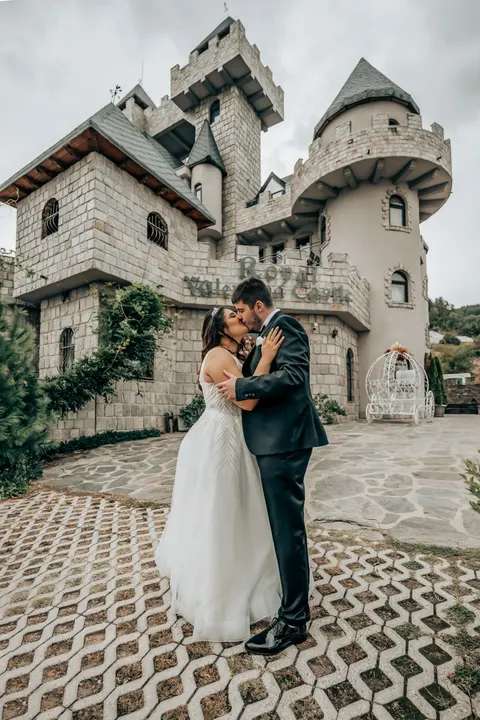
Was it worth it? “It was worth it, absolutely,” Simona says firmly, then smiles: “I even joked with my husband: look, if we ever get divorced, I’m keeping the surname. This whole adventure can’t have been for nothing!”
She’s used to skeptical reactions, too. “It’s inevitable. There are plenty of people with opinions. Many find it strange, others are impressed and happy for us.”
I ask whether it couldn’t have been something typically Bulgarian after all. “Well, no. We decided it wouldn’t be Bulgarian.” Hence the LinkedIn post. “So that people would understand, first, that it’s still me, the same person. Second, so they’d stop thinking it’s some foreigner, that I got it from Italy. People are pretty creative in the stories they can spin.”
The Two Gentlemen of Verona
…from Sofia and Pernik.
One more curious fact: Davini turns out to be a genuine Tuscan surname. According to the Italian directory Cognomix, about 550 families bear it, most of them in the province of Lucca. It comes from the medieval name Davino. Saint Davino was an Armenian pilgrim who died in Lucca in 1050 and still lies in one of the churches there. People call on him for help against headaches.
For a family that has been through five months of waiting on a court, there could be no more fitting patron.
And one more thing. Shakespeare set thirteen of his plays in Italy, yet there isn’t a single document showing that he ever set foot there. He wrote about Verona, Venice and Padua from books and other people’s stories.
Simona carries an Italian surname, and she is going to Italy for the first time—on her honeymoon.
All the World’s a Stage
“Look how few people know where their surnames come from,” signora Davini sets me thinking. “Go back four or five generations and you no longer know. Somebody somewhere was an Ivanov for the first time. Strange as it may sound, it’s a fact.”
Linguists confirm it: Bulgarian surnames are young, taking shape only in the 19th century. Before that, people were “the Abadzhiya” (the maker of homespun woolen clothes), “Ivan’s,” “the Shepherd’s.”
And the figures of the Bulgarian National Revival and our beloved poets did exactly what Simona and Steven did. Petar Berov, the enlightener who wrote the first modern Bulgarian primer, became Beron. Sabi Stoykov became Rakovski, the revolutionary. Peyo Kracholov became Yavorov, the poet. None of them asked a district court.
There have been surprises, too. Simona set up new profiles on every network… and discovered there are quite a few other Simona Davinis—only in Italy.
The Comedy of Errors
“Some people keep getting my surname wrong. I didn’t even expect it—it isn’t complicated, but they mix it up. Davino? Davina? What? Come again?”
There is, however, one more surname many people hear in Davini. “Everybody tells us—why not go straight for Da Vinci? Will your kid be called Leonardo da Vinci one day?”
This is where the last character enters the story. “We have a cat named Romeo. All our close friends and family have renamed him Leonardo.”
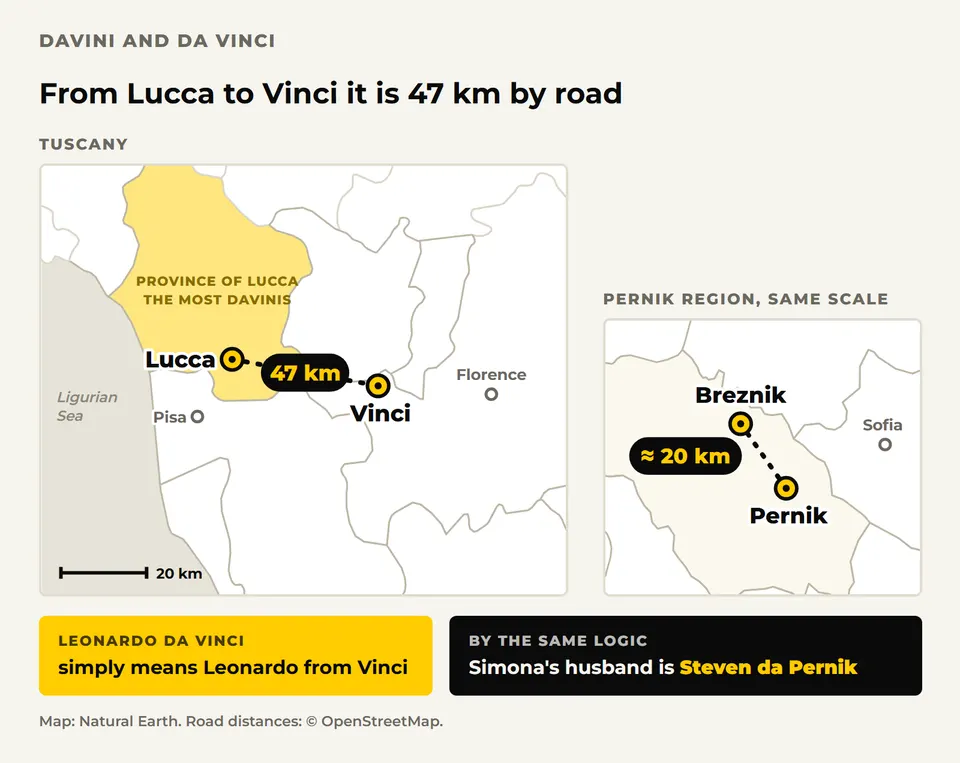
By the way, Da Vinci isn’t a surname. It simply means “from Vinci,” a small town in Tuscany. By that logic, Simona’s husband is Steven da Pernik. And the distance from Lucca, where most Davinis live, to Vinci is 47 km.
“Since yesterday my new favorite derivative is “Да вино” (Da vino, “yes to wine”)—let’s drink more wine!” Simona adds.
And isn’t she right? Da Vinci’s ancestors said it long ago—in vino veritas… And AI goes where we are ready to challenge ourselves.
Dear AI, what would my name be if I weren’t Georgi?