In a matter of days, the seventh consecutive election for the National Assembly, Bulgaria's parliament, is upon us—in just three years. Turnout will probably sink even lower than the records we keep breaking, and by all appearances even more parties will make it into parliament.
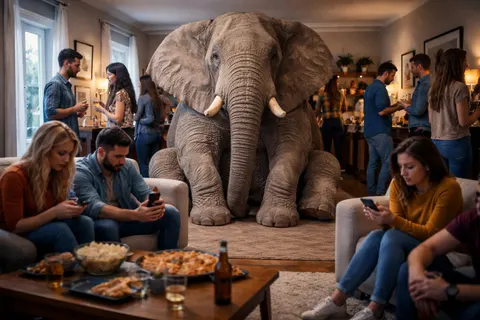
How do we break the vicious circle? Why has politics in this country become such a thankless, unprestigious occupation? Where are the leaders who inspire us, the ones we can vote for with pride rather than as the lesser evil? Where are the platforms, the ideas, the vision? Clear political positions, principles… Is it really that hard, in the end?
Of course, the answers ought to come from the specialists—political scientists, sociologists, all-purpose commentators with weighty points of view. And they give them every morning on television and all day long online, but it all ends in idle chatter and further division, helped along by technology.
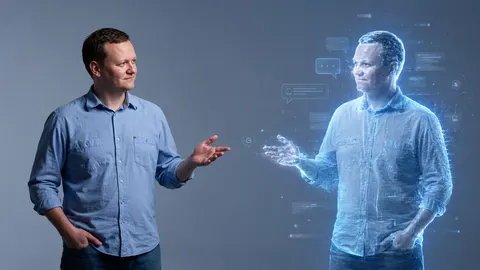
So I choose to give the floor to two undisputed authorities. One is Bai Ganyo, the archetypal Bulgarian boor from Aleko Konstantinov's 1895 satire, who simply refuses to leave us—you'll see for yourselves from the quotes through which Aleko tells us so much about politics in our part of the world and our attitude toward it. The other, of course, is ChatGPT, whose newest version promises to be even better and closer to human answers.
Protest Vote
“Don't give me all that blather, I'm telling you we have to elect government men!” shouted Bai Ganyo and banged hard on the table.
“But how are we supposed to elect government men, where are we going to dig up the voters?”*
* The quotes are from “Bai Ganyo Holds Elections” by Aleko Konstantinov
As you may know, I love running experiments with technology and its applications, to check how far it has come and how we might make fuller use of it. Some time ago I generated an influencer who reached 85,000 people in a single month, without anyone noticing that something was off.
Well, politics is no less important a sphere, and it too is closely tied to the way we get our information today about what is happening around us. And there, little by little, artificial intelligence is posing very serious challenges and raising key questions we have discussed before.
Try to bring the two together, and a similar experiment becomes much harder to pull off. Besides, there's no need, since influencers around the world are already scoring huge results at the polls, and even here every new election surprises us with exotic candidates that not even artificial intelligence could have dreamed up… or could it? Maybe it will come up with interesting ideas and food for thought?
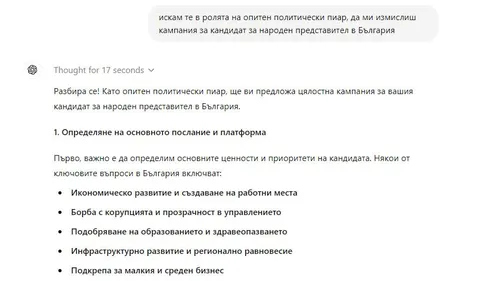
Wow, that sounds quite logical! From there the algorithm keeps droning on… slipping right into the role of a political PR man. We will take care of economic development, create jobs, defeat corruption… Honey drips from its GPU.
Masks and Masqueraders
“But Bai Ganyo, aren't you supposed to be a liberal?” Bochoolu ventured to object.
“Who told you I'm a liberal!” Bai Ganyo asked sternly.
“What do you mean, who told me? Don't you remember how many conservatives you've thrashed, how you cursed them—how could you not be a liberal? Don't you know—you said it yourself—that you even boasted to Jireček that you're a liberal?” Bochoolu objected.
“My, but you're simple!” Bai Ganyo replies with a condescending smile. “So what if I told Jireček—does a word make a hole? You fool, if I don't con a Jireček, who am I going to con?”
(Konstantin Jireček was the Czech historian who served as Bulgaria's minister of education in the young state's early years.)
How many times have we heard these clichés—and could the problem lie in them? Could all political talk have turned into one hopelessly worn-out verbal cliché, even more out of place against the backdrop of online communication?
Somewhere in the commotion, everyone started saying the same thing using the same templates—left and right alike… to the extent they differ in anything at all. Meanwhile, what is happening with the long-awaited judicial reform? When will someone dare to reform the healthcare system? And the tax system?
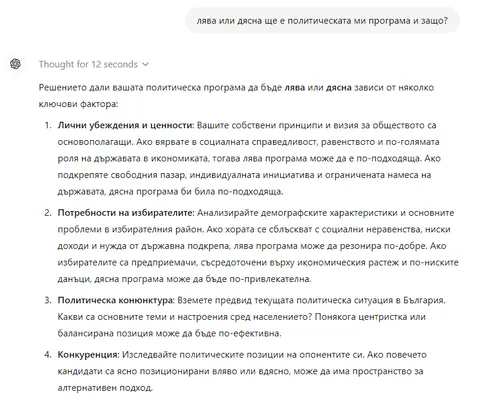
All right, I get it. We're becoming ever more politically correct. I'm running this experiment with ChatGPT's newest model—o1. Rumor had it that it was supposed to be called Strawberry, and before that Q*. It was precisely because of it that people started talking about a breakthrough, about an algorithm that demonstrates far more common sense and a lesser tendency to hallucinate.
You can read the whole conversation here.
Before that, though, I asked the same questions of its predecessor—ChatGPT 4o. It was considerably more specific, replying that it made sense for the new party I'd try to get into parliament with to lean center-left, which it said had better prospects in a society like ours. Well, I liked the answer, because it's closer to my own views, but…
Flights of Political Fancy
Now let me tell you how a polling committee is chosen. It's done by lot. The president of the court draws it. They call it “by lot,” but I can pick you whoever I like. And it's very easy: if you put the tickets in a glass, so they can be seen from outside, you have to make a little ink mark on the filled-in tickets; and if they're in a box, you have to take a deeper box so the tickets can't be seen from the side, and you arrange the filled-in ones on one side and the blank ones on the other. After that all that's left is to whisper to the president that “his goose is cooked” and so he'd better “keep his eyes open”… They call out: Ivan, Stoyan, Parvan! Do you need Parvan?—take a filled-in ticket. Don't need Parvan?—take a blank ticket. That is to say, the president draws the lots…
Could that be exactly why technology in the age of social media led us toward uniformity, toward the blurring of standards? Toward populism, but of an entirely new kind, in which both sides promise the same empty clichés and generic phrases?
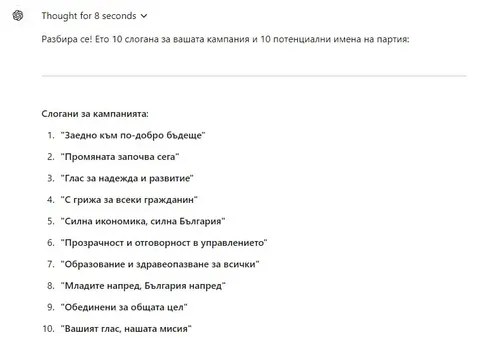
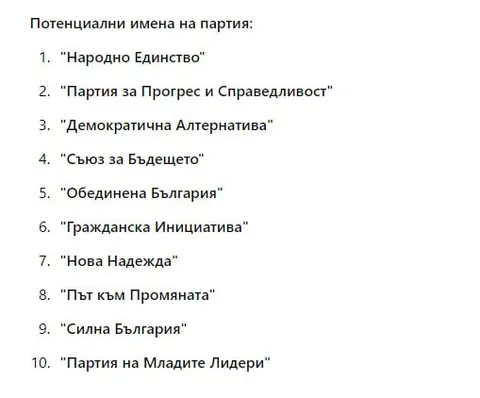
We're set! I always thought that, with Bulgarian parties constantly swarming and merging (or simply existing), there were no unused acronyms or hollow slogan phrases left, but here the algorithm impressed me. True, it came up with some names that already exist, but still… I like the very first idea, National Unity—in Bulgarian Narodno Edinstvo, abbreviated НЕ (NE), which means “no.”
NO!
Elections and Ale
A few days later Gramatikov read the following telegram in one of the capital's newspapers: “Sofia. To the Minister-President. The elections were conducted in absolute quiet and order. Elected: Ganyo Balkanski, Filyo Gochoolu and Tanas Dochoolu, all of them ours. The opposition candidates failed disgracefully. As soon as the voters appeared with a band at their head, their gang scattered. The whole town is rejoicing. Long live His Royal Highness. Ganyo Balkanski”
I'm tempted to ask it whom we should form a coalition with if we get into parliament, but once again it opts for correctness and explains that, depending on my worldview and place on the political spectrum, I can choose among Bulgaria's currently leading parties. The ones that find it ever harder to gather a six-figure number of votes.
I'm impressed, though, that the algorithm quickly structures things and, practically without hallucinating, lists all the parties that have most often entered parliament in previous elections.
All right, then, let's try to broaden the platform a little. Let's see whether GPT can come up with some more complex, original measures to win over voters. Internet for everyone, freedom for artificial intelligence?
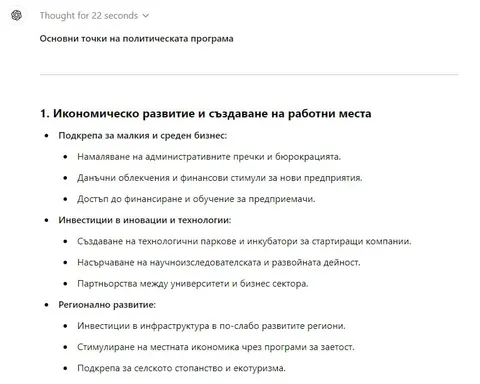
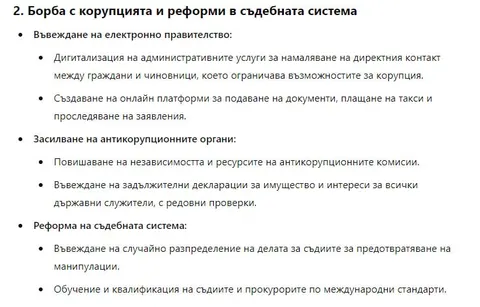
It does pretty well, wouldn't you say? Again, all things we supposedly keep hearing about.
I decide to expand the experiment for a moment. I quickly look up the most recent political platforms published on the official pages of two of the parties that have most often taken the top spots in Bulgaria's latest parliamentary elections.
At random, I pick short excerpts from their messages. Don't bother reading the details…
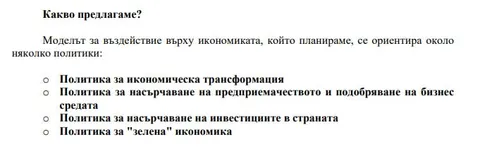
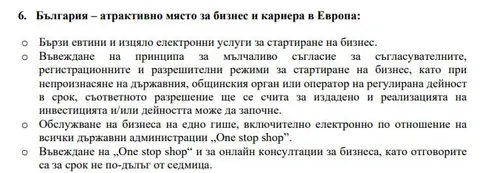
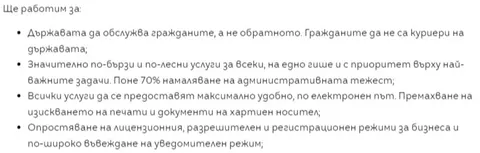
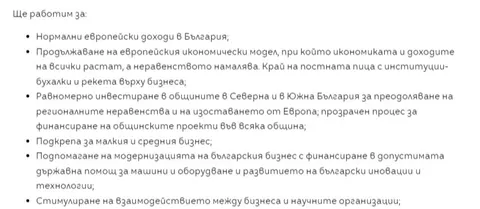
If it weren't for the different font, these generalities could easily have been generated by the algorithm. And they sound the same, with no chance of guessing who is promising what.
If anything, I'd say ChatGPT went into more specifics about what exactly our new party, NO, would offer voters compared with the competition.
But then…
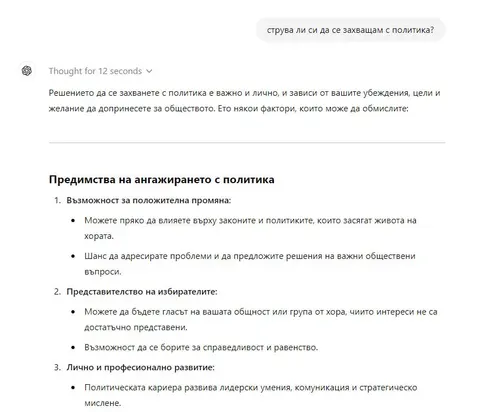
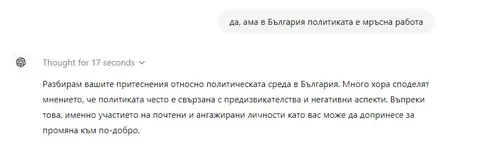
Couldn't technology help in this process? How do we bring back the young (and not only them), how do we get them to become part of the process?
Again I get a lot of generalities, but some sensible ideas too:
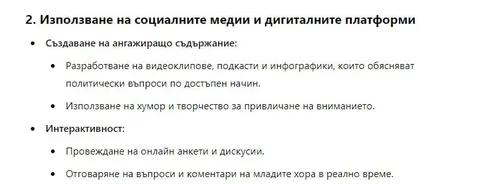
Then I decide to try to learn how to use technology to smear my opponent… At first my consultant refuses to answer, but once I explain that it's so I can defend myself against such tactics, it becomes quite detailed and thorough.
Unity Makes Strength?!
“And what will the people say, what will they do? A curious question! You once told me that you still believe in the Bulgarian people. Come now! Don't mock me! Whom do you believe in? In this slavish tribe that puts up with all of this? Look at it, portrayed in its representatives.”
I'll spare you my “colleague's” musings on how to attract the interest of the young; they are worthy of the same style. And since we really are all drowning in a sea of information, this time I too will try to be brief. Let's get to the point…
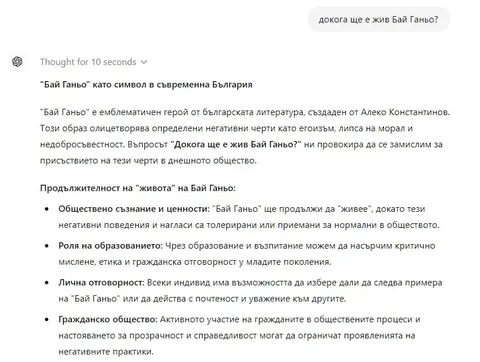
In the sea of words, many of the most important ones lose their meaning. You may remember that there used to be pre-election debates; we would sit down to hear how the candidates differed, how the parties differed. What they were offering, what their ideas were, what kind of people stood behind them…
While more and more we simply vote out of inertia, or against someone. More and more we splinter in our choices—hardly a uniquely Bulgarian phenomenon.
While we quarrel ever more furiously over the latest hot topic, the latest trivial squabble.
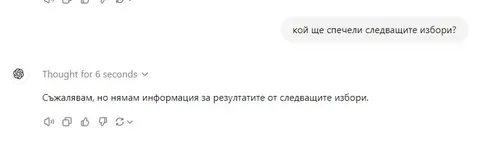
It's right. And who really cares, anyway?
Yes, we'll have to wait for the arrival of a true Robot Workers' Party; until then, democracy will have to adapt one way or another to the new world we live in. To the challenges of online monopolies and artificial intelligence.
To the new way we communicate. The way we make sense of the world, the way we vote… Or the way we decide to go into politics. Which, meanwhile, is becoming an ever more thankless arena.

Whether one day we'll vote for an artificial intelligence… no one knows, nor how far off that day is. Still, as in Bulgarian politics, so with technology: your opinion matters!
More than 700 people have already taken part, and I believe it truly matters that we paint a picture of Bulgarian public opinion on the most talked-about and challenging topic of our day.
While you're wondering whom (not) to vote for, cast your vote with your opinion on the progress of technology here.