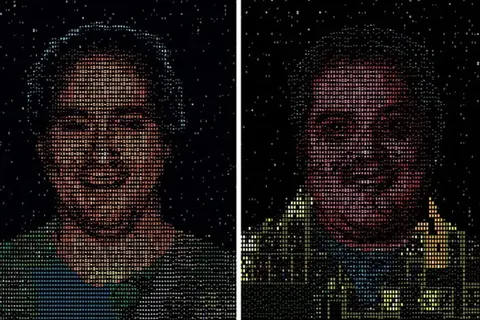
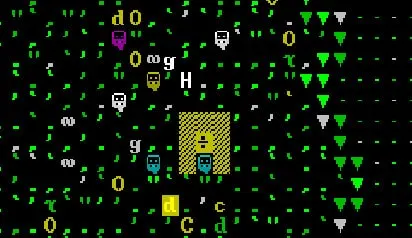
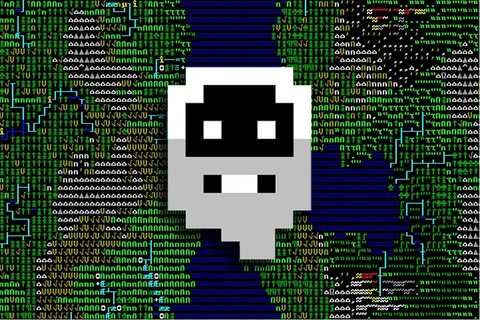
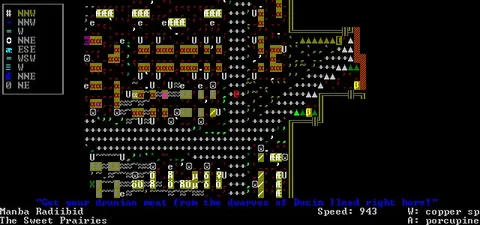
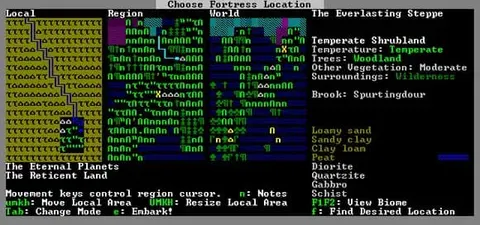
When you see the strange picture… it won't remind you of real life at all—a string of symbols in a one-dimensional space, scattered, at first glance, at random. It will take you back to the stone age of computing and the Pravetz 8, the Bulgarian clone of the Apple II that filled the country's schools and homes in the 1980s.
And yet we are talking about a modern game that has reached version 0.50.04. Because it claims to resemble 50.04 percent of… real life! It has a huge number of devoted fans, and over its 20 years of existence it has earned cult status. It has been admitted to a museum of games and inspired the creators of Minecraft, which for many people is simply its more comprehensible sequel.
For two whole decades it was developed voluntarily, on donations alone, by two dreamer brothers who gave everything to their adventure.
Until that same adventure… quite unexpectedly turned them into millionaires. And that, it seems, is only the beginning. The story of Dwarf Fortress is as strange as the game itself…
Snow White and the Seven Meatballs
Just imagine how wacky it really is. The creator receives a complaint that, for some reason, heaps of vomiting and even dead cats have started piling up in one of the taverns of the imaginary world. And what turns out to be the cause? A bug in… the eyelids of the meowing creatures. The tavern's patrons keep spilling their drinks on the floor, the cats walk through it, the alcohol sticks to their little paws, and when they start rubbing their eyes it gets into their bloodstream and causes alcohol poisoning, because the eyelids weren't designed to reduce the alcohol content…
“Once you get hooked, you find yourself in a huge, enveloping, living world,” says the New York Times.
“You have to have played Dwarf Fortress to fully understand the madness of its creators. And of its most fervent fans,” writes Wired.
It has also been called “the deepest, most complex simulation of a world ever created.” Not a bad result for the work of two people, wouldn't you say?
The title says it plainly: a fortress of dwarfs. That is what dwarfs do in the classic fairy tales—they dig stubbornly, caring nothing for what goes on around them, until they reach the gold. And in the end it turns out that the gold is far from what really leads them along the way. Meaning does that.
The Adams Family
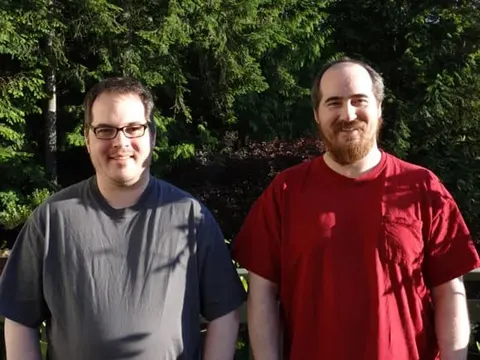
So it is with Tarn Adams. From childhood he is good at math and loves computer games. He was born in Silverdale, Washington, in 1978. His father works at a water treatment plant, and part of his job is processing large sets of data. It is he who shows Tarn and his older brother Zach the first rules of programming. The pastime grips them, they progress quickly, and from an early age they know that one day they will make it their profession.
The family moves constantly, and what brings the two brothers even closer is their new hobby. They don't just play computer games all the time—they also carry notebooks everywhere, drawing their own designs for games and imagining all sorts of fantastic creatures. They aren't the least bit keen on running around outdoors or mixing with their classmates. “I was one of those kids who sit down at the computer the moment they get home from school,” Tarn recalls.
The brothers create their first computer game in fifth grade. They say they always did it so they would have something to play themselves. To have games complex and interesting enough for them. And indeed, success in this life rarely comes from something you do out of obligation rather than for your own satisfaction and some kind of meaning—the story of the Adams brothers shows that too.
In high school they already make a game that they release for download—the theme is space, a simulation of a rocket test.
Come and Eat Me, Wolf
Very quickly their games become astonishingly complex and ever more unpredictable, so that there are more possibilities the next time they are played. This leads them to a direction that was gaining popularity at the turn of the millennium—procedural generation. Here games are built so that only minimal frameworks and foundations are set, while the environment, the characters and the circumstances are generated by chance. That way a game can unfold in an infinite number of variations, and every time you start over it will greet you in a completely new way.
And so we come to the dwarfs. In 2002 Tarn is working stubbornly on a game of his, but… things aren't working out, and he decides to abandon it, keep only the foundations he has written and start something entirely different. He invites his big brother Zach to join the venture. Very soon the new project grips them so much that it becomes their main occupation. And it also becomes… a legend.
Meanwhile, the two have received a distinguished education. Tarn earns a doctorate from Stanford. He says his first year at the renowned university was especially hard, because he ran into serious competition, and he has never liked fighting with others. On top of that, he felt torn between continuing with mathematics or with video games. It is a difficult period—he even goes through drugs—but in the end he decides once and for all that games are what he will do for the rest of his life.
A Man a Span Tall with a Beard a Cubit Long
“If you devote yourself to mathematics, in the end you have a paper that may become a building block in the great edifice of that science, and that isn't so important to me. But if you work on a game, you have a problem you're solving, and at the end you also have a game. That's just incredibly cool!” Tarn explains.
In 2006 he walks away from his math postdoc at the University of Texas, and with it his stipend, to concentrate entirely on the game. Soon his brother does the same. Zach studied ancient history, and much of the game's lore is owed to that knowledge.
At first Dwarf Fortress is a small side project, officially started in October 2002 with the idea that it would be done in two months. Soon, however, it becomes clear that it will be much more.
Within a few years the game has already acquired a huge number of fans, not only because of its ambition to recreate an entire world, but because it does so remarkably convincingly. Thanks to all its complexity, it has become both difficult and utterly absorbing.
Dwarfish
Of course, Dwarf Fortress is definitely not something that will lure teenagers with stunning graphics, the way modern games do. It is the exact opposite, and that is precisely what makes it so dear to the hearts of true nerds. And of people who prefer a game to have meaning and get the brain moving, rather than simply pleasing the senses.
From the very beginning the Adams brothers decide that the dwarven fortress will be free and that they will live solely on donations from fans. And through all these years their dream comes true—yes, at times they barely make ends meet, but they keep their principles.
In the first five months of the project donations amount to only $300, barely enough to cover the hosting. Then, little by little, the money starts to grow, though it comes nowhere near dizzying heights.
In 2011 Tarn turns down an extremely tempting offer to join a big computer game company, and a little later the two receive an offer to sell Dwarf Fortress for $300,000.
Trolls Big and Small
Today they surely don't regret saying no. Because, having created half a new universe, they now face a rather different challenge… life as millionaires.
How does it come to that?
The idea comes from the fans. The brothers never manage to scrape together enough money even for health insurance, and the game's admirers insist that it's important to take care of their health, because the years fly by.
So Tarn and Zach agree to bring a designer into the project to tidy up the prehistoric graphics a little, and to release it for sale on the Steam platform. Meanwhile, the exact same game remains free on the project's main website.
A slightly strange business logic, wouldn't you say? But it turns out to be exactly right.

Money Under Steam
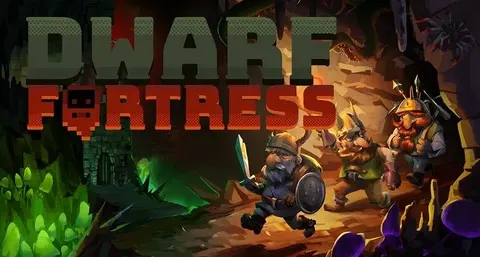
The game was released on Steam on December 6, 2022. In the first three days it sold… 300,000 copies! That exceeds the platform's expectations in every way. In a single day sales surpassed what had been forecast for the first two months. Yes, the price is affordable—30 dollars—and still, for that money you get something only symbolically different from what you could get for free.
A user on the Steam forum asks whether all the buyers “have been playing Dwarf Fortress for free for 25 years and were just waiting for the chance to pay 30 dollars.” What follows is 237 pages of replies, almost all of which simply say “Yes.”
None of this seems to impress the brothers much. Nor does the arithmetic showing that, so far, they will split about $8 million after long years of barely surviving. “Yes, it's a ton of money, but we earned it with 20 years of work,” Tarn says flatly. Zach, for his part, says his wife is happy because they will finally be able to buy a proper home. “We just found a foolproof way to save our money—by selling nothing for 20 years and then dumping everything we have on the table,” the big brother smiles.
I'm in the Game
There is one more peculiarity. This is, after all, a game that will never have different editions. While the brothers are determined to develop and extend it for the rest of their lives, they are far from convinced they will reach version 1.0—that is, a simulation successful enough to be comparable to real life.
But how exactly can you be sure you have achieved reality? Very easily. You sit down and make a list of all those aspects of the physical universe that you think are worth reproducing in order to get something indistinguishable from it. That is exactly what the brothers do at the very start—let me remind you, just in case, that these are high-level mathematicians.
And so their list ends up with… 2,600 different features, aspects and phenomena. For a long time they linger at versions 0.42 and 0.47. The 50 percent mark of reality was passed only in 2022.
I can tell you right now that they won't manage to finish them all, even if we solve the problem of immortality once and for all. Simply because what matters to them is not adding something from the list, but doing it the way it should be done.
The Players' Game
For example, they spend several years developing nothing but the belief system. They drop everything else in the project and bury themselves in thick textbooks before creating what they had in mind. And the beauty of procedural generation then lets them be surprised themselves by the results and the twists.
“It's like that with every area. I know nothing before I turn to it, but I start and don't stop reading until I'm sure what to do,” says Tarn. You can come across an interview with him, many pages long, in which he explains how complicated it is to simulate… boats.
All the while, fans keep chiming in, having stumbled on bugs like the one with the cats' eyes.
Their website remains the same strange place—even your browser warns you that it isn't secure, which would be fatal for any active page. But that is where you can report a bug, and some of them have gone unsolved for a decade. They have accumulated around 80,000 suggestions from admirers for improvements and new features in the game.
The Dwarf Who Talked to the Sea
Tarn has two favorite bugs that he still hasn't fixed. One is about a dwarf farmer who plants his own bed. The other is about a dwarf executioner with broken arms who can't do his job with the hammer and so punishes criminals by biting them… for years. It's no accident that he calls the game an “open-ended story generator.”
As Tarn explains, if it ever reaches version 1.0, it will be like “sitting down to read a moderately good fantasy author you haven't read before, but with all the extras a video game provides, including the ability to write your own continuation.”
They say the game is written in a “messy hodgepodge of the C and C++ programming languages.” The two of them are the only ones with access to the source code. And, quite obviously, it grows ever more complicated, complex and incomprehensible as features are added.
The original still relies on symbols; the Steam version does at least have some design and an interface, which also looks more in the spirit of 1980s games. But, as I said, that is exactly what the Adams brothers want. Tarn says he loathes massively multiplayer online games—their popularity is addictive because they exploit players' compulsive mania for hoarding useless items.
Against a Sea of Troubles
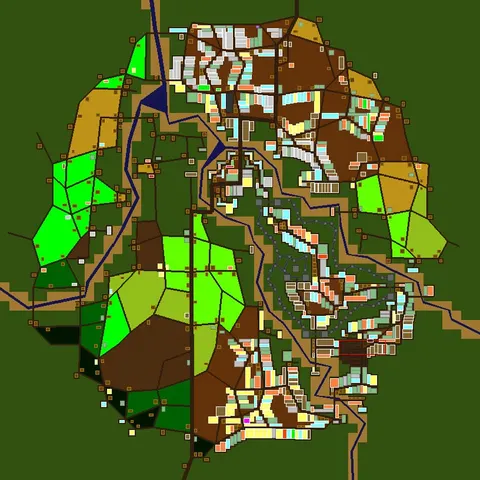
The Fortress is a strategy game you play alone against the computer. With it you can be sure that things will never happen the same way twice. There are several modes, but in the most popular one you acquire your own civilization of dwarfs and look after their well-being.
The Adamses' next plans involve creating a complex magic system, improving combat and the overall concept of how civilizations develop. Among the innovations of recent years is an extremely complex economic system, which also took them several years and serious reading before they moved on to turning the idea into computer code.
The game doesn't even have… an end goal. You play for the sake of playing. You go on while your colony flourishes and is saved from its troubles, and if you like, you can enjoy it for a long time. But sooner or later new problems appear, so there is no situation in which you win. A bit like life…
Just One More Game
That is probably part of the charm that gives the game so many active fans online. The community's motto is: “Losing is fun.”
Just as it is with the brothers themselves—they make a game for the sake of the game, with no end goal. That would greatly please the faction of anarchists for whom “the goal is nothing, the journey is everything.”
“It's funny, because it all started with ‘I want to write a game I'd like to play,’ and there just weren't any other good enough titles that we liked,” Tarn smiles.
When the two talk about the project, you can see how much passion and enthusiasm they pour into it, even though they have been at it for two decades. They say they work about 100 hours a week, at least 80 of which are devoted to the game. They have never burned out, because they have always had far too much work to do. Just like a pair of little dwarfs…
“Not just geometry, but an entire simulated world,” reads the announcement on Steam. “It generates the rise and fall of civilizations, of individuals, of creatures, of cultures. Endless hours of play, now with beautiful graphics and built-in tutorials! An immortal ‘living’ project, created and updated since 2003, with no end. A new endless hobby just for you!”
Well, unlike Dwarf Fortress, this text has to have an ending. And if you are adventurous enough, it is a recommendation: go and try this wacky game. It's not my fault if it doesn't live up to your expectations… or if you like it so much that you get hooked.