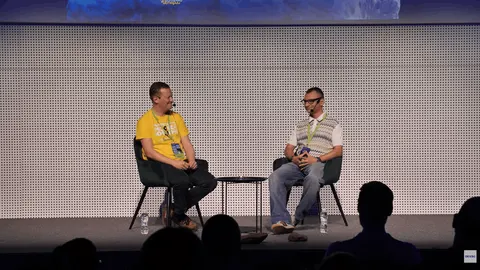
How many people do you know whose idea Google itself has put its faith in, and with a serious investment of $1.5 million at that? Well, I now have the good fortune to have met at least one—Kris Mladenov. At the epicenter of the coronavirus crisis, he showed how the people who look after our cars can be trained properly. And, quite logically, the success of his academy led to the coveted backing of one of the rulers of today's internet.
Today Kris dreams of his auto academy running at full throttle in more countries. And of technology storming into the Bulgarian automotive trade with new force. Because, as he sees it, it is no longer serious to hand our cars over to anyone who has an inspection pit in his garage and can tell from the sound of the engine whether it's time to replace the bearings. Technology has long allowed for far better… and, according to our hero today, cheaper servicing of our cars.
Kris's story is as instructive as it is motivating for anyone who has a good idea and is wondering whether to try to make it happen. Here is how it all began.
Gasoline in the Blood
Not yet 20, Kris left for Germany to fulfill his great dream—training at the Volkswagen academy… without knowing German, and without even intending to learn it. How did it come to that?
“At first I was interested in technology in general. Not so much in cars specifically, more in the technical side of things. Making something out of nothing. Seeing a problem, locating it, diagnosing it and fixing it completely. Cars bring all of those elements together, and maybe that's exactly what drew me in,” Kris says. On top of that came his inexplicable love for German cars, and more precisely for those of the Volkswagen Group.
But how to begin? He applied to the academy where the company trains its future specialists and was accepted. The only catch was that he didn't know a word of German. He reckoned that learning it well enough would take him between three and five years, which, added to the three years of actual training at the academy, would push his dreams too far into the future.
Looking for a solution, he stumbled by chance on an unconventional key to this tricky situation. He met a girl who not only knew German well but was very strong in technical terminology. He hired her as his interpreter for the entire course of his training and… things got moving.

Gas, Brake
The academy studies in detail every discipline related to the manufacture and maintenance of cars, with an emphasis on those made by the Volkswagen Group. Detailed modules examine every element of the engine, the electronics, the gearbox. Bit by bit, the students work their way through everything that the day-to-day work on cars involves.
With the help of his interpreter, Kris graduated with honors and was even offered a job with the group—on terms that were, to put it mildly, rather good, and with a secure future.
“It looked wonderful at first glance. To stay in Germany, to spend a large part of my life at Volkswagen, to retire on a very decent pension… Only it was too easy, and I asked myself: is this really what I want? The answer was: absolutely not.”
So Kris decided to come back home to Bulgaria and set up his own repair shop. “Returning to the Bulgarian market was a huge challenge. Because in Germany everything happened easily, and suddenly I found myself here, where it's exactly the opposite. There isn't a single step you can take without heaps of difficulties. But that's how things turned out…,” Kris recalls.
And Where's My… Academy?
And so he put together a team in Sofia and started applying in practice what he had learned. He also organized closed training sessions for his colleagues so they could exchange experience and knowledge.
Before long he noticed that mechanics from other shops often contacted him and his people asking for advice. “Quite often they'd ask us about things that for us were routine, things we used constantly in our daily work. That's when I said to myself: why on earth not run an open training course and invite mechanics from other shops…?”
That set off the avalanche that later became Das Auto Academy, the project that would attract the attention (and the money) of Google.
Of course, not everything went like a fairy tale. Kris and his colleagues put serious effort into organizing the first training session, and in the end… only 11 people showed up. They had invested quite a lot of money, which they failed to recoup.
Still, they decided to give it one more try.
Whether because of the positive impressions of the first trainees or thanks to better advertising, this time things were completely different. Seventy mechanics from various shops came, people were satisfied, and Kris realized he was on the right track and that his venture made sense.
The Online Driver
Gradually the academy established itself as the leading institution of its kind in Bulgaria. And Kris's new dream was to work hard for better service in the automotive trade. He prepared and published five books—textbooks with technical documentation—because the training sessions had shown him that nothing of the sort existed. And it would be useful both to the academy's trainees and to anyone who earns a living repairing cars.
“For me it's very important that what I teach has value for people,” Kris says.
“Value they can't get just anywhere—by going on Google and reading the specifications of a crankshaft and the finer points of repairing it. My goal was for them to get something that isn't available at arm's length.
Then I saw that they take the knowledge and literally the next moment implement it in their work processes. So with every step, the service that reaches the end customer gets a little bit better. And I said to myself: this is the direction in which a lot absolutely has to be invested.”
Over two and a half years, more than 4,000 people have passed through the academy's various events—training courses, seminars, workshops. The courses of the core program last between six months and a year for those who want to learn the most important things it has to offer. To acquire the full range of knowledge they need to handle the work of a repair shop today.
Screws, Bolts and Nuts
And so we come to the spring of 2020, which slapped us all so hard. Like every other academy, whatever its trade, Kris's was forced to close its doors because of the coronavirus. But he loves his technology, and he and his team very quickly managed to organize online training.
The move to the web turned out to be the big opportunity. They ran into quite a few difficulties—many of the trainees lacked even basic knowledge of working online—but according to Kris that was also a plus: they had to acquire it.
The academy got going at full steam. And that was exactly when it caught Google's attention. The company itself contacted Kris, impressed by the organization he had created. As he puts it, not because his idea was all that original, but because he had managed to set up online training quickly and effectively, getting ahead of the competition.
What's more, this is a field with high demand and, still, far too few good practices. These days academies that can train you to become a programmer are a dime a dozen, one click away, but that isn't the case when it comes to repairing and servicing cars.
The negotiations between the global giant and Kris's academy went on for several months, he says. In the end they told him they had a separate budget for digitizing the regions, which had last been used for our country more than a decade ago, when the telephones were digitized. Then came a letter of intent and… today Das Auto Academy is an official Google partner.
Bro, Cars!
One of the internet mastodon's requirements fully matched Kris's own plans—for the training to quickly and noticeably cross Bulgaria's borders and reach more countries. He was given the condition that very soon the services had to be offered in at least three languages, and that is already a fact: besides Bulgarian, the platform offers courses in English and German.
It is also set to expand in subject matter, its creator says. Besides thorough courses in every area of car care, it will cover areas such as running a repair shop, communicating with customers and accounting. The idea is for visual content to dominate, since it is absorbed faster and more easily, supplemented with as little explanation as possible.
Although with Google's backing he is already riding on the wings of success, Kris's main goal remains his work in Bulgaria and the drive for the overall development of the trade.
One of the main challenges in that direction, in his view, is for every mechanic to learn at least basic English, because both the terminology and the documentation almost always require it.

Current and Wire
On the other hand, everyone in the sector has to learn how to learn very quickly, because the mass adoption of electric cars is coming very soon, and they demand entirely different knowledge from mechanics, our interlocutor says. There, the trial-and-error method is much harder to make work; additional, specialized knowledge is needed. Suddenly the technician becomes an electrician too.
But even before that, there is plenty of catching up to do.
“The European level in repair shops has somehow frozen in recent years. And Bulgaria lags another ten years behind. Technology has developed a great deal, and people haven't managed to keep up. They've stayed with the old models, the old knowledge. There's something that's typical not only of the automotive trade but of every other one—once you fall into a rut, it's very hard to get out of it and see that there's something different now. Something that would help you in your daily work, that would help you grow. That would improve the service you offer, let you build a bigger team, let your business expand,” Kris says.
In his view, most mechanics don't even realize they are business owners. “Often these are people who once loved working on cars and little by little turned their skills into a profession. At some point they started charging money for it, but in many respects they've remained simply amateurs with the odd hobby of fixing cars.”
“According to official statistics, 97 percent of the trade is in the gray economy,” Kris adds. “And while we're there, there's no way we can develop, grow, see what's new in the profession. It's time for that to change!”
Rails Adrift
“Times are changing. A lot of people will drop out. Fortunately, others realize that change is coming and it's time to move on. That things don't work the old way anymore and new things have to be learned,” Kris says.
So it is—times are changing very fast, with the pedal of technical progress pressed to the floor. Sometimes it is very, very hard to stay on the crest of the wave and keep up with their demands.
Clearly Kris Mladenov and Das Auto Academy have found a way to meet these new demands and pass them on to people. After all, so many people in the trade trust them. Not to mention the backing from Google. Sometimes ideas outgrow their moment and rise higher, and it is wonderful when they are of use to more people…