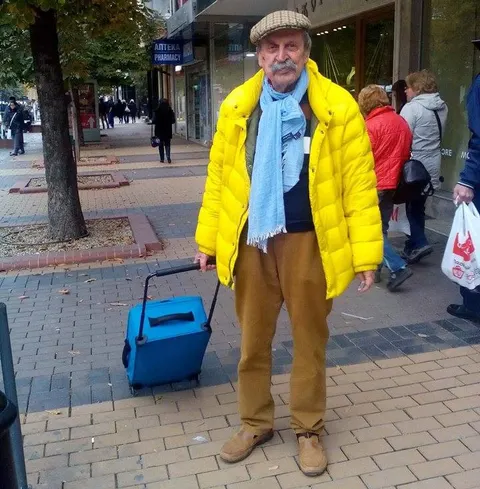
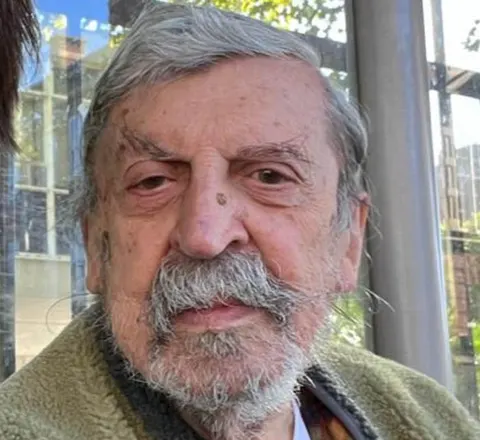
At 80, today's hero went along to keep an acquaintance company while she enrolled to study journalism. On the spur of the moment, he decided to go back to the lecture hall himself. It turned into an adventure that lasted eight years, full of knowledge and stubborn study. A few months ago, having already turned 88, Petar Shoilev received his diploma as a doctor of journalism!
We meet to talk about learning and the love of science, about journalism and the future of how we get our information. About how old age doesn't have to be a grim, sad, lonely affair, but can be the well-earned autumn of life's journey. About how we, too, could have more happy, smiling older people who enjoy their days. And what might Dr. Shoilev's plans for the future be?
We keep repeating that these days a person has to learn throughout their whole life… But how is it possible for someone to be so motivated, to have the strength to study an entirely new field at that age, and on top of that to finish a doctorate with highest honors? Here's how!
The Eternal Student
Music, mechanical engineering, economics, advertising… and finally journalism. Just think how many professional fields Petar Shoilev has passed through. And this from a generation that was used to the idea that you might never change your workplace in your entire life.
True, music never became his professional destiny, although as a young man he loved playing the piano. For a long time he prepared to apply to the Conservatory, until at the last moment he made a sharp turn. He went to what is today the Technical University of Sofia to study mechanical engineering, and after the first year transferred to electrical engineering.
His first job, assigned to him under the socialist system of job allocation for graduates, was at an electric motor factory. Soon afterward, at a Party meeting, he heard the slogan that every engineer should become an economist. “And why not? I figured that if that's what they wanted, why shouldn't I?”
He kept working but also enrolled in a part-time program, and four and a half years later he had a degree in industrial economics as well. He went on to a one-year course in foreign trade before stopping his studies in the higher education system… but only for 40 years or so.
A Man of 88
His professional path meandered in different directions. At the factory, Petar gradually rose from process engineer to shop foreman, and all the way up to head of all 12 shops. But he didn't like staying in one place, even in those far more conservative times in that respect, and soon found himself in East Germany, sent to Berlin to specialize in electrical equipment.
After returning, he spent four years heading the advertising and marketing division of Balkancar—at the time the world's second-largest manufacturer of forklifts. “We Bulgarians were at a very high level in what we did. I think we can be now, too, as long as we have the will,” Dr. Shoilev smiles.
He worked for two years in Moscow, where he helped set up a Bulgarian Technical Center. He ended his career back in Sofia as one of the directors of the new state company Bulgarleasing. That's where 1997 found him, when he reached retirement age and it was time to rest.
All his life Petar has loved traveling the world and meeting new people. He traveled a great deal as a young retiree, too. Sadly, in 2009 his wife passed away, and shortly afterward Dr. Shoilev moved to London to be with his son, who has lived in England since his student days.
Tell Me, Doctor!
So why, then… did he decide to study at Sofia University? Truly by sheer chance. On one of his trips to Sofia, the future doctor of journalism met an acquaintance who was on her way to enroll there. “Will you come with me and see what it's like?” They arrived together, and Petar, quite spontaneously, asked what it would take for him to enroll as well. It turned out that for a master's program it was enough to hold a completed master's in another field with a grade of at least “very good”—and he had several.
Half as a joke, he started attending the lectures and seminars, but he found them more and more interesting. He was pleased with the professors he met, too. “These professors struck me as being at a very high level, and I can tell, I've seen a lot of teachers. Each of them was deeply versed in their field and experienced in what they taught.”
The master's degree came easily (with nothing but sixes, the top grade on Bulgaria's six-point scale), and after he graduated his academic supervisor, Prof. Zdravka Konstantinova, invited him to continue with a doctorate. Over the next four years he passed all his exams, finishing with a dissertation on contemporary political cartoons in Western periodicals.
Will Dr. Shoilev keep studying, or will he start a career in journalism?
There's no exact plan yet, but one thing is certain. Sitting around doing nothing is not for him… “I'm just thinking about how to go on, where to head next. Usually people start writing memoirs at this stage of their lives. I think I should do something that is useful not only to me but to society as well. I'm still thinking it over, I can't say yet what it will be,” our hero shares his credo.
Doctor's Orders
There's so much talk lately about lifelong learning, about how it's never too late to master a new skill or venture into a new field. Stories like Dr. Shoilev's show how sensible that idea is—how this kind of activity can give life meaning and keep a person's spirit up at any age. That's why his advice is worth hearing.
“Some people end up disappointed with learning. In my view, in most cases you study not to remember what you see, but to know where and how to look for it. If something is taught as dry material, if you just have to tick off the required points of a given subject, it can't help being boring. But you have to make what you study interesting for yourself.”
And most important, in his view, is for everyone to do work that interests them. “You may have taken something up, but if you see it's not for you, drop it. That doesn't mean you're not finishing the job or that you're giving up—you're readjusting.”
All Ages Bow to Higher Learning
We reach a topic that matters a great deal to me, and I'm curious to hear the opinion of someone with two degrees more than me in the same field. What will the future of how we get our information look like? Can journalism once again become a respected profession with prospects?
“I think it can, but it's hard. Because either you have to follow the line of the outlet that hired you as a journalist. Or you have to be brave, decide for yourself what you'll say, and see it through. Unfortunately, the media space has filled up with constant lies. And in that situation a journalist has no chance to express himself as an independent figure. You've rightly turned to what you're doing, because journalism doesn't necessarily mean you'll make money from it. You can reshape your journalistic work in a particular direction.
It's a hard profession, and it really is a great challenge to practice it honestly and decently. Journalism has to evolve, and I don't know whether the media will stay as they are or turn into new digital forms like yours. Perhaps the tools for practicing this profession will be refined.”
Study Hard So You Won't Have to Work
And how can we make knowledge and learning a priority, a value? When 40 percent of Bulgarians say they didn't read a single book last year. “It can't be done by force,” Petar says firmly. “In the old days people used to say, ‘Study so you won't have to work.’ That doesn't hold anymore—now, if you want to work, you have to study. Through the demands of the workplace, young people have to know that they need some kind of scholarly grounding.
And that will happen if the work offered to them is paid or rewarded in such a way that better education is valued. When work tasks are tied to science, to training, harmony can be achieved. Otherwise, you can shout ‘Study!’ at him all you like, and he'll think—I can manage without studying, there are plenty of examples of people who become billionaires.”
Still, the most important thing, in his view, remains the ability to find what captivates you, what you find interesting and enjoyable. If you never try to paint, you'll never find out whether you can, whether it gives you pleasure. All I can do is agree, having written my first line of computer code at 33, full of preconceptions, and started working as a programmer a year later.
Youth Revisited
During his studies, Petar got along wonderfully with his young classmates—they swapped materials, discussed current topics, and were on first-name terms. The doctor makes no secret of liking the coming generation and having high hopes for it.
What strikes me most in Dr. Shoilev's story is how far it is from the stereotype—and that stereotype certainly has its grounds. I'm sure you, too, see sad, despondent older people around you… Couldn't that change?
“Bulgarians have an interesting character—they don't much like anyone else knowing what they're doing, and that makes them keep their distance. On the other hand, after a certain age, to talk, to travel, to learn, to start new things, people need to get together. In the Netherlands, for example, older people gather every Thursday to dance, have a bite to eat, and enjoy themselves. In Bulgaria there are no places where you can go and see other people. All that's left are retirees' clubs here and there… but those are more a place where you go to watch the other fellow frowning while you frown too… The idea is the opposite.”
The School of Life
Before we part, I can't help asking Dr. Shoilev about the topic that has been making so much noise lately: artificial intelligence. “I think it will come into use. I don't use it personally, but it helps a lot of people find their way quickly, get information about certain things right away. When it comes to information, I like it. But when it comes to it telling me what to do—no!”
And here I agree completely. Because a man who has so much strength and desire to keep going with his next interesting ventures—and in a way that is useful to others too—has no need of electronic advisers. Only of health, to keep moving forward, and I wish it to him with all my heart!