What would you buy if you had a little money saved up? A home, a car, or… a plot of land on which to grow a forest?
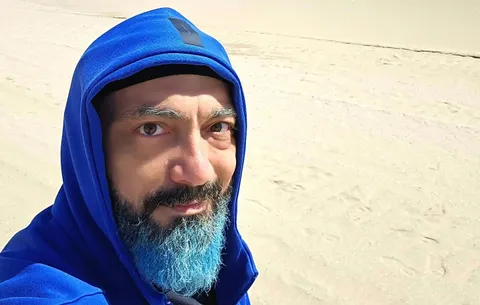
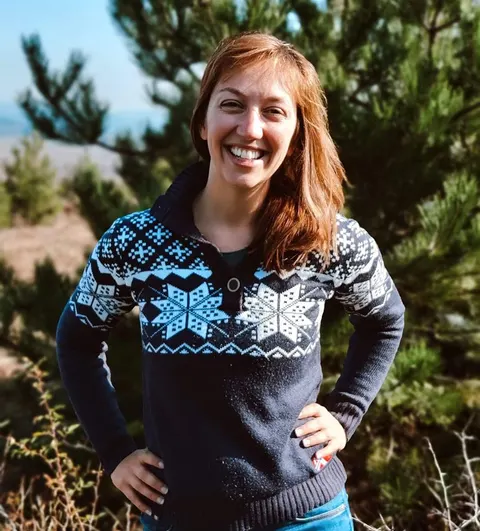
What does paradise look like for Raya Ubenova, whose name echoes рай (ray), the Bulgarian word for paradise? Probably like a forest. Because if you listen to the excitement in her voice when she talks about it, you can't help being carried away. And thinking about things we supposedly discuss all the time but rarely look into deeply. Such as how to preserve our own planet.
Raya doesn't just talk with passion—she acts. After years of caring about environmental issues and looking for a way to help, she decided it was time for a more serious undertaking. Less than a year later, she already owned 20 decares (about five acres) of abandoned land, planted with several thousand young saplings.
She has created a baby forest!
The First Private Forest
Raya works in publishing and has lived and worked abroad for more than a decade. She currently leads the team of designers who prepare the reports of the UN's International Labour Organization, and is directly involved in its publishing and communications. Very soon she will move from Geneva to Rome, where she will take up a similar position at another UN institution—the Food and Agriculture Organization (FAO).
Meanwhile, in her spare time, she creates a forest.
How does one end up in such a strange line of work?
Environmental protection has long been close to Raya's heart. Back when she was a student, the questions surrounding climate change became very personal to her. They still are today—she is about to complete a master's degree in climate change and development.
“I've always followed these topics with enormous interest. In 2015, when the Paris Agreement on climate was signed, I breathed a sigh of relief. At last we had some more solid political consensus and a vision. But then it became clear that the status quo was here to stay. That we want to keep living the same way and have the problem somehow disappear by magic. That we want others to change, not ourselves,” Raya says. “According to the latest scientific data, humanity keeps doing far too little to secure a stable climate in which to go on living as before. The years until 2030 are our last chance to prevent catastrophe. For the next generation it will be too late. They won't be able to stop the changes. They'll be locked into a climate apocalypse.”
Raya Goes Forest
Yes, the first step is personal initiative. Raya started buying local food and goods and gave up meat. She tried to travel by train and to get around the city by bike. She took the small steps that, in her view, make sense for reducing her carbon emissions without depriving herself of anything or going to extremes.
But she was nagged by the thought that this wasn't enough. That big change comes from the system, and personal effort matters most when it outgrows the usual patterns.
She wondered how she could be most useful. If she turned to an academic career… it would take a decade for her work to reach the scientific journals, which already carry plenty of publications anyway, and in the end what changes the world is action. She wondered whether to write a novel or a children's book… For a long time she searched for the direction in which she wanted to make her contribution.
The forest. The answer turned out to be simple and obvious. There is no other resource so valuable to nature, so helpful to the development of ecosystems and to the absorption of carbon dioxide. The forest, with all its magic.
The Forest, Poor Thing
The idea took firm shape the year before last, while she was on the beach. Raya had come to Bulgaria on holiday and got absorbed in a book by Christiana Figueres, one of the architects of the Paris Agreement. “The message was all about action: do something, however small. On that beach I decided I would create a forest,” Raya recalls. “I told my family. They laughed a lot and said it sounded absolutely crazy. ‘At least plant some useful trees: chestnuts, walnuts, linden.’”
But she had already made up her mind and began looking for a way to turn it into reality.
She went back to Geneva, where she started following the Gorata.bg (The Forest) project. Just then they announced they would be giving away linden trees… “I told myself it was a sign—linden was exactly what my parents had been talking about. I ordered 50 saplings, the minimum. I called my family and told them 50 lindens would arrive tomorrow.” “But what are we going to do with them?”
Wooden Philosophers
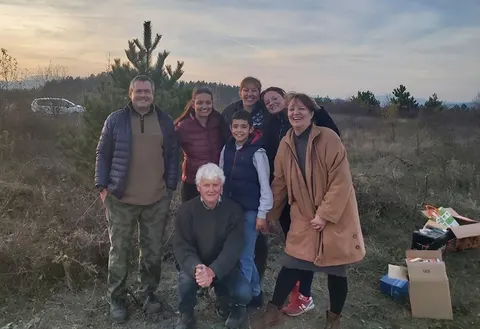
Raya, however, had a plan, and she found support among her loved ones. Her stepfather, Valeri, helped her enormously. “When he heard about the lindens, he burst out laughing, laughed and laughed, then hung up and called me back five minutes later with an idea. He said he had land in the village of Shiroki Dol, near Samokov, and suggested we go and see whether it might be a good place for the lindens,” she says.
The saplings found a home in Shiroki Dol, and 200 little oaks soon followed. Meanwhile Raya joined several tree-planting campaigns. She was dismayed to see that they were planting monoculture forests—a single species, which today is considered a rather outdated idea, especially in the context of climate change. A real forest has different species that complement one another.
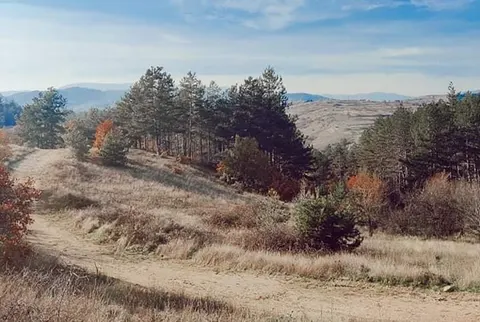
By now Raya had decided to set aside some of her savings for a place where she could create her own forest. The kind of forest experts advised her it should be—close to an existing woodland, in a mountainous or foothill area, and not on fertile farmland. In her stepfather Valeri she found a kindred spirit, and after several failed attempts they chose two plots in the village of Tserovo, 50 minutes' drive from Sofia.
If You're Afraid of Bears…
On her first trip, Raya spent a long time searching for the place and stopped to ask a local man who owned a cherry orchard.
“He asked me what I was going to do, I explained, and he looked at me as if I'd fallen from Mars and said:
– And you're going to make this forest without getting anything in return?
– Yes, there will be benefits, just not directly for me.
– Then you must be awfully rich!
– No, unfortunately I'm not.
– Well, then you must be awfully mad! They cut down the forest here, and you're going to pay to have trees planted.”
Ikebana Makes the Trees Ache
It's a reaction she meets often. Many people tell her how incomprehensible it all is. “Yes, in 20 or 30 years someone may come and cut this forest down. But in that time it will have lived, the trees will have grown, they'll have absorbed carbon dioxide. Even if that happens, it won't be fatal to my goals.”
Of course, she would be happier if the forest stood there for centuries, if it became home to all kinds of creatures, if it contributed to biodiversity, to keeping moisture in the soil, to stopping erosion.
Raya strings story after story together. Forest makers, it seems, are colorful folk, almost as colorful as the directors of waterfalls. And stubborn. And convinced of what they are doing.
Once she had the land, she wondered where to find the best advice on turning it into woodland and… simply went to the Executive Forest Agency. From the internal phone she called an expert the receptionist had pointed her to.
Forest Wanderer
The expert was so astonished by the call that she quickly assembled a team and set up a meeting where she gave Raya valuable guidance. She said no one had ever come looking for advice on how to create their own forest. She sent her to Assoc. Prof. Dr. Nasko Iliev of the University of Forestry to draw up the technological plan with which such ventures begin.
The specialist not only liked the idea but traveled at his own expense, calculated, discussed and created a plan that met all the forest owner's requirements. It included various tree species and, to her pleasant surprise, oaks dominated—among the longest-living trees in our latitudes. He studied which plants already grew on the site and let them guide his choice of species.
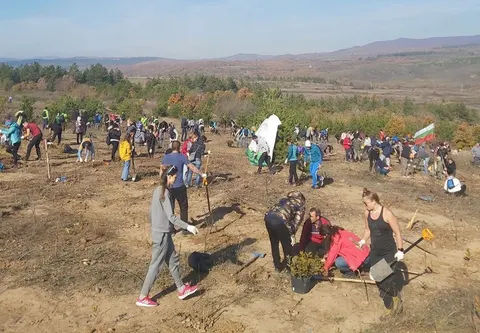
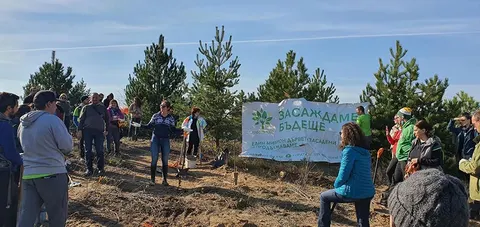
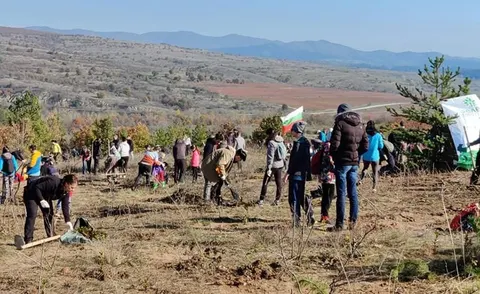
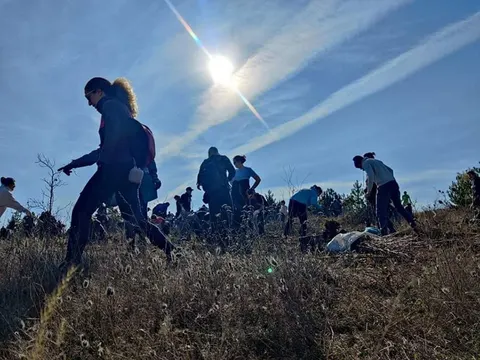
Then everything fell into place as if by miracle: the necessary saplings were found, and on the day set for planting about 300 volunteers turned up.
A Forest of Hands
“I was deeply touched that people are willing to give of themselves for something they can see is useful,” Raya says. “Maybe they're open because they understand I'm not doing it for profit.”
She says her greatest satisfaction is that today she feels part of a community with shared values. “When I started this initiative, I was determined to see it through and wasn't swayed by what others thought. For a long time I felt alone, and then lots of people helped me with advice, and so many volunteers joined in… Suddenly we became a community doing something worthwhile. That gave me wings.”
“The climate crisis is also about values, about what we consider important,” our guest adds. “Over the last 50 years or so, Western society has been very focused on individualism and consumerism, yet all of us actually need community and a deep, non-commercial connection with the people around us. That's exactly what I felt with this forest of mine. I felt I had to do something as an individual, and surprisingly I found a community. That makes far more sense than someone cycling to work (not that it isn't important!). The path to effective climate action lies in collective initiatives and in pressure on the system that is destroying our planet—above all, the fossil fuel companies.”
Growing Pains
The forest has been planted, and a little later a friend of hers marked the saplings so they would be easy to spot among the surrounding vegetation in spring.
This, of course, is only the beginning of caring for it. Two or three times a year—in May and June and in early autumn—the forest is tended. The young trees are cleared of surrounding growth, and saplings that haven't taken root are replaced. The raspberries, a widespread weed in the area, are expected to be the hardest part. Then it will once again be time for volunteers to lend a hand. In case of a dry summer, Raya has arranged for a man from the village to water the trees with a tanker.
She is glad to hear about more and more initiatives like hers. Asen Nenov got in touch with her—he looks after 30 decares of land by the sea, leaving it uncultivated so that it can become a wild space again, a natural habitat for local species squeezed out by humans. A woman from Pleven has set aside 30 decares of her land to plant with trees. Raya is also inspired by Nikola Rahnev, creator of the Gorata.bg website, who helped publicize the initiative and provided tools for the volunteers.
The Tree of Life
How does Raya dream her new property will look one day? “Like a real forest. It takes 30 to 40 years for most species to grow. I'd be very happy if all kinds of creatures came—rabbits, roe deer. I'd really love it to be part of a dynamic ecosystem and to keep spreading.”
Raya has no intention of stopping here. Other people from Tserovo are also offering their land for the forest to expand. She has been invited to the village of Lopyan, near Etropole, where her father comes from. And she doesn't stop dreaming of the next steps and the next forests. Although it's getting harder and harder to juggle her career, her personal life and this ambitious venture. “But on the other hand, it seems so important to me that I'm ready to reorganize everything around it.”
Do you still think one person can't start a big change? Or shouldn't fight for their dreams, even at the risk of being called mad? As Hristo Botev, Bulgaria's revolutionary poet, put it: the madmen, the madmen—long may they live…