With every year we grow more desperate about the political state of our country. Disappointed, disgusted, with less and less hope that there is anyone we can vote for without regretting it afterward.
That is why strazha.bg—Strazha means “The Watch”—is such a meaningful venture, and one created, what's more, by young people unburdened by prejudice. In just a year the platform has drawn serious interest and keeps offering more and more possibilities. Reminders that politics is not just the people on television, but all of us.
Thanks to the project, we can see what the person we ourselves sent (or plan to send) to the National Assembly, Bulgaria's parliament, said and how they voted at any moment. We can check whether they keep their word and deserve our trust. We can search a vast database of payments made by every state institution over the past 16 years.
“Democracy is not just a slogan!” reads the motto of this venture. Not only its existence, but also how effectively it works depends on all of us. And now we have a valuable weapon with which anyone can put it into practice.
Me and the Robot
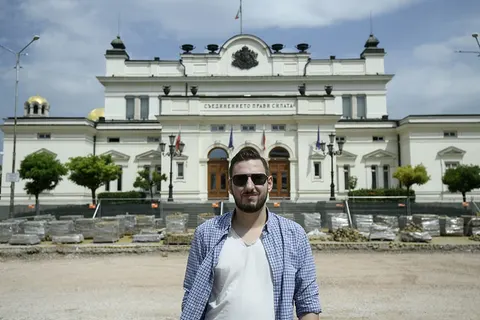
A democracy enthusiast—that is how Blagoslav Mihaylov describes himself. Now 26, he has spent the past year pouring all his efforts into the Strazha project, because he believes we all need an impartial platform like this.
After finishing school, he left for Sheffield and specialized in artificial intelligence. Although he found the subject interesting, he decided he did not want to build a career in the field.
“To work in artificial intelligence, you have to go through a PhD and then hope to land a job at one of the big corporations. And I simply didn't want to be part of the system,” Blagoslav recalls. “And I started thinking: this field comes from our dream of creating something in our own image. At some point I realized I didn't understand people well enough. That I had spent so much time understanding numbers, formulas and algorithms, but not how human society is put together.”

The Right to Vote
He felt something was missing abroad, and after graduating he came back to Bulgaria. He spent four years educating himself in various fields and thinking over what he wanted to do. That is how he arrived at the idea of an impartial civic platform, and in June 2021 he got to work.
“I've always believed in technology, and I began to wonder how it could be used to transform the social sphere—for example, to change politics.”
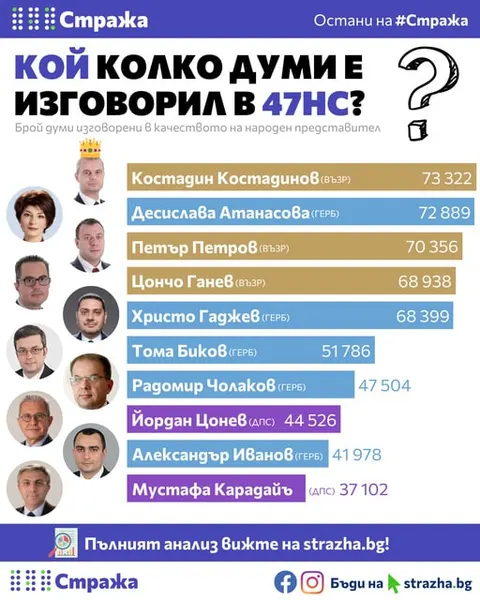
10,849,598 roll-call votes over the past 13 years, 541,831 speeches from the rostrum by 1,409 members of parliament from 2001 to the present. This enormous body of information is now available to anyone at strazha.bg.
The concrete idea came from his friend Friedrich Krepiev, the platform's co-founder, who is now studying medicine in Germany. He was inspired by a similar venture in Germany, which is also where the name comes from. Abgeordnetenwatch can be translated as “parliament monitoring,” but also as “watching, tracking, guarding.”
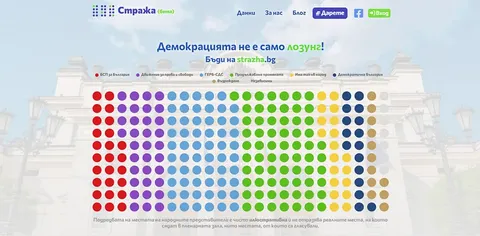
Power to the People
At first the problems were purely technical. Officially, there is plenty of information on the National Assembly's own website, but it is extremely awkward to process. That is exactly the problem other platforms ran into when, before Strazha, they tried to make the database of speeches and votes accessible.
Blagoslav found the solution thanks to his experience as a programmer. All the other platforms relied on downloading (in “professional” jargon, “scraping”) the data with slow and inefficient scripts. The young man, however, noticed that the parliament's new website was built so that requests to its servers were made in a standardized way. In other words… “without meaning to,” the developers had made all the data on votes and the transcripts of sessions available in a convenient form. Nobody had simply noticed it before.
And so processing the data became possible, and Strazha stood guard. When the last National Assembly began its work, the platform even managed to initiate changes to the rules of procedure, under which voting data is now published with only a one-day delay.
Why does all this matter? Because now we can check everything done by “our man,” the one we sent with our vote to represent us and forge laws. On top of that, you can make fascinating comparisons of how the votes of different parliamentary groups line up. When anomalies appear—things hinting that decisions were made “the other way”…
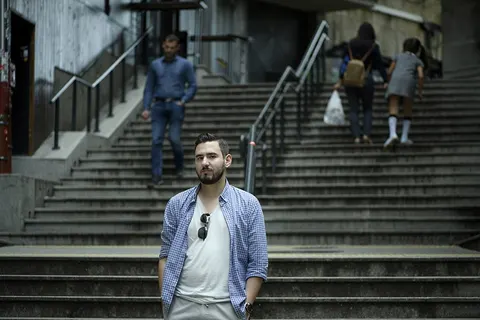
I Am the State
And speaking of “the other way,” this is Blagoslav and his like-minded colleagues' main, fundamental goal—to create a platform that is completely transparent and independent. Each of them has his or her own views and political preferences, but when it comes to Strazha, the goal is an entirely impartial look at the data.
“The fact that this project was created outside the party environment is its main advantage,” says Blagoslav. “The idea from the very beginning was an initiative of the people, for the people, funded entirely by people, not by grants or funds. Entirely civic.”
The platform relies on microfunding and does not accept donations above a certain amount. Precisely because its whole philosophy is aimed at each of us, at the “ordinary” voter who will appreciate what he or she gets. It seems to be working, because in recent months the number of donors—giving symbolic but regular sums—has been growing fast.
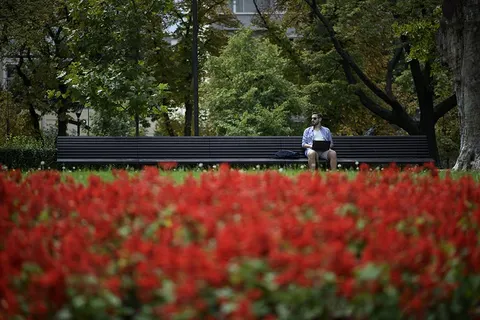
Of the People and for the People
Blagoslav's next big step was to build a convenient search form for SEBRA, the state's electronic payment system. Now his plan is to prepare a similar solution for the state budget—how funds are planned and how they are spent, year after year. All the necessary data is there, and this feature will soon appear on Strazha too.
“Imagine what it feels like when you can see the state's payments the way you see your own online banking. Suddenly it tells you that the state isn't something so complicated, it's just bigger and has more money to distribute. I think a possibility like that seriously changes the way we perceive the state. We get inside that black box, we make it transparent, and we can see what's in it,” Blagoslav adds.
Another personal motivation for him is to try to change the way politics is talked about in Bulgaria. “When people talk about it, they usually grumble; they perceive it on a purely emotional level. Nobody thinks rationally, and that's the only sensible approach. I think the problem isn't the people, it's the environment we live in, and that's what we have to change. The natural task of every politician is to do whatever it takes to keep and expand his power.”
That is exactly why, according to Blagoslav, the big problem is that we cannot judge politicians' morality, only how well they can simulate it. And that is where Strazha comes in, as a way to track it.
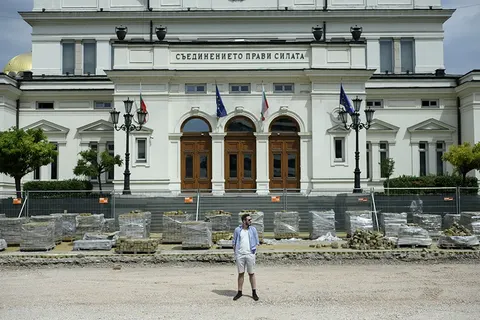
A Man of the People
“I believe real change happens when a society's culture changes,” says Blagoslav. “The biggest problem in Bulgaria is that people don't believe in anything. Many think the world is driven by some conspiracies, and if you believe everything is rigged, you'll never do anything. The world doesn't ‘work’ like that; a lot of things happen completely chaotically.”
The solution, in his view, lies in the exact opposite approach: giving people ever greater access to impartial information. “Of course, I'm not the first to realize this, but I think Strazha's contribution lies in a different understanding of things. We don't see transparency simply as publishing arrays of data, but as citizens being able to reach them quickly and easily, open them and quickly find what they're looking for.”
In a way, he also sees the venture as an entrepreneurial experience, a business of sorts that relies on a broader mass of users. “People support ideals, unlike companies,” says Blagoslav. “As a programmer, I see things more systematically. I don't talk about morality, about abstract things; I look at how a system works and how it could work better.”
In his view, the key goal of most other NGOs is not to meet people's needs but to win new projects and funding, and that is predetermined by the mechanism through which they exist. Besides, most of them are aimed at academia, at making search convenient for researchers, but not for every voter.
Servant of the People
He does not see it as a problem that when we vote, we always choose the lesser evil. “A person can approve of someone's policies without even liking the politician. If you're one of those people who don't vote, who grumble all the time, for whom nobody is good enough, you're simply not a factor. And then the ‘bad guys’ win. That's why I think we should be more pragmatic and vote on the basis of reason. In the end, the lesser evil is also the greater good. Not choosing is a choice too, but it's usually the worst one, especially in politics.”
One of the big challenges, according to Blagoslav, is to draw the next generations into politics as well. Because it is the young who are always more inclined toward change, toward reform, even toward idealism. “Many people are still looking for a savior; others are still fighting some imaginary communists. I was born in '96; obviously that doesn't work for me. I think: can't we leave these things behind? Stop with the past and finally look to the future?”
There is still a place for left and right in politics today, Blagoslav believes. But to get to that argument, the dialogue first has to move to the next level. “One side says, ‘Stop, you'll break the economy,’ and the other says, ‘Let's make the economy better for everyone.’ And those debates are important; there's room for them. Whereas in Bulgaria the debate goes, ‘You're thugs.’ ‘No, you're thugs.’ And I think: Let's get past this and talk about some real problems? Clearly you're all thugs, but let's at least do something so we can live better.”
It is in an attempt to bring pragmatism back into the process that one of Blagoslav's next big ideas is to let every person use the platform to have a direct line to “their” member of parliament. To ask questions, to share ideas. But for that to happen, pragmatism and dialogue have to return to the political table, and the next National Assemblies have to have longer and more meaningful lives.

O People????
We know the minimum number of swallows it takes to make a spring. It is not one, and it is not two. And yet every step that restores our trust in the system and allows us civic oversight is worthwhile. Especially when it rests on solid foundations and on people who value their independence.
And then… beyond the deeds, all that remains is to dream that more steps like this will help us have a far more meaningful political class, that democracy will stop being just a slogan, and that running the state will be in the hands of the competent and the honest. Yes, all this may sound like a utopia, but it is precisely to utopias like “freedom,” “democracy” and “kindness” that we owe our greatest steps forward as a civilization…