He is a man of the exact sciences, but also a dreamer. Trifon Stefanov's story is so interesting and motivating (forgive the cliché). And it is only just beginning. Expect interesting news from him.
When the time comes to choose a university, he leaves for Japan and masters the difficult language so that he can learn the foundations of engineering from the best. Then he tests his experience in the West and returns to Asia for a master's degree at the university Xi Jinping graduated from, along with many other politicians who lead China today.
Trifon is 27 and says he has traveled this path because it will help him reach the big goal: together with like-minded people who have been working in this direction for two decades, to bring about an engineering revolution. To change the economy and the way enterprises are run with the help of technology. To make life better for every person on this planet with a concept that places the human being at the foundation of everything. One that stands on the strict engineering criteria the young man absorbed in the East.
How often do we meet someone so determined to change the world that he is ready to learn Japanese and Chinese? What makes him believe that the road he has taken can really get him there? Why does he think it is precisely the engineering approach that has the power to change things?
And also: are there dreams that are not worth chasing?

All Power to the Engineers
By the time he graduates from the Sofia High School of Mathematics, Trifon has long since decided he will pursue engineering. “Everyone in my family is an engineer, and I grew up thinking that these sciences are the foundation for the development of people and of the world,” he says. His childhood fascination with Eastern culture meets his objective assessment that in this field Japan's education is among the world's best. It is important for him to get a full scholarship, and so he does. He passes through a fine sieve of difficult exams. Even the requirements in mathematics turn out to be far above the level the young man reached at the most prestigious specialized high school in Bulgaria.
The result, however, is worth the effort. The Japanese Ministry of Education fully covers five years of study—the first to tackle the language, and four more for the bachelor's degree itself.
Today he admits that the hardest part was learning to speak Japanese. In the first year he studies with 60 other people from all over the world; some, like him, start from zero, others have a basic knowledge of the language. “It wasn't hard for me to get used to the way of life in Japan, because it was very orderly. It's very easy to fall into their rhythm when everything is organized and thought through. But the language was a problem, especially when the actual lectures began. Engineering disciplines have a lot of terminology that is native, not borrowed from the West.”
From Here to the End of the World
Trifon is not one to give up. He tells himself that, having come this far and put in so much effort, he has to hold out. So by the second year of his actual studies he is in his element, makes friends with some of his fellow students and plunges into mechanical engineering proper at Saitama University.
This is the field he has been drawn to since childhood, one in which his family also has serious experience. In Japan, higher education is similar to Bulgaria's—specialized in a particular field, with few electives outside it. So Trifon advances in robotics, in electrical engineering, in the fundamentals of every branch of the engineering world.
And when he graduates, the time comes for an important choice. He is offered a job at Honda, the second-largest Japanese company, an honor few of his classmates earn. But he knows there is a bigger goal ahead of him, and he chooses an offer from the Austrian company Berndorf, on the understanding that he will work for them for a year and then go on to a master's degree.
“It was a hard decision. I also wanted to stay in Japan, because I had secured good opportunities for myself and I knew people there. But I became convinced that there are more important things,” the young man recalls.
He starts work as a project manager. Although this position is sometimes more of an organizational one, in his case he works on an internal project to build a company test center. So, now in a European environment, he gains invaluable experience in his field.

Liberty, Equality, Engineering
The year runs out and it is time for the next step. First he applies for a master's program in Korea and is even accepted, but the moment coincides with a diplomatic conflict between the Asian giants, and the Koreans stop admitting graduates of Japanese universities.
That is how Trifon ends up at Tsinghua University, which is in the top 15 of the world rankings and among the three most prestigious engineering schools on the planet. As mentioned, its graduates include the Chinese leader Xi Jinping, who studied chemistry there. The young man chooses it over Peking University, which also accepted him, precisely because of its international reputation. But does Trifon carry on with engineering? No, and this is one of the key steps on the road to his dreams, which we will reach soon enough.
He will soon complete his master's in business administration. His plan to move to China and learn Chinese does not come true, because the start of his studies coincides with the outbreak of the COVID pandemic. To this day China has not opened its doors to foreign students, and everything happens online. Trifon studies remotely, from Bulgaria. The time difference causes him plenty of inconvenience, but the subjects seem easy to him.
Hammer and Computer
“Why did I choose this program? Our family business has always been connected with managing the economics of enterprises. A master's degree should give exactly that—management knowledge and skills. An MBA, as they call it in English, is a must in job ads for senior managers,” Trifon explains.
And around the world it is also quite popular when it comes to politics. The Chinese leader is an engineer, and almost all senior French politicians, for example, graduated from the famous École Polytechnique. So, chatting with Trifon, we conclude that it is very strange how few Bulgarian politicians have an engineering background. Which is a loss, because engineering directly or indirectly teaches systems thinking, and in Bulgaria it is often precisely the lack of a broader, analytical view that holds back progress.
It is a fact that for many years engineering disciplines in Bulgaria received little attention, and my interlocutor agrees. “Western ideology, in which the economy comes first, still rules. Because of the idea of the knowledge economy, most manufacturing enterprises moved to China back in the '90s. Here we keep following the mantra that there is no need for manual labor and engineers, that we should be managers and simply manage those processes. But when you don't see the processes every day and don't understand them, how can you manage them?!”

Engineers of the World…
Trifon says his current subjects are easy because he approaches them with his engineering knowledge. “Compared with mechanical engineering, where I had to slog away before every exam, here I passed most of them on general knowledge. Economics, ethics, philosophy, strategic thinking… nowhere is there a complex system you have to learn, as in physics, for example. Here everything is fragmentary,” Trifon says.
And so we arrive at his big dream, which is closely connected with everything we have told so far. Since the mid-'90s, a group of mechanical engineers, including Trifon's family, have been developing and testing in practice a large-scale system for managing the processes in an enterprise.
This field of knowledge is by no means new or unknown. The popular ERP systems take their name from “enterprise resource planning” software. Every larger enterprise uses them to manage its daily work. In 2020 the market for this type of product was valued at $350 billion, and it is expected to double by the end of the decade. Global giants such as Oracle and Microsoft work in this business.
Trifon and his colleagues, however, are convinced that so far these systems reveal only a fraction of their potential. And that they have something on a qualitatively different level, which can improve the work of enterprises all over the world and develop the entire global economy with the help of the engineering approach. Pretty ambitious, wouldn't you say?
There Is Such an Engineering!
“In the sciences I'm studying now, everything is fragmentary and disconnected, and so you never go deep. If you don't have a unified system to bring it together, everything just floats in the air,” Trifon says. And he believes that this unified organizational system has already been created, and that over the coming years it is important to talk about it and apply it in practice in more and more places.
He describes the current economic management of enterprises as driving while looking only in the mirrors. Decisions are based not on processes but on statistics from a past period, which may be completely irrelevant to the next one. Because enterprises, like all more sophisticated systems, are complex and dynamic.
At the heart of understanding such complex systems lies the right model to describe them, Trifon believes.
The venture in question has been in development since 1997, when our interlocutor was almost a baby. He compares what it means for economics to what happened to medicine in the 16th century. “Until then there was no model of the anatomy and physiology of the human body. Doctors didn't clearly know what they were doing. Only when the model uniting the body as a single system appeared and began to be applied widely did this science start to develop rapidly. You don't just look from the outside and wonder; you use the best practices and you know the system.”
In his view, economics today tracks consequences and outward symptoms, but not the system that produces them.

When Millions Rise Again
In '97 the creators of the model began serious research and looked for software solutions for the factory they were running. They never found exactly that knowledge—how an enterprise can be managed as a single system—so they decided to create it. The first step was the model, and the second was the ERP software system developed on its basis.
“In economics, it is believed that a laboratory experiment is impossible,” Trifon says. “It's a philosophy; you look at how people change. It turns out, though, that it is entirely possible. And now, when I present and demonstrate it to my professors at the university, they are all impressed. And we're talking about world-renowned specialists. My master's thesis is devoted to this as well, and the professor rated it the best he had ever read,” the young engineer adds. Most scholars believe that enterprises are too different from one another for a single, holistic model of them to be created, yet according to Trifon such a model exists.
“The creators of the model weren't after money. They wanted to create something the world needed, something that didn't exist but was very important. It has already been created, and our job is to spread it.”
Work Ennobles Man
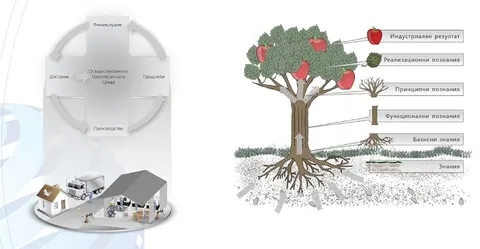
The model operates with two basic units. The first is the enterprise's work cycle, and the second focuses on the people on whose shoulders it rests. At its core is the business cross, which includes sales, production, supply, financing and the provision of the technological environment. These are the five main functional systems, which can be compared to those in the human body—the respiratory, the excretory, the digestive. If one of them does not function properly, the enterprise does not work, again just as with the body.
The second main factor, located in the middle, is the people who work there. They are the ones who think and analyze what other resources are needed in all the other systems; they must equip the technological environment so that they can work effectively. They do this for themselves as well, which makes them a kind of metasystem.
The technological environment, which is the foundation of every enterprise, is divided into two components: the technical one, where the machines are, and the organizing one, where knowledge and people are.
The Time Is Ours
“All our experiments over the years have been in a machine-building enterprise,” Trifon adds. “They are fundamental, because if we don't have computers, phones, machines that build other machines, we don't have anything else either. Besides, these are the enterprises with the largest range of products; they are the most complex.”
“In our model, the most important thing is the human being. Today people are neglected in economics and management; nobody talks about them. We don't appreciate the importance of the individual, yet it is the enterprise's task to give them everything they need to work effectively.”
According to Trifon, perhaps the most important part of the model is that it manages to turn the interrelationships into specific mathematical formulas. “It's one thing to have the connections on an intuitive level, and another for them to be linked on the basis of mathematical relations.” That makes it easy to then encapsulate them in specific software that can be used in practice.
Of course, the concept is far too complex and deep for us to present in a few lines, but it undoubtedly deserves attention. If you don't believe me, I advise you to listen to Trifon describe it some day—you will be hard pressed to find a weak link.
If what has been said is enough to spark your interest, you can read a good deal more about this system; quite a lot of information has been gathered here, for example.

…Have Nothing to Lose but Their Chains
Trifon and his colleagues have founded two organizations so that their project reaches more people. Over these 20
years, the Institute for Systemic Economic Engineering has been building the concept, while the aim of the foundation Information Technologies and the Future of Economic Science is to popularize it.
That is now Trifon's big dream, too. One of the directions where he will look for growth is China; he is soon leaving for a series of meetings there. “This idea needs supporters in order to function effectively enough—people from the political, media and business elites. Reaching them is a very long process: explaining it to them, popularizing it. Our focus is on economic science, but politics also rests on economics. On the basis of the model there will be not only technological effects all over the world, but social effects as well. A new professional class will emerge that understands the economy in depth and can manage it. There will be social effects for the whole world. But this is a very long-term plan. First we have to reach people, to discuss it more and more,” says Trifon, determined to do it with all his strength.
How does he see his future a decade from now? He believes his dream will have become reality, that the system will have entered the universities. “This process will solve many of the world's problems. It will enter consulting companies and enterprises, and at the same time the ordinary person will understand it. They will no longer be a servant in an enterprise, but will see the point of being there. It's different when you see the point…”
And is a new global economic revolution based on engineering thinking really on its way? Who knows. I am sure of only one thing: I admire Trifon, who does not let difficulties stop him from making his dreams come true. When a person doesn't give up and believes in what they are doing, they really are capable of miracles…