The digital story of Vu(nyo) Nguyen barely fits on one planet. Born in Vietnam, he landed in Sofia as a little boy. Then he left for the United States to study… and to fall in love, twice, with Bulgarian women. A short but dizzying career followed at outlets like The New York Times and MSNBC, while his wife Rali held a senior position at Microsoft. And their careers were short because their older son Adi had never seen his relatives in person when… one day he called the laptop “Grandma.” In that moment Vu and Rali decided they had had enough of America and came back to Bulgaria with no plans at all. So how did it turn out?
A painter who never was, a successful journalist and a terrific programmer, who today leads the team of a promising startup. That is Vu, and as a bonus: a proven cook who made it to the finals of MasterChef. Clearly it is never too late to start, and you should never stop trying. And if that isn't an exciting Digital Story, what is!
At Vu's
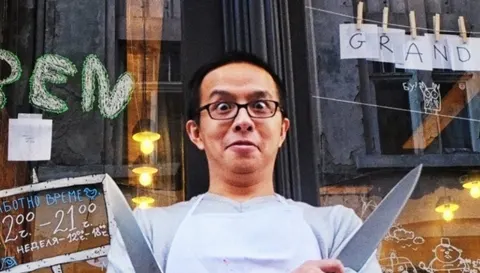
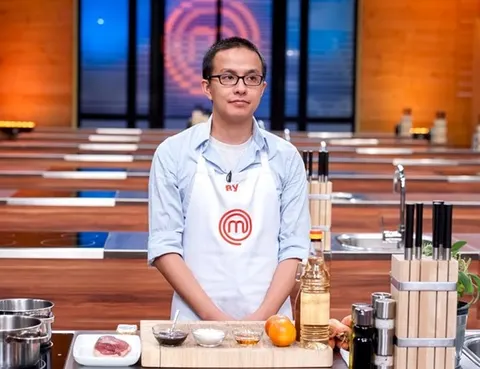
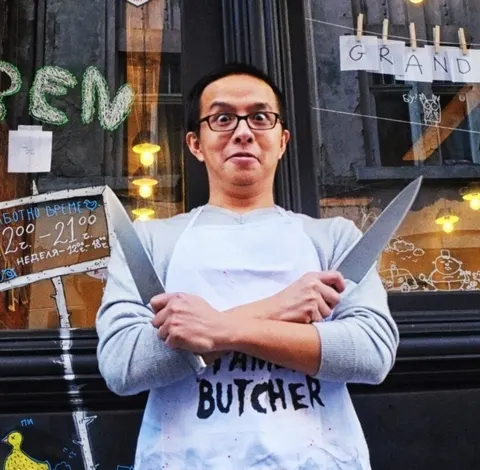
You most likely know him from the screen, when, in a chef's apron and with a charming accent, he gave an impressive performance in the first season of the Bulgarian MasterChef. Or maybe you wandered into his charming restaurant U Vu (“At Vu's”), which served gourmet sandwiches from all over the world but, sadly, didn't last very long.
Vu's story is full of twists and intriguing details. And with that charming accent of his and his unconventional take on Bulgarian and digital topics, he is a very, very thoughtful conversation partner for the digital age. We meet, supposedly, for an interview, but his story keeps unspooling and unspooling, so we begin with it.
Our hero Vu Nguyen was born in Hanoi. His father graduated in civil engineering in the USSR and in 1986 came to Bulgaria for the first time on an exchange contract. The family often traveled between Sofia and Vietnam, and in 1994 it settled here for good.
By then Vu was 11. He lived in Bulgaria for almost a decade, learned the language beautifully and got used to his surroundings. He finished high school here, which he remembers with great fondness, and then decided he would go to study in the United States.
Déjà Vu
His first choice was computer science, and he left to study in Kansas. “You know how it is, in an Asian family you become a doctor, a businessman or, as a last resort, a computer specialist,” Vu smiles. It was 2002, computers had only just broken through, all of us were tangled in the web of webs for the first time… and then came the first crisis, the dot-com bubble, which hit the United States hardest. Interest in the field dipped for a while, and that affected Vu. He wasn't particularly drawn to what he was studying, and he figured it would be hard to find a job. As a kind of protest against his practical parents… he decided to enroll in painting.
“Freshman year was great. In sophomore year the drawing professor walked in, and the first thing he told us was that every year 16,000 people graduate in this major. Of them, 10 have some serious potential. Another 1,000 find jobs as graphic or other designers. ‘As for the other 15,000, it's great that you want to paint, but…’ He hinted that most of us would never amount to anything, which is the truth.”
Vu decided to change direction yet again. After his second year he had the chance to transfer to another university, but he felt completely lost and had no idea what he wanted to study. He decided to shoot blindly. He applied for architecture, computer science, journalism. His girlfriend at the time was Bulgarian, and to be close to her he chose to move to North Carolina, where he was accepted into journalism, or rather visual communication.
Vu York Times
This time the profession truly captivated him. In his very first year he was won over by his data visualization professor, a Spaniard with serious experience at El País and other well-known outlets. “He impressed me so much, and he took such a liking to me, that we built a really great bond. He got me fired up about working with data, about telling visual stories.”
Vu was lucky that this happened just as multimedia journalism was first making its way. Big media outlets were starting to bring video, audio and graphic elements together: charts, maps and who knows what else.
In senior year the university organized trips where students could put into practice what they had learned. Vu went to Peru with classmates. He ended up in a monastery in Arequipa and in two weeks put together a large-scale documentary project. He talked with the nuns, prepared 360-degree photos, audio interviews, historical archives, explanations from the people there, and all of it in a web format.

InterVu
His professors were impressed, and he got interview invitations from The Washington Post and The New York Times. He decided to try the Times first, at that time the best in multimedia journalism. They sent him three projects with the task of writing how they could be improved. By then Vu had a new girlfriend, Bulgarian once again. Her name was Ralitsa; a little later they would marry and have two children.
She advised him to be honest in his criticism, and he… perhaps even overdid it. “I agonized over it. The projects really didn't look the way they should, but I felt awkward. What was I supposed to write? If it was only nasty stuff, I'd never get the job. In the end I sat down and left some brutal criticism. Visually the projects looked beautiful, but the information was badly misinterpreted, it wasn't right at all.”
Honesty turned out to be the right move. The paper's graphics director was impressed, and Vu was invited for an internship. He wasn't at all sure he would be hired, because that was when the media crisis began, as the press lost its strong position in the advertising market to Facebook for the first time. But Vu evidently handled the task very well: he was the only one of his classmates to get not just an internship but an offer of a permanent job. His university peers quickly found their footing too, and today some of them are Pulitzer Prize winners, working at outlets like CNN, The Washington Post and The Wall Street Journal.
Vu and the Battle for Truth
The work literally swallowed Vu, who genuinely enjoyed what he was doing.
He won awards, including for investigative journalism. He was part of the team that uncovered a serious corruption case in which a huge share of the money meant for nursing homes was being stolen. He also covered the 2008, 2010 and 2012 elections: Obama's two victories and the midterm race for the Senate.
Vu and Rali worked a lot, and I mean a lot. “At some point I started to realize that journalism is a super cool thing to do, but it takes a lot of work. I often worked more than 12 hours, preparing stories, graphics, things for the print edition and for the site,” our guest recalls.
Meanwhile his wife got an offer to start working at Microsoft. She had left Bulgaria as a longtime competitor in mathematical linguistics and was advancing quickly in the world of programming. Vu also decided it was time for a change, and the two of them moved to Seattle.
Vu got a job offer from the MSNBC television network; the head of the computer visualization department turned out to be a graduate of his university as well, and they hit it off quickly. In the meantime Vu decided to leave journalism behind and return to computer science. As he himself says, because of a bet.
Vunderkind
His journalism professor used to repeat that anyone can learn to code, it's mechanical work. But few people know how to tell exciting human stories. Something that can change the world, or at least the society you live in. “He was a real journalist, a Fulbright scholar, a photographer for National Geographic. Truly very good at what he did,” Vu adds.
These were exactly the words he shared at a gathering with other Bulgarians in Washington. One of them turned out to be a computer science professor, who shot back that this was utter nonsense: only smart people can become programmers, the rest just aren't cut out for it. “You, for example, couldn't do it, no matter how much you wanted to!”
Oh really? Vu said to himself, and made a bet with the professor. He started studying hard on his own, with a lot of help from his wife. He learned the fundamentals of the profession, data structures and who knows what else. Then he arranged with his bosses at MSNBC to be moved to the project for a new mobile phone platform.
“That's when the iPhone came out, and the first more serious mobile sites started being built; before that they were awful. I don't know how, but they let me lead that department. We did the design, wrote the project and built MSNBC's mobile platform. NBC News still uses it to this day; it was very successful. That's how I was promoted to lead the department responsible for their entire online presence,” Vu says.
Vu at the End of the World
Over a few years Vu went through all kinds of projects: as a front-end programmer, a designer, even a product manager.
Especially amusing was his experience at a large startup that processed road traffic data. Back then it was even selling that data to Google: it was the first service to show on a map how congested various intersections were. The project was very interesting, but the owners turned out to be… religious fanatics. They had even named the company after the biblical name of Christ and the Latin word for “cross.”
“By then I was at director level, one of six people reporting directly to the CEO, and the company had 250 employees and a $100 million valuation. On my first day I had a meeting with the managers, and the first thing they did was quiz me on religious terms. It turned out that of the other five people, four belonged to the CEO's church. And he was a Harvard graduate, a very smart man, he'd even been friends with Bill Gates and early on bought part of the company from him. And this same man had written two books about the end of the world, which is coming soon,” Vu looks back with a smile. But at the time he didn't find it funny at all. “That's where I lost it, I snapped. I went through culture shock. Not that I'm an atheist, but that fanaticism didn't sit well with me at all.”
FreeVudom
A little earlier his older son Adi had been born. The system in the United States does very little to help young parents. Rali was at work literally on the day her contractions started, and she got only a few weeks of maternity leave.
Still, the two parents coped with the daily challenges. Until one day, after a Skype call with his grandmothers, they heard Adi pointing at the laptop and repeating: “Grandma, Grandma…” “Adi really thought the laptop was his grandma. And it made us very sad. I had slipped into some kind of depression: living in Seattle for so long, the lousy weather, the lousy work environment.”
The two of them felt this was the last straw. They understood that the time had come for a drastic change, but they didn't know what it should be. They did the first thing that came to mind.
Bai Vu(nyo)
They handed in their notice. Over the course of that month they managed to sell everything they owned. With six suitcases holding all their belongings, the three of them found themselves at Sofia Airport with no clear plans for the future, but convinced it was time to try a calmer, more normal way of life. They left the United States in the very month they had received their long-awaited American citizenship.
You probably know the rest of the story. Rali signed Vu up for the first big cooking show in Bulgaria, and he did wonderfully. He was eliminated relatively early, but he left a lasting impression. Which he later turned into the family restaurant. Things didn't take off, and Vu and Rali returned to programming, but now with a different mindset and on a European scale better suited to a normal life.
In the meantime their second son was born. And Adi grew up and, almost without noticing, fell in love with mathematics. Many people think his parents push him in that direction, but the truth is he chose his favorite pastime himself. He began winning medal after medal at national and international math competitions.
Vu.js
For the past five years the two of them have been working for a British startup that Vu co-founded. They optimize smart offices by collecting data from all sorts of sensors and processing it precisely. Countless factors are measured, such as how often a particular desk is used, CO2 levels and humidity; these are analyzed and recommendations are made on how things could be improved.
At first the Covid crisis hit the venture hard, for understandable reasons, but it is now clear that one way or another the office will still be needed, and the company is moving forward again, preparing to raise a Series A round soon. Vu is in charge of the technical side; their front-end project uses the Vue.js platform, which seems to have been made for him.
Meanwhile Vu has fit beautifully into life in Bulgaria, and even goes by Vunyo online, a nod to Bai Ganyo, the archetypal Bulgarian boor from Aleko Konstantinov's 1895 satire, a literary character every Bulgarian knows. And what does he think about life abroad and here at home? About the future of journalism and the fear of technology? About whether anyone can become a programmer, the way it happened to him (and to me), almost by accident? Expect the answers from the man himself in our next interview.