He is 21, and he has already helped more than 200 children take their first steps in a professional field that could grow into a successful career.
Today Vasil Anastasov has taken up another cause: using modern technology to make Bulgarian museums more attractive, more appealing to the young. At first he walks the road to the magic of the past himself, to grasp the meaning and importance of exhibits that otherwise hide behind baffling display cases with uninviting labels.
Come on, let's go treasure hunting together! Let's try to find the paths that matter in the overgrown meadow. Paths that lead to turning museums into magnetic places for the young. To where curiosity hides, along with the urge to share knowledge and to help. To stories told against the backdrop of the most modern technologies in the development of computer games and augmented and virtual reality systems. Roll up your sleeves, an adventure awaits!
Yo-Ho-Ho and a Bottle of Rum
You walk into the museum and a row of display cases greets you. If you're lucky, the right guide will be there—someone who loves the job and knows how to tell the story so that it touches you. Otherwise your gaze simply slides across the exhibits, with nothing to hold it. Here and there something will impress you with its beauty; elsewhere a label will tell you an interesting story…
The world is different now. It's time for technology to enter this part of our lives on a much larger scale. With its help, the plots of the past can come alive, the most curious exhibits can tell their stories in an engaging and meaningful way, and a visit to the museum can become a thrilling experience.
On this site, as you know, we're in no hurry. We'll get to how all this is possible, but first let me introduce our protagonist.
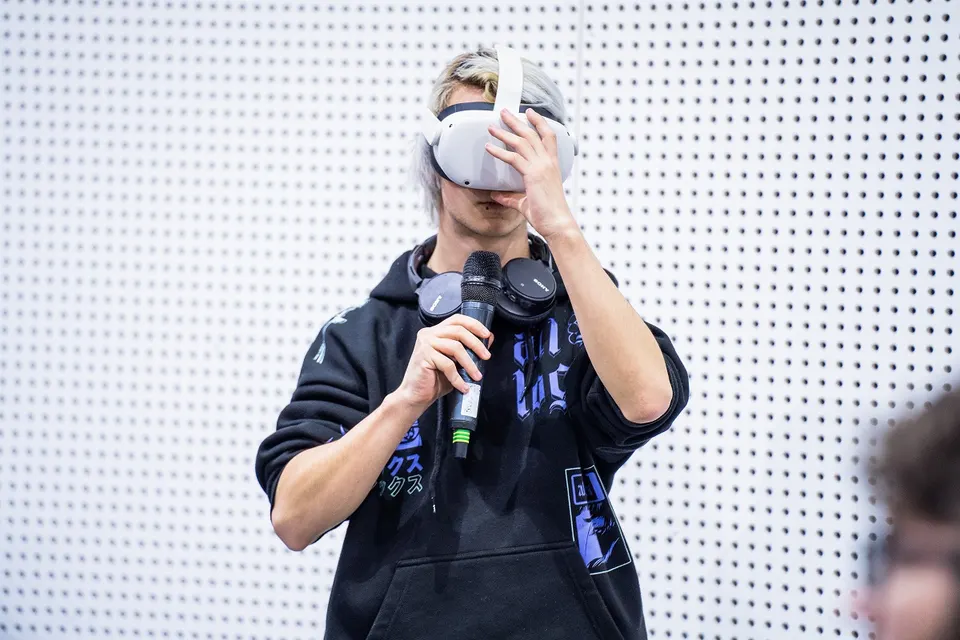
Vasil Anastasov is 21, and he already has seven years of experience developing video games and virtual reality projects. His main goal is not to keep climbing and build large-scale projects (though he could, believe me!), but to help more children learn the basics of what excites him. To show them what game development looks like from the inside, to win them over to his favorite field. To lend them a hand the way others helped him when he was starting out. Everything else—the projects, the apps, the ventures—comes along so that his workshops can reach more and more young people.
The Gold Rush
“The mutual teaching method.” If you paid attention in history class, you'll surely remember the principle—the monitorial system, in which older pupils teach younger ones—that laid the foundations of Bulgarian education in the 19th century. There's no way the associations won't lead back to the Bulgarian National Revival, even when the main subject is a treasure hunt. Not only because of Vasil's name—Vasil Levski, the revered hero of the struggle for liberation, shares it—but because of his goals.
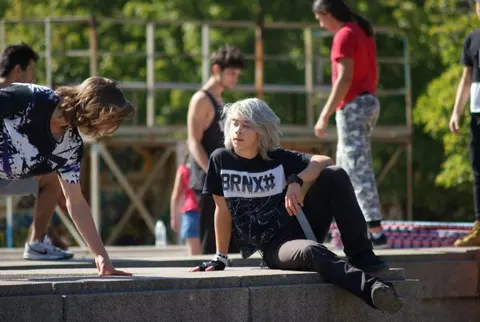
People like this young man with dyed hair and lip piercings remind me how the National Revival began. With persistence, with faith, with a desire to share knowledge in search of freedom—the kind that is the step that comes even after liberation.
“Why do you do it?” I ask Vasil cynically. What makes him share his knowledge and make that his main work, while his real “work” of building software projects exists only to keep the workshop afloat… I can afford the cynicism because I sense the answer coming; I've lived it. This site is my main work too, and my “work” exists to let me work on it.
“When I was 14, I started making my first video game with my older brother,” Vasil recalls. But the two of them start from zero. As if not knowing the basics weren't enough, they decide to make things harder for themselves by building a virtual reality game. Such games became especially popular with the rise of BeatSaber; they layer virtual, nonexistent objects onto photos, videos or real-time images of the real world around us.
I apologize if my description is fuzzy—even defining it for the uninitiated is hard, let alone actually developing such projects as two boys with no experience at all.
Unloved and Unwanted
Still, Vasil progresses quickly and is soon ready to earn a certification in Unity—the software he works with, and the most popular one for this kind of task. That takes him to Romania; at the time, there are no such courses in Bulgaria. He travels with his parents, and once the exam is over, they ask him whether he might like to stay another day, because a major event is about to start for IT specialists who develop games.
The organizers are delighted by his youth and enthusiasm and invite him to stay, giving him a free ticket. His father and mother agree.
“I went… Me at 14, and everyone else with the same number of years, but of experience in the industry,” Vasil remembers. “I was super nervous at first. I walked into a workshop on ‘how to run a successful crowdfunding campaign.’ Gabriel, the man leading it, saw that I was really young and nervous, found out I was making a game, and turned the whole workshop toward me. Most people gave me advice. A few even came up and offered me code. I was super surprised—wait, isn't that something you're not supposed to give to other people?
I realized that every developer not only has to keep teaching themselves, but also has to share their knowledge with others. Not to work in a closed environment where everyone hides their own stuff—people have to keep exchanging ideas and solutions to problems. I got really fired up and decided I wanted to do something like that!”
Danube Bridge
Still a student, Vasil goes to his school principal with the idea of teaching a course during elective classes, and he finds support. Although he offers to bring his own computer and virtual reality headset, Asen Aleksandrov, the principal of the 51st School “Elisaveta Bagryana” in Sofia, named after one of Bulgaria's great poets, takes the idea to heart and provides two sets of the necessary equipment.
Afterward Vasil seriously advances his skills and creates a series of apps, even though he is not yet of age.
Teaching, explaining, sharing knowledge is more than a challenging task. Especially at 15, which is how old our hero was at the time.
He not only likes it, he finds enormous meaning in the training sessions. Students come, impressed by the chance to develop in the field of video games, and many of them carry on.
Then Vasil graduates, by now convinced that teaching is his purpose. He has met a kindred spirit—Boyan Ivanov—and the two quickly manage to find other enthusiasts to support them along the way.
Treasure Island
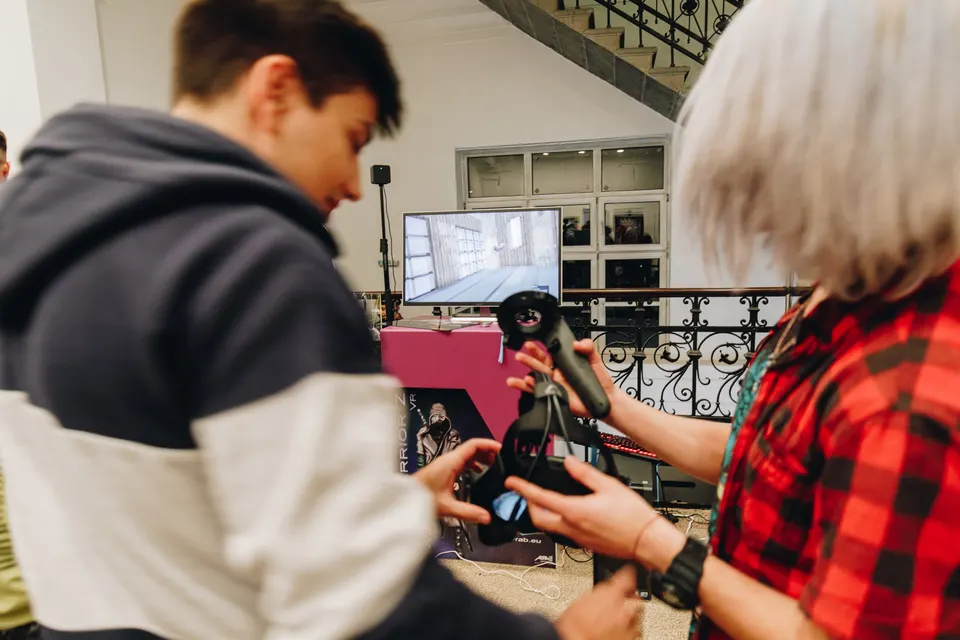
That's how DevHubOne comes about. The young entrepreneurs' company earns the trust of like-minded people and becomes a hub where, every Saturday and Sunday, students are welcome free of charge to get a taste of what modern game development can do. The room is equipped with 16 modern workstations and usually hosts eight kids at a time, who go through intensive training.
Most often they are students around 14 or 15. On the first day Vasil shares his knowledge in a workshop on video game development and game design with Unity. On Sunday it's another teacher's turn—Kosta, who demonstrates 3D modeling in Blender.
“The idea is that during the workshop the kids make their first small project, see what it's all about, and if they want to and they're interested, keep going. After that they can use the room for free twice a week to develop their projects,” Vasil says.
More than 200 students have come through so far. Some of them continue in their professional development, while others go on to different fields, successfully using the knowledge and skills they've gained.
And game development, by all signs, may well turn out to be a needed field even when machines become flawless at writing computer code. Gamification—inventing not just a game, but a way for it to become a useful tool—is as old as the world. We are all Homo Ludens; humans need play.
That idea also underpins the newest venture of Vasil and his collaborators.
Night at the Museum
But weren't we going to talk about a museum, to hunt for treasure?!
Well, the time has come for both. Vasil and his team have a great idea for making museums far more magnetic places for young people. Through story, through storytelling. By turning a visit to each new destination into a treasure hunt.
“Treasure UP” is the name of the platform created by Vasil and his colleagues, which already links four Bulgarian museums—the ethnographic and natural history museums in Sofia and the history museums in Vratsa and Blagoevgrad. Through a mobile platform, visitors hunt for “treasures” in them.
“The idea is to present museums and their exhibits in an interesting and fun way,” Vasil says. “People install the app, and when they visit the museum, they start hunting for treasure—through a series of questions they move through the main exhibition and try to guess the answers. That way they get to know some of the most important exhibits and the stories hidden behind them.
El Dorado
The first questions are multiple choice, the next ones are open-ended, and the third kind come with a picture. At the end of the hunt, tourists receive a medal—bronze, silver or gold, depending on their results. The bronze gives them a camera filter—a photo as if they were part of a museum poster. The silver comes with augmented reality—an exhibit from the museum. The gold medal, earned with at least 90 percent correct answers, unlocks an augmented reality filter on the user's face featuring exhibits from the museum. From Blagoevgrad, a helmet; from Vratsa, a medallion; from the Ethnographic Museum, an amulet.
Then there are rewards beyond the virtual. Every season, tourists who score above 90 percent will have a chance to win physical prizes. And every holder of a gold medal can also receive a 3D-printed coin with a themed image from the respective museum.
The idea is to bring in many more museums; the list will grow every season, Vasil says. The platform is ready to welcome galleries too, and after that all kinds of other tourist destinations.
“The main thing we do is gamification. A game, but with some higher purpose. A game you can learn from, build on, grow with.”
Hidden Treasure
Before this venture, Vasil wasn't much of a museum lover. Yes, he'd visited quite a few, but only after getting to know the subject more closely did he realize how many interesting things he could have seen.
“I was one of those people you can hardly drag into a museum. I'm interested in history and artifacts, but I see 150 stones and a label saying they were dug up somewhere. Every museum has so many exhibits, there's no way I can focus and learn something specific. That's exactly how the idea for ‘Treasure UP’ came about,” he says.
“It's not easy to realize the value of what you're looking at. For example, in Vratsa they have a nephrite amulet shaped like a frog. If I'd just walked past it, I'd have thought, ‘OK, really cool.’ But it's more than 8,000 years old, and to this day nobody knows how it was made. And the Ethnographic Museum has an amulet that looks like it came straight out of the anime series Yu-Gi-Oh! Exhibits like these are very, very interesting and deserve to reach more people.”
Could it be that curiosity really is what matters most? If it's there, each new generation will rediscover what is worth rediscovering. And will keep going. For me at least, the story of Vasil and his students shows this very powerfully. I wonder what the next successes will be—his, and those of the people he has decided to show the way.
It's here, it's alive—the spirit of the National Revival, in its finest modern dimensions. Some stories, some messages and ventures simply pass through time…