Can you tell a real human voice from one generated entirely by artificial intelligence—and in Bulgarian, no less? A serious challenge awaits you, and there are prizes! But before we get to the experiment, let me tell you a full-throated digital story that, I believe, will go on echoing with a timbre all its own.
It's no news that AI generates images and texts that (we checked!) cannot be told apart from those created by humans. Video still seems to lag behind, but… Can you imagine a voice indistinguishable from a human one reading the news? Or calling you on the phone without the slightest chance of you telling the difference? We're not talking about the popular trick of cloning a voice, but about one created entirely artificially that is nonetheless this convincing. And in pure Bulgarian, which is almost impossible for anyone who isn't a native speaker!
And what a challenge awaits you on Tuesday…

The Right to a Voice
Although it doesn't have a commercial name yet (I suspect its creators would welcome interesting suggestions), this is a venture that is already being used successfully in practice. Thanks to the heroes of this digital story, for half a year now listeners of Radio Focus all over the country have been hearing regional news read specially for them by their favorite hosts.
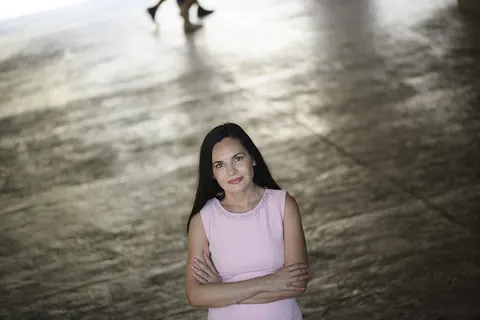
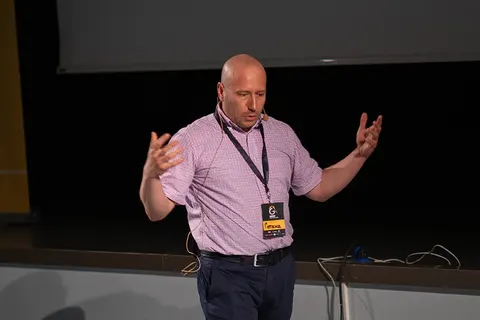
Assoc. Prof. Mariana Todorova and Ivan Vankov (Gatakka). If you follow Digital Stories, these names are familiar to you. Assoc. Prof. Todorova is paving the way for futurology in its modern form in Bulgaria, and every year she joins me for an important conversation about what lies ahead and the big questions we ought to be asking ourselves. Gatakka, for his part, is a tech specialist with vast experience who long ago won popularity for his knack for explaining technology and peering into its future. What could possibly unite these two undisputed authorities? Precisely the project whose skills we will put to the test at the end of this encounter.
A Voice as Sweet as Honey
In an era when the media still face the great task of reinventing themselves, personalized content is proving more important than ever. A personal touch, the right selection, but garnished with the authority that the media (ought to) provide. The conversation on this topic was opened by Assoc. Prof. Todorova, who at the time hosted a regular segment on Radio Focus, and the station's owner, Kiril Naldzhiev.
“Almost as a joke, he asked whether someone could make an AI that would clone the host's voice,” the researcher recalls. “I suggested Ivan, and half-jokingly we decided to experiment. We cloned the voices of two hosts—Bilyana Bozinareva and Zhivko Georgiev. The results were surprisingly good, especially for Bulgarian!”
The joke quickly became a working venture. Since September 2024, the cloned voices of the two hosts have been “reading” eight newscasts every day, different for each of the 11 regions where the station has a local channel. I listened to the news… the result is definitely impressive.
Voices
“It's not that this would be impossible with radio hosts reading the news, but it takes a lot of resources, and the station didn't have them,” says Assoc. Prof. Todorova. “So with one simple solution, Focus became the biggest radio outlet for regional news. This democratizes knowledge, because it makes it more accessible—people who don't have time to read will hear it. People with visual impairments and older people also get the chance to take in the information.”
Personally, I can't wait for regional quirks to be added! If I hear Zhivko Georgiev reading the news for the Northwest as if it had been written by Torlaka in the style of his dialect-soaked “Severozapaden roman” (Northwestern Novel), and so on from region to region… life will become more interesting and colorful.
“Но! вината” (No! vinata, a pun on novinata, “the news,” that reads as “But! The Blame”)—that was the title of the first of what are now more than 450 articles on this site, in which, four years ago, I imagined how technology would take over even more of journalists' work. I don't know about you, but I choose to be enthusiastic rather than frightened that everything I described on the subject in that piece is actually happening. Let the next impressive technologies come; how we introduce them and where we keep the human touch in them is better left for a separate conversation. One so important that it has kept me writing two digital stories every week for four years.
Voiceless, to the Letter
The project of Assoc. Prof. Todorova and Gatakka (tell me they don't sound like a superhero duo!) has proven itself in practice, and it's time for it to grow further. Yes, cloning is getting easier, but… might the next step be a good idea—creating voices, so that under the familiar credit “text read by” we hear the words of people who don't exist?
That is precisely today's challenge facing our superheroes, and how well they rise to it we'll soon have the chance to judge together.
Why would the sound made by a person need to be generated at all? First and foremost, because of copyright. Our voice is our own, just like our fingerprints, and that can always create problems of this kind. That's where the next step of the venture comes in. It is focused on Bulgarian, with the ambition of moving on to other rarer (against the backdrop of the world's diversity) languages of neighboring countries.
Glasnost and Democracy
Personalized news. A newsreader who reads texts selected specifically for us… it still frightens me, however much I lean toward optimism. At the same time, I understand how useful something like this can be if those texts are verified, thought through, presented in context and with sufficient guarantees of reliability and competence.
“In creating content, there is still no way for humans to be replaced,” Assoc. Prof. Todorova says firmly. “There's no one else to do investigative journalism, to write with a particular sense of humor.”
But then a generated voice has so many other applications. Announcements at airports or train stations, for example, can be made by it quickly and easily. Stores that sell huge numbers of items could prepare short information about every product and make it available to every customer. And what about the pharmaceutical industry? Everything important from the leaflets for medicines can easily be turned into audio, accessible to older people too, and even personalized.
Many lessons and lectures could be turned into audio, which would make life easier for students and schoolchildren. In tourism, too, it's easy to imagine the next step—personalized information that is also read aloud in different languages. Assoc. Prof. Todorova can talk at length about the many applications that already seem so close…
Not in the Mood to Sing, Not in the Mood to Laugh
The technology of generating a voice that doesn't exist is a fascinating subject. Yes, lately there are plenty of projects that rely on cloning—an AI is trained on long recordings and creates its own audio based on your favorite actor or host. But a voice out of nothing, one that also copes with Bulgarian, a language exotic for neural networks… turns out to be a difficult undertaking, full of many unexpected challenges.
“Cloning a voice turns out to be surprisingly easy,” says Gatakka. “We use our own model; the entire architecture is ours. There's nothing innovative about it—I went through the papers, saw what works, took the best of seven components and put them together. But when the idea came up to generate completely synthetic voices, with no reference and no data… It turned out to be possible again, but I had to add important things of my own. It requires a new architecture, serious changes and some ideas I'd rather not reveal.”
Can you guess what turns out to be hardest in Bulgarian specifically? I couldn't have—stress. “We've worked magic to feed it in the right way so the model understands it,” Gatakka smiles. “In Bulgarian there are words that have three different meanings depending on where the stress falls! Add context and there are even more. Some 9,000 words in Bulgarian change their meaning depending on stress, while in English there are only seven or eight!
We met with linguists from the Bulgarian Academy of Sciences, and they explained that there are no rules to go by. You get two dice, you roll them, and that's that. “Той бе уверен, че тя ще дойде” (“He was sure she would come”—or, with the stress shifted, “He was assured she would come”). If the stress isn't explicitly marked, how can you be sure you'll grasp the meaning of the sentence? Увèрен or уверèн? The same goes for the models; they can't tell them apart either.”
One of the next steps along this path is to give the voice emotion. Not just reading in a monotone, in the spirit of “the level of the Danube in centimeters,” the water-level bulletin that has droned on Bulgarian radio for decades, but with that certain something—emotion, an actor's touch that can make an audiobook even more than just a book. “It's achievable, but it's hellishly hard,” says Gatakka. “Technically there's no problem doing it; it's just no longer a job for a few people but for a team with very serious hardware. With the right investment, I know technically how it could be done in any language, but it's a lot, a lot, a lot of work.”
Time for an experiment! Will you be able to tell the generated voices from the real human ones? The challenge awaits you on Tuesday!