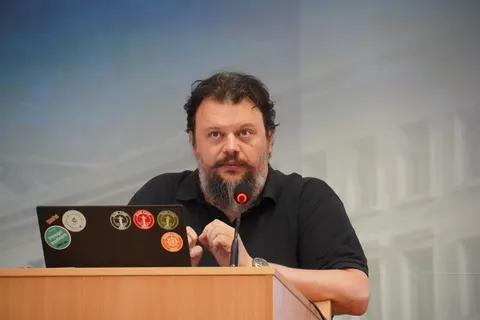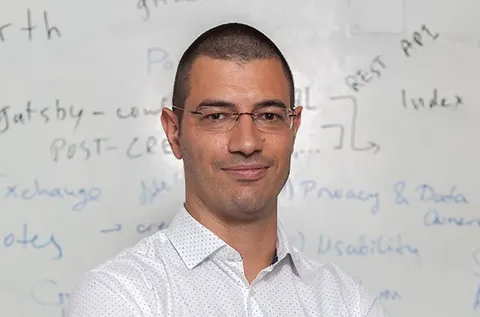
Nikolay Markov is among the specialists paving the way for artificial intelligence to enter every area of our lives. He has spent more than two decades in information technology, yet he trained in engineering physics and macroeconomics. His experience runs from building cloud solutions through cybersecurity to researching and deploying AI.
Today he leads the AI, DevOps and cloud practice at SoftServe. At the same time, at TeamLandi, he is building a system that will give small and medium-sized businesses access to the full range of possibilities artificial intelligence offers.
Why are these technologies here to stay and change our lives? How is it that AI is the first technology that can reach into absolutely every field? What will the future look like?
– I hear you're working on a project that will make artificial intelligence more accessible to companies. Will you tell me a little more?
– With TeamLandi we're launching a product on the Bulgarian market aimed mainly at medium-sized and small companies, because there aren't many solutions for them. It's a complete system that helps them take advantage of the latest advances in AI services quickly and easily. So they can integrate those services into their business through a platform that makes it genuinely accessible and easy to use.
We already have a first version of the product, we're in active testing, and we're getting inquiries from companies. I'll be glad to say more soon, but it's definitely an end-to-end solution.

– What kind of everyday applications are we talking about?
– At SoftServe, a company that has just turned 10, I work mainly on transformations in large companies, many of them in the Fortune 500. I have a lot of experience with all the big cloud platforms. And I can see how,
unlike the cloud, with AI there is simply no field and no task where it can't help.
Absolutely any task a person can imagine can be made easier by artificial intelligence. That wasn't true of any other technology that arrived over the past few decades.
And it's important to keep that in mind from the very start, at the planning stage. Every transformation begins with planning the specific applications. With cloud services, the goal might have been reaching the global market, cutting costs or developing software faster. With AI you don't need to think too hard—it can help with absolutely any task, whatever your business. Look, you're recording our conversation right now; afterward, instead of listening to it, you can have AI summarize or transcribe it for you.
– Except far from always successfully… As a programmer I also see apps like that being rolled out, but they still can't cope; they'd summarize our conversation rather clumsily.
– Yes, it doesn't always work well. But look back in time:
people say this about every technology at the start—it leaves a lot to be desired, it isn't good enough.
I remember virtualization. In the beginning it used 50% of a server's resources and didn't work well. Now everything has moved to cloud services and utilization is above 99%.
In other areas it already does a great job. For programmers, for instance, there are all sorts of copilots that work well. Even ones not tied to Microsoft, because sometimes it matters that the model runs on your own computer. The data may be critical. A friend of mine, for example, works at a firm that deals with patents, and they were using Google Gemini before they realized it wasn't a good option.
If I had critical data, I wouldn't share it with the model.
That kind of data is better kept with you; you can use open-source models, which are quite competitive these days.
There are also hybrid solutions where, instead of everything being centralized and running on servers packed with graphics cards, part of the computation happens in the cloud. It turned out, for instance, that the chips in Apple computers handle small models very well, which is convenient for companies. We had a client with 70 programmers, all on MacBooks, so no additional investment was even needed. Everyone runs a model locally that integrates directly with Visual Studio Code, and that way they avoid all the risks of a remote model.

– And yet, even before ChatGPT, and especially since, I've talked with many guests about how these applications will spread. But I don't get the impression it's happening on a mass scale yet. Why are we so slow?
– With every technological change, especially one this big, there's resistance of various kinds. From employees—fear; caution from the people at the top. A great many technologies get adopted following the “FOMO concept”—let's not miss out on something important. The slowness also happens because most people don't believe in it.
Last year I talked with many companies that think AI is just the latest fad.
Ninety percent of people don't like change, and in large organizations the figure may go up to 95. We recently had an internal study that revealed lower-than-expected use of generative AI in companies. Only 22 percent of organizations said they use the technology effectively across all business functions.
With AI, though, there's something very different as well. When cloud technologies arrived, people could see and understand that this was something they could learn—the transition wasn't that big, just another new technology we'd have to get used to.
Whereas what I've noticed lately with AI is a great deal of fear. Before ChatGPT, this type of technology was used by specialized departments that dealt with the company's data. Now people have become broadly acquainted with it, and many of them are afraid AI will take their jobs.
Put all these factors together and it becomes clear why things are moving more slowly.
Still, the main reason is weak leaders.
Most of the people at the highest levels of the large companies I've worked with avoid risk. For them a technology has to establish itself first, and only then is it adopted. There are exceptions, of course, and with AI you can already see them. Some sense that this really can give them an edge over competitors, and they're looking for partners to pull it off successfully.

– Do you think it's a mistake that lately, when we talk about AI, we almost always mean large language models?
– I don't think so. We're trying to get people to adapt as quickly and easily as possible, to understand what this is, so it has to be as close to their language as possible. Just as elections in Bulgaria are a good example of how, when you speak the language of most people, you get the best results. It's more or less the same with language models.
ChatGPT's main success came because they made the interface easy to use, convenient and free. OpenAI's focus lately isn't on building an even smarter model but on making it as easy to use as possible—now with voice commands too. I love showing people who don't use ChatGPT the paid version right on my phone: you can switch it on and just talk to it in Bulgarian. They're very impressed and start using it, especially now that it's free.
There's another important direction too. Since last year we've been working actively with AI agents, an extra layer that brings open-source models closer to the commercial ones and in some cases helps them reach and even overtake them.
– I recently wrote about the concept of agents myself. What's interesting is that while mass adoption seems to be lagging, everything else in this field is changing at lightning speed. Just a year ago you had to spend hours getting a local model running; now it takes two clicks.
– That's wonderful, because it helps integration. I talk with friends who aren't in our field, and they all agree that
we humans live better solely and exclusively thanks to technology.
And its development is the road to prosperity. So far, every technology has made our lives better. Because of it, each new generation lives a much easier life. Yes, the difficulties are different, but we delegate more and more tasks to technology.
With AI, the breakthrough involves several things. One is the idea that as many people as possible use it to be more effective, and I believe people should be measured by that. It doesn't matter how many hours you work, but what you do and how you do it. Someone can finish a job in 15 minutes; someone else won't manage it in half a year.

That's exactly what large language models do—they let us be much, much more effective.
They're the old X-Men character who amplified all the other mutants' powers. Thanks to AI we can work on more projects, get our work done faster; it saves us time. That's the practice I lead at SoftServe, too—the aim is to work smarter, with fewer time and human resources.
With the help of agents, Sam Altman said that most likely by the end of this year we'll see a single person build a company with a $1 billion valuation. That's why effectiveness matters. Especially with agents, we can form entire teams available 24 hours a day, 7 days a week, solving all sorts of tasks.
And after that, the next big breakthrough will be androids; quite a few companies are making progress in that direction. I expect that within five years we'll be able to buy a fairly sophisticated robot to help us for the price of a mid-range car. Personally, I can't wait.
– Neither can I, although before then we'll have to answer, as always with technology, some rather important questions. But do you think we might soon achieve a breakthrough in computing power? Because right now these models consume an enormous amount of electricity, so much that I read you can tell from the power consumption in the US when OpenAI is training its next big model…
– That's an exaggeration, but it's true that right now every data center under construction is fighting for licenses for high power consumption. At AWS they're reaching 1 gigawatt, and everyone is pushing ahead—Meta, DELL, Microsoft, Meta, X.ai.
We're seeing chips being made for real-time computation. Like with bitcoin—first we mined with graphics cards, and in 2014 purpose-built solutions came in on a mass scale. All the big tech companies are already investing in chips for this purpose, so that NVIDIA's can be reserved just for working on the models. Because right now a large share of them go purely to running them.
As for training—I see very serious money being invested in nuclear fusion. Sam Altman personally, everyone is looking in that direction, toward a breakthrough after which we could produce more energy.
There are many avenues in the search for more efficient energy sources. See how we keep coming back to efficiency…
– And in your view, what is most holding back the next stage of development right now? Computing capacity, the models, or a lack of more data?
– People obsess over data, but that's more of an inner egoism, like back when we thought everything revolved around the Earth.
It's clear that all publicly available data has been used in the models; they've been trained on it. But data also has to be of good quality. We moved past that long ago. A new NVIDIA model, for example, is very well suited to generating synthetic data. I don't think there's a problem with it; there used to be assumptions that a model trained mainly on synthetic data wouldn't work well, but apparently that isn't so.
From a data standpoint, I really don't think we'll have a big problem. In my view the main challenge really is energy. You can see it in all the leaders—everyone is trying to get as many chips as possible. But power takes time. No matter who you are, it takes between three and five years to get a permit for a data center.
Zuckerberg, Altman and Musk all talk about the energy challenges. For the European Union, for example, the main region Microsoft will be developing is Sweden, probably because they've secured enough energy to power the EU's potential needs in the coming months and years. So, in my opinion, the biggest challenge is energy, though I don't expect it to stay that way for long. But it's very hard to predict anything; from one day to the next, astonishing things come out.
– That's true—forecasting in the world of technology is hard, but important. Thank you for this conversation!