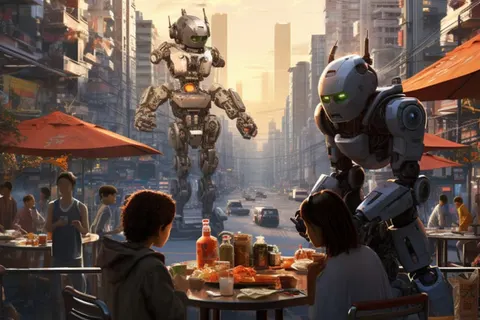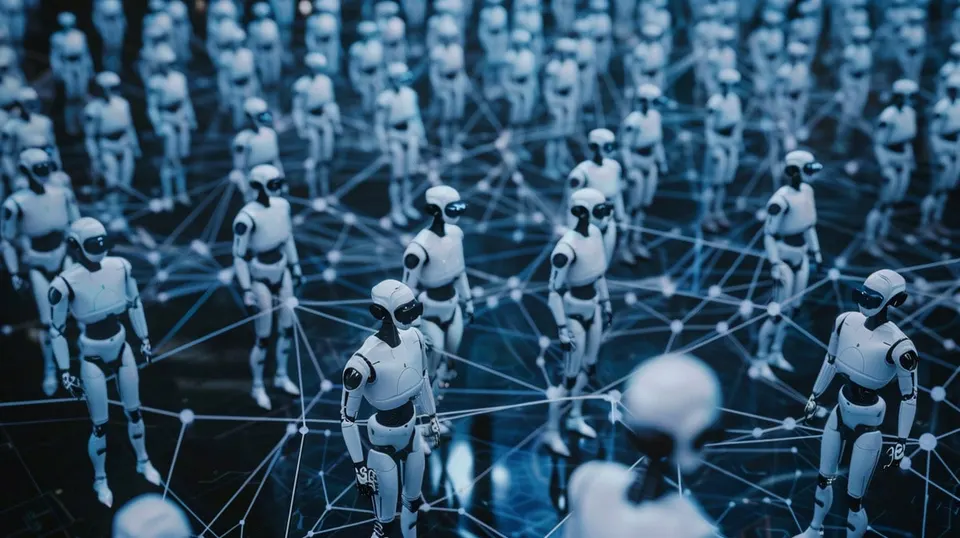
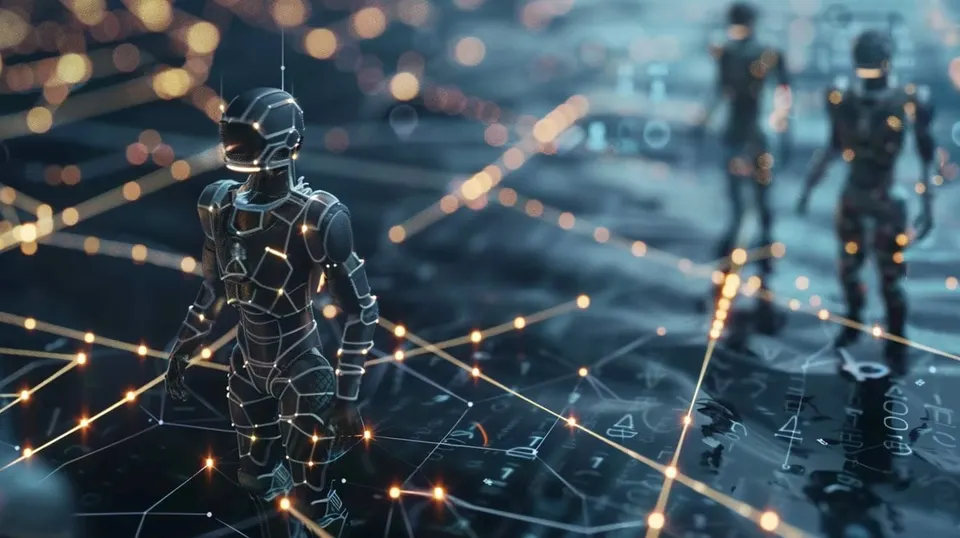
What if we turned the stereotype of artificial intelligence on its head? Instead of a single model we chat with, we face countless separate “individuals.” We hand them tasks, and each works autonomously, specializes in a particular job, accumulates knowledge about it, keeps an eye on the others…
The goal might be, say, to build software. One model learns to formulate the requirements, another writes the code, a third prepares the visual side, a fourth tests what came out and how… and so an entire software company comes together, working millions of times faster than ordinary ones, because it is built not of people but of algorithms.
How far off is that future today?
Not long ago Sam Altman said that this is exactly the direction in which very serious breakthroughs are coming. AI agents are one of the fields of computer science where we expect big news. The next generations of artificial intelligence, able to solve far more complicated and complex tasks while making far fewer mistakes. Many of the leading experts say this is the approach by which we will take the next big step in the development of artificial intelligence. Here is why.

Many Hands Make Light Work
In our part of the world, “agents” remain those mysterious figures who set the political agenda from the shadows—the informants of State Security, Bulgaria’s communist-era secret police. Never mind that 35 years have passed since they last “snitched”: hardly a month goes by without yet another list of files being published.
These agents are entirely different. They are the good guys, like their colleague 007. We are talking about a different concept of how to use artificial intelligence as fully as possible.
Have you ever considered that a… secret agent is roaming around your home? If you own a robot vacuum cleaner, for instance, it meets the criteria of an AI agent, and there is no question it is secret—after all, it never introduced itself as one, did it?
But relax, you won’t find it on the next list from the Files Commission, the body that unmasks former State Security collaborators.
It does, however, fully fit the definition of what an “AI agent” is. Yes, it may be a long way from the complex-task scenario we started with, simply because it sits lower in the hierarchy of such systems. AI agents come in quite different types. Some are already around us, but the more interesting ones are the others—those that will be able to carry out the scenario we began with. To solve complex problems.

Freelance Informant
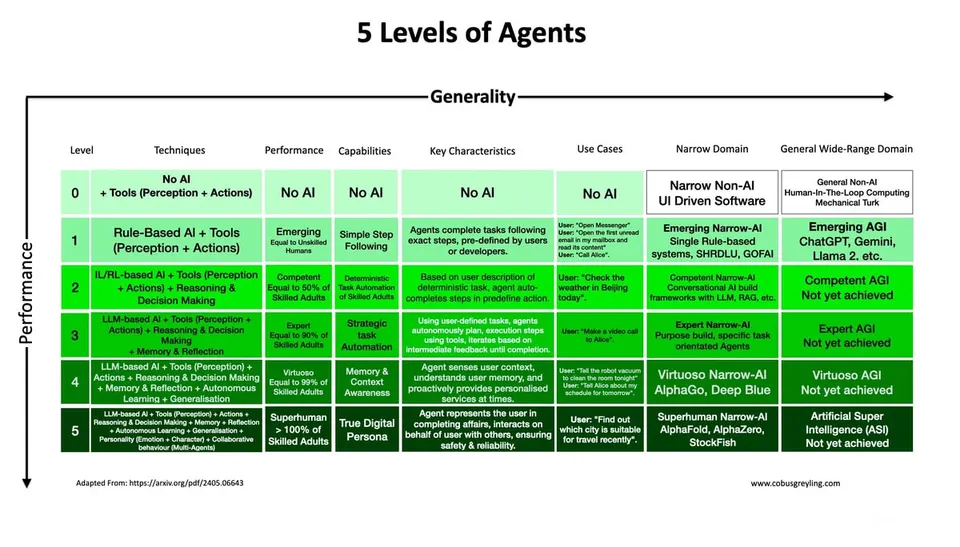
The obligatory short definition: an AI agent is an artificial intelligence program that has been given a specific task. It can be physical, like the vacuum cleaner mentioned above, or purely software. And the other obligatory condition: it must be able to act autonomously within certain limits. Just as the vacuum cleaner decides exactly how to make its way around your living room, but would never go beyond the boundaries you have set for it.
One of the intriguing directions of development is personalized agents. Our own personal superhero, able to help us with so many and such varied tasks. Of course, the future looks quite thought-provoking and motivating once we have the perfect personal assistant. Our very own Jeeves or Watson… or perhaps a personal copy of ourselves, trained to resemble us as closely as possible. Another Georgi, to whom I could delegate only the boring tasks and those I think he would do well. Writing these pieces I would keep for myself, at least for now. (I’ve tried it—it’s fun.)
For the moment, in any case, the development of AI agents that perform a specific, strictly defined task is much further along. One recently unveiled agent, Google DeepMind’s SIMA, specializes in 3D video games. Trained on a given title, it becomes capable of handling some 600 skills—from navigating the game to clearing even the hardest challenges. But… if we delegate the very playing of games to algorithms, what will really be left for us?
Stierlitz
When it was announced, the Devin system was a hit. The namesake of a well-known Bulgarian mineral water promised to do exactly what we began with—to create software with the help of agents. Its unveiling became huge news in the software world. This was a pioneering development in the field, one already ready to take on a full 13.86 percent of the work… which, in such an expensive and highly specialized activity, adds up to quite a lot of money saved.
You simply give it the task and it does everything else—from the concept of how the program should look, through the architecture, the writing of the code itself and the tests for it, to the testing. The demonstration was more than impressive, because it really did look as if the first “AI software engineer,” as its creators called it, could take the bread out of many people’s mouths.
Yet, at least so far, there has been no word of the system entering widespread use. Most likely it has still turned out to be more expensive to have software specialists check and fix everything that didn’t go as it should than to build it themselves.
Still, let me say it again: this is a pioneering development in a field where progress happens extremely fast. It is enough to point to the speed with which algorithms learned to create images. Or the opposite—there are areas where progress seems to have stalled.
Recently the well-known researcher Andrew Ng wrote that, in his view, AI agents are the next big direction in machine translation. Because they can easily work on several levels, agent after agent assessing how well the previous competitor has done and improving on its result.
Hand in Hand
Of course, the idea is by no means new. GANs, the networks that were the first to prove capable of creating human faces indistinguishable from real ones, work on this principle: one neural network aims to generate, while the other works to judge how well the first has done.
And yet the next step became possible with the development of large language models in recent years. Ventures began to swarm that let a person build a small army of agents with all kinds of goals. For example, harnessing several instances of ChatGPT to talk to each other in search of a solution, debating until they reach a consensus. Here is an approach in which the answer to a given question would be much better and largely free of the great flaw of this type of model—hallucinations.
One example of such a tool is AI Agent, an app in which you simply pick a name, assign a task to your AI agent, choose a GPT model for it to use and watch the result. Minimal programming knowledge is needed, and soon it will probably be possible without any. Another popular project offering similar possibilities is AutoGPT. And BabyAGI too… but wait, a baby artificial general intelligence—are we really that close? We’ll get to that as well.

Miss Congeniality
Unlike a chatbot such as ChatGPT, agents don’t need you to keep sending them questions, instructions and assignments. In this approach they work until they achieve the goal set for them or hit a given limit. That is precisely why today’s heroes are considered the next step in the development of artificial intelligence—because of their independence.
AI agents become a powerful weapon when they have the opportunity to improve, to learn. Yes, our vacuum cleaner also has a sophisticated artificial intelligence that knows the optimal way around our home, but all of that happens within given rules. If an agent we ask to work as a journalist can improve based on feedback, if over time this makes it better at its tasks, then things become not only interesting but limited almost solely by imagination…
Welcome to the first virtual town! A year ago, researchers at Stanford University used OpenAI’s models to create an entire “settlement” inhabited by 25 virtual agents. Each had basic memories and a personality, and they were set loose to live their software lives in their virtual town—something like a video game. The 25 were given names, ages, professions, families, interests and innate habits. From then on they were left to interact without any additional instructions, guided only by the large language model.

The Files Commission
The result? Gradually each of the “people” developed a character of their own; some even fell in love and wished each other a happy Valentine’s Day. In the end, what emerged was something resembling a real human society—the characters communicated, remembered information, reflected on their experiences and made plans for daily activities.
That is why agents are thought to be extremely useful for the next level of simulations. With their help we could, for instance, study different forms of interaction many times faster than science does today.
I have already written about the dispute between the “structured” and “unstructured” approaches to developing artificial intelligence (here and here). According to many experts, we are already close to the limits of large language models in their current form, and either they have no way of leading us to the much-vaunted artificial general intelligence, or they will, but at the cost of very serious dangers.
Well, for some scientists the solution lies precisely in developing more advanced AI agents. They can have different architectures and even follow entirely different ways of interacting. But they complement and check one another, showing only their strengths. And in this way they lead us onward, toward an artificial general intelligence that will surpass humans, the next step toward a possible singularity.

The X-Files
And if everything so far sounds rosy, the concept naturally comes with its risks. Because the more activities we delegate to technology, the greater both the responsibilities and the risks become. As the analyst Reece Hayden puts it, on top of the problems already inherent in generative AI—hallucinations and bias, for example—agents could be capable of even more mistakes.
“When you give them the autonomy to iterate, to change their answers, to respond to feedback, this leads to far more serious and deeper hallucinations. The tasks become more complex, and every small mistake can lead to further, much bigger ones.”
He expects that in three to five years we will already see widespread use of automated AI agents carrying out complex operations from end to end.

A Past as an Informant
Another risk, which Google DeepMind researchers warn about, has to do with ethics. If even today it is increasingly easy for us to perceive ChatGPT as “something like a person,” the additional anthropomorphizing that comes with agents, the ever more personalized service, “could make people much more vulnerable to inappropriate influence by the technology.”
“AI assistants could radically alter the nature of work, education and creative pursuits, as well as how we communicate, coordinate and negotiate with one another, ultimately influencing who we want to be and to become,” the authors write in the paper.
And so, as it turns out, advanced AI agents are already knocking at our door (only metaphorically, for now). Perhaps the moment when that knock leaves the metaphor behind won’t be so bad after all? We could use this kind of technology for so many interesting, unexpected applications. To free us from so many tedious tasks, to help us advance science. As long as, this time, as never before, we hold the important conversation in time. The one we never seem to have time for, and the reason this site exists. About technology, about the way we use it. About the way it often imperceptibly and irreversibly transforms our lives…