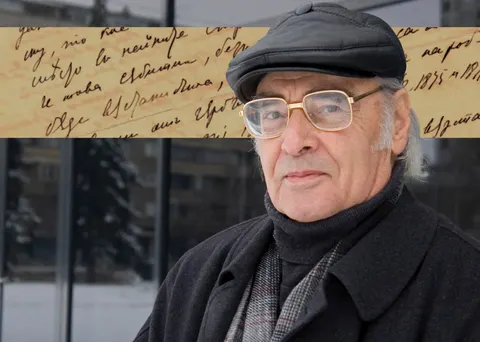
A fateful 13 years have passed since this interview with Anton Donchev, and his words sound even more urgent now. The writer passed away on October 20, 2022, at the age of 92.
“What will the world look like in a century? We know nothing—whether all this horror now unfolding won’t give rise to a new branch of science. Whether some microbe won’t pop up… The thing is, humanity today lacks the art of synthesis.”
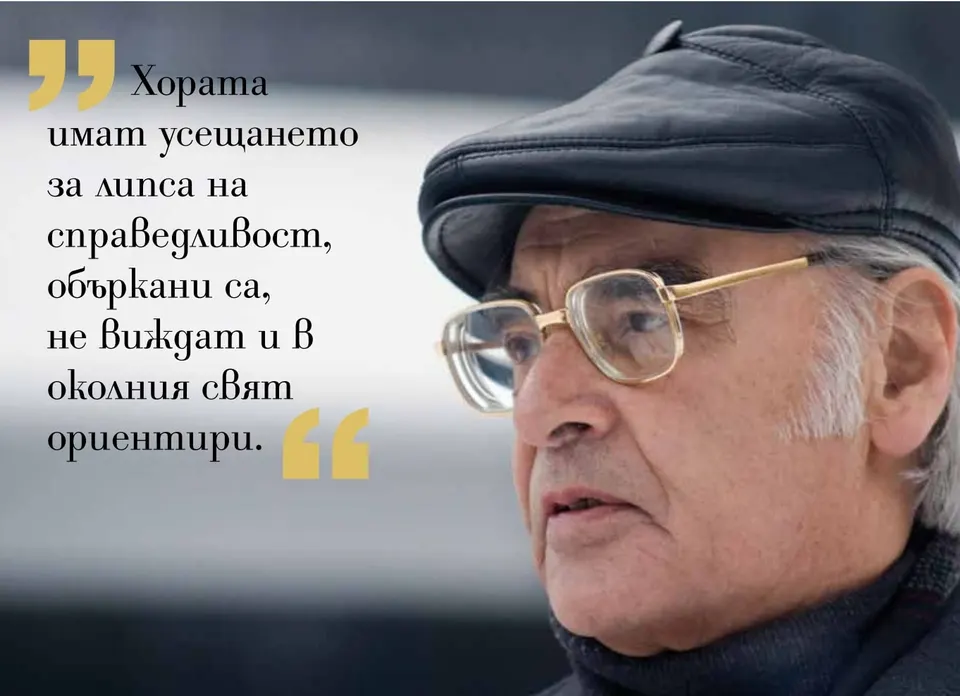
“People feel there is no justice. The great loss of these last 20 years is the confusion about the place of the spiritual and the material in the life of the individual and of society.”
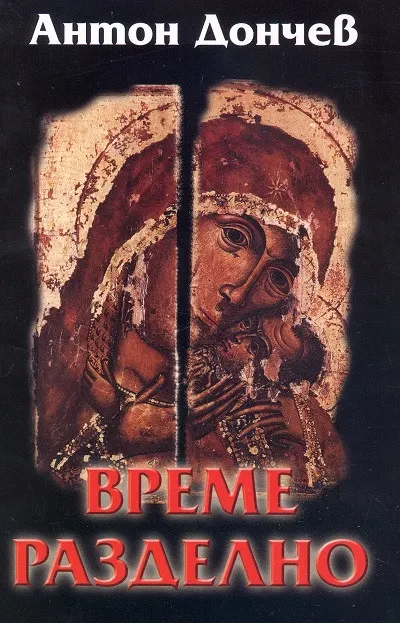
The writer is best known for his historical novels, and the most popular of them by far is Time of Parting, which sold more than 1 million copies in Bulgaria alone and has been translated into more than 30 languages.
Born in Burgas in 1930, Academician Anton Donchev studied law but gave up a legal career for literature. His other well-known works include the novels The Strange Knight of the Holy Book, Skazanie za han Asparuh, knyaz Slav i zhretsa Teres (The Legend of Khan Asparuh, Prince Slav and the Priest Teres) and Trite zhivota na Krakra (The Three Lives of Krakra).
The interview was published in issue 2/2010 of Spisanie 8 (8 Magazine).
– We have only just entered 2010. What, in your view, sets us apart from the Bulgarians of 50 or 100 years ago?
– These 50-year spans separating 1910, 1960 and 2010 are literally chasms. For Bulgaria, 1910 is a year of ascent; the whole country is full of self-confidence. It has just declared its independence, and in two years the Balkan War will begin.
The Bulgarian’s field of vision is narrower than today’s, but the horizon is not foggy. I remember 1960—I was 30. Bulgaria had begun to get back on its feet economically. Seven years after Stalin’s death and 15 years after September 9, the day of the 1944 communist takeover. Economically you could say we were moving forward; psychologically, the nation was already sliding back.
It was isolated from the world. Existence itself was a lie. That constant need to think one thing and say another, to be one person at home and another outside.
This split personality could not help but lead to the erosion and dissolution of society as a whole.
But as with every pressure and depression, there were positive traits too—a concentration of thought, a desire to break out in another direction. Art seemed to stir; there were a few figures in literature, painting and music who, despite the atmosphere, created things that 50 years later are still Bulgaria’s calling cards.
– What do we look like today?
– Bulgaria today is dressed in rags, underfed, desperate. Fifty years of a totalitarian state, 20 years of chaos. These things will be studied by psychologists, by psychiatrists, by unbiased historians, and
I suppose the label stuck on them will be national tragedies.
People feel there is no justice. The great loss of these last 20 years is the confusion about the place of the spiritual and the material in the life of the individual and of society.
There’s a terrible but telling joke. The teacher asks the children what they want to be when they grow up—one wants to be a cosmonaut, another a driver. And little Ivancho says… “I want to be a dirty bastard.” “What are you saying? Why?” the teacher exclaims.
“The other day a convertible with three or four chicks drove past us, and my dad hissed ‘dirty bastard…’ I want to be like him.”
Values have been lost, and in their place a conviction has settled in that some things, which demand years of patience and a lot of work, can fall into your lap from the sky.
That people whose names nobody knows can appear and become leaders of the state.
– Isn’t it the job of intellectuals to awaken the people?
– Intellectuals, first, create culture and, second, preserve it. In Bulgaria right now they do neither, and nobody gives them the chance to do anything at all.
The great mistake, the great sin, the great blunder is the rejection of culture.
I mean culture as a unity of education, science, art and morality. What is happening to culture, education, science, art? Who monitors the level of Bulgarian culture the way they record the level of the Danube? Bulgaria will not solve its economic, political, moral or any other problems unless it solves those of its culture.
The individual and every society are born nearsighted, like puppies and kittens. I have 11 diopters; when I take off my glasses, all I see are blotches.
For nations, the glasses are culture, which helps them see the world,
find their place in it and only then begin to change it. We can earn the human right to touch the world, to shape it, once we understand it. Every year the UN publishes charts showing how much money each country spends on culture. The peaks of the US, Sweden and Germany stick up. We’re not there; we vanish.
For us the Earth is Bulgaria, a part of the Balkan Peninsula that is unique, with its own inner life and laws. If the climate is changing, it happens differently here. And what to do about it, only scientists can say—which crops to focus on, where to develop irrigation, what to do for our forests and our waters, what to do for the health of our people.
The garden of science needs constant watering.
There is also the problem of identity. World culture is an orchestra in which everyone plays their own national instrument, and there is no music without the violin, the flute… without the Bulgarian gadulka, our folk fiddle, too.
Hard as it is for me, I have to say that I don’t see anyone taking care of this.
– What do you think we will look like in another century?
– I have written science fiction novels and I love to fantasize. But in this case the fantasy has no direction.
We know nothing—whether all this horror now unfolding won’t give rise to a new branch of science.
Whether some microbe won’t pop up.
Or whether the Sun won’t take it into its head to kick like a mule.
The thing is, humanity today lacks the art of synthesis. With some wild passion we gather facts, knowledge, data and pile them up and up, without seeing how they interact. We are like people who pick fruit, kill animals and freeze them, without it ever occurring to them that they cannot eat it all. We have an enormous amount of knowledge, but we cannot draw any benefit from it.
We have no minds, no branches of science, that would seek the great meaning. We cannot answer the question of whether mobile phones, or something that will pop up tomorrow, won’t be the end of humankind.
Do you know what wisdom is? Foreseeing the distant consequences of your actions.
We are simply not wise.
– Do we have talented young writers?
– I read quite a lot, and I had the fortune and misfortune to sit on the jury of a competition for the best Bulgarian novel. I read 66 novels written in a single year.
In 1950 I read a report that reviewed the 12 novels written that year. Now we have five or six times as many titles.
The level of our literature is good. The level of Bulgarian poetry is very good. But the problem is something else. In that same competition, the winners were supposed to be published in English. That doesn’t happen, though, because it comes down to the following dialogue with the publisher over there. He reads the book and asks us how many copies have been sold in Bulgaria. We answer 500, 1,000, at most 2,000. And the Englishman says, “You can’t sell your book in Bulgaria—how do you expect me to sell it in England?”
Literature is a partnership and co-authorship between writer and reader.
If a nation wants to have a literature, it has to take care of both sides. We need to promote our literature, to reach the Bulgarian reader; otherwise it will remain a little circle—the last Bogomils, followers of the medieval Bulgarian heresy, gathering in the woods and chatting: Ivan has written something, Dragan praises it.
Every day in Sweden a book comes out paid for by the state. Excuse me, but what’s stopping us from doing the same? It has been proven that, as a commercial activity, it covers its costs. When 550 bookstores in Sofia were sold off, Bulgarian literature was killed. Because if you want there to be a god, there have to be temples too.
What kind of god is this, whose temples you take away, sell off and turn into boutiques and tripe-soup joints?!
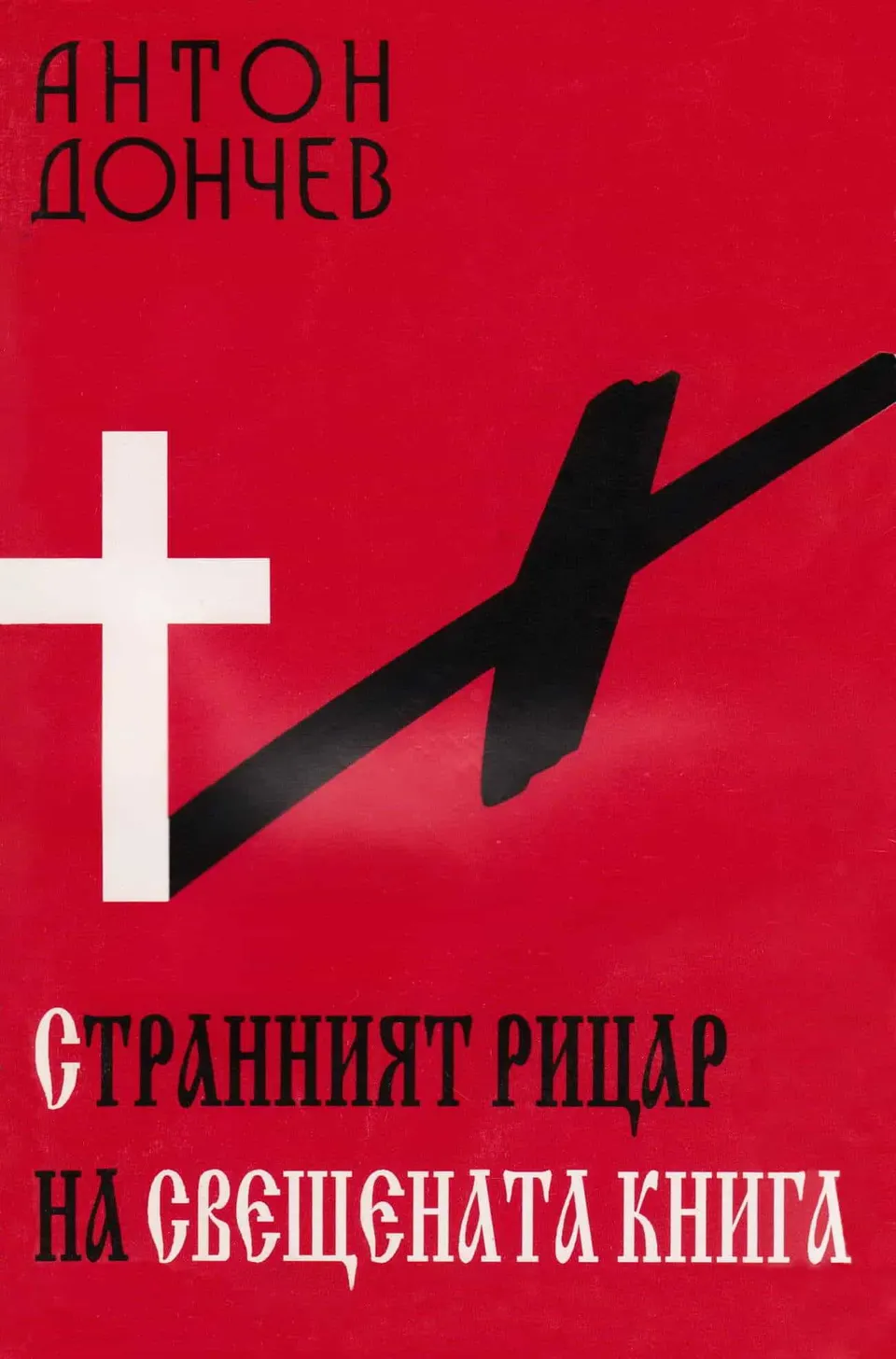
– My favorite of your books, The Strange Knight of the Holy Book, tells how Bogomilism reached Western Europe. What don’t we know about the Bogomils? Can they be a source of pride for Bulgarians?
– In purely theoretical terms, a lot is known about the Bogomils. For the ordinary, average Bulgarian, though, they remain a mystery. You used the word “pride”—I steer clear of such a phrasing.
Pride is one of the seven deadly sins. On the other hand, it seems accepted that people feel pride in one thing or another, and that gives them strength and inspiration. The Bogomils are an astonishing manifestation of the Bulgarian spirit in the Middle Ages. They matter not only for themselves but for what followed them.
– How do you explain the fact that the teaching started precisely from our lands?
– The ninth century: almost no people can read the Bible. There is a translation into Gothic, but there are no Goths. Everyone knows how few read it in Hebrew; in Latin only the priests, and only some of them. Only in Greek do more people understand it. The English get a translation only in the 13th century, the French in the 14th, the Germans in the 15th, the Russians only in the 18th–19th century. In other words, the holy book does not reach the ordinary person.
Only here, on this patch of land, do the rulers make their people get to know Holy Scripture in their own language.
In just a decade, Boris I, the ruler who converted Bulgaria to Christianity, organized the training of 10,000 Bulgarian priests. The state managed to produce 10,000 Gospels on parchment in our language—they must have skinned 100,000 cows for that. Thousands of churches were built, and seven enormous cathedrals—we have one in Pliska, the first Bulgarian capital, with its foundations preserved, and one on the island of St. Achillios. These are huge achievements of construction and architecture.
And the Bulgarians begin to read Holy Scripture, something unbelievable for that time, as if today every other person had a university degree.
This is an absolutely unique moment in the cultural history of Europe. But also a tragedy for the official church, because suddenly people see that what the priests preach is not in Holy Scripture. There is no patriarch, no bishops, no priests. No gold on the altars, and, if you like, no churches either.
And these shepherds and soldiers—because back then every man was a soldier—say to themselves, “Hey, what’s going on? These people are making fools of us.”
I don’t know why some are still puzzled about where Bogomilism came from. It’s in the Acts of the Apostles, in the very first few pages. Even the rituals are there—the breaking of bread, for example. At its heart lies the discovery that faith,
the true religion of Christ, has nothing to do with hierarchy, money and hypocrisy.
– What were the consequences of this in Western Europe?
– It starts in Bulgaria, passes through Bosnia and later turns out to be the cause of the Bosnian tragedy. Because Mehmed II the Conqueror managed to turn the Bogomils into Muslims. The teaching goes to Northern Italy, to Southern France. Its followers are called bougres, Cathars, which means the pure ones, they are called Torbeshi—they carried everything they owned in bags. That is why they became the most dangerous heresy imaginable for the official church—both Orthodox and Catholic.
Both St. Francis of Assisi and St. Dominic are children of Bogomilism.
I don’t understand why Western Europe resists this, but for these people, when they were burned, the records of the Inquisition say they were bougres. They struggle to claim they were brought over by Byzantine slavery; then they want to prove they came from North Africa, that St. Augustine planted them 500 years earlier. The truth is that the flame was lit here. The authorities put out the fire in Southern France, and Northern France gobbles up Provence.
But they cannot swallow the souls and the knowledge. This thing spreads through the Middle Ages, passes through Jan Hus, through the Enlightenment, and the ideas of Bogomilism become the cause, the spark that lights the fire of the Enlightenment. Right here where we sit is where the fire blazed up and managed to illuminate Europe. And
it ought to be shining to this day, but we ourselves don’t dare toss in a log each, because we are too lazy.
– Another subject that draws you is the life of Nicholas Roerich. Does the East have things to give us that we are too closed off to receive?
– The East gives us Japan, China, India. And India alone is an abyss, such an ocean that even the Indians cannot comprehend it. There is a history of Indian philosophy by Radhakrishnan. If you have the patience and the nerves to read it, you’ll realize that to touch the East you have to give it a great deal of time and a great deal of energy. There are three or four thousand concepts. Part of this philosophy counts not six senses but 26.
It works not only with the consciousness of the normal waking person, on which our European, Greek philosophy was built. It is a philosophy of the sleeper, the waking, the madman. We encounter an incredible world we are not prepared for. The whole path we try to walk, paved with our concepts, values and so on, is so different from the path India follows that it is not clear whether the two can ever meet.
To be recognized as belonging to raja yoga, you must not utter the word “I” for three years. Tell me,
how can the two philosophies meet, when the foundation of our Western one is the Self?!
To read Radhakrishnan you need two or three months, to understand him two or three years, and to feel him… We are in a hurry, we have no patience, we lack depth. We are superficial, lazy…