How did we lose the ability to wait, and why does it matter that we get it back? Will we manage to learn how to be bored well when technology supposedly frees up our time? What will the last book written by a human say?
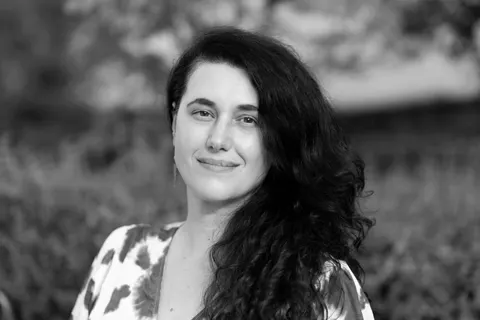
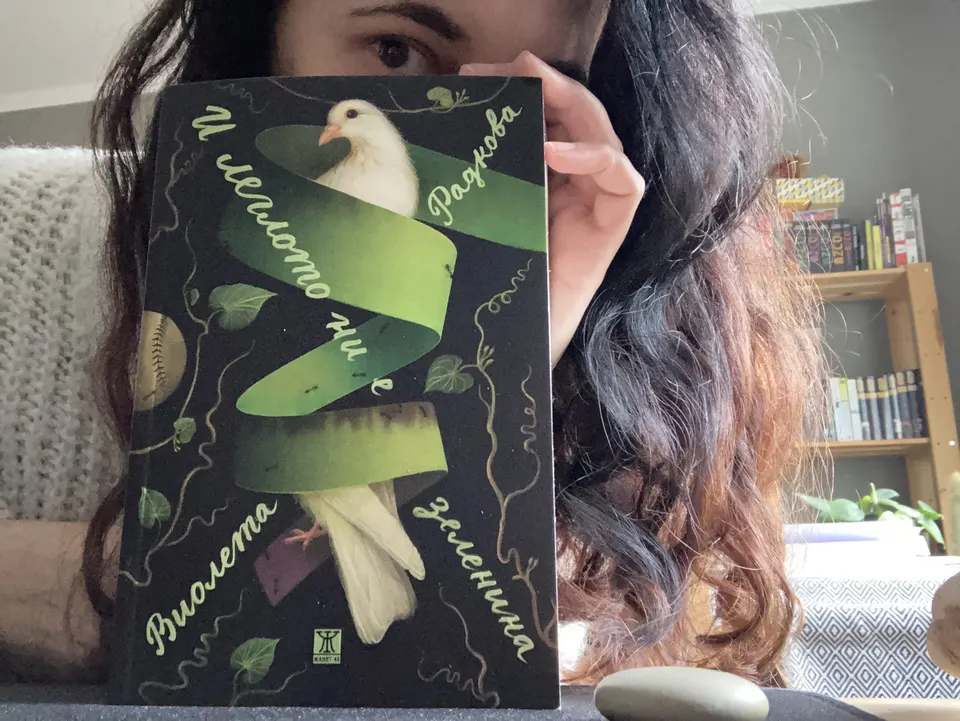
Violeta Radkova impressed me with her debut novel I legloto ni e zelenina (And Our Bed Is Green). She is an interpreter and an editor of translated literature, the host of the podcast Chetene mu e maykata (Reading Is What It's All About) and the managing director of the Elizabeth Kostova Foundation.
Her book rests on the memories of her great-grandmother, written down in a grocer's ledger, while she wrote much of it on her phone.
Caught up in the present, we talk about the future and the past, the fast and the slow. About books and meaning.
– And Our Bed Is Green made a strong impression on me—its characters, its language, and its stories, which felt very close to me personally. Do we all need a little more greenery?
– I hope so. I hope the thought of greenery, in every possible sense of the word, matters to many other people too.
– When do stories from the past give our lives meaning, and when do they harm us?
– The harm comes from substitution—
when one point of view declares itself the true one, seizes a narrative and makes it its own so it can use it for manipulation.
When we read stories from the past, we have to do it critically and keep asking questions. And, of course, not rely on a single point of view. That's about big History. But what interests me are the small stories—preserving a person's memory, not letting them be forgotten. That is an individual responsibility, a voluntary one. My wish is for people to be remembered, mentioned, talked about.
– I think that even today the “small” stories are what give the big ones meaning—that's why this site is called what it is. But while we're still on the past: in recent years I've read four remarkable new books by Bulgarian authors that take us back to the 1910s. Why do you think that period turns out to be so interesting?
– I have no idea about the others, but that period has always interested me, and I've spent a long time with it, including in literature. It's when literary modernism was born, for me the most interesting movement in the modern cultural history of humankind. It was a time of breaking with tradition, of experiment in literature and art, but also of looking deep into the human soul.
The years before the First World War were also a time of optimism, thanks to technological progress, achievements in science, and people from the back rows of society stepping forward. Besides electricity, cars and cinema, we have Einstein and Planck, Freud and Jung, and the feminist movement is being born.
Man stands at the center of a utopian euphoria.
Naturally, the great war blows it apart. The period is especially interesting here, in the Balkans, in Bulgaria, where many narratives are layered on top of one another—refugee, entrepreneurial, peasant, bourgeois, enlightening, bloodthirsty. In just a few years we lived through three wars, persecutions, a host of shattering events. It's natural for a writer to be drawn to that. But what occupies me is still the personal story unfolding against the backdrop of the big one. If the personal story I care about had happened in another historical period, then my book would have been set in another time.
– Could it be that today we're looking for, or finding, parallels with that time? You mentioned it, but I hope it isn't… hmm, the association with a big war on the horizon?
– Periods of (apparent) stability are preceded by crisis. Crisis is inevitable;
the bubble has to burst sooner or later. That is always tied to suffering, both individual and shared by all of humanity,
the scale is what differs. But crisis and suffering are part of our existence as living beings; they “marinate” us and make us more resilient. Some people may well look for parallels with that time, maybe even call for it to come back, but I feel no nostalgia for it—I simply imagine it, because that serves my story. I'm not nostalgic about any past era, but past eras fascinate me, far more than the present, because I haven't lived them, I wasn't there, and I'm so curious; I want to know what it was like, how it was.
One of literature's greatest gifts is the chance to travel in time and inhabit lost or nonexistent worlds.
And for me in particular—the chance to talk with the dead.
– Today that seems “easier” than ever—we can create virtual doubles. Wouldn't it be easier?
– I talk with my ancestors and other people who are already on the other side all the time, not necessarily through literature, but quite literally—I look at their photos, or imagine them, and talk with them. They talk to me too, and I try to hear them. I don't know how I could create virtual doubles of them, or what use they would be to me.
– Does history repeat itself? Why is it so exciting even online, and yet unable to keep us from repeating the same mistakes?
– History repeats itself, and I think that's common knowledge. It can't protect us because it isn't supposed to; that's not its job.
It can only remind us; whether we protect ourselves, and how, is our business.
But nothing can stop a human being from wanting to see how far their will can reach. And that leads to crisis, because that desire has to be stopped somewhere, and then everything starts over. These are natural cycles; I don't think we can control them, but it's good to be aware of them and prepared.
– You wrote the book over seven years, and it reads slowly, too. What are the pros and cons of slow writing and slow reading?
– You're the first person to tell me it reads slowly—I'm quite surprised, because I very deliberately tried to write it so it would read fast. I'd be glad if it's a book you'd want to reread, mostly because I played around a lot encoding things in it, and I'm delighted when someone finds them.
As for the seven years, it quickly became clear to me that this was a process I couldn't control and that didn't depend entirely on me. I had to submit a great deal to reality and to what was given to me or, as the case may be, not given. If it had been up to me, I'd have written it in much less time, but that's how it went. On the whole I'm not a slow person—quite the opposite, I do everything quickly—and the fact that outside circumstances kept slamming on my brakes upset me a lot at first, but in the end it changed and tempered me a great deal.
I learned a lot from that long process, above all that I can write anytime and anywhere.
I wrote most of the book in the Google Keep app on my phone,
while doing something else or being somewhere—riding the metro to work or standing in line at the store. I'd just take out my phone and write down whatever was speaking to me at that moment, no matter where I was, who I was with or what was happening around me. Later I'd transfer what I'd written to the computer and edit it there if I thought it needed it. Most of the scenes stayed just as I wrote them on the phone, and you can still see them there; they're just sitting there.
I have no recipe for reading. I read two or three books at once and somehow manage to be in two or three places at the same time. Sometimes I read fast, sometimes slowly, I take notes—it depends on where I am and how much time and space I have. I read always and everywhere; if I don't have a book or an e-reader with me, I read on my phone (which, by the way, is small and no good for reading), and
if I don't have a phone either, I'll read whatever I find, labels and packaging included.
– Will we manage to get our attention back, the skill of being bored well? Shouldn't it become a value precisely now, when technology frees up more and more of our time?
– I'm a huge fan of being bored. Without it there is no creativity,
no urge to play. I adore playing and try to do it constantly and in every possible way. Writing is a game for me—while I write, I play, but at the same time I create a game for readers, because I want them to play with me too. And technology ought to free up our time for exactly that—for play. The thing is that,
while supposedly freeing up our time, technology keeps us captive in other ways.
That freeing of time is, for now, imaginary. But here too we'll hit a crisis, and something will happen.
– My thoughts run the same way, but what will it be? In the novel, the main character's relatives go for years without knowing whether he's alive. Not so long ago, finding out a football score could take days or weeks, and today if we don't learn everything that very second, we get frustrated, edgy, angry. Is that good? Is it reversible?
– We get angry if we don't get instant gratification, because now we have the chance to see most of our wishes fulfilled instantly.
Besides losing the ability to be bored, we've also lost the ability to wait, to be patient.
But I still think that just as a baby is weaned and learns to wait for food without crying, humanity will be weaned off quick gratification and learn to live without it. “Човек знае две и двеста” (chovek znae dve i dvesta, literally “a person knows two and two hundred”) is a lovely saying that reminds us we are flexible creatures: whatever fate serves us, we'll be able to take it and cope.
– Unless we've lost that skill for good, drugged by the easy life. What do you think: was it harder a little over a century ago, or is it harder today, to be brave enough to pursue your dreams, your love? To be different, to have your own opinion?
– I think it's equally hard. Today we have more material comforts that were missing in the past.
My grandmother's family of nine had a single spoon,
which everyone at the table took turns eating with. Now we have a hundred spoons, but so what? I'm not braver than my grandmother—quite the contrary.
A settled life is no precondition for courage or for dreaming more broadly.
Just the opposite—scarcity breeds resourcefulness, lack breeds inventiveness. I dream, but I know my grandmother dreamed too, that she loved, and how! The fact that she only went to school through fourth grade and worked in the fields doesn't mean she wasn't different or didn't have her own opinion.
Today we have more words for these things, we read more, we're better educated, we can check our knowledge against other people's, and talking about feelings is considered normal. Back then, the surroundings imposed limits; the impossibility came from outside. Now it comes from inside, from limiting beliefs, from inner fears. We
care far more about how we look in other people's eyes and censor ourselves at every step, because our lives are on display.
So how can we be free?
– Your great-grandmother wrote her memories in a grocer's ledger, and you said you used your phone. If the story happened today, she would most likely post them as stories that vanish after 24 hours. Can these eras and these ways of telling stories meet?
– They probably can, but I don't see the point. It would be good for humanity to write and read outside the digital scroll, too.
– What does technology change in storytelling, and what will it never touch?
– Honestly, I don't think much about it—about technology, I mean. In fact, I don't think about it at all. It probably changes everything, because, as far as I understand, it's replacing us more and more successfully in writing anything at all. But technology doesn't love to play, and humans do. So I suppose it won't take from us the joy of creating, of playing.
– After letters came telegrams, telephones, messengers, and even TikTok. What faster and more ephemeral thing is left to invent?
– I have no idea, because I don't think about it. Maybe I should, but I don't; it doesn't even occur to me. I think more about living things, about nature, about water. I'm very interested in the future of water, for example. Those things interest me much more, because we can't do without them. But
we could do without technology, and we still will be able to.
– Is there a technology you can't wait to see? And which one would genuinely frighten you?
– I don't get excited about any technology. What interests me is whether there will be drinking water for everyone on the planet. What genuinely frightens me is an AI-generated voice, and the possibility of technology deciding humanity's reproductive rights.
– For me, the experiment that showed readers can't tell my text from a generated one was disheartening. How do we find the positive sides and the opportunities here?
– Let humanity have its fill of playing with technology and come back to itself—if not on this planet, then maybe somewhere else. There are probably positive sides, but, as I said, I don't think about it. I don't play with AI, I don't use it for every little thing, I don't deal with it.
– What will the last book written by a human say?
– I hope it's a lullaby, though I wouldn't mind if it were a recipe for stuffed peppers.
– How can we tell that your novel wasn't written by AI?
– I have no idea. Maybe AI would smooth things out so there'd be no snags and no dross, it would fix my mistakes (whatever that means to it). I suppose it would edit out whatever seemed too unusual to it, too potentially unsettling. So
you'll know me by my rough edges.
– When will it be time to stop writing?
– Never, I hope. I hope it won't be within my lifetime.
– What is the first thing to be lost in a language written mostly by machines?
– The sense of humanness, of an emotional being behind the words.
– You say that when you write… you code. How so? Isn't writing computer code a boring, monotonous, repetitive task, unlike real art?
– But doesn't coding demand creative solutions and inventiveness? Just as a programmer can slip something of their own into the code they write, I love planting Easter eggs and hidden levels in what I write. In that sense,
yes, I code, because I think through how this code of mine will work, where it will go, how it will have different degrees of concealment and difficulty to decode.
I code because, as I said a moment ago, while I write, I play. For me this book is also a game book. It has encoded messages for whoever finds them. One translator found a linguistic code at the very end of the novel's third part; a writer decoded the whole game with the Bible for me. Those things make me very happy, because it means those readers, like me, were playing.
Of course, there are things no one will ever discover, but that still makes me happy—I know I put them there.
– You translate and edit translations. Hasn't the end come for that skill and art?
– I don't think it will come. It's the art of close reading and of making connections. AI tends to make obvious, predictable connections, while a human being is unpredictable, impenetrable, and so the connections they make can be quite unexpected. Editing a translation requires deep knowledge of both languages, of registers, of emotional nuance. AI is well trained in English, but the same can't be said for Bulgarian, at least at this stage. It doesn't catch registers either, let alone the emotional charge of words. Besides,
it tends to even out, to level, to smooth over, to erase the oddities, while fiction is a wild, strange plant
that can't be neatly shaped to a mold.
– Is there a text a machine can write better than a human?
– It depends on what you mean by “better.” AI writes correct, well-structured poems, but that doesn't make it a poet. It can only imitate. It can use meter and know what a metaphor is. But that doesn't make it a poet either.
A poem is an emotional picture in motion. AI has no feelings; it can only imitate the motion. Instead of being afraid, we should be aware of that. We can be amazed, even admire its abilities, but
we mustn't forget that this is not a being that feels, and behind what it writes there is no sincere, raw emotion.
– What is the most important thing for AI to read before it moves on to the next level?
– What is the next level?
– I doubt there's one single possible answer; I, at least, will keep searching for it on this site. Thank you for helping me look for it together, and I hope it will be less than seven years until your next book, because I'd love to “play” with it too!