The first day of school is approaching, and it is a good occasion to look for answers to the big questions in education. How do we bring more young, well-prepared teachers into Bulgarian schools? How do we teach technology when its fast-moving world produces big news every week? How can artificial intelligence become a friend and helper to both the teacher and the student?
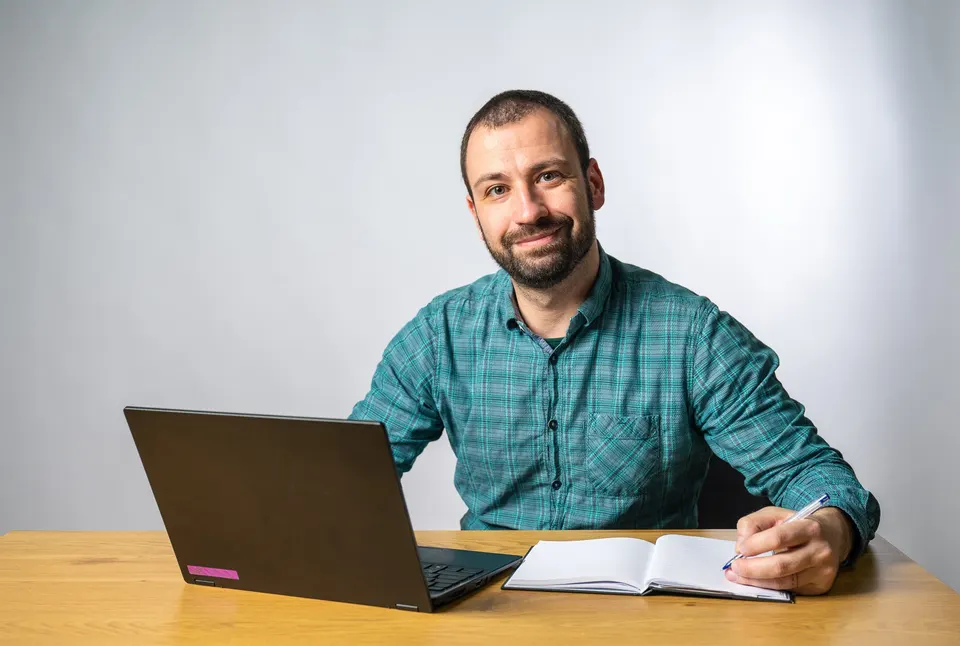
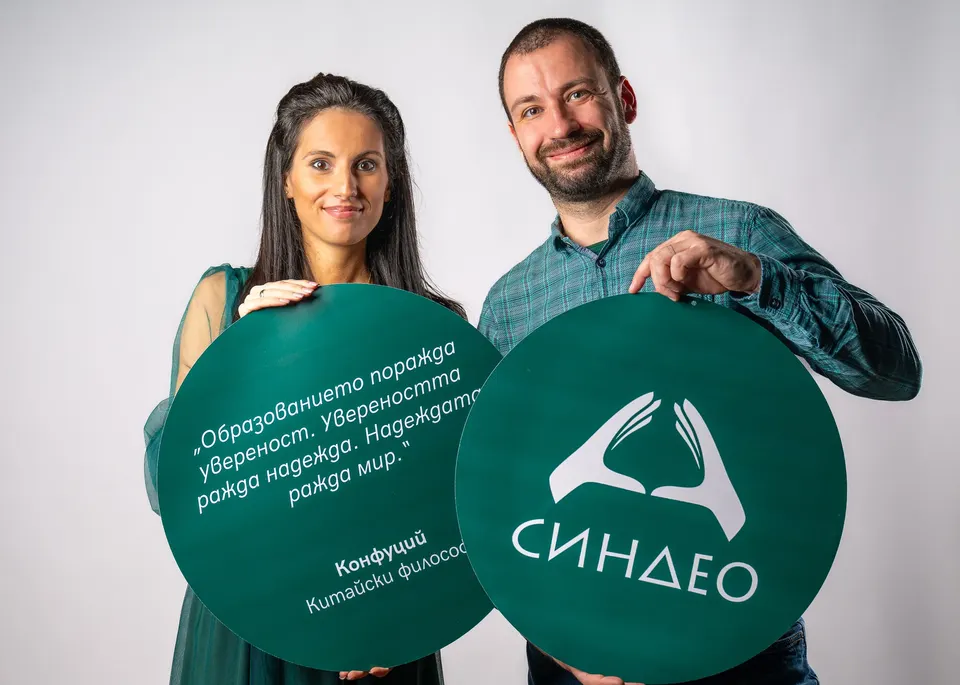
Angel Georgiev decided 18 years ago that education was exactly what he wanted to work on. He created the Znam.be platform and spent many years developing the programs of SoftUni, one of Bulgaria's largest coding schools. Recently, together with another young teacher, Dr. Teodora Dimitrova, he founded Sindeo, an applied academy for education. Its goal is to support, prepare and inspire current and future teachers to handle the challenges and be more effective in today's fast-changing environment. (You can find the complete program here.)
– One of the ideas behind your academy is to get more young people into the education system. What does success depend on?
– The idea is to help people who want to step into the classroom figure out how to do it.
Teaching at a school today is more accessible than ever.
The law changed a long time ago: a person, even without a degree in education, can walk in and teach. Teachers and principals can bring in people like that and help them succeed in the school environment.
Our academy wants to help people gain all the knowledge and skills they need so they can teach with confidence. We're preparing various trainings that we'll run until the end of the year; one of them is on literacy. The teacher leading it already has a lot of experience and also teaches university students. She told me: “When I started, it was incredibly hard, because there were so many things I didn't know—the regulatory framework, the tools, how to plan a school year, a single lesson, what to do for the children, how to approach every case that came up.” Every young teacher runs into this and needs more support.
That doesn't mean universities don't cover it—students even have mandatory teaching practice—but from what I see and sense, there aren't enough tools and practices handed directly to teachers so they can bring them into their lessons.
For more people to sign up, they need to understand that being a teacher is something that can happen for them.
– What's the shortest path? Say I'm a programmer and I decide to teach—what do I have to do?
– I could recommend you to a school tomorrow, and they'd hire you on the spot.
That's the shortest path—find a school that needs someone like you.
Getting hired is easy; the next step is much more important, and that's what this is all about. The shortest path is to find a school that's ready to invest in you.
– What did your own path look like?
– When I went into a school for the first time, I already had experience training adults and running extracurricular activities for students. In my case it wasn't the shortest path, because I had 7 or 8 years of experience training sales staff; I had a background in teaching.
A friend of mine who's a teacher just told me: “Acho, we need someone to teach programming. You run extracurricular classes, let's give it a try.” We tried, and it turned out to work. And it's very
rewarding, because children are genuinely happy when they see a teacher who comes from the real world of practice.
If you have no teaching experience, I think the most direct path is our academy. In 9 months, from October to June, we'll give these people all the knowledge and skills they need to be ready to walk into a school.
I've already helped about ten people start teaching in various schools; two or three of them are still teaching. The others either lacked the knowledge and skills, or realized it wasn't quite for them. But they learned it the hard way.
Our preparation will help such a person start work as early as next September. What we'll add soon is that, together with partner universities, we'll enroll people in the postgraduate teaching qualification that many universities in Bulgaria offer. With it, you become a certified teacher in the subject of your university degree.
– What surprised you when you ended up in a school? What hadn't you expected?
– What surprised me most, perhaps, is that
I had to be not just the person who passes on knowledge, but also the one who listens, understands the students and supports them, even in their everyday troubles.
One day from my first school year comes to mind right away. An eighth-grade class walks in after some tough test. They all look tired, bored, sad. I'd planned to teach them something complicated, and I say to myself: “Okay, clearly we're not doing that.” “Do you want to play games?” Everyone's eyes go wide. “We're not doing anything today, I'll let you play. I just want you to keep it down.”
They were so happy, and the next lesson they came in so eager! They expected we'd play again, and I told them: “No, this time we're doing something else.” But because I'd listened to them, seen and understood that the moment wasn't right for teaching something new, the next time they were far more motivated to learn.
Back then I reacted on reflex, instinctively, without even thinking. Afterward I analyzed that situation a lot, asking whether it really was the right decision at that moment. And I realize that it was. Now I try to be more conscious when I make decisions like that, so that they serve the children's interests in the moment.
– Why do you think we've reached a point where the teaching profession is aging?
– In my opinion, because
for decades the teaching profession hasn't been held in the highest esteem.
When I was a student—and maybe this comes from my family—my parents always treated teachers with respect. I very rarely allowed myself anything disrespectful, and when I did, it was usually to look cool in some group. But it always made me sad.
After 2000, though, I think there was no longer that much respect for teachers. Because of lower salaries, because of many things that happened over the years.
In recent years the Ministry of Education has taken several very useful steps—it raised teachers' minimum salary, which immediately raised their average salary too. They created many tools to encourage learning and the development of these teachers, and they support principals.
Yes, it doesn't work equally well everywhere, but they've definitely taken good steps. A teacher's minimum salary is now, by definition, twice the national minimum wage. Which means that whenever the minimum wage goes up, teachers' pay follows immediately.
Right now it's around 1,500 leva (about $850) take-home; a teacher starts with that right away, no questions asked. And in a small town that's a pretty good salary.
And this isn't widely known. That's why most young people aren't interested, and naturally the profession ages. People in the system are overloaded across the board, especially math and science teachers, who take on more than the required hours. Simply because there's no one else. That's exactly why we created the academy.
– How many people need to enter the system for it to work well, be balanced in age, and have enough prepared teachers in every subject?
– Right now we have about 80,000 teachers. The National Statistical Institute gives an official figure of about 67,000, but only for general education schools; vocational high schools aren't included.
Those roughly 80,000 teachers cover, let's say, 90 percent of the need. Ninety thousand—in the perfect scenario 100,000—teachers would cover the country's entire need. It's a regulated profession; there can't be many more.
The bigger problem is that
15 percent of teachers are already of retirement age.
They shouldn't have to work if there are young people, and it's not a question of whether they want to—by law, if a person who isn't a pensioner can fill a given position, the school is obliged to hire them.
Those 15 percent are the system's huge need right now. That's 10,000 to 12,000 people. And on top of that there are another 20,000 to 25,000 who would be good to bring in.
At the same time, about 20,000 people graduate from universities every year with a teaching qualification, and far from all of them become teachers. Why? Partly, I think, because many are philologists who didn't enroll to study pedagogy. A very large share of them go in other directions—they become translators, consultants. Either way, there's a serious gap that universities aren't filling.
– How do you think we should teach technology? Every year, every month, something big happens in this field; lately it's artificial intelligence. But education is a conservative system that can't change the curriculum and introduce new things every year. How should we approach it?
– In our complete program, the first 3 of the 9 months—a third of the teaching—are devoted to digital skills for teachers. Three months focused only on that, because we believe it's crucial for these teachers to succeed in today's reality.
We believe technology should be taught within and through the other subjects, not as a separate subject.
Right now we have “Computer Modeling and Information Technology,” which starts in third grade. It teaches how to use a computer for specific tasks. To me that's very valuable, and it's important for a subject like that to exist up to a certain grade.
After that come the subjects “Informatics” and “Information Technology,” where programming is also taught. Under the national standard, HTML and CSS—the way websites work—must be taught everywhere in Bulgaria.
To me that's as valuable as history, geography, physics, chemistry. None of these subjects makes you a world-class chemist, but they make you someone who understands how the building blocks of that science work.
Once you finish school, you might have no interest in chemistry and never look at it again, but it's valuable to have basic knowledge.
Still, I think information technology shouldn't be taught as a separate subject; teachers in every subject should use it to teach. Then they'll naturally expect students to use it as well, to learn the subject or to demonstrate knowledge. That's why I think it's very important for every teacher to have digital skills they apply in their lessons, so that the students do the same.
– But that's hard to make happen, because of the system, because of the aging, and because there's a generational barrier when it comes to technology.
– We ran a training on media literacy and artificial intelligence—two elements of digital competence. How to spot fake news, handle information sensibly, check sources, and how to use the newest thing, artificial intelligence. A very large share of the teachers who signed up were older.
They were very eager to develop. I don't think age is what holds people back. Because a basic level of understanding of these technologies isn't out of anyone's reach. I don't think an older teacher would have a harder time grasping the basics and using Google search sensibly, with parameters, and showing students how to get to the right information quickly and easily.
These older teachers say their students are interested in these topics. They're not struggling with themselves, but with keeping up with their students, which is very sensible and very valuable.
The barrier is similar to the one with math. Lots of friends tell me they're not good at it; the bill arrives and they refuse to work out how much they owe. It's absurd not to be able to add up two or three numbers. It's running away from responsibility in one form or another.
I think it's the same at school with digital skills. They're something anyone can take on. Especially that basic level—absolutely every teacher can do it.
– As long as they have the desire and the energy to grow. You mentioned artificial intelligence—have teachers gotten used to the idea that it's not just something that will write homework, but can also be useful?
– The way we've built our training, we first tell teachers about the AI tools that help students. I say: “Students can use AI this way and that way. And—surprise!—they're already using it like that. If you give them this kind of homework, artificial intelligence can write it.”
First I even try to reinforce their impression that AI might be something bad, pushing it to such an extreme that they say: “Fine, so there's no getting rid of it—what do we do?” So they reach the realization that they need to know what this technology is.
Then I start showing them tools that help the teacher. The concept is that AI is a very smart neighbor you have no visual contact with. There's a door, you slip notes under it, and he slips others back. He's very smart, but he has no idea about you, he's never seen you, yet he can do very good things. You have to give him enough context, tell him what your goal is, so he can help. If you tell him, “Solve the problem my math teacher gave me,” he'll solve it without asking.
Whereas if the teacher sets the task so the student has to explain the solution—okay, you have a solution, but I want you to walk me through it. You wrote an essay; tell me why you reached these conclusions?
You can tell very quickly and easily whether a student has their own reasoning about it or is using an AI tool.
By the end of the training, I arrive at the point that artificial intelligence widens the gap between teachers who simply take some material and pass it on to their students, and those who really think, understand, and want to do something more with that class, with those students.
We finish the training with the “flipped classroom” tool. Many teachers tell us they worry that kids write their homework with AI. Don't give it to them as homework—give it to them as preparation for the next lesson. Give them the same tasks before you've taught the material. They'll find the answers, 50 percent of which will most likely be wrong, but you'll have room to discuss why they're wrong and to teach the new material after they've already used the “super cool AI tool.” And you can easily refute it, simply because it solved the problem wrong—2 plus 2 doesn't equal 5. I believe this can work in almost every subject.
– I don't know if you came across my experiment—I competed against ChatGPT to see who would score higher on the matura, Bulgaria's school-leaving exam, in Bulgarian language and literature. We both got pretty good grades, but I beat it by a little. There was an extra task: the examiner had to tell which answer was mine, and he managed it because of the literary interpretation essay.
– Even if it can write a good enough essay, I don't think that's bad. If that happens, we should start thinking at the level of the system.
Okay, until now the teacher has asked the student to write an essay; now there's a tool that does it.
Then the teacher can ask the student to build a set of such essays and find the similarities and differences between them—which AI can also do. But the analysis that happens afterward is a skill you need very often in real life. You see a huge amount of information and make connections; that's how the brain works—it tries to extract meaningful information from that data.
Fine, AI can do one of the tasks. Give the child 10 such tasks! Let them solve all 10, draw analogies, connect the ideas, understand why—or use 10 different AI platforms and see what the similarities and differences between these models are, why that is, what data they were trained on. That gives you the next tasks, which can do the same job as the literary interpretation essay.
As I understand it, its purpose is for the teacher to find out whether a student has understood what they're interpreting—whether they've read it, whether it has passed through them, whether they interpret it in a meaningful, logically coherent way.

– And whether they can express themselves fully.
– Expression is precisely what may be hardest. When you have a tool that can produce your means of expression for you, you lose interest in developing them, which means you may stop having them. Maybe that's where we need to think about how to improve the approach.
– When ChatGPT appeared, Bill Gates said it was a revolution precisely because of education and healthcare. Simply because a huge part of the world that never had access can now have a teacher or a doctor. Do you think big changes are coming to education because of AI?
– I don't think huge, revolutionary changes will come. Just as they didn't come after the introduction of the computer. There are evolutionary changes, a lot of good things are happening, but they're not a total transformation.
Gathering a group of children with one or more adults to do something together won't change, in my view. It will remain the way to consolidate or focus on a specific element of knowledge, skills or attitude.
Rather, what AI will help with, as I said, is flipping classrooms. First, so they're no longer: “I, the teacher, will now tell you, the student, what you need to know!” Good teachers don't do that now anyway, but it will simply disappear.
The setup where the teacher stands at the front and the children look at him will be turned around. Lusio Architects is a Bulgarian studio that designs schools, and they have many successful examples of how a learning environment can be shaped. It doesn't have to be children looking at each other's backs with one teacher at the front; it's more a space that can be rearranged. Small groups working on a task; a big circle for discussion; something happening in one corner, something else in another. Changing spaces that still let one or more adults with a larger number of children carry out some process.
That won't change. The physical need for these people to come together won't disappear, at least not because of AI.
It might happen with virtual or augmented reality, but that technology is still less developed.
– But we shouldn't underestimate it either.
– I think all of this will help such revolutionary educational systems emerge. I have an idea for one. The school year doesn't have to run from September to June—9 months of going to school every day and doing something specific, followed by 2 or 3 months of vacation.
A revolutionary system like that certainly won't be the mainstream way of learning, but I believe it will be very valuable for some. Children need rest, but not 2 or 3 months bunched into the summer. I imagine the year could be split into three four-month blocks, each with three months of learning and a month of rest.
And this learning doesn't have to happen physically in one place. For two months, assignments are prepared and students work remotely, being given the hard material they need to understand, learn and prepare. For one month there's intensive teamwork, where they physically gather in one place to put it all together.
With technology, this can be done very well. It requires a drastic change in the daily lives of parents, teachers, everyone, but I think it would help students who need more independent time and fuller rest. Without 3 months of vacation after which they have to start over.
– Quite a few new phenomena would help—remote work, for example. And again the problem is that we're talking about a very conservative system. I've also interviewed a teacher who has never set foot in a school. There's so much we could change and develop. The current school year was designed around farm work—so children could help out until September 15. Things change slowly and with difficulty…
– I think we'll see revolutions of this kind. And at some point, not necessarily because of technology, there will be successful examples that get applied more and more, even in the more conservative view of education.
And why is it conservative? I think about it in the context of why private tutoring exists. Parents want peace of mind that translates into: “I'm sure this child can handle a given exam.” It might be the matura or a class test. There are many specific moments when knowledge is tested, the child has to give 100 percent, and if they fail, it can have a very bad effect on their long-term development.
The system is conservative precisely because if something changes, it could be bad for an entire generation.
Even though the pandemic showed very clearly that overnight we switched to online learning, which is a fundamental change to the entire education system! And it turned out to work. Maybe not at 100 percent of what it would otherwise be, but it works. We'll see more and more changes like that.
– Interesting changes are coming because of technology and artificial intelligence… And I'll take the opportunity to invite you—and all readers—to take part in an important survey about our attitudes toward it, here. Thank you, and I hope many talented future teachers sign up at Sindeo!