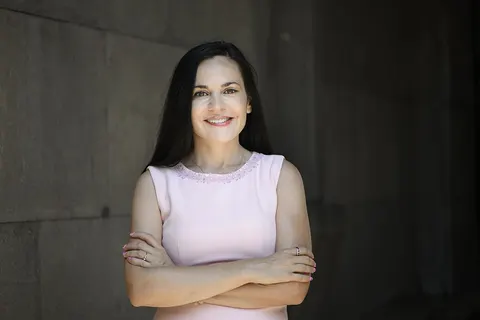
For Denitsa Daverova, “yesterday” is cinema. She gave it two decades, and her father wrote the screenplay for Vchera (Yesterday), the legendary Bulgarian film of that name. Today and tomorrow, though, belong to technology.
Since childhood she has had a passion that is rare among girls: cars. Then came electric vehicles. In 2018 she rode in an electric car for the first time and quickly decided that this was the future, both for mobility and for herself. She left the film sets and founded Travel by Electric, a platform that gathers all the information drivers need in one place.
Does the future finally belong to electric cars? What will mobility look like tomorrow? Will we still own cars of our own? And how far away is the moment when people will no longer need to drive?
– Your path is a fascinating one. How did you go from making films to suddenly landing in the world of electric cars?
– Cars have always interested me, the mechanics themselves, the physics of it all. But with cars specifically, it all started with one trip.
I saw a technology that was huge and ripening on the horizon. I got to touch it, and I saw for myself what possibilities it had.
I managed to see past the obstacles that the momentum of the time was throwing up. And at the same time I saw how many problems were looking for a solution. I already had some ideas in my head and… it just pulled me in.
I compare it to gravity, because sometimes, when you find a good solution, it’s very hard to walk away from it and not develop it, not try to do something with it. When you see a good idea, it’s so big and has such a pull that it really isn’t a matter of choice.
You get a chance to be a pioneer only once in your life, and if you spot that chance and let it slip, you’re a complete idiot and you don’t deserve to be a pioneer.
I think electric mobility is giving rise to a new way of traveling. A new way of planning, of refueling. It’s no longer the gas station.
– What is the biggest difference?
– I think the common denominator is the users. What I’m really building is a platform for the person behind the wheel who, while traveling, sometimes needs a restaurant, sometimes a fast charging station, a place to stay, an idea for a destination. This whole system the traveler weaves around himself is tied to his electric car and to how he actually lives inside that ecosystem.
I saw a chance to create a huge ecosystem around the user. Only, if you decide to improve the Mercedes assembly line, you have 120 years of data on the changes to it. Here you set out to create something that has never existed before. There’s nowhere to get data from; first you have to build this microworld where people come and do the very thing you want to create a solution for.
So at first I built a platform for renting electric cars, then a complete charging solution. After that, once I saw how it was being used and what the problems were, I went on with the idea of creating a convenience that wraps you in every comfort you need: it keeps track of whether you’re hungry or thirsty, whether your car needs power, where you’re going, how much of a hurry you’re in. With today’s technology, it’s simply the perfect moment for such a solution to be built.
– In recent years it seemed we expected electric cars to catch on faster, especially when Tesla came along and we saw they could be affordable and well made. We even decided that within a decade there would be no other cars. But it seems all that optimism didn’t pan out—quite the opposite. How do you imagine things will develop from here? Will we all switch to electric cars, and if so, when?
– For me there’s no such thing as the absolute number—a moment when absolutely everyone does the same thing. First, it makes no sense at all; second, I don’t think it’s realistic. But
I think electric cars will reach a huge share of all vehicles, because it’s a technology that costs less to maintain and to charge, and the hardware lasts much longer because there are fewer parts that wear out.
It’s simply the better technology. As for what you mention—yes, the EU loves putting timeframes on evolution, but evolution, unfortunately, doesn’t care about bureaucrats and moves at its own natural pace. Very often, interference with market principles, such as incentives to get people to buy more electric cars, has a very negative effect on the brands. It distorts the market artificially and disrupts production planning.
Incentives like that can only have a populist effect. In fact,
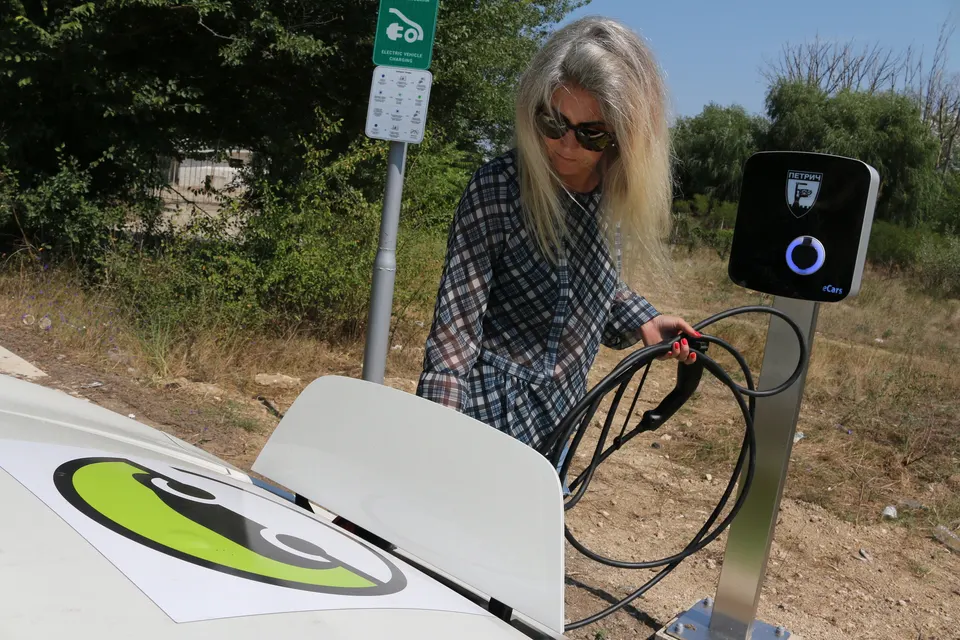
Bulgaria is a great example of how we do very well even without incentives. Our charging infrastructure coverage is among the highest in Europe.
You can see that very easily on the aggregated maps of Travel by Electric.
The truth is that things are rolling and there’s no way to stop them. As for when scale will be reached and what it will look like, time will tell. There are certainly geopolitical factors that are strengthening this trend considerably. But I’m not entirely sure the infrastructure could handle a sharper rise.
In Bulgaria we actually have growth of 200 to 300 percent a year, which helps this whole microsystem grow at the same pace, without imbalances between its parts.
– If I had to buy a car in Bulgaria tomorrow, what would your personal arguments be for choosing an electric one?
– Oh, the arguments depend entirely on what you want. If yours are financial, there are clear comparison tables that let you see the costs over time.
If the time your car spends at the repair shop doesn’t scare you, but it matters more to you not to spend time at a charging station—because you’re always spending time somewhere—those are different arguments.
There are 100 reasons to buy an electric and 100 not to; it’s all a matter of personal justification.
I stopped explaining to people how cool electric cars are a long time ago. I just let them get there on their own.
– And is the trend reversible? Could it turn out that electric cars aren’t the solution of the future?
– I don’t believe a trend that is so blatant and strong can reverse. Yes, there may be some peak, then a plateau. But I think that could even be a way to balance our energy system. I love that tired line about how if everyone plugs in their electric car at once, we’ll all be left in the dark. It’s an absolutely hilarious claim. It’s as if we all stuck the nozzles into our gasoline and diesel cars and filled them up at the same time.
But all these technological moments get examined in tiny slices of time, without looking at the whole picture, without seeing the interlinked industries. The world is built so that people hear only what they want to hear.
– Especially when it comes to technology, which is why this site exists. And what do you think of self-driving cars? Purely technologically, three or four years ago it seemed they were coming soon, that we had already cracked it, that they would spread on a massive scale. Yes, there are many pilot projects, but we’re still far from that. Why?
– I think whoever believed this could go mainstream in three years was most likely five years old. At the very least, for it to happen we’d have to mark every road in Bulgaria, which is impossible.
This field will grow over time; it is growing, that’s a fact. Almost every new car coming out right now has distance-monitoring systems, lidar systems and so on—things that five years ago existed only on premium models. That’s the path by which these technologies will arrive. First their most basic functions will become mainstream, then they’ll start making fewer mistakes, then there will be a big recall by some brands that rushed out something because it was fashionable. In human history, things move in waves.
Humans can’t evolve on efficiencies alone. We won’t get taller, stronger in our muscles, or bigger-brained. This is what we have. The question is how to use it to expand our abilities.
– Will you miss driving if at some point nobody needs to drive a car?
– I don’t know. Years ago I thought I wouldn’t even want to drive without a gear stick. But people change, technology changes them, perspective changes. I used to have cars with big engines that growled and spun all the tires… Now that seems like some antediluvian technology to me.
I’m a child of the ’90s, and being able to drive was the one thing without which my life would have had no meaning. But as you can see, other things are starting to give our lives meaning—we grow up, we change, we have children. Our children face other challenges; other things matter to them.
In human history, driving is at this stage a fairly short period anyway, a micro-grain of our development. And if it disappears in 10 or 20 years, maybe there won’t even be a picture of it on a cave wall.
– Then again, the Hemus motorway, which Bulgaria has been building for decades, might still not be finished.
– Recently I was on a Bulgarian National Television (BNT) podcast with Martin Zaimov, and he said something I really liked—that evolution doesn’t have two sides. Like it or not, that’s how it is: the world is heading that way, and it’s better to ride the wave than to swim against it.
– If we let our imagination run free and picture how things will develop with the arrival of self-driving and electric cars, aren’t we heading toward a time when there will be no point in owning a car, and it will be some kind of shared resource—you’ll just order a ride from point A to point B?
– That has long been a concept of the big brands; Mercedes had even decided to roll it out by 2025, if I’m not mistaken, but COVID messed things up. I think for Musk and for every manufacturer, this should be the next idea. Producing a car is a resource you have already acquired, and you give the user the right to drive it. Once it has no life left in it, you take it back, dismantle it and recycle it. It’s a concept that works very well for the brands, and I think it will become real very soon, because humanity’s inability to know what to do with resources it has already used is heartbreaking.
For me, the next big wave of entrepreneurship will be precisely in recycling and in using the resources we’ve already pulled out of the ground.
Science, thank God, doesn’t depend on people’s opinions; it just keeps moving forward.
– But sometimes it comes into conflict with economics. We see that cars last far fewer miles than they used to.
– There’s planned obsolescence, that’s obvious. But we have to find some new mechanisms so that we can keep surviving financially and economically. We’re already seeing serious problems and layoffs in the auto industry.
When politics gets into economics, things don’t work. It’s exactly the same with cars. If your policy is to build a business on warranty and after-sales service, it’s like selling people ticking time bombs. The truth is that Henry Ford’s concept was forgotten long ago, because the car he created was made so that you could fix it yourself with a single tool everyone has at home and with auto parts from the hardware store.
Carmaking outgrew that moment long ago, and I think it’s now at the other end of the pendulum. In the ’90s marketing won out over engineering, and that’s why the last truly good cars were made back then. After that, everything became marketing, a battle of brands and ads.
Shared cars swing the pendulum back.
People don’t actually need to own cars, and now they’re starting to realize it.
Why should they hunt for parking, change the tires only to have to change them again, deal with insurance, oil… At some point people’s attitude changes. I see it happening before my eyes, because my clients are exactly like that. They don’t want to buy, they don’t want to own, they don’t want to be tied down. And in fact the idea of minimalism is a very big part of the green idea.
Not drowning yourself in things, in excess, not having this consumer society that serves the whole marketing machine. It’s still marketing, but aimed in a different direction.
– Still, how does someone with a background in film suddenly become an entrepreneur?
– I didn’t have many other options; maybe it’s something that had been smoldering in me for a long time in different forms. I studied business in high school, I was part of a very interesting Erasmus program back then, in ’93, when democracy was just being born. To this day, that is the foundation of how I think about economic processes in general and how things happen, because
entrepreneurship is a bit like art. You need to paint; it’s not something you chose to do.
At some point you see you’re good at it and you try to turn it into something that makes money.
The ability to think flexibly, to adapt, to observe the conditions, to try to get some benefit out of them—I think those are skills I’ve always had. I’ve always been logistically literate, I’ve had an affinity for mobility. Tetris is my favorite childhood game. I love for everything to have its place, to have its shape.
– Tetris is a fascinating subject, including the way it has shown in recent years how to find our next goal even after AI. But why does it seem there’s no sense of a good entrepreneurial environment in Bulgaria? Online we see an abundance of entrepreneurs, but that doesn’t match the success rate if you look at how many startups there are in Bulgaria, how many of them succeed, how many have become unicorns or other mythical creatures.
– It’s a matter of perspective. A step I took many years ago that turned out to be very important for me was becoming a member of BESCO, the Bulgarian Startup Association. That way, at some point I stuck my head into a different bubble.
I left show business in 2018, pretty worn out by my, so to speak, corporate career in film production. I’d had it up to here. I believed I could do much more; that what I was doing made absolutely no sense. So I actually moved into another bubble. Away from the filmmaking one, where we work 18-hour days, go straight from one project into the next, and every director and every script is the same. Not for the director, of course—for him it’s something completely different, and we have to be excited along with him. But the film comes out, the next one comes along, and that cycle pulls you back into a bubble where, however, the problems are made up—by the script, by the director. Made-up problems very rarely have real solutions, and they leave you feeling that you can’t cope with anything.
In this case I abruptly entered a completely different bubble, where I saw people like Payhawk and Endurosat, who were young at the time, startups like Veda Accounting, which are giants now.
You meet young people who have conceptual ideas in their heads and a firm conviction that this is the way business should be done.
You see them building their own companies and you say to yourself, “Wow, this is really cool, I want to be there too.” If you get together with people like you, your world doesn’t look small at all. I have no utopian ideas that there are no such people in Bulgaria. Quite the opposite—there are. Yes, they’re few, but we are 6 million people. If we look at the per capita statistics, we’re by no means behind—on the contrary. Obviously something is missing for us to make a big explosion and become the next Ireland or Monaco. But the seeds are there…