Can a child get a more meaningful education without ever crossing a school's threshold?
“He is the best programmer I know—he gets to the bottom of everything, to enormous depth,” says Todor Kolev, a guest of Digital Stories who explained to us why technology will turn us into creators.
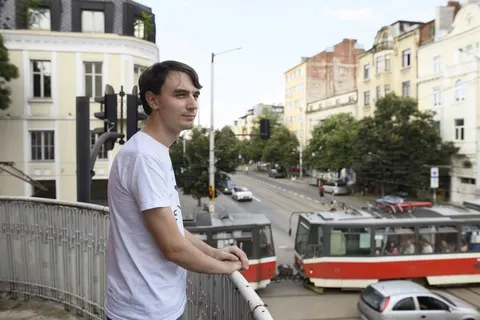
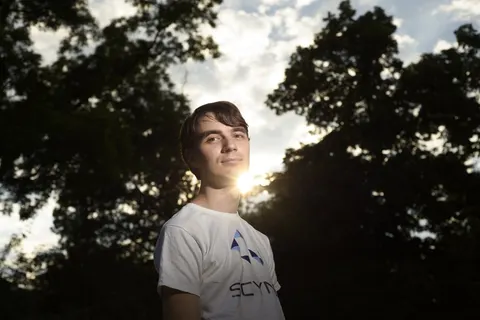
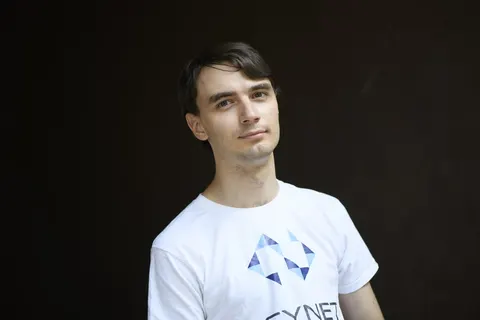
Bozhidar Marinov is a remarkable young man. Only 22, he already has 15 years of programming experience. Today he heads the curious Comrade Cooperative and works on promising blockchain projects.
He has never set foot in a school, because he is a “homeschooler,” a pupil taught at home. He won a string of programming contests before he was barred from competing for being outside the system of traditional education.
Who would he recommend such a choice to today? What does he find most exciting in the world of computer science? What does a programmer with vast experience, despite his youth, dream about? What drives him to teach programming to the next generation of kids? And why did he… decide to write a historical novel about the past of the Rhodope Mountains?
– I can't help starting with this topic—I don't know many people who have never been inside a school. Why did you and your parents decide on this?
– I was little, nobody asked me back then. My parents are divorced, so the decision was mainly my mom's, and she discussed it with
my grandmother and grandfather, since we live close to them. Both of them are teachers.
The idea came from various family acquaintances who had also decided to teach their children at home. One reason is religious—we are Christians, and we believe that since the Word of God says “teach your children the whole law,” it means doing it in the best possible way. It turns out that school never gets to God's law, to morals and values, so it isn't a very good option.
Other reasons have to do with quality and environment. Homeschoolers abroad, and here in Bulgaria too, achieve very good academic results, because for all 12 years they have been able to focus.
Homeschooling is individual; we can focus on particular subjects or fields.

– Your mother must have had to devote herself very seriously to your education.
– To some extent, yes. She was a lot more involved in my education than, so to speak, the average parent. On the other hand, that only lasted up to a point. From a certain age I became fairly independent. In the morning we would just agree on what there was to study and quickly go over the lessons to see whether there were any unfamiliar words, since some of them were in English.
Later she simply handed me the textbook. And every now and then I'd say I needed the next test. Some homeschoolers even go a step further and take the tests and fill them in themselves. But we're programmers, we somehow want the testing to be scientific, investigative. No contact with the test before you've read the material, and no reading the material during the test.

– My knee-jerk reaction—and I'm sure I'm not the only one—is that such a decision takes a toll on socialization. Because that's no small part of school's role, with all its imperfections.
– The socialization question comes up so regularly, I get asked it in every interview…
To some degree it's true, you really do have contact with fewer people. On the other hand, it's not at all clear
how much socializing with people of the same age and the same background corresponds to the real world.
For example, at our company I was the youngest on the team for a very long time. Now there are younger people too, finally… In general, my socialization in the real world has always been with people of different ages and different interests. I find that more enriching.
The parent can also do quite a lot to give the child a social environment. Signing them up for courses, lessons, sports. These things help. It's not as if parents say, “We'll study at home and never go anywhere.”
But even if they did say that, homeschooling would in that case serve those parents' interests. In my view, we shouldn't force all children to be in one place, under one system and one standard. There can be other ways.
– And what kind of children do you think it's a good option for? Ones who stand out in some way?
– The question is more what kind of parents. Because you can't tell whether a child stands out when they're 4 or 6. If they do, some kind of individual approach certainly helps. But
even if they don't stand out, this way children stay closer to the family. It's a matter of a conscious decision and clear values.
– Many schools can offer an individual approach as well.
– True. In Bulgaria we don't have all that much freedom on this, but some of the people who have studied homeschooling in the U.S. write that it is, on the whole, inefficient. It's much more efficient for parents to have a choice and send the child to teachers they've picked, or to hire teachers together with other parents. But the point is that, once again, control lies with the parent, not with the state saying, “We'll all study this and that.”
– And when you head toward a field where your parents aren't specialists, isn't that a problem? Say they're philologists, but you have a programmer's skills.
– Personally, I haven't had that problem. My parents, my grandmother—they're all in programming. Even if I'd wanted to do something else, I would still have learned this. But even otherwise there's a solution. For children with very different interests, you can always find a teacher, or someone to intern with and observe. That way they can both judge how interested they are and learn something. The parent doesn't have to be the only teacher.
– I read that you won a programming contest and then they stopped letting you in, because you weren't part of the system. Is that really what happened?
– As a kid I started doing competitive programming at Telerik, a Bulgarian software company. After a few in-house contests without top placings, we decided I'd go to Veliko Tarnovo and compete at the Winter Informatics Festival. As it happened, either the problems were easier for me at that point or I'd learned something in the meantime, but I took first place.
For the first time, the Ministry of Education and Science realized there were people outside the system who were, in this case, taking places at national competitions, and decided to take measures. Under the rules, the winner's school was supposed to get a scholarship, and since they didn't want to set a precedent, they said it couldn't be done.
I was turned away from subsequent competitions, including ones I had taken part in before. But word of the case got around, and I was invited to the privately organized competition “I Can, Here and Now,” even though I was a year below the minimum age. I went and teamed up with some students. We worked well as a team. The first year we came second, then first, and after that I started an internship at the software company Obecto.
– Don't you get tired of programming? I rarely see people who've been doing it for more than 10 years and still do it with passion, with eagerness…
– The mechanical writing of code itself really does get tiring. At some point, when you write the same function for the 40th time, you start wondering, “Am I doing something wrong, or is this really repeating itself? Wasn't the whole idea to automate what repeats?”
On the other hand, that's not the only thing that keeps you interested.
Right now I'm working on more interesting projects, things that haven't been done before, in the blockchain space, for example.
You can always find something new to get carried away with.
– I read that you're finally thinking of studying formally, that you'll start a university degree. Why?
– I focused on programming from about the age of 7, and from a certain point on it was the only thing on the agenda. In the meantime I missed learning some subjects to the depth I'd like.
Especially history. I feel it's my weak spot, and I think it will be useful for my general knowledge.

– Does one need to study history to be a good programmer?
– Well, to write the code itself you don't need it. Maybe just a bit of the history of the concepts you use. Why we call something a “class” or an “object”—things you read about in passing and remember at some point.
But as a person you need it. First, when you talk to others on the team, you need some common ground to start a conversation from. Someone can't mention “World War I” while you have no idea what happened back then.
And later you need it when you start organizing, creating new projects and products, planning. Then it's important to be able to find your way in the historical and political situation. And my sense is that both have a lot to do with history, especially the most recent history, which is what I lack most.
– But you could still catch up on that the way you're used to. It doesn't have to be in some academic form.
– Yes, but I want a theoretical grounding in subjects like higher algebra, higher mathematics, logic. I feel they largely set the course of programming, and they're not something I can grasp just by reading random articles.
I have some understanding; I can read enough of a paper on some algorithm without getting lost in the terminology and the complex algebra. But still, I want to understand it better.
To dig deeper into the theory, so that I too have a chance to say something to this world.
– What kind of projects do you dream of developing?
– Programming languages, compilers. The tools we use to explain the programs we write. We have quite a few right now, but most are object-oriented. I share the view of other programmers that object-oriented programming may not be the best, but I can also see it offers many conveniences when working in a team.
I feel there may be some concept which, if we borrowed it from logic, could help us achieve something better.

– What do you like about blockchain technologies, why did you turn to them?
– To some extent, blockchain showed that we don't need a centralized system to be able to work together. That it can be done another way. But it's a fact that decentralized systems still haven't been built to their full potential, and that makes me want to have a go too.
– A few years ago they promised a lot of applications for blockchain, but so far the only one that has stayed mainstream is in finance.
– I think the speed of this type of system is still too low and the costs are high. I can't, for example, use blockchain to host a blog if every time someone reads an article they have to pay 10 stotinki (about 5 cents). This isn't a physical library—it's on the internet, after all.
For now, blockchains themselves are optimized for security, decentralization and anonymity, but in the process they lose other important practical qualities, like high speed and low cost.
– I see here one of the solutions to what I think is the biggest problem technology has brought us—the way we take in information. And it will get more serious as artificial intelligence becomes more convincing at every form of fakery. Perhaps blockchain holds some possibility of preserving authenticity and credibility.
– I'm thinking along those lines too. It was a problem before as well—how long has everyone been saying we can't just trust everything that's written? But until recently there wasn't such a need to verify information.
Today we may no longer need centralized media.
Because the way we take in information changes a lot when you can find anything you're looking for online.
Maybe not blockchain in its current form, but cryptography can certainly be useful for tracing exactly how a piece of information came about. For example, that an article about some forest being cut down is based on information from such-and-such a source, from this eyewitness.

– What made you start teaching programming courses for children?
– I myself started programming at 7, through a course my mother organized for homeschoolers. I suppose she saw that I liked it and that's why she decided to turn it into a course for more children.
Somehow I wanted to repeat the gesture, to do the same for someone else.
I didn't quite know how to start, although I'd made a few attempts. The nudge to organize a course came from a program in which we not only write books but also start our own businesses. Selling a book isn't easy, so it's better to learn how to sell with something else first and then try with a book.
I had to come up with a business of my own, and the idea of a programming course was the most realistic. It turned out quite successful, and I hope I'll be able to keep it going.
– Why did you sign up for a writers' course? What did you write?
– Well, I've also talked to people with long programming careers who, at 40, wonder why they've wasted their whole lives on programming and, say, become shepherds. So I looked for another hobby, not just programming.
I liked the idea of writing, as something I could do alongside programming. I wrote a novel in English, since the whole program I mentioned was in English. It was historical, which is strange. History and literature were my weak subjects; I don't know what possessed me to sit down and write a historical novel. It's set around Smolyan, a town in the Rhodope Mountains, in an undefined past period between Ottoman rule and communism.
– I've interviewed all kinds of people about artificial intelligence, even a priest. I'm an atheist, but you mentioned you come from a religious family. Do you think religion has a place while we develop technology? What can it give us in developing artificial intelligence?
– Religion has a lot to do with ethics, in general. In developing technology you also have ethics, relationships with other people, moral values.
Religion can give us the starting point for ethical frameworks. It's a bit hard to say
in a democratic world like today's, where everyone is right and has their own truth.
Christianity at least, as a religion, defines an absolute from which everything follows—principles, presumptions, values. When it comes to developing, say, artificial intelligence, we could judge what is and isn't proper for a robot, or a programmer of robots, to do, again starting from that absolute. And I think that's considerably more effective than trying to grab some fragment of truth through democratic voting, endless debates or thousands of experiments.