“We are surrounded by a huge number of software systems, we use them in our daily lives, and they were written by mediocre programmers. The way we create software is broken!”
“The value of meaningful content will rise, because there is far too much garbage, far too much noise. The only way to preserve ourselves as human beings is to put up barriers. To sift what gets into our heads.”
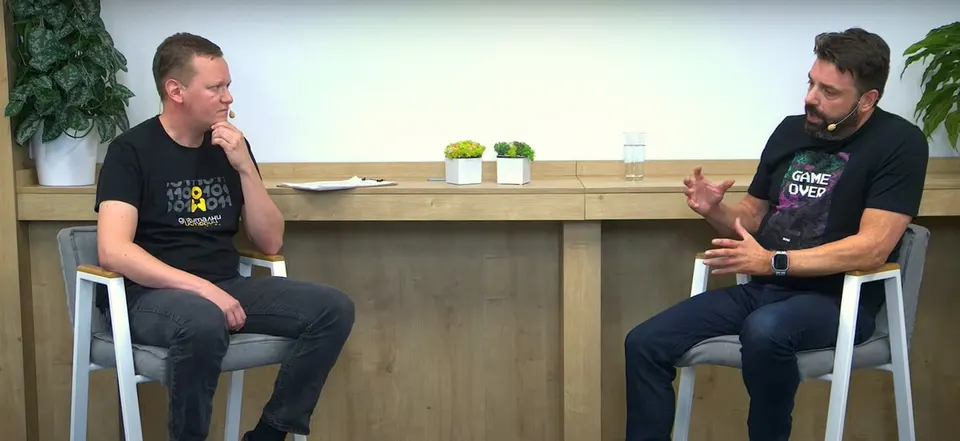
Boris Simandov has vast experience in technology. For nearly 10 years he held a director's position at Chaos Group, one of the most successful Bulgarian IT companies. Today he helps develop the next generation of startups.
Together with Rosen Genchev, he created the Facebook group DevBG, the liveliest (and often rather strange) online space where people from the tech world meet.
We talk about:
- whether we can feel at ease in today's turbulent times
- the artificial intelligence revolution we are living through, and the skeptics
- the next important step—Sora and video generation
- the big challenges and the professions doomed to disappear
- the return of truth as a value, and the media of the future
- the DevBG group as the best example of why and how democracy doesn't work today.
– News from the world of artificial intelligence has been flying lately. You spent a long time working on video generation, and in our previous conversation—on the DEV.BG podcast—you told me that you sometimes get fooled by artificial video yourself. Now the big news is OpenAI's new model, Sora. Is this yet another huge breakthrough, or will it turn out to be mostly marketing?
– What they showed is the next big leap in generative AI, and we've all been expecting it. It started with a startup, Runway, which was at the forefront of this field, and they made attempts that looked impressive but were decidedly far from professional use.
What OpenAI showed, if it really works that way, is fundamental—as big as ChatGPT.
Because GPT has existed for a long time, but only specialists and the people who believed in large language models knew about them. We'll watch the same thing happen now with the creation of video content.
The bad part is that this opens up even bigger challenges, because creating text is very important—our communication is built from it, a person can recreate everything in text, and from text make everything else.
It's clear that we are living in an AI revolution; I don't know whether we even need to discuss it.
What OpenAI showed is the next step. In the “Netflix of the future,” you'll have a prompt and the video will play in real time—whether it's generated directly on the device or on some servers. Imagine a world in which multiple ChatGPT-style agents make a film—one writes the script, another enriches it, hands it off to the next ones—they'll make the video, the music, synthesize the speech… And you get an entire film, personalized at that.
Each of these components already exists on its own. Is it perfect? No, it isn't…

– But it keeps getting better, and extremely fast. I see it in text generation, in images, even in computer code. The question is, where's the limit?
– In my view, it's where these technologies start replacing people 100 percent. From there on it will be self-sufficient; however much better it gets, that won't matter so directly.
The layoffs in the IT sector are often given as an example right now. Many people say that here
generative AI has already replaced programmers. That's not true at all!
Not only has it not replaced them, I think it has even made their work harder, because there's a sense that they now have to be much more productive and do higher-quality work.
The layoffs around the world are happening for entirely different reasons—a sobering moment in the IT industry, when it's become clear that the money of huge companies can't grow exponentially. Their revenues are still growing, just at a more natural pace. If you're a startup, you can have exponential growth, but a company valued at $2 trillion, if it grew exponentially, would in a few months be as big as the entire economy of the Earth—$105 trillion a year.
It's clear to everyone that these market valuations are artificial. NVidia's reached $2 trillion; it passed Google. A hardware company that makes graphics processors?! What if quantum computers advance tomorrow? Right now they work with 20 to 30 qubits, but there's talk of a breakthrough, and within a year we'll have 20,000 ready for use.
Such a machine will be a billion times faster than all the computing power on Earth!
And then do you know what NVidia's market valuation will be? Under a dollar.

– Still, it's counterintuitive, against the backdrop of all the noise around artificial intelligence and automation… that demand for software specialists is falling. In Bulgaria there are visibly fewer job ads, and the advertised salaries are melting away too.
– That's a good thing! The money around the people I'm hiring right now is getting bigger.
I think a big problem is looming. It's much harder for so-called juniors, people who are studying right now, to get into the IT industry. Only the best will remain, the talented ones who understand things in great depth, because the other, simple tasks will be solved by artificial intelligence.
– Or perhaps at some point there'll be a new boom in demand, precisely because fewer people are entering the profession.
– The other bad thing is that our profession isn't institutionalized.
We are surrounded by a huge number of software systems, we use them in our daily lives, and they were written by mediocre programmers.
The way we create software is broken! For years the big companies haven't managed to keep technical debt under control. That's exactly what's suffocating the software industry right now; there isn't a company on Earth that doesn't have enormous technical debt. Colossal!
Maybe artificial intelligence will help us in that direction. Yes, what's happening now is a huge revolution. But we're still using AI as an assistant in limited applications..
I would never get into a car with autonomous driving written by a large language model. They're doomed to make mistakes, they make things up, because they don't think the way a human does—they don't have that mechanism. Perhaps another type of neural network, built in an entirely different way, will resemble our thinking.
That doesn't change the fact, though, that if they start making video very well, huge industries will disappear. It's already happened with pictures—I don't have a single presentation where I use any other images. I used to find a picture and buy it. Now I describe what I want, the style I want it in, and that's it.
This could be devastating. After all, I spent 10 years at a company that works on visual effects; today I wouldn't feel at all at ease if I were in that sector.

– So who can feel at ease? I discuss this with many people, I think about it, and in my view there's no field that won't be shaken by these technologies.
– No one can be at ease! We all see it.
In my view, we are living in the best times of humanity, despite the fear.
But fear of what? Of change, of being fired as a programmer, say. I have many acquaintances, especially in Silicon Valley, who live in fear that they could be fired any day, and not only because of AI, but because our industry is one giant bubble. Can you imagine Sam Altman saying, “I need $7 trillion to disrupt the chipmaking industry through artificial intelligence”? What kind of world are we living in now?!
– He's also the one who said that soon there will be unicorns—billion-dollar companies run by a single person.
– But who can be at ease? No one; we live in a time of total transformation. There's no way to be at ease.
Maybe if you have a little house with a yard, grow your own food there, don't listen to anything, read books. If you close the cycle of life the way our grandfathers lived 200 years ago, maybe it won't matter there. But for you and me it will. Are you at ease?
– Yes, to a fairly large degree. Once I changed my profession from the ground up, and that gives me a perhaps deceptive confidence that I could do it again.
– That's exactly how people should be able to feel at ease!
Being able to adapt—those are the most important qualities nowadays.
Every narrow specialist is under threat, because there will be an AI to challenge them. At the same time, though, everyone else is under threat too. Look, a few days ago Gemini 1.5 came out, a model that can take in a million tokens. Now we're talking about the next level of managing information in a large language model. I can fine-tune it on the entire code of one of my projects, not just four functions, and tell it: “Fix the bugs!” This is where things start getting even more interesting!
A person can't read 30,000 lines of code, and even if they did, a human's context is much smaller. In large language models it keeps growing. Unbelievable! It's another step in the revolution. It could be used for so many meaningful things…
– You say there's no point discussing whether we're in a revolution, but I think we should, because for most people we aren't. I'm convinced too, but I read the comments under my articles. How do we convince the rest? Or will that happen when jobs start disappearing?
– Every society of more than 1,000 people is a kind of sample, and it has specific behavioral types. Between 3 and 6 percent are early adopters—people who are the first to take up the new, who believe in it and follow what's happening. I think you and I are such people—when I see something new, I dive in completely, try it, study it, try to break it, think about what to use it for. And after a few days of testing it either works well and I keep using it, or I throw it out, because it's no longer useful to me and therefore no longer interesting.
Then there's about 15 to 20 percent who trust these early adopters. If they approve of and recommend something, these people will try it. This applies to everything, not only technology—to every new musical or fashion style. On the whole, these people are skeptical of novelties, but they watch the reactions of the first group closely. And they trust them, buying the phone that was recommended to them.
Now we have a solid group of people getting used to the innovation, and only then will 60 to 80 percent of the rest accept it too.
50 to 60 percent of people are the biggest skeptics. For them it doesn't matter what you show and prove to them, whether it's clear that the new technology will change them.
They simply don't believe until the moment they're forced to.
You can't convince someone who as a rule doesn't accept arguments; that's human nature. If you and I think we're living in an AI revolution, at least 60 to 70 percent of people won't believe it. And whatever we do, we won't convince them.
Not until the knife cuts to the bone. Not until taxi, truck and bus drivers start losing their jobs and are replaced by autonomous vehicles. Not until 60 to 70 percent of programmers are fired, because the rest, with the help of some AI, will do twice as much work and it will be infinitely cheap—in our industry, labor is precisely the biggest cost item.
In 1912, when Ford was producing 15 million Model Ts, no one believed that horses would disappear from the streets as the main means of transport. At some point the people who shod them were simply left without work.
It will be the same with software service companies: the best will remain, and the mediocre will be replaced by AI.
– Isn't part of the problem also that we killed off the media in their traditional form, that we killed the authorities? And so it's harder for us to talk to each other as societies…
– In my view, the media transformed. I'm still subscribed to the ones I think have real content, the kind I want to read. Back in the day we bought newspapers, but a newspaper also costs money to produce, purely in material terms. Now I'd rather give money on a digital platform to a journalist I love to read; I know their information is verified, and I trust them. And I'm willing to pay 5 or 10 euros a month.
The value of meaningful content, in my view, will rise, because there is far too much garbage, far too much noise
and the only way to preserve ourselves as human beings is to have control over the flows of information. To sift what gets into our heads.

– Yes, but I know extremely few people who pay for content, including those who can afford it.
– The average Bulgarian fascinates me—no money, yet buys cigarettes for 6 leva (about $3.30) every day and coffee from a street kiosk for 2 (about $1.10). Even with no income, there's always money for their vices.
But there's no money to go to the theater, or 10 leva (about $5.50) for digital content, because they feel no need for it. That's the problem. When a nation doesn't have enough quality individualist intellectuals who also value the work of others, it can't happen. It's like reading Shakespeare in an unfamiliar language—it has no value at all.
– Why can't we talk intelligently in our own guild either? I mean specifically the DevBG group, where not particularly witty jokes alternate with ugly hate. Is it a reflection of that same national psychology, of some sense of superiority often found in the guild? Or is it because all sorts of people come in, attracted by the good working conditions?
– All three are true. First, the group was created completely open, and since its topic interests a wide circle, all sorts of people joined. Back then, the only ones posting meaningful content and getting discussions going were Rosen and me. Then another 10 or 15 people showed up who started very serious discussions and technical conversations. The group was created with a technological flavor; it had a concept, which is now totally distorted. It's gone, and there's nothing we can do.
This group is a phenomenon. It's an example of how democracy doesn't work,
but it's still the single best thing humanity has come up with.
If we moderate everything… every day we get 1,000 requests to delete posts! And that's for about 100 posts. If we made everyone a moderator, how many posts would be left? Zero.
That's the phenomenon of human beings. Political work, as Churchill said, is the most thankless job on Earth. Whatever you do, even if you lead a country to victory in a war, half the people still won't be satisfied.
It's the same in DevBG. The group is an example of another social phenomenon too. It's very easy to write something and hide behind the mask of a digital platform, to curse at someone and say how great you are. But it's harder face to face. Besides, it's much easier to spit than to do quality research and defend your position with arguments.
– And when you see what comes back at you, you have no reason to do it either. I used to post some of my articles in the group at first, then I stopped.
– Whichever platform you use, the comments will never be good.
But DevBG also has a meaningful audience which, just like you, has either stopped posting or even stopped reading. Because amid all the noise there's a small percentage of meaningful information, and people tell themselves it's not worth going in there.
And that's bad; we don't have a good solution. For fun I drop in now and then to laugh at a meme, but I'm fed up with the negativity, with the hate.
Even if we set rules, there would have to be 50 to 100 moderators—there's that much content. Many people wonder, “Come on, don't you read the posts?” Even as an administrator I get a sample, not every post. Facebook's algorithms decide what they'll show me! Even if it's a crime, they judge whether to send it to me, and the only thing I can do is ban the user. And the post is cached, so many other people keep seeing it because of the scale at which Facebook operates.
– What are the next most important technological breakthroughs you're waiting for?
– One of the next big steps will come when 70 to 80 percent of cars in big cities are in autonomous mode, even with people inside.
I expect a big boom in robotics. Robots have been in hibernation, but thanks to the progress of the models they'll gain, in a very adequate way, sensitivity to the outside world, and in that field this is very important.
I expect better connectivity; humanity is still in very bad shape there. In particular hubs around the world there's lightning-fast network access, but move a few kilometers away and it all vanishes.
In AI, I expect everything to get even better, for code to be written at ever higher quality.
– But aren't we close to the limit of what we can squeeze out of large language models?
– It's possible. But as we see with the announcement of Gemini, we apparently haven't reached the peak. Context limitation is a very important problem. Imagine the next generation, which receives a database of gigabytes, organized and structured.
You have a tool you can use for every type of task that requires aggregation, grouping, reasoning, sorting, ordering, answering questions about the data.
I'm also waiting for the quantum computer. There's no way it won't happen; we're squeezing the maximum out of silicon, and computers have stopped getting exponentially faster.
– As Kurzweil says, not only does Moore's Law hold, but when we reach the limit of a given technology, the next paradigm somehow appears and lets us keep going.
– We're definitely living in incredible times…