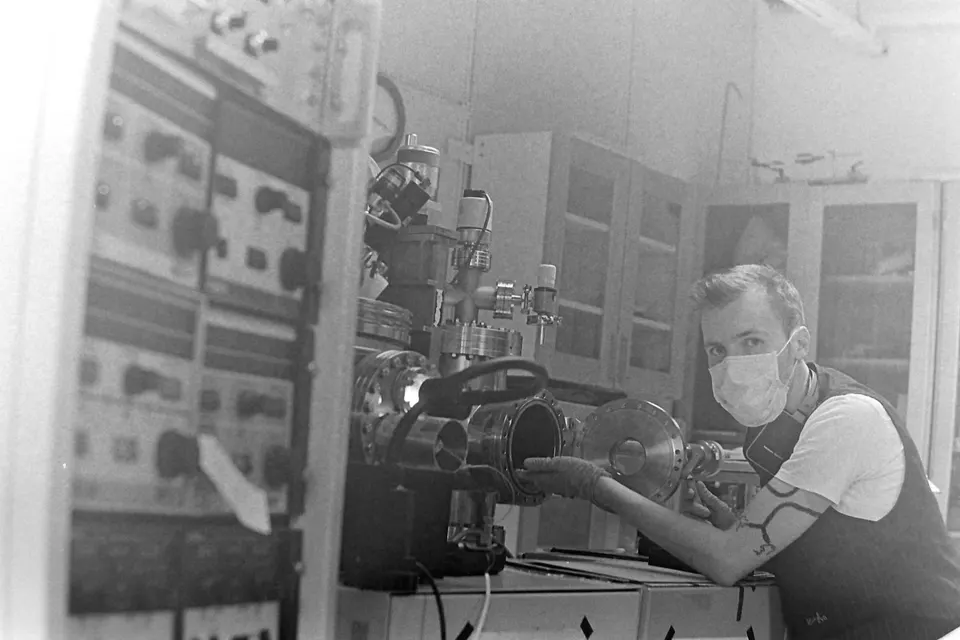
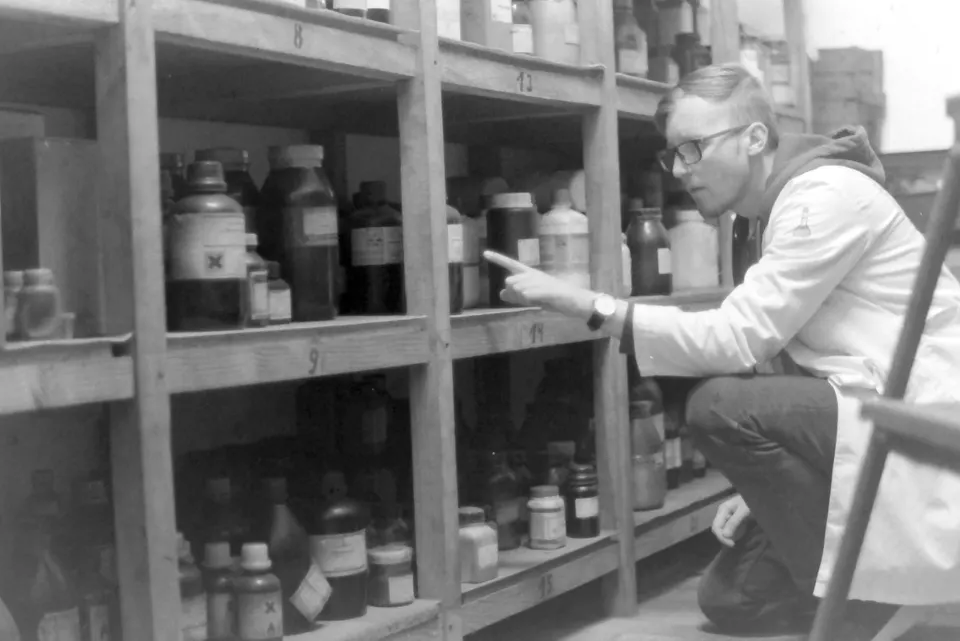
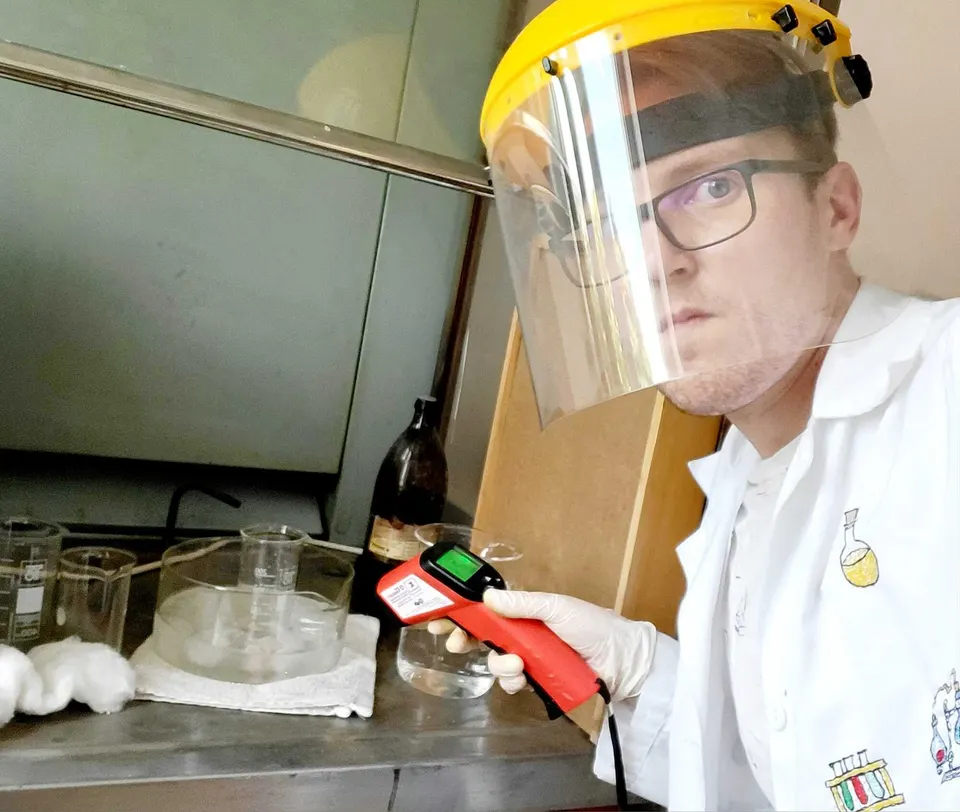
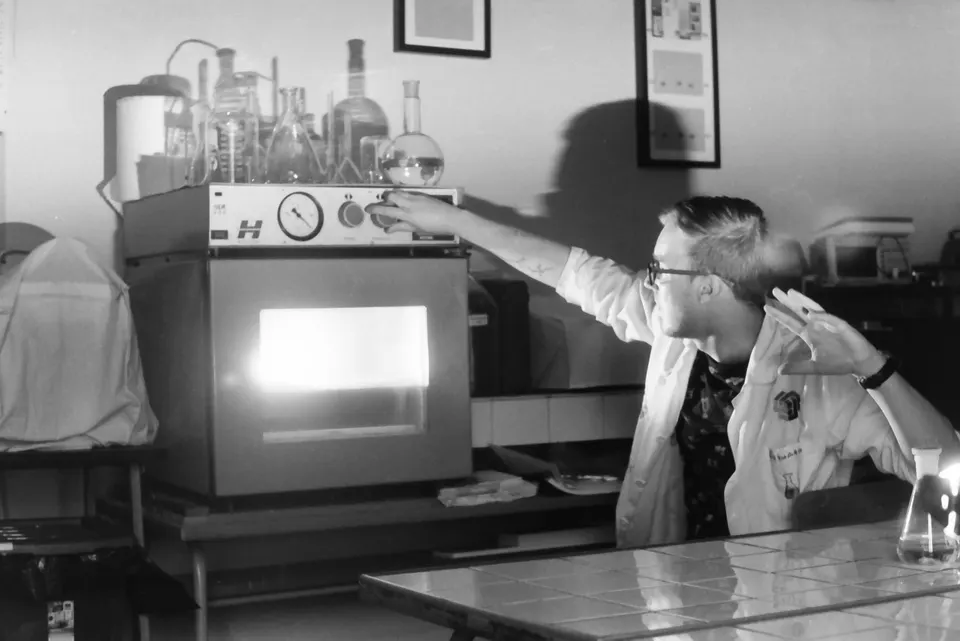
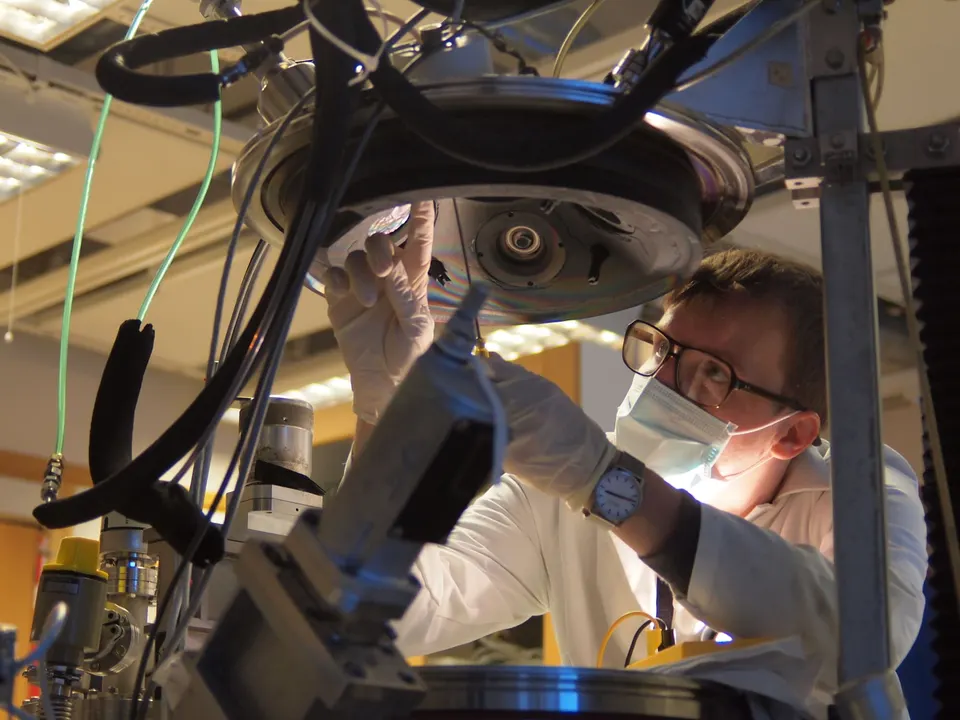
Bozhidar Stefanov was invited to work at Oxford, but he chose to build a chemistry lab at the Technical University of Sofia, in a room that still has no air conditioning. Before he moved in, he tells me, his colleagues called it “the isotope room,” because in the 1970s it was used for experiments with radioactive isotopes. “I’m not going in without a Geiger counter,” I say with a smile, and he pulls out the very instrument and shows me that the readings are normal. Never joke with a chemist.
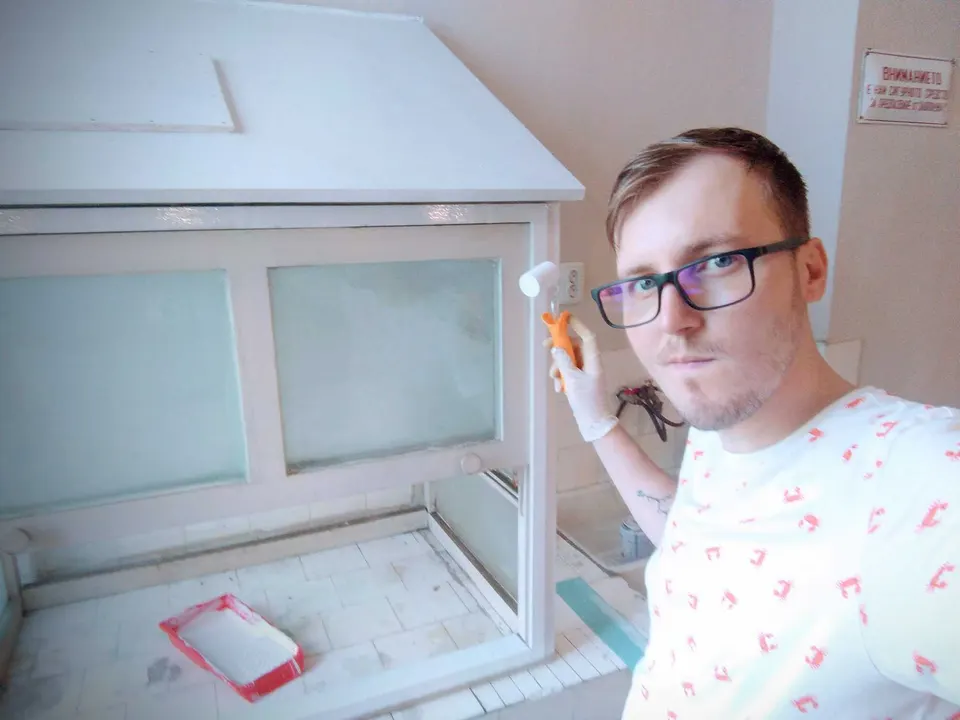
Then he tells me about clearing out the lab, about the layers of dust (and East German porn magazines) he shoveled out before he finally had a place of his own to do research.
During the pandemic he learned to embroider. And before that, for many years, he caught the cameras’ attention as someone who could present science in an accessible, accurate and attractive way at FameLab events. Lately, though, his focus has been elsewhere: on producing scientific results.
I believe him that the environment is healthy; I have no choice, he knows the subject. But I also believe that we can have both clean air and great prospects for science in this country, if there are more people like him. I may even forgive him his skepticism that artificial intelligence will solve the big questions of chemistry… because he is a chemist, a recognized scientist with rich experience. And because it is time we listened more and more to the people who burn for science and have chosen it as their calling. People who understand what they are talking about and may not offer the most colorful, animated view. But they offer the one that really paints the future…
– You took part in the discussion about why it is worth doing science in Bulgaria today. Afterwards I watched some of your interviews, and they always ask you: how come, why did you come back? Why do you think it sounds so strange that someone who could work at Oxford chooses to “dig out” a lab in the middle of Studentski Grad, Sofia’s sprawling student district?
– I really don’t like that line of questioning. I keep getting asked it because we grew up in the 1990s, when
the media constantly repeated that every capable person should leave for somewhere else.
So now, when some people come back, everyone else is surprised.
I don’t like it when this topic comes up. You see, it’s as if I’ve arrived here and the red carpet has to be rolled out for me.
It isn’t a sacrifice. Look, for me it was simply better to come back. Because if I had stayed abroad, I wouldn’t have had any real chance of a permanent job, of steady development. There, in science, you’re on temporary contracts, one year at a time, you plan year by year, and you need a lot of luck for a position to open up at a university. In The Big Bang Theory, whenever a professor died, everyone would say: “Now there’ll be a tenure opening.” That’s what they call it abroad when you get a chance at a permanent career.
My option was to stay on as a postdoc, one year here, one year there. People who keep moving around the world until they’re 45 or 50.
– Still, it’s Oxford, that’s where big science is done.
– I don’t want to talk about Oxford. Last time,
when I said that I’m better off here than there, there were comments under the piece saying they only pick the best, he isn’t good, that’s why he didn’t stay.
They did offer me a chance to stay; they had a new project. They’re still developing what I worked on there, they’re even commercializing it. My contribution is very small, I don’t want it to sound as if I left them something tremendous. I just didn’t want temporary contracts. I didn’t want my whole world to fit into one suitcase at 30, knowing that soon I’d pick it up and move on to the next university.
– Isn’t that system a bit broken, if it turns away people like you?
– You have to stay motivated, to fight, if you really want it, but in the end you wonder what for. Wherever I go, if they offer me a permanent contract, the science I develop will be their projects. In other words, I’d have to invest myself in somebody else’s ideas. Whereas here I have the chance to develop my own ideas, to apply for funding, to build my own lab, and in that lab it’s just me. The one-man group, as I joke at conferences. And that’s the big advantage.
It’s possible here because there isn’t much competition. At Oxford, if they post an opening, they’ll get dozens of applicants from all over the world who don’t know why they’re applying, except that it’s Oxford and they want to be there. And that distorts things a little. Their system, where you get competition, selection and sorting, doesn’t guarantee that the best person really ends up in the position. I’m not saying it out of sour grapes. I just think the criteria they use are somewhat subjective.
– Isn’t science done in big teams? What can a single “one-man lab” achieve?
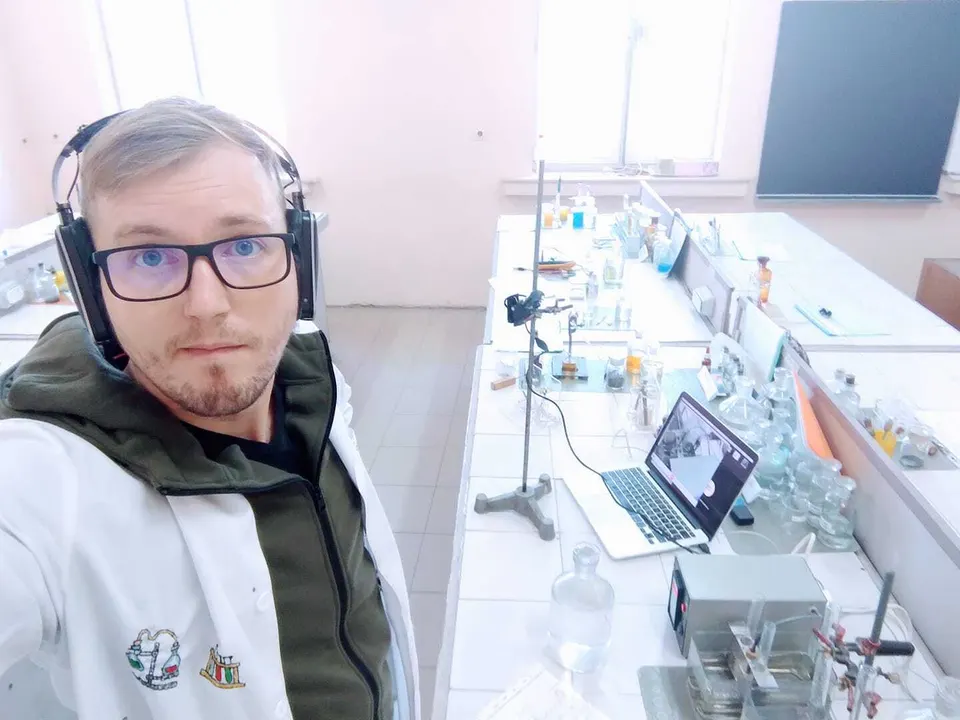
– No, I don’t work alone. I collaborate with Sofia University: with Assoc. Prof. Nina Kaneva, we started working on nanotechnology back as students, in 2007. Now we have a project with the Bulgarian National Science Fund, KP-06-N59-11. A code worthy of study by numerologists, but with that combination Nina and I hit a career restart in science, and it helped me build my lab. I also work with the Bulgarian Academy of Sciences; at first it took me time to make contacts and find good people. And I work with colleagues in Sweden, in the group of my former supervisor, who really wanted me to come back.
I simply decided I was better off here, so that I could develop my own ideas.
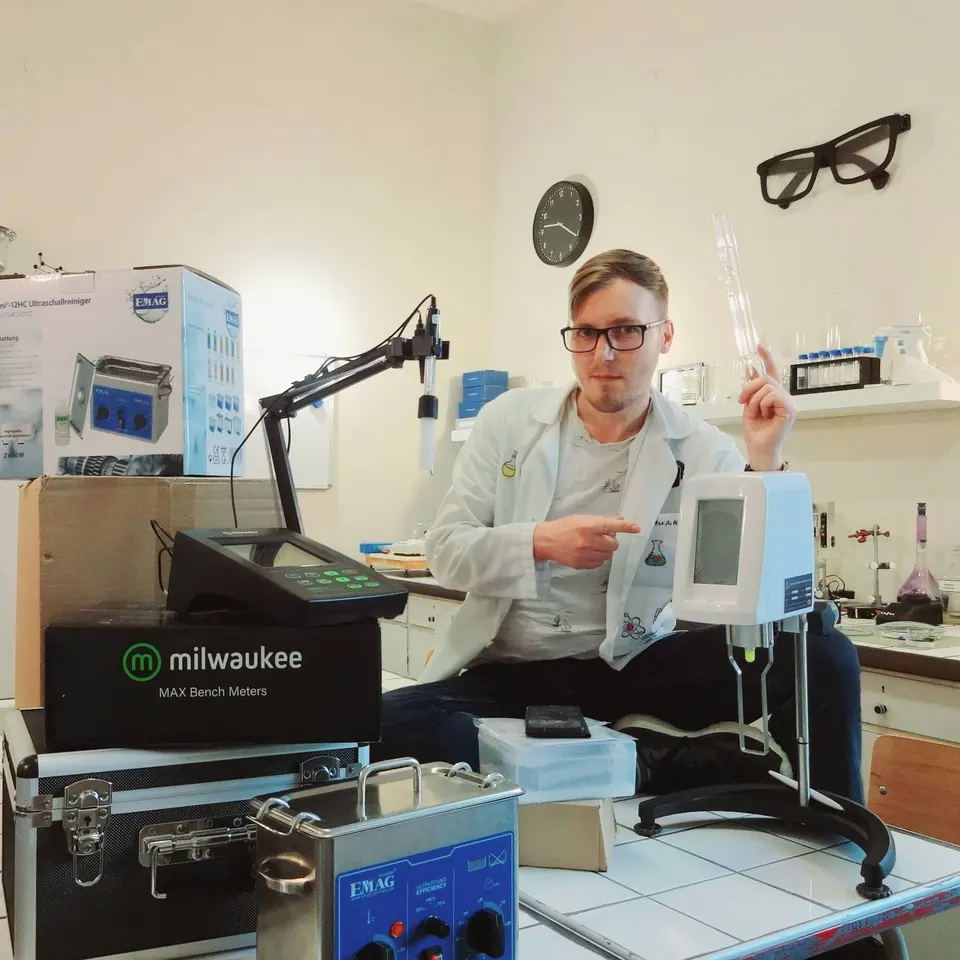
It was a bit hard at the beginning, around 2018, because there was nothing. But now I have all sorts of things, from a 3D printer to a milling machine. You start with small steps, from zero, you attract funding, you buy equipment bit by bit. That’s how the ball starts rolling, grows bigger, and eventually I have enough to do what I used to do before.
– What exactly do you do?
– I work on depositing thin layers of various materials that can absorb light. They’re about 100 nanometers thick, 1/500 the thickness of a human hair. The material is transparent, but it can absorb ultraviolet light and turn it into chemical energy.
One application is self-cleaning surfaces. If I coat my glasses, which are always getting dirty, with this layer, then when I go out in the sun all the greasy smudges will break down on their own. It’s also used in solar panels. Over time dirt builds up on them and lowers their efficiency, and cleaning them is very difficult. Besides, with the method I’m developing, such layers can be applied much more cheaply, without the vacuum deposition the industry uses now.
Building on that, we moved into other things. We worked out how, with the same technology,
to make small electronic circuits on glass.
We also decided to test whether they would work as sweat sensors. Say we want to measure whether there’s some protein in sweat that serves as a marker for a disease. I’ve made humidity sensors this way too, and now I’m making heat sensors.
– I’ve been writing about science since 2004, and back then so many experts said nanotechnology would be everywhere within ten years and change our lives, the way people talk about artificial intelligence now. Why didn’t anything like that happen?
– Every ten years or so there’s something like that, which turns into a marketing tool.
There are plenty of examples. When a hot topic like that appears in science, everyone starts working on it: “I’ll write that I make nanostructures when I apply for money, it’s a hit right now and they’ll fund me more easily.” That’s how it was 20 years ago, and then it passes into marketing.
Now it’s happening with artificial intelligence. All the companies that make windshield washer fluid would have written back then that they use nanotechnology, and now it’s AI. I’ve often wondered, reading a label, what exactly nano-micellar facial cleansing water is.
Quantum computers, 3D printing… All extremely
flashy topics for research, and in the end there really aren’t many applications that change our lives.
I definitely think it’s about marketing.
There are some examples, of course. Self-cleaning windows are already in use: the two largest companies in the industry offer that kind of architectural glass for all the tall buildings where architects decide to wrap everything in glass. But still, unfortunately, in science just as in marketing, there are these keywords, these hooks, that change periodically…
– And why is chemistry somehow off the media’s radar? I can’t think of any big news in recent years. Physics, say, or computer science get talked about far more.
– That’s very interesting, the difference between chemistry and physics. I’ve always felt somehow proud to belong to the minority group of chemists, but I also feel we’re underrated in terms of our usefulness to society. If you think about it, physics grows out of philosophy. So way back, 2,000 years ago, that’s where it all started.
Whereas chemistry—we had alchemy, which was closer to the spiritual, and it was harder to understand what exactly they were doing. It didn’t find applications; it was mostly craftsmanship. Chemistry really starts from metallurgy.
It’s simply more applied, and that’s why I don’t think it generates big news that interests the media.
– Society somehow has the impression that everything in chemistry has already been discovered. Sorry for the sweeping generalization, but that’s how it seems to me.
– If you think about it, whenever a new chemical element is synthesized, one that has practically no use whatsoever, it’s always news. Because there’s an element of a race there. The two ends of the world compete over who will come up with the next one, who will manage to synthesize it. When they succeed, there are no applications.
– The notorious artificial intelligence we mentioned—does it have applications in chemistry? Are there places where it could lead to a breakthrough? For example, in generating new materials much faster…
– I have colleagues who use machine learning to predict the properties of substances. I see it more and more in scientific papers too: “Our group used machine learning and predicted that the material with optimal properties for a given application will have composition XYZ. We haven’t made it, we haven’t tested whether this material will really be that useful.” In my view, the goal is to make the paper stand out, and again it’s mostly marketing.
I graduated in computational chemistry, and the main thing they trained us for was how to use simulations to predict the properties of substances. Honestly,
however attractive it is to put “artificial intelligence” in the title of a chemistry paper, I don’t think it’s all that successful.
About 20 years ago there was something else, called QSAR. The idea was that if you’re the pharmaceutical industry and you want to make a drug, you know what the molecule should look like, but you have several thousand variants and you don’t know which will be the most active. What they did was similar to machine learning. They synthesize a few variants, the most extreme ones, measure some properties, feed them into a computer, build a statistical model, and then for all the remaining 2,000 variants you can predict what the effects will be.
– But just weeks ago Google announced a new model that will create new materials extremely fast, and that this will let us advance computing very quickly. You’re rather skeptical.
– It’s just not new… Computational methods in chemistry date back to the 1970s. If I studied computational chemistry at Sofia University in 2007… that’s exactly what we were doing in practice. The goal wasn’t to predict, to create a new material purely on the computer, but for the computer to help us explain where the properties of a material come from, what structure it needs in order to do the job we expect of it.
Developing new materials is cheaper and faster on a computer. But unfortunately it turns out it’s not always quite right. There were many publications, even in Nature, where they used machine learning to predict candidate materials for, say, lithium-ion batteries, with a better weight-to-capacity ratio. They predict which is the best of 5,000 variants, but in the end it turns out that when it’s actually synthesized, it doesn’t do the same job.
And the problem is that
this way of predicting, of synthesizing materials on the computer, is only as good as our understanding
of the relationship between the structure and the properties of materials.
– Except the idea is that the algorithm will be more impartial than we are.
– But it will be based on what we know. Say I know that with a copper-zinc alloy I’ve measured the density and the electrical conductivity at three different ratios. I’ll ask the computer to predict an alloy in which the two metals are in the best ratio to give me a certain resistance, and that computer will rely on the five points I’ve measured. In other words, my understanding of reality may be wrong.
AI and machine learning are useful for chemistry. Yes, you could say everything in chemistry has been discovered, but very often it turns out that the things we believe we understand are only an approximation.
I tell my students about this too. At the end of the 19th century there was a lecture at the Royal Society in England where a lord declared that
we now know absolutely everything about the world, down to the smallest element.
We know there are atoms and nothing new will be discovered. Yet a few years later they go and discover the electron, then the proton, then that there are other things inside the proton. In the end it turns out our idea of the atom was completely wrong.
– We should even change its name—it comes from “indivisible.” And we still call it that.
– Not only that, we went through three stages. First we had the model of a single positive mass with electrons floating in it, the “plum pudding model.” Then Rutherford discovered that the nucleus is very small, it sits in the center, and the electrons orbit around it. Then Schrödinger came along and complicated things even more.
So there are things we still don’t understand. Only well enough to use them in practice, but I think that when it comes to the fundamental questions, there’s still a lot left to be desired.
– What do you expect to happen in this direction in the coming years?
– My topics, chemistry’s topics, go only as far as the outermost electron shell, as physicists like to joke. I don’t know what to expect. But I’ve noticed that in recent years the Nobel Prize in Chemistry has increasingly gone to people who don’t work in chemistry but in biochemistry. Maybe materials science isn’t that attractive at the moment.
– You’ve been popularizing science for a long time. How do you think we can make it more appealing? Should we have science influencers?
– I’ve stepped back a bit from those topics; in recent years I’ve focused on the lab and on getting projects moving.
– But the trends are the same. And you meet young people, you teach them.
– When I came back to Bulgaria, I spent some time at Sofia University too, but there was no chance to stay there, so I ended up at the Technical University. And I discovered that it’s an incredible plus to teach chemistry to people who are engineers. For them chemistry is something they don’t believe they’ll ever need, and they didn’t pay much attention to it at school. But when they come here,
and I try to present it to them, I notice how impressed they are by how interesting it actually is.
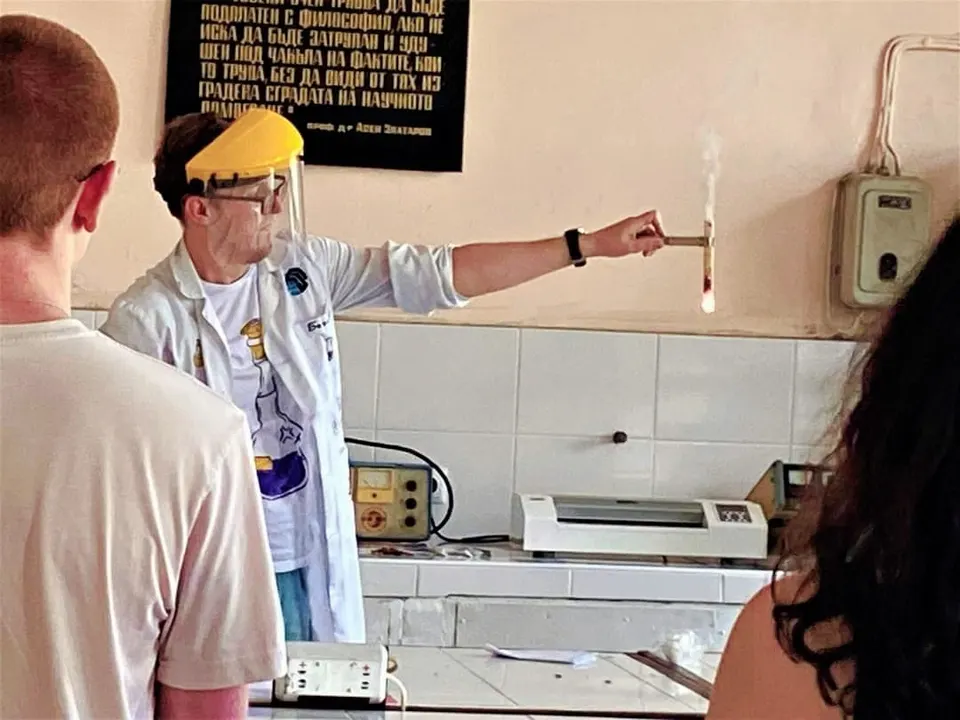
When I see that someone finds what they’re doing interesting, and I can hold their attention for 45 minutes before they do the experiments themselves, that gives me real pleasure.
As for science influencers, there are quite a few good YouTube channels that show science. I’d say some of them may even do more interesting things than what I’ve seen colleagues do in labs. Breaking Taps is one example: a YouTuber who has a scanning electron microscope and an atomic force microscope, equipment some universities don’t have, and makes interesting videos. In one of the latest, he showed how he built something like a primitive sensor on a piece of glass, like the ones I make here, a matrix that captures images.
My problem is that these more specialized channels would mostly be watched by people like me. Whereas
some of the general-audience science channels sometimes give misleading information.
Veritasium, for example, is hugely popular, but sometimes slightly misleading.
The reason is that when you lean more toward being an influencer than a scientist, you’ll try to make what you present more attractive, and you’ll lose some of the science.
– Those are very strong examples. But in Bulgaria I don’t think we have anything that comes close to either direction. I think that’s somehow a function of society’s overall interest in science.
– If you ask society, people are very interested in science. Everyone watches National Geographic, Discovery… I think in Bulgaria we have yet to develop this kind of science content.
When I read books, I buy them from an online bookstore; I don’t set foot in physical ones at all, and the reason is that in my first years back it really traumatized me: I’d go into any bookstore, reach the science section, and
50 percent of the books there were esoterica, even though there was a separate, much larger esoterica section,
with the memory of water and all sorts of other topics like that.
People find that interesting, I understand, but if you take it as an example… It’s easier to get people to listen to how aliens visit us than to how hair dye or sunscreen works, where the chemistry is in that.
When it comes to chemistry in particular, people are wary. I think it still sounds scary. And boring. At school I didn’t find chemistry interesting either. With many subjects, my problem was that I didn’t understand why we were studying them. It only became clear to me much later. I think something similar will happen, slowly but surely, at the level of society too.