No, you won’t! Technology and science are the way forward—for every young person who wants to achieve something, and for all of us as a people, even as a civilization.
Last year, posts from the site Bulgarian Science were viewed 29 million times on social media. Accessible, yet accurate and well grounded, it tells the stories of scientific breakthroughs, of the challenges, of the great successes of Bulgarian scientists.
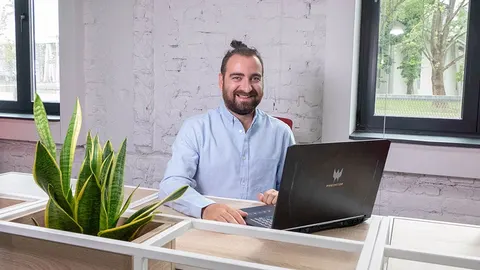
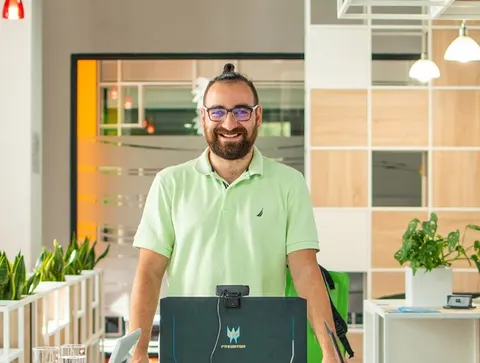
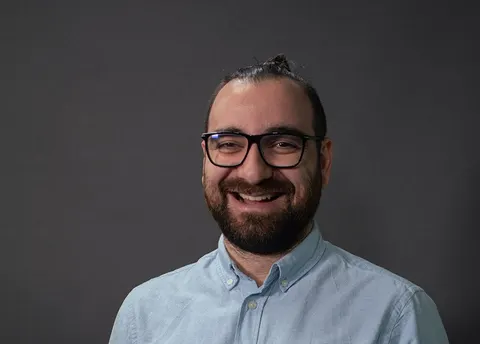
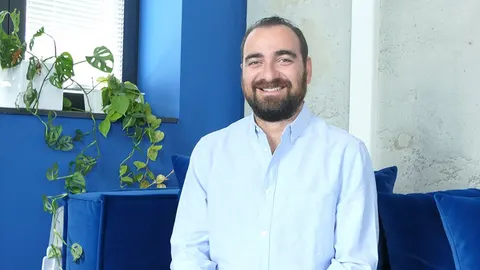
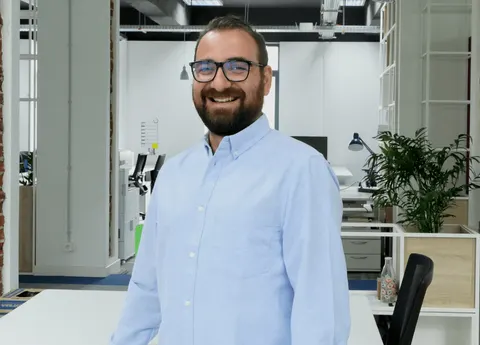
For 17 years now, Petar Teodosiev has poured his soul into this cause. He started as a kid who had no money to buy the books he needed to learn programming. Then he got so carried away telling stories about science that to this day he hasn’t lost his faith.
Faith that we can turn the stereotype around. That it matters to light the spark of curiosity, of a love for books, the flame of science in the next generations of young people. Because that is our chance as a nation.
But how do we make it happen?
– How was the idea for Bulgarian Science born?
– We started 17 years ago, my twin brother and I, when we were just 14. We made a website that talked about science in a way we felt was missing from the education system. I spent more time in the library than at school, especially from eighth to twelfth grade.
In eighth grade I discovered books—the people around me simply showed me that there were other, very important things that nobody talked about in class. But where do you get books when you have no money? At the library! I sat in the reading room all day, carried on at home in the evening, returned them, took new ones. In a single year I went through several library cards because they filled up.
That’s when I thought there must be lots of people like me who enjoy reading about science, and so my brother and I made the site.
I taught myself to program!
We were very poor, and I had to save for months to buy a single book on programming.
This was 2004–2005, and the library didn’t have them yet, because they were very specialized and expensive.
And I learned—you literally read the code, write it down on a piece of paper, then open Notepad and start, without seeing what works how or what’s wrong. Programming happens in a very different way now…
– Back then websites looked very different too. There wasn’t even WordPress…
– That’s right. I wrote the site in PHP, we had to write the articles and publish them ourselves, exactly the way WordPress does it now. The MYSQL databases,
I built the whole thing on my own, and then… forgot programming.
My brother and I took on the content. The idea was to start with a magazine—that was the spirit of the times, the big international magazines were just arriving. We had to do everything ourselves; we had no money at all. We caught a hosting promotion and invested, literally, the few leva we had saved from our lunch money.
We set up a forum—before Facebook, forums were very active. Ours came to life quickly. Scientists dropped in, lots of people registered and started posting, and we reached hundreds of posts a day.
The online magazine got going and grew popular among scientists too. We even received our first donations! We were still schoolkids—imagine seeing 10 leva (about $5.50) arrive… Wow, how cool is that! Without our noticing, it started getting more serious; we set about building a more serious site, with more information…
– Listening to you, the story reminds me a lot of that of Bulgarian History. They too started as schoolkids, almost as a joke. Until there comes a moment when you feel that things are serious and require the next, bigger step. What did that moment look like for you?
– There was one. We came to Sofia, I enrolled at university, and we started working on projects. We created a nongovernmental organization. And although there really are similarities, our focus isn’t quite the same as Bulgarian History’s. What we do is a kind of news content about what’s new in science.
Alas, globally too there is much less interest in these topics.
The strongest is in astronomy, but it’s still a far cry from the interest in Bulgarian history.
But the moment came for us too, when we asked ourselves: “OK, is this what we want to be doing?” We would have had to sell ourselves and the ideology we started with in order to do other things that were more in demand, but we told ourselves there was no way. So eight years ago I took over Bulgarian Science entirely.
I decided I would give a few years of my life to see whether I could achieve something bigger here. And I still waver about all of it, because there are many hard months that shake everything.
Even so, every year we reach more people, we expand and improve the content, we make more and more documentaries and interviews, we publish more issues.
That has a price, which isn’t financial—it’s measured in the life you give to the cause.
– Why do you think there’s so much interest in history, while we can’t spark the same interest in space?
– Look at the political situation. The easiest way to manipulate people and build parties is through history and nationalism. It’s about using history. In my view, the least educated are the easiest to manipulate on these subjects. The people who have Botev and Levski—the heroes of Bulgaria’s 19th-century struggle for liberation—tattooed on their bodies know the least about our history. They’re exactly the ones who would jump into a fight against the very truths Botev and Levski fought for.
For me, that’s the problem—our education is at a very low level.
That made me the person I am now. Fighting against that system, I didn’t go to school but to a place where I read every day. It changed my views on education, and that’s why I keep doing it all my life, ever since eighth grade, and now I’m 35.
Over the past five years I’ve read more than 150 books on marketing and business so I could figure out how to “sell” science for free. If I were selling sofas, it would be much clearer how, but
“selling” knowledge to people who have never been interested in knowledge is terribly hard.
“Selling” is in quotation marks here—the goal isn’t for them to pay, but to pay attention. To set aside five minutes of their lives to watch or read something related to science. And that’s the hardest part—creating the content so that it’s accurate and understandable. That’s the other side of the coin, because if you write about history, you can say: “He went there, they beat him up, and he came home.”
Now try explaining what dark energy and dark matter are…!
– I know very well what you mean; I’m lucky not to have to “sell” my technology pieces to support my family. I now have almost 300 Digital Stories, and the most read of them is called “Where Do the Bulgarians Come From?”, and it doesn’t even give an answer… How can we turn this around?
– Nobody gives a damn in the long run, and it shows. More than 30 percent of students are functionally illiterate.
The dropout rate is formally going down, but the number of dropouts is by no means small. The real data stays hidden from the people who should be tackling it. The statistics keep getting prettier because we look at the numbers that suit us instead of fighting the problem head-on.
There’s a program called Education under the Ministry of Education and Science. It hands out 1.3 billion leva just to solve problems like these! Huge sums, given to programs that report their “successes” with data that does nothing for the students or for society.
– By those same statistics, more and more young people finish school, and then entire graduating classes get a 2—a failing grade—on the matura, Bulgaria’s school-leaving exam. What went on in that school for every single one of them to fail literature?
– And then some of them will go on to university, waste their time there, and say, “I’ve got a diploma, I can do this.” But what you can do and what your diploma says are totally different things.
We started a campaign with films about business and science, about how
to motivate young people that it makes sense to study so you can work at a good company, create something, above all in engineering.
Last week we interviewed a company. They told us they had racked their brains for a long time and finally decided to hire 90 Uzbeks, whom they train and who become experts, even engineers. Separately, they train people from India and Nepal. Because they’ve thrown up their hands and decided there’s no way in Bulgaria.
We keep saying we have no prospects, no manufacturing—that’s not true! We have factories, and they have no one to hire!
Most students today couldn’t tell you which continent Uzbekistan is on, what its capital is, or which countries it borders. So what are we doing? Some kind of education that’s useful… to whom? We can’t staff our own factories, our own production here, yet we don’t want the Germans and the Americans to come; we want to do it ourselves. Then who is going to work, and at what?
There are programs, there’s money in the system, but where does it go?
– Have you ever regretted taking on Bulgarian Science?
– No! I don’t know the alternative. What I do has given me a lot. It has taken from me, but it has given me a lot too.
– Which results over these years are you proudest of?
– We’ve managed to show a lot. In Bulgaria the good comments stay silent, and hate rules social media instead.
There are countless stories. Many students win awards, write, draw, make videos related to science. We motivate so many young people who learn about various scholarships, apply, travel. We’ve run training and exchange projects in Europe and taken hundreds of people to different countries—to see things and take part in various programs.
Last year our content as a whole had 29 million reads on social media. We attract new people, and we’re developing a podcast too. We reach people, and I can see they’re interested—genuinely interested! They buy mugs with chemical formulas, they buy the magazine, take out subscriptions, donate to schools, and schools themselves want to work with us.
Even a kindergarten wants us to put on a science festival.
That’s exactly how a love of science should grow. It’s something alive—science is everything!
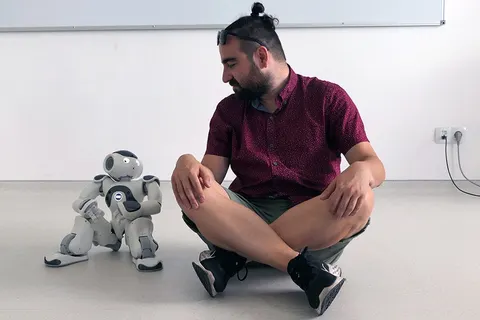
It’s reading the thick books, but also looking through a telescope, a microscope. Seeing, touching, changing things, doing stuff with flasks. A child doesn’t need to build a huge reactor or accelerator, but with Lego, a robot, a microscope or a telescope, a real desire to do science can be kindled.
– I see it in my own kids. I think it works, and your experience proves it—there are more and more platforms like the Science Festival, Ratio… But how much of it happens online? Because on the web it’s much harder to capture attention.
– Yes, that’s the hardest part—reaching people in the feed. Here it’s quite peculiar: there’s disinformation, political interests, economic ones. What takes the most time is creating and promoting the content.
– How can a presentation about dark matter look sexy? And should we even make it sexy?
– In my view, science IS sexy! The point is to explain it.
How do we make it so that it isn’t sexy to be a mutra—a thick-necked gangster type—a bouncer, dumb and crude?
Because the values have been turned upside down: chalga, Bulgaria’s flashy pop-folk, has become the luxury. It used to live in seedy taverns; today it’s in expensive restaurants and clubs. To look like a chalga singer you need a lot of money and a plastic surgeon. I see it every day.
Chalga is the luxury, and science is the poverty. It shouldn’t be that way, but for far too many years people said there was no money in science—if you’re a scientist, you’re poor. If you do science, you’re stupid, doomed. Why didn’t you choose the good life, driving a new Mercedes, with a hot blonde by your side? Something must be wrong with you if you don’t want that. It’s not true!
Explaining and showing that science is sexy is, sadly, a need that didn’t exist before. I know many scientists who earn very high salaries, create startups, run projects worth millions, but we don’t hear about them, society doesn’t know about them, because it isn’t sexy. And they couldn’t care less about talking about how many millions they do or don’t have.
– The sector I work in is a case in point. The INSAIT institute, for example, which is already creating startups, successful people and a lot of added value for the country.
– Exactly, and more and more scientists from abroad are coming there. But there are many other fields too. Even in energy we have good examples involving renewables. In medicine we have results in epigenetics and in vaccine development. But they help more abroad.
Here, people en masse don’t even believe in vaccines. And it shouldn’t be a matter of belief, any more than whether I believe I have eyes. Do you believe it? “Yes, because I’ve seen them in the mirror.”
As a species, we most often believe things we can take in with our senses, which is why fake news spreads so well.
“Did you see the man who set foot on the Moon?” “Well, no.” “I didn’t see him either, so he didn’t set foot there.”
That’s how it goes in many other sectors; science is more timid. We have a new telescope at Rozhen, Bulgaria’s national observatory in the Rhodope Mountains, and serious achievements in astronomy too. We have developed science and a very good environment for research. The problem isn’t even money anymore, it’s people.
– Next you’ll be telling me the Earth isn’t flat… So which scientific breakthroughs do you dream of writing about on the site?
– I’d like to see how science is done on the International Space Station. And why not a base on the Moon, as a step toward other planets? It isn’t that far off at all!
We don’t realize what Musk has achieved—he made space accessible, for sending up cargo, for people to travel. Humanity used to rely on Soyuz rockets, but the technology is different now; everything happens far more reliably. And somehow that news never quite reached Bulgaria.
– I also think space has been so underrated in recent years. Once upon a time every kid dreamed of becoming a cosmonaut.
– What happens in particle accelerators is unique too. At CERN and other places around the world, new physics is helping us understand dark energy, dark matter, black holes, the cosmos.
Alas, that takes much more understanding. As individuals we need much more information to be able to understand each next stage.
And since the subject matter is complex, we as a society fail to grasp it, because there isn’t enough information.
Here’s another example—coal-fired power plants, green technologies, the energy transition… What are the arguments for and against? Even national television, which is funded by our taxes, doesn’t produce useful content on these topics! Are renewables a bad thing? Should we shut down the coal plants?
If there are any interviews at all,
they’ll give every point of view, including some Uncle Ivan who counts the stars or reads the future in a frog’s entrails.
To me it’s madness—you turn on the news and get flooded with nonsense. The scientific point of view isn’t there, the experts aren’t there. Knowing who the authority in a given field is.
– I think we got here because the media followed the feed, and today they no longer have the power to change things.
– They do, they do! The Eurobarometer shows that more than 90 percent of Bulgarians watch television every day.
– Facebook is the deciding factor, at least in my bubble.
– Outside Sofia things are different; television in Bulgaria remains a serious force. Maybe in France, Germany or Britain the feed matters more.
In Bulgaria, I think this is one of the problems—the state has the power to change things but doesn’t, and it’s the same with education. Bulgarian National Television (BNT) has four channels! What if at least one of them were for culture and education? The funding is there, the journalists, the equipment, the history, the culture. That really gnaws at me! One of those channels could be devoted to science, education and culture…
– Where does Bulgarian Science go from here?
– Toward creating more video content. We’ve invested in a new studio, and I want us to make more short documentaries that explain and tell the stories of scientific processes and phenomena.
The magazine too. Our subscribers are on a separate network, and we also have a mobile app. That’s our focus—
to give people more and to show that science makes sense.
We keep trying to convince ministries and scientific organizations that talking about science makes sense.
It doesn’t matter whether it’s through us or whether they set up their own Facebook page or YouTube channel—it’s very easy now. The big universities have their own faculties of journalism, media, studios better than those of the big TV networks… but they don’t use them!
That’s my goal—for them to start doing it. For there to be more talk about science!