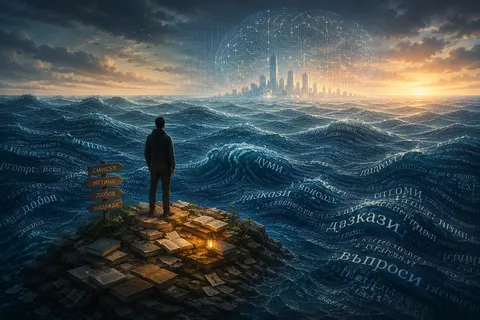
Magic is part of life, and if we give it up, we are left with dry, meaningless algorithms for living.
But how do we keep from driving it away while we are swallowed by the stream and its deceptive momentum?
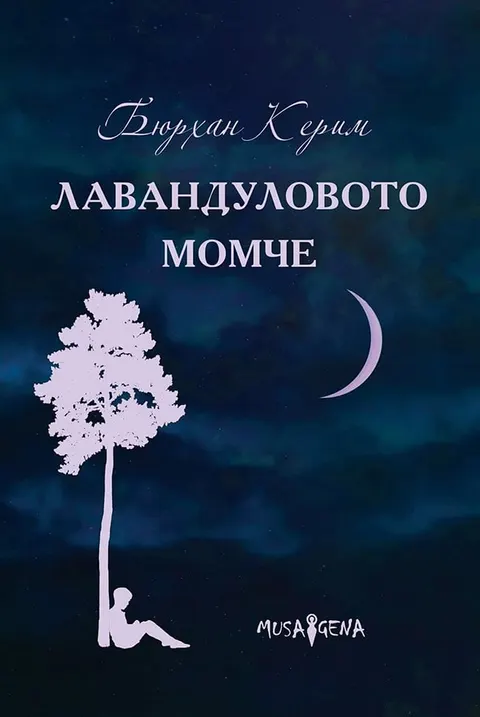
Byurhan Kerim gives his answer with Lavandulovoto momche (The Lavender Boy). His debut novel brings together eternal themes and a modern gaze, classic Balkan plots and magical realism. All to show us how real magic is. Born every day as part of growing up, in the meeting between people, generations and ethnicities.
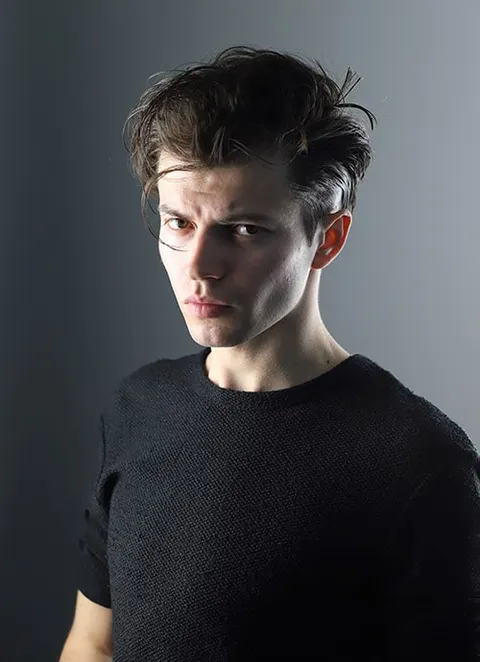
Today’s guest is an actor and director, and with his first novel he adds one more color to a palette of callings that only grow more precious in the age of artificial arts. In the lines that follow we will bring together technology and art, TikTok and Márquez, the Bible and Socrates. And, of course, magic…
– Why does the world of magic quietly vanish as we grow up?
– When we talk about “the world of magic,” sadly, my first association is Harry Potter, and my second is some garish ad for a travel agency. In our time the word “magic” gets used a lot, it covers all sorts of meanings, mostly in popular culture, and it has certainly drifted away from its old mystical ring.
I doubt that in the technological environment we live in today young people will ever truly touch magic as transcendence.
It is as if something has been swapped out.
And the quiet disappearance of that presence from life comes down to something banal. Once you see the actor in costume, you stop believing in Santa Claus.
– I have a problem with Santa Claus too. On the one hand I want there to be magic in my children’s lives, on the other he of all figures strikes me as so clumsy and banal next to “real” magic, next to fantasy, folklore, daydreaming. Then again, maybe my attitude is itself a banal plot for us humans as a species. We grow up and stop imagining, stop believing in wonders… So where does magic stay alive?
– Could it live on in writing? Probably yes, but years ago, back when things were depicted in hieroglyphs. Somewhere between the figures of a snake, a sun, a bull’s head and a human form there was a gap through which the sense of magic could slip in.
In fact, to me every Arabic text looks like a spell. But when content is atomized into zeros and ones—the writing of our time—there is hardly any room left for mystery.
I really love a moment in Karen Armstrong’s A Short History of Myth, where she writes that if a person from our era asked a woman taking part in the Eleusinian Mysteries whether she believed in the ritual, she would not understand the question.
Mythical thinking was part of civilization, and now it has fallen away as a necessity.
I think one specific watershed was Nietzsche’s declaration that God is dead.
And another example: a grandmother from our village, also in a Nietzschean vein, commenting on technological progress there, once said: “Then came electricity, and the vampires fled.”
Today we are split between different habitats of living, and magic has dropped out of our everyday life, which is probably a natural process. Even so, we can feel its presence in literature, in unconscious mental processes, in the secrets of distant space.
When I had lost faith that vampires exist, I learned that they are personified archetypal fears, and I believed in them again. But I stopped waiting to meet them here; their place is somewhere between literature and the unconscious.
– Maybe my problem here is also that I haven’t asked my own children, to see whether even Santa Claus can be something beyond the banal. What is worth asking children about more often?
– The human questions. Everything that for an adult is a given, a fact, logic—a child can phrase in a new, paradoxical way, finding simple explanations for truths we find complex. Sometimes I think I don’t know any more than I knew at seven.
– What is the last magical thing that happened to you?
– Recently, in a moment of surplus energy, I happened not to sleep for two days straight, and I watched the sun rise twice “in one day.” Of course there is nothing magical about that, but at the second sunrise I already felt that I had stepped out of the cyclical nature of time,
as if some law had fallen away and I was no longer a participant in this cycle, but an observer.
– And so, having set off down the path of magic, we arrive at its modern dimension—artificial intelligence. How do we teach it that wonders exist?
– A very interesting assignment. I wondered whether it is possible at all. I think the meaning of wonder, as it exists in people, can never be installed in a machine. Wonder is tied to a mystery that precedes humans and is greater than them; perhaps it draws from the unconscious, the archetypes, the spiritual foundations.
If a machine tried to reproduce it, it would be an imitation, closer to a conjuring trick. Ones and zeros producing formulas of paradox meant to fool people, while at its core it would be emptied of any content beyond the empirical. If it is for entertainment—no problem, it would be no different from a game, but otherwise it would be forgery.
– Does the possibility of algorithms writing novels worry you or please you?
– They already write them. I watched a video in which a man “wrote” a novel in less than an hour, designed the cover and even put it up on Amazon. For now it doesn’t worry me; I’m more curious how it will develop. It will turn out to be a peculiar provocation for authors—what can a living person offer the reader that goes beyond the algorithm? It’s not out of the question that one day
a note full of spelling mistakes will acquire literary value in a technological world flooding us with facts and values.
– If an algorithm’s work cannot be told apart from a human one, does that make it art?
– I don’t know whether anyone can answer that right now.
– Which role will be hardest to teach algorithms—director, writer or actor?
– Actor, of course, a living person. With directors and writers there is a stronger intellectual element after all,
a machine may well master an algorithm that mimics the necessary conceptual minimum,
but will the audience be able to empathize with a robot?
– Why shouldn’t it learn? Especially if we have truly figured out how to convey the essence to it. Magical realism, for example. Why do you think it is so popular in our part of the world?
– In my view magical realism is not so much a literary concept as a narrative tradition. Its connection is quite direct with folklore, with the tales of “the grannies,” with the daily life and the existence of people living in a given region. When Márquez was asked where his stories came from, he said he made nothing up, it was all true. And when you read his memoir Living to Tell the Tale, you can see for yourself. The characters of Yordan Radichkov, the great Bulgarian writer of village fantasies, can also be found in the villages he writes about. I think the transition from this oral tradition to literature is quite natural, because it is part of our culture anyway. Readers easily recognize the patterns of the stories, or else find them interesting because they are different and go beyond the everyday.
– Do you like this genre yourself, the one your novel keeps being linked to—rightly, in my opinion?
– I do, yes. I see it as a means of widening the space of life.
Inner life, which has no material dimension, is externalized in magical realism, it takes shape, it becomes personified.
To me it is also a rather poetic reality.
– What is the most beautiful Bulgarian word?
– Съновидение (sanovidenie, a dream vision).
– Is there a story you dream of telling?
– Every love story deserves to be told. What interests me most are the beginnings of love. The first spark that comes close to a miracle.
– What is the hardest part of writing a novel?
– The writing itself is hardest for me. While I’m coming up with things I’m inspired; at the start you stand there more like an explorer. I also like the mental processes of constructing the idea, but
once it’s time to write… it feels like the labor of a porter.
It is probably also down to lack of experience, especially if you insist on a particular style.
– Do you like TikTok?
– I do, yes. I’ve argued with colleagues about whether it’s a waste of time and whether it sows stupidity. It does, yes, but once it shapes the algorithm to your preferences, it starts offering you meaningful things too.
I avoid the people who act interesting to rack up popularity, but there are also many valuable captured moments. For example, when the earthquake hit Turkey, I spent several evenings in a row watching clips uploaded by eyewitnesses.
There were far more personal stories than you could ever see on the news.
I felt much closer to the tragedy. There are also lots of educational clips, people making all kinds of things. The problem is probably with younger users, who can’t fully judge and get exposed to inappropriate content.

– The great cliché of our day is our hectic daily life. Is it really hectic? When does that become a problem, and when is it worth slowing down?
– It is hectic, yes. At the very least, anyone who uses a smartphone is already part of this acceleration. But
I’m a fan of a hectic life; I love running between a hundred things.
The problem comes when the pace starts creating tension and becomes more destructive; then it’s good to find a way to slow down.
– When does a person fly?
– I associate flight with happiness. When it swoops down on you most unexpectedly, unprepared, lifts you up for a moment and then sets you back down. It always lasts insultingly briefly.
– One of your characters is an idiosyncratic inventor of miraculous machines. What would he do today if he could create artificial intelligence?
– I think at first he would become obsessed with it, and then, I don’t know why, but he would come to hate it.
– If we fully understood the mechanics of the world, the mechanics of human thought, would there be any point in going on?
– I suspect it is practically impossible. Pascal sees man as “a mean between two infinities.” And if Socrates is right too, as the circle of our knowledge grows, so will the range of the unknown, the unknowable. So there will always be a point.
– You often return to biblical themes—were all the powerful stories already invented back then?
– They were, yes. The templates are there, and everything else is variations on them.
That doesn’t mean artists today have nothing to do—biblical motifs, myths and fairy tales are the backbone of all stories, and you can use them to help yourself. To realize that not everything starts with you, and to reinvent what has already been invented.
– Today we hand our memories over to machines. What do we lose that way?
– When it comes to memories, I’d call myself a junk collector. I get paranoid that something that was mine and happened to me will somehow be denied or taken from me.
I look for all kinds of ways to store memories. It’s probably a symptom of the general anxiety of our time.
The machine gives some assurance that the memory of events will be preserved, but it blocks the pure perception of the senses. For consolation—real memories are usually made in seconds, and there’s no time to reach for your phone and snap…