Children and computers: how do we make that meeting go as well as it possibly can?
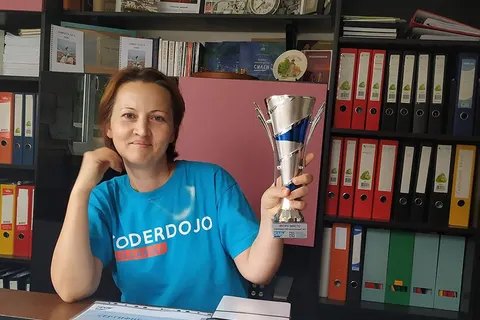
Elitsa Tsoneva worked as a journalist before moving into the world of information technology. She spent a full 15 years in the field, and then, quite unexpectedly and without any plan… she became a teacher.
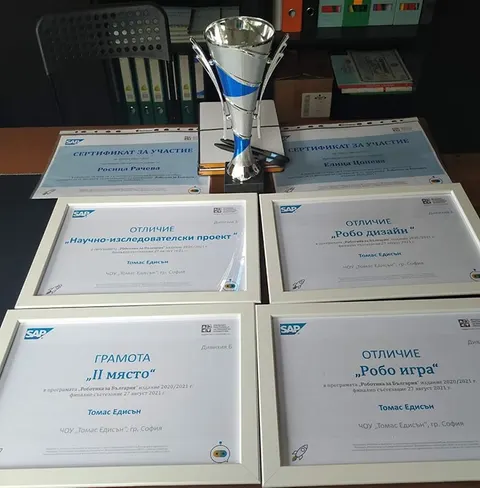
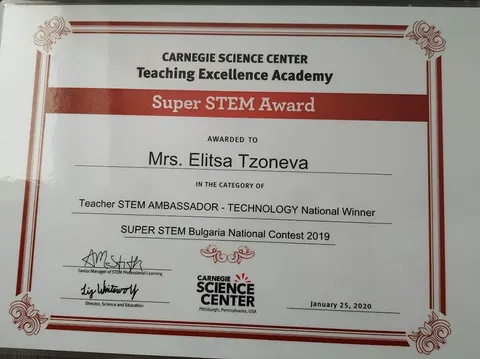
Within just a few years, the children she teaches were winning impressive awards at national and international competitions in informatics and information technology.
She has introduced a number of innovations. Instead of textbooks, she prefers concrete projects that the children develop as a team, organized much like a software company. She often combines lessons from several subjects to stimulate the children’s thinking and creative potential at the expense of cramming and repetition.
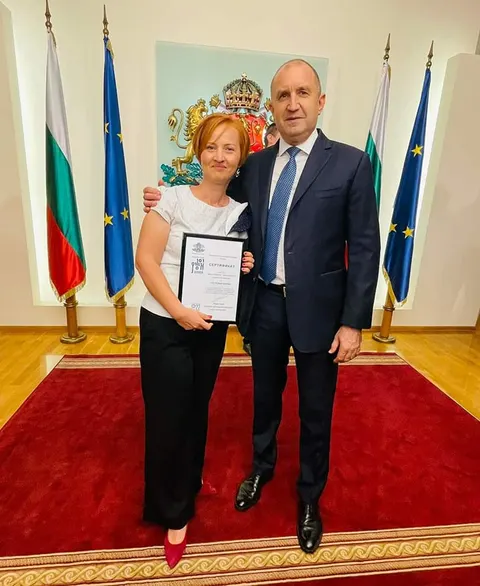
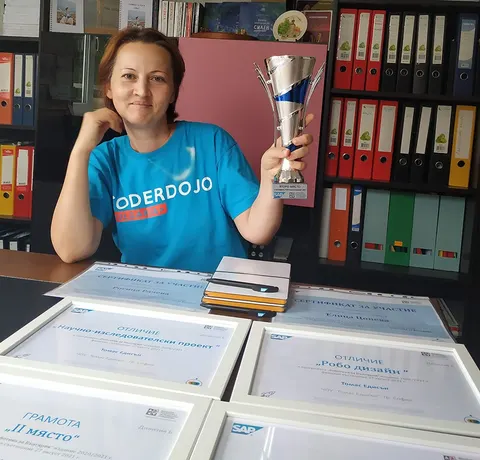
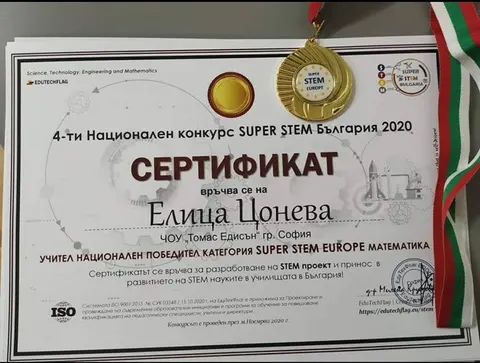
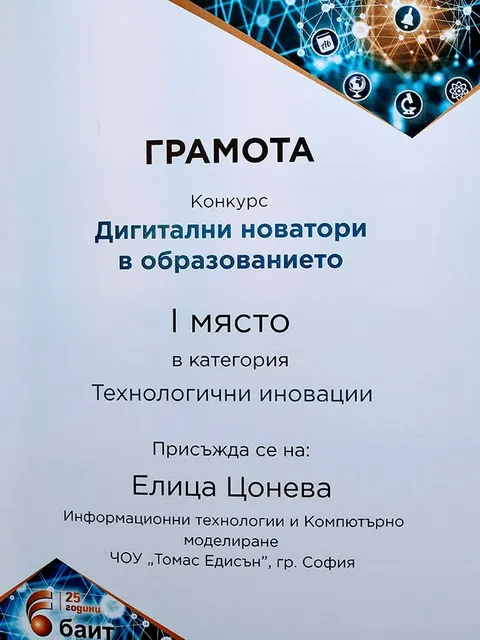
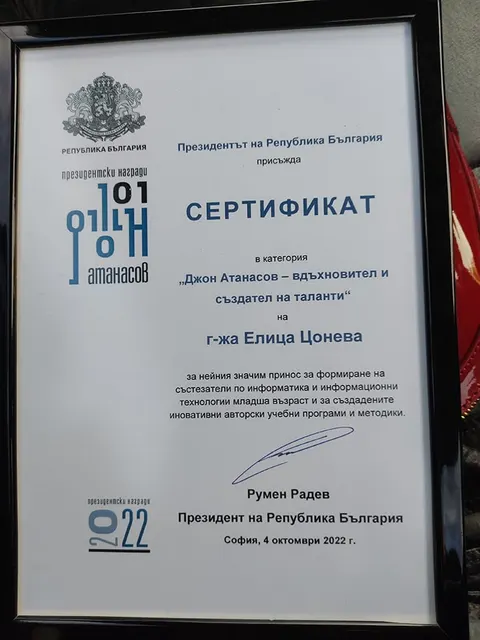
Elitsa has received prestigious awards from the Bulgarian Academy of Sciences, the Ministry of Education and Science, BAIT (the Bulgarian Association of Information Technologies) and the President of Bulgaria.
Why does education in Bulgaria never become a priority? How can a teacher win the attention of her students and motivate them? Are there children with a humanities mind and children with an algorithmic one, or are these stereotypes from the past? How do we spark curiosity in a child’s eyes, so that the child learns and grows to the full?
– The story of how you went, quite unexpectedly, from an interested parent to a teacher is a curious one. Would you tell it?
– I really had no intention of teaching. For more than 15 years I worked in the software industry, in quality assurance. Completely by chance, my son’s school got word of some technology competition. The principal knew what I did for a living, so he asked me to look into what could be done and whether the children could take part.
I decided to do a little research and ask my colleagues at the office. Right at that moment I was very inspired by agile methodologies, and some of the techniques used there reminded me of a children’s game. I wondered whether it could be adapted for kids, and it turned out there was very little experience with that anywhere in the world. But I decided to try. My son’s entire class joined in, and we won the competition first at the municipal level, then at the regional level, and finally at the national level. It was interesting for me; I hadn’t expected it.
– And how did the children do in an agile environment, working in a team with divided responsibilities, just as happens in the software world?
– That month we really did “install” an agile system at the school and assigned roles to the children. Some were programmers, others were QA, and others managed the project.
I saw a miniature of real-life processes. Exactly the way it happens in big teams!
The same problems, the same difficulties! It was interesting to watch how the children solved them. That’s when I felt the motivation to work with children; I saw that I enjoyed it.
Then the principal invited me to work at the school and handle projects. After that I retrained as a teacher of information technology and computer modeling.
I started working with the children, and the principal gave me a great deal of freedom in my teaching methods. That let me experiment. I grew bolder and bolder in my experiments…
– In which direction did they go?
– I started lowering the age of the children I brought into various projects and competitions. To my surprise, it worked. It turned out that you can work with little kids almost as successfully as with older ones. Especially when they get the right motivation.
Actually, the motivation is their own! It isn’t something that has to be forced on them by parents or teachers.
But it can be nurtured in a fairly informal, fun atmosphere.
We started entering competitions with different groups: municipal, regional, then national, and since this school year international as well.
It turned out that Bulgarian children can be trained to a world-class level. We are in no way behind any other country!
We may be three or four years late in taking part in this kind of programming format for children. In robotics, unfortunately, we are hopelessly behind; we don’t even have an olympiad for it, unlike other countries.
But little by little the successes started coming on their own.
– How young should children be when they first encounter information technology?
– I work with children from 1st to 7th grade, and I have some older ones too, but they are former students of mine who have moved on.
I start with five- and six-year-olds. To reach a higher level, children need to start studying this subject early enough. Under the Ministry of Education and Science’s current curriculum, computer modeling is taught from 3rd grade. For me that’s far too late. Most children get to know technology as early as 1st grade; they know what mobile devices are, they use them at home for games, and it never crosses their minds that they could use them for anything else.
I think it’s time to bring something like this into the official curriculum, even with shorter lessons. I do it at the school where I work, the Thomas Edison Private Primary School, but it’s by no means common practice.
– What can create the inner motivation you say matters most in children that young?
– There is one basic difference between the curriculum and what we do with students from 2nd grade up. The curriculum is built like this: here is the material, now repeat it.
There is no creativity in it; they don’t let children go through the research process on their own, which is hugely important if learning is going to stick.
Every adult who opens an app says, “I need to click around in it to learn it.” Exactly the same goes for children! They have an even greater need to click around, to play, to try things themselves, to make mistakes, to learn from their mistakes and keep going.
The curriculum isn’t built that way, though. “Repeat this. You’ve drawn a rabbit here, now draw it two ears.” And that’s it!
In my classes I turn the process around. I tell them:
“Now you’re going to make your own fairy tale, your own story, your own app! You’ll come up with the topic yourselves!”
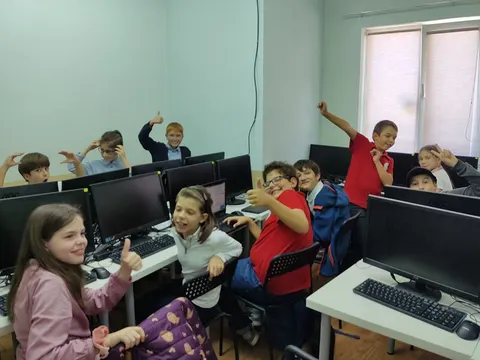
Or, if I give them some direction, I leave them to make the images themselves and prepare the sounds themselves. That way they have a lot of creative work to do.
When they’re given a task and don’t know how to do it, they start inventing very creative solutions! Things that wouldn’t even occur to the authors of the textbook.
From a very early age we move quickly on to programming games. Children love to play! Some have never played games; they’ve only drawn. But even for them it becomes interesting, and they also get a chance to shine: the platforms I use for teaching include a drawing environment too.
Others don’t like drawing at all; they just want to write code. I make sure those kids aren’t bored either. I put them in teams where they play the main programming role, so they feel useful and at the same time don’t compare themselves with the others, who can draw much better.
Then there are children who can both draw and program but don’t feel like making the effort. For them I choose some other role, such as writing documentation or testing. Everyone finds a place in the project.
Some children have very pronounced leadership qualities; I make them project managers.
– And how does that suit them?
– It’s fascinating. I’ve noticed that things get hot in that position very quickly; suddenly it turns out that everybody comes to you for everything. A lot of kids give up fast. They come to me and say, “Miss, I can’t take it anymore, everyone wants something from me.”
That’s how it is: a manager’s life is hard.
They imagine that being the boss is really cool: you sit there, you get paid, and everything happens by itself.
But they see it’s nothing of the kind. I make a point of having everyone take a turn in that position, so they can see for themselves that it isn’t so easy.
The interesting thing is that once everyone has had a turn in the hot managerial seat, at some point the children start choosing on their own which role best suits their temperament and skills. That makes me happy too, because it happens completely voluntarily. And once they decide for themselves where each of them feels most comfortable, they start working together, more smoothly now, with great enthusiasm.
They feel very important when they have a role, and maybe that’s part of the motivation too. There was one child who was weaker at programming, and drawing wasn’t his strength either, but he had a different talent. I appointed him as the specialist in that area; he felt engaged and useful in the project, and he gained self-confidence. Today I see him walk into the classroom eagerly.
– For all this to work, though, the teacher needs an individual approach and needs to know the children.
– Yes, the individual approach is very important, and I think every IT teacher tries to practice it. The regulations allow a class to be split into groups of no more than 15 children. That is extremely important and helps a lot.
The groups are small, and I invite the best students to an after-school program, where we study even harder, at a much higher level. That differentiation really helps me pick out those who are very capable and assign them to suitable roles according to their skills and abilities.
In first grade the children cry a lot, literally about everything. A year later, when I tell them stories about what they used to bawl over, they laugh and can’t believe it.
The transition from kindergarten to first grade is a very serious one
and that is the only year when I avoid putting children through competitions. They are very vulnerable and sensitive, and any failure could put them off. And the saddest thing is when a talented child gives up!
– How much of a stereotype is it that there are humanities people and science people? I, for one, had to turn 33 to find out that I could program, because I had always considered myself, and been labeled, a humanities type.
– Anyone can program!
If someone doesn’t believe it, I can send them links to platforms so they can go in and see for themselves that, at an elementary level, anyone can learn to write algorithms and create code.
The point isn’t that people are humanities-minded or algorithmic. In some people one half of the brain is a little better developed, and it’s easier for them. But that doesn’t mean the rest can’t do it!
I recently read about crows that perform recursion. If even an animal can grasp such abstract principles and work them out, what about humans!
I would rather divide people into the more artistic and the less so. If I make any division at all, though I don’t tell the children, it’s more like this: some children sing, draw, dance, and those talents usually go together. Others don’t like doing such things. There are children who are frightened by the very thought of drawing, and for no other reason than that they didn’t develop that skill when they were little.
In fact, nothing is impossible; anyone can learn anything!
If they put in enough effort, they can become a doctor or a police officer. You and I are proof of that: we retrained and completely changed what we do. Only at almost 40, after I had already become a teacher, did I say to myself, “God, why didn’t I go on to become a doctor back then!” But at the time I didn’t believe in myself.
It’s very important for a person to believe in themselves, and that applies above all to children.
The one thing a teacher must never do is say, “You can’t.”
There can be “I don’t want to,” “it’s hard for me” or “at this stage it isn’t easy for me,” but never “you can’t”! Everyone can! Only a short person can’t become tall, although even in growing up there are degrees.
You have to believe in yourself and keep trying; that’s the only way you get the chance to find what truly gives you pleasure.
One child came to me with extremely low self-esteem and no knowledge of the subject at all. His computer modeling teachers hadn’t followed the curriculum whatsoever; he had learned absolutely nothing. Entering a very strong class full of competitors, where everyone was advanced, this child developed a complex. Right at the start of the school year he came to me and said, “I don’t feel worthy of this class, I can’t do anything.” I answered: “Don’t look at what you know right now at all. I’ve had new kids come in before; they get ambitious, and through hard work they manage not only to catch up with the others but to overtake them.”
The moment I told him that with conviction, he believed it. And he started doing exactly that: working harder than the others in class, making up the lost ground. He caught up with them, and at some point he surpassed them. In the end,
that very same child won first place in a world programming competition.
In the space of just one year, you can go from absolute zero to number one!
Adults themselves don’t believe in themselves, and that’s why they can’t make children believe them. That’s where the problem comes from. Motivation comes from believing you can.
– I think a large part of the problem is that teaching isn’t a very attractive profession, and not everyone in it is motivated and well enough prepared. How can we make it more attractive, so that more people like you come in? Because it’s people who change a system, not curricula…
– I work at a private school, but I did my specialization at a state high school in Sofia. I got to know how things work there, and a lot of things struck me.
The difference is enormous, like night and day. Yes, on the one hand it depends on people’s motivation, but that in turn is largely dictated by the opportunities the school gives them.
Often, in such a complex bureaucratic machine with so many people in it, teachers’ individual rights and opportunities are severely limited.
Teachers are overloaded with administrative work; that is the first and biggest problem.
On top of that, they aren’t given a chance. I often talk to teachers who tell me, “The principal wouldn’t let me.” He simply can’t be bothered. There was an attempt to replace these irremovable principals and bring young people in their place. With respect for age and experience, but people who have the qualifications.
Right now the requirements for becoming a senior teacher are higher than those for becoming a principal. And the lowest of all are the requirements for working at the regional education inspectorate. A complete absurdity.
When people with few qualifications and little experience manage you and make decisions about your fate, it’s clear how you are going to develop. It’s as if junior programmers were project managers, mid-level ones were team leads, and the most proven ones worked as programmers. It’s obvious what the result would be. That is the upside-down structure in education today.
– And all of this inevitably demotivates people…
– Yes, many teachers in state schools have completely lost heart. That’s 20 years of constant changes, of experiments that are usually ill-conceived and then get changed again. Many people have lost all desire to teach: they don’t earn big salaries, everyone has an opinion about them, parents are becoming ruder and ruder, insulting and threatening them, and the children are increasingly demotivated and don’t want to learn.
They find themselves in a super-stressful situation in which it is absolutely impossible to work, and their motivation just keeps dropping.
The people working as teachers today, in my view, are either those with extraordinary motivation who keep fighting despite everything that’s wrong, or those who somehow have to hang on until retirement. It’s their main income, and they’re ready to defend their position tooth and nail, even though they neither can nor want to do the job. In other words, they’re there for decoration.
Other problems in the system are the delegated budgets, under which funding follows each student, and the fact that a student can’t be held back a year. Schools try to fill up their classes and don’t care what kind of children they get or how. All of this has an effect.
– I think society has the feeling that education is not a priority. Just look at the schools where every single graduate gets a failing grade on the matura, Bulgaria’s school-leaving exam. And that’s when the matura’s standards are appallingly low as it is.
– If I go back to the subject of technology, there is a particularly big problem in the older age range. That’s where we create the problems with exactly the people we need in the IT sector.
The problem is that there is no decent entrance exam for the mathematics high schools. There are schools specializing in mathematics and informatics, but many of them lack enough experienced staff to teach. Many parents want their children to study this and steer them toward the mathematics high schools, but admission there is based on the national external assessment exam, and the bar is very low. So children who aren’t prepared get into these schools. The parents are happy, but the problems begin as early as 8th grade.
Nobody wins from this! The state spends a huge amount of money to invest specifically in education for the IT sector. We sabotage ourselves, we make the wrong choices, we confuse the children. We create the false impression that once they finish 12th grade they can already work as programmers. Well, no, they can’t. For someone to become a truly good professional, they need to go through university, study mathematics and many other things.
These are just some of the many issues teachers in Bulgaria face. There are problems and there always will be; the question is what we can do, how we can change the situation as a whole. For me, the best way is to unite. That’s something missing right now. Unity among private schools, between private and state schools, standing together for common interests. That isn’t happening at the moment; everyone has hidden away in their own hole. As a result, there is no way to show everyone that the problems are shared, that they belong to society as a whole.