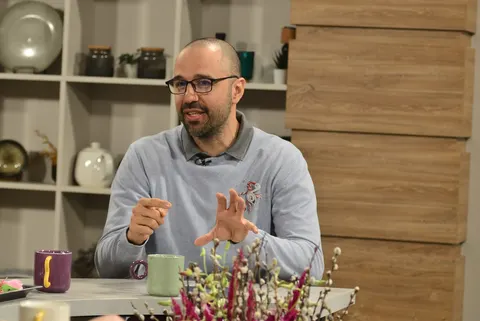
Hari Haralambiev has more than 10 years of experience in software. He started out as a school programming champion, and at Musala Soft, a Bulgarian software company, it took him only three years to earn the trust to lead his own team. He quickly realized how hard that was, though. How many problems you run into when you work with people, and how few ways there are to learn how to deal with them.
So, little by little, his path turned toward soft skills. Together with his colleague Petya Deleva, he decided it was high time someone worked more actively on the human side of the process, so crucial in teamwork, and five years ago they founded the platform Tochka 2 (“Point 2”).
His other ventures include the online comic A Leader’s Tale (“Like the Leaders”), which he draws himself, the podcast Radiotochka 2 and Soft Skills Pills.
We sit down with Hari to talk about all the stereotypes surrounding programming and the people who do it. About hard and soft skills. About difficult conversations. About leadership and the road to success. About the struggles every team goes through. About the human side of an industry that has become so fashionable and so attractive in recent years: software.
– Hari, what’s the truth as you see it—is it easy to communicate with people in IT? Speaking from personal experience, I think a lot of the clichés have some basis…
– You think it’s hard?
– You shouldn’t generalize, of course. But still, I think people in the industry very often think in a kind of binary way. There’s less nuance, less empathy, less understanding that there might be more than one right point of view…
– For me, all of us humans are pretty bad at communication in general. Honestly, the main reason I got into training was so I could learn it myself. The best way to learn something is to start teaching it.
I think it’s incredibly hard for us as people, period. On the one hand, we’re advanced compared to other species—we can speak and write. At the same time,
every problem in any team, any group of people, even in couples, comes from communication.
At the root of it is the fact that we have different worldviews, a different map in our heads of how we see things. It’s a fact that people who program, for example, have more developed logical, algorithmic thinking. Yes, if the person across from them doesn’t have it, that leads to problems. When we play our training games with companies’ HR teams, for instance, they do much better with the human communication and struggle more with the logic puzzle. And that’s natural.
But often, based on what you’ve told me or what’s written in your profile, I can form a hypothesis about how you see things. Say you don’t have an IT background, you’re into writing, and in the same way I could say, “Oh, writers, they’re all…” Everyone is different, and that’s why we keep breaking down in communication. Only very, very often we don’t see that we’ve broken down, and we realize it after the fact.
– Then where did the cliché of the dry, stiff programmer come from?
– Personally, I find it easy to work with IT people because I spent a long time in that environment—I understand the jargon and the attitude toward problems. That’s why communication may be hard for a lot of people; that style is simply more foreign to them.
To be able to talk to someone, I have to get to know them a little, to understand how they think, how they act. For trust to form between people, they have to be able to communicate. For that to happen, they have to get to know each other. And to get to know each other, they have to be vulnerable.
Yes, it’s easier to stick labels on people so we can communicate, but every generalization leads to a lot of problems. If I start communicating based on my prejudices, I’m automatically broken already.
It’s easier for me to tell you “You’re such-and-such,” because it’s quicker
than explaining in two sentences what exactly I mean.
– Maybe that’s also the reason for the horrifying hate online. Communication on the web has to be fast; there’s no time for nuance and understanding, for details.
– Yes. I’m waiting for the moment when I get more online hate. Right now I don’t get that much, which means I’m not reaching enough people.
– Be careful what you wish for…
– I know what you mean. For example, there’s a popular Facebook group for IT people that’s a one-of-a-kind place for venting hate. I once posted something there, and apart from the many positive comments, there were quite a few negative ones. And I told myself: great, that means I’ve finally reached enough people, not just my comfort zone and the ones who only cheer me on. But yes, hate is a matter of worldview…
– I only post there when I’m feeling immortal. But most of the time, the interest in a post there is directly proportional to the number and quality of words from the people who are going to “feed” you. Just on principle, and from the bell tower of the final authority.
– Then again, it’s a really good distribution channel. Here we go, back to the clichés. Usually people who communicate well don’t hate. They’ll quietly see your link, read the article, and some of them will like it. But there’s no way for them to find out about it unless you find the right channel.
– So many people are heading into programming today. What are the most important soft skills they need? Because everyone reduces the profession to a language, a framework, but never to personal qualities…
– For me, being open to learning and being curious matters more than anything else—whether we’re talking technical or soft skills. Beyond that, something I think every one of us has to keep learning our whole lives is how to actively listen to the other person. That’s a problem in a huge number of situations. Trying to understand the other side, to really grasp what they want to tell you. Because conflicts usually arise because people don’t bother to listen at all; they’re usually in “let me tell you” mode. Very rarely are they like you are right now—not just asking the question, but listening, and if something isn’t clear, asking a follow-up.
If a person has developed that skill, empathy will come more easily from there. Because you simply care what the other person wants to tell you, what they think. And conflict situations get resolved faster. So often conflicts stay on a surface level where we haven’t understood at all what the other person is trying to say; we’ve taken offense, we disagree with them, and we start arguing.
– What qualities does a person need to become a good leader?
– My conviction is that good leaders don’t have to be jerks. I believe you can lead a team, do great things, get awesome results and have fun doing it. But for that you mustn’t be a nasty piece of work—you have to genuinely care about people.
A leader has to not be afraid, to act despite the unknown, despite all the potential problems that come from nobody having walked the same path before. That occasional madness of
setting off alone in some direction, leading, not having to wait.
I’ve seen a lot of good managers who aren’t leaders. They’re always waiting for something, for someone—approval, direction. A leader doesn’t wait. On the other hand, to be a good leader you also have to be a good manager. Because people get fired up by ideas, but they give up very quickly if there are no results. For a leader to keep people around them, besides leading them, they also have to get them to some point.
– But you need charisma too, for the first part to work.
– I don’t know. A lot of people emphasize charisma as part of being a leader. I believe much more in being yourself, and so charisma is about whether people recognize themselves in you. Or in what you think, in what you’re chasing.
For myself, there are few leaders I would follow. And I wouldn’t say they’re charismatic, but they’re people with a very clear value system whose actions follow their words. I see how much of themselves they give. Once I believe in their cause, once I see their value system, I’d follow them. I don’t know if that comes close to your definition of charisma, but very often people imagine some extroverted types who can charm with sweet talk. Most strong leaders aren’t all that charismatic; they’re simply devoted to one direction. There’s something they believe in strongly, and they push in that direction their whole lives. And
when you see that flame, that passion, you tell yourself: “Okay, this charges me up too.”
But the goal also has to make some positive contribution, it has to be meaningful. When those things are there, when those leaders care about people, that’s when the magic happens.

– Why do you think burnout is such a common problem in IT?
– There’s often a very heavy focus on results there, on automatically assuming that more hours means more work done. To me that maxim is very wrong, but fortunately, partly because of the coronavirus situation, more and more attention is being paid to balancing how a person feels against how much they work.
There are people who can’t sense burnout in time on their own, sometimes because they love what they do. They don’t rest. In this industry you have a lot more freedom—it’s rarely set in stone when you start and when you finish work. The downside of that flexibility is that you give one person the freedom, and if they don’t have the skill to look after themselves, they burn out. But if their team is mature, someone will tell them: “Stop coding all day, you need to slow down.”
It’s clear, though, that freedom is necessary for creativity. The work isn’t the kind where how you do it is rigidly fixed. The dynamics in the IT industry, the pace, is very fast. Of course, that’s true of many other fields too.
– For me, another explanation is the high level of abstraction you have to work with—you’re constantly “somewhere else.”
– One of the typical things in the IT industry, and one of the biggest problems, is that you don’t see the result of your work one to one. If you write an article, say, you can physically touch it; with software it’s not like that.
– To be honest, that’s exactly why I went into front-end—you see the thing you’re creating.
– People burn out most in situations where they constantly have to switch context. Because companies aren’t organized like an assembly line with a very strict process—every team is independent, every process is unique. If you go to other industries, you have much clearer frameworks.
– So why did a technical person like you at some point turn to working on soft skills?
– In 2005 I started working professionally in software, and things came naturally to me. I thought I understood what it means to make software, but I quickly realized that creating software isn’t just writing code. So it happened quite naturally that
the reward for a job well done is more work.
They gave me a small team to lead. And that’s when the first problems appeared—what do you do with these people? Programming is one thing; working with people is something else entirely. Countless cases came up that I didn’t know how to handle. Back then Petya, with whom I co-founded Tochka 2, was in the company’s HR department and also did internal training. I used her as a mentor—I’d have a case, go to her and ask: “What do I do when two programmers, instead of talking directly and getting some work done together, route all their communication through me?” “What do I do when the team argues and can’t reach a common decision, and I don’t want to be the one saying: This is how it’s done, listen to me!”
Cases like that came up all the time, and at some point I started finding it interesting. Even more interesting than writing code. Ever since I was very little I’ve been fascinated by solving problems. And the ones that were coming up were nontrivial, unpredictable, serious challenges. That’s how I dug deep into the subject.
The pace in the IT industry is extraordinary; technology is constantly changing. You have to deliver results and learn new things at the same time. You never get a calm moment when you know what you have to do, the tools are clear to you and you just have to act. So I told my bosses I didn’t like how people’s development was happening, the way they were being prepared. And they gave me the chance to take charge of the technical development of everyone in the company. That was a turning point, when Petya and I started working as partners. At first I handled the technical side and she handled soft skills, but gradually we became intertwined.
– And at some point you decided to move entirely into that…
– Yes. Team leads came to us with cases every day, and we told ourselves: we can help them solve their problems every single time, but it’s better to teach them to handle the cases that come up on their own. Very rarely were the problems technical.
“What do I do with these people?”, “How do I make the team better?”—everyone with a technical background who was growing into a leader had big problems. So we started an internal leadership program. Gradually we began working with a focus on the team level, not just on individual skills. We saw that leadership skills are only one part of group dynamics; there are lots of things to do with how people interact. That’s how I got hooked on team development. Even back then we brought in games—we started with the concept that people have to experience things in order to learn, not just listen.
This kind of training was a small part of what Petya and I did day to day, but we both liked it and became convinced that it had a very positive impact. And we told ourselves we wanted to keep developing it. We founded Tochka 2, left the corporate world and built a company focused solely on training.
– Was there interest at the start?
– A lot of people saw us off thinking that nobody would order this kind of service, that it didn’t make business sense. We launched with the idea of doing soft skills training, not even for IT people but in general. The first six months were really rough—people would send some inquiry and in the end nothing would come of it. We started experimenting with open trainings, programs; nothing worked. At one point colleagues who also do training complained to us about IT people, saying they
are very peculiar, it’s hard to communicate with them. Hard? How could it be hard?!
That’s when we realized we weren’t using a big part of our skills. We had announced a training and used “Soft Skills for IT People” as the title of a blog post. A huge number of people responded—it was the first time that had happened to us. And it became clear that we’d been doing really badly, that we weren’t using our real experience from the industry. From the moment we decided we’d work only with IT companies, little by little, companies started showing up.
Of course, like any startup, the first year or two is a matter of survival. But we’ve now worked with more than 40 companies, and we look for long-term relationships. There are both small and large companies—Experian, VMware, Uber. We’re focusing more and more on working with teams; we still work on individual skills too, but our goal is to unlock the team’s potential. For every team to become a better version of itself—maybe the most accurate term is “team coaching.”
– What matters most for that to happen?
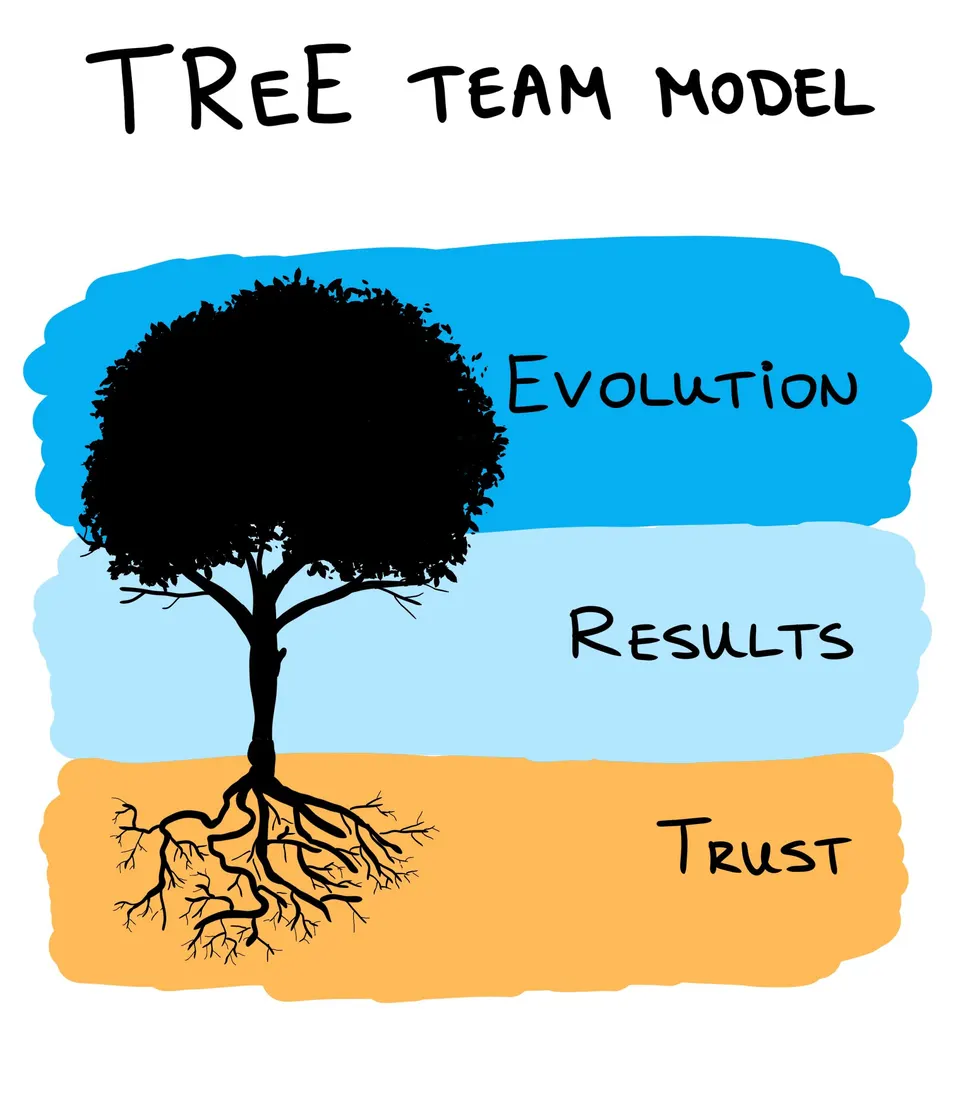
– From our point of view there are three key aspects, and we recently shaped them into a model of our own—TReE, as in “tree.” It stands for Trust, Results and Evolution. The idea is that teams are usually very focused on delivering results. But in fact the root is below the surface—trust is what makes a team healthy. Psychological safety—people trusting each other, interacting, being close-knit, being, roughly speaking, one organism. If there are differences, they should be a strength rather than lead to unhealthy conflicts.
This gets skipped far too often, and the focus is usually on delivering results. Yes, results are very important. There are teams where everything is lovely—people are best buddies…
– …but they get nothing done.
– Yes, but they’re in a comfort zone where they don’t deliver a product. We don’t believe in magic pills—there’s no single solution for every team. Every team is different. And our idea is to help the team find the right ways to interact. On the one hand, for people to get to know each other—to show them that this is extremely important—and on the other, to learn to interact in a way that keeps the process moving.
Then comes the very top part, evolution. How a team can be both flexible and stable in the vague and constantly changing circumstances of this industry. So that when a storm comes, it doesn’t break the tree, but the tree stays strong and keeps delivering results.
Both in our trainings and in the group games, our main goal is to put the team in a “sandbox,” an isolated environment close to reality, and let them practice there. For example, if the goal is conflict resolution, we’ll put people in exactly that kind of situation—for three hours they’ll be resolving conflicts close to the real thing.
In the games we’ve chosen, all of a team’s strengths and all of its dysfunctions show up immediately. People see them too, and at some point we start reflecting them back, commenting on their decisions. The main problem, both in the game and at work, is that people try to solve the logical problem, they chase the result, but pay no attention at all to what’s underneath—how they interact, how they make decisions.
Because what usually happens? Even if it’s a team that has worked together for 10 years, whoever talks the loudest, whoever is the pushiest and most insistent decides what happens. And the game itself is a metaphor for the fact that a chain is always only as strong as its weakest link. If one person doesn’t know the strategy, or doesn’t agree with it, the whole team fails.
– Do you think we should somehow build soft skills into artificial intelligence too?
– It depends on what our goal is. When you chat online with chatbots, you immediately sense there isn’t a person on the other end. At the same time, all my friends who have robot vacuum cleaners give them pet names. That means they attribute some human characteristics to them—it does what’s asked of it. On the other hand, you’d never fully liken it to a person. But the more soft skills you add, the more you improve the communication… if your computer shows empathy, you think: “Wow, that’s so human!” It’s both scary and amazing, fascinating.
If we want machines to do things that involve human relationships, we have to build in soft skills somehow. What will come of that… anything is possible.
– Next thing you know, they’ll be teaching us communication…
– Like everything created by humans, to me artificial intelligence is neutral in itself. I don’t think anything is good or bad; the way it’s used is what makes it so.
My hypothesis is that we’ll mess things up. It’s a purely human thing to set out with good intentions and do everything very badly. Then we’ll learn from it and do it better. Up and down—that’s always how it goes with new technologies, it’s their natural way of developing…