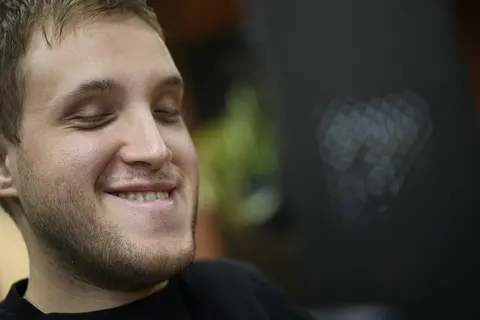
Today’s guest is the strongest person I know. Kristiyan Grigorov’s story, his presence and his musical talent made him a genuine star 15 years ago. It all began with an appearance on “Slavi’s Show,” the late-night talk show hosted by Slavi Trifonov, which was then also at the height of its popularity. Cliché aside, the 12-year-old Kris moved the whole of Bulgaria with his stirring music and his enormous charisma.
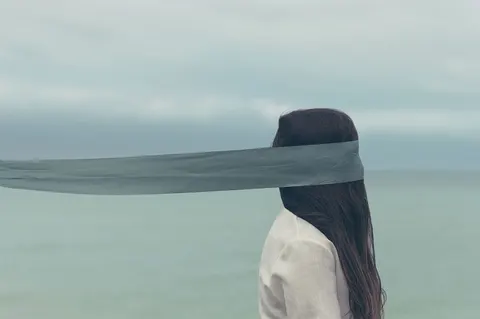
Shortly after he was born, his parents learned that he had microphthalmia—a congenital condition that irreversibly damages sight. When he was 4, it became clear he had another rare disease, one that makes a child’s bones soft and brittle. They tried every kind of treatment, but nothing worked. Hundreds of painful fractures followed… Only when he turned 19 did the breaks become less frequent and his bones stabilize. But the countless fractures had left Kris unable to manage without a wheelchair.
At the peak of his fame he sang duets and songs with some of the biggest names in Bulgarian music—Grafa, P.I.F., Mimi Ivanova, Orhan Murad. Instead of continuing with music, however, after finishing high school he decided to study Bulgarian philology at Sofia University. He graduated with honors.
His next goal is to become a teacher. He has told himself that if no school offers him a job within 5 years, he will create his own school where he can teach. Four years have already passed.
Until 2020 he worked as a journalist at the online radio station Braille FM, and lately he has been keeping a fascinating blog about music and all sorts of other things in life.
I don’t know about you, but every problem I have ever faced seems absurd next to the obstacles Kris has overcome and keeps overcoming. And he does it unobtrusively, without pathos. Without even the faintest trace of the devastating wounds that fame leaves in its wake.
Should we ever stop fighting? What does light look like to someone who has never seen it? What is it like to dream of being a teacher, of all things, despite every obstacle in the way?
– Kris, I’ve read that you say the word carries the light. What else does the word carry? What is the word?
– A friend of mine once asked me what I would do if I suddenly went deaf. There are people like that, deafblind. It made me realize that without words and music I would feel completely superfluous in the world; I would lose all meaning.
The word is a window onto people, onto knowledge, onto myself.
When I feel chaos in my mind and my feelings, I sit down and write a few pages, and that is a kind of therapy in which every feeling and every thought finds its proper current. I used to do it on a Braille typewriter; today I use a keyboard.

– I’ll admit your choice to study Bulgarian philology surprised me quite a bit. Why did you settle on that subject?
– A blind person like me, who on top of that is deprived of the ability to move freely, doesn’t have many ways to fill his time productively. Music, radio and books—those were the main things that accompanied me from early childhood, and they are still with me today.
The choice of philology over music came down to two main reasons. It offers far more opportunities. Besides, music academies aren’t wheelchair accessible, and to study properly you need to be there constantly. Either way, I will carry music inside me and love it always.
As for the opportunities philology offers, the two closest to me are teaching Bulgarian and journalism. The first brings you together with people who expect to learn something from you to improve their literacy; the second, with people you learn a great deal from. In both, the results are almost invisible, but if you feel in your element and like your work, you don’t lose motivation and you aren’t swayed by the things holding you back.
If a teacher complains too much about his work, he is worn out and can no longer be useful.
– Is it really true that you can’t find a job as a teacher?
– Yes, and there are many reasons for that. For years people in Bulgaria were taught that integrating people with disabilities means fitting them in among everyone else, in everyone else’s environment, without asking anything in return.
But integration is a process of mutual inclusion, in which each side looks for a way toward the other.
Today few people look for a way toward others, and when those others are different because of a disability, it gets even harder.
People with disabilities have so far produced few examples of those among them who can change their surroundings and society’s attitudes. Most comfortably stick to the established stereotype and slip into the convenient cliché of the victim whom others help and look after. This nationwide syndrome will be very hard to uproot, and it is harder still in the relatively closed groups of people with disabilities.
Everyone wants to see success stories that show them it can be done. But for there to be any, people need to be given a chance. It’s hard to break this vicious circle. There are plenty of examples around the world of teachers with disabilities; it isn’t something unattainable. It’s a matter of methodology and a well-disposed team.

– What will be the hardest thing for you as a teacher?
– Being blind, in a wheelchair, and teaching sighted children who are constantly on the move is a challenge.
At first glance it looks as if you have no control over the situation at all.
To many people it sounds laughable. They say, “Be a teacher, follow your heart.” But inside they are skeptical and think, “Poor thing, what does he imagine teaching is like? How disappointed he’ll be by the system and by those cruel children…”
That’s a shallow way of thinking. If you believe in yourself and in the meaning of what you do, if you have worked out your approaches and build on the teaching experience of those who came before you, if you are open to children’s quirks and don’t judge hastily, then neither the system nor the children are an excuse. You know there are reasons for everything, and you are there precisely so that things can be better. You know that this same system, these same children, need people like you who work wholeheartedly and to their full potential.
I know that to some this sounds presumptuous. But in the end what matters is the drive to keep getting better at your job, to look for the reasons for failure in the things that depend directly on you, too.
If there is no self-reflection, if you don’t improve yourself every single day, you cannot be a teacher.
You are stuck in the last century, telling yourself that your truth is the most authoritative one, only misunderstood.
– Listening to you, I can only dream that one day my children will have teachers like you. And what kind of teacher do you dream of being?
– This is one of the most responsible professions there is. All of human culture rests on the shoulders of education, along with people’s ability to cope with all kinds of problems. Investing in education is investing in the future not only of the individual but of the generations after him. That’s why being a teacher is a mission.
Years ago my motivation to teach was sparked by the desire to teach others something new. Over time that idea evolved into the understanding that the most important thing isn’t to pass a piece of knowledge on to a student, but to get him to seek out and find that knowledge himself. To learn to explore and get to know the world, to have an unquenchable thirst for knowledge, to find meaning for himself in constantly adding to it.
The ability to check information and sift out what’s useful is a major challenge in today’s technological era, in which young people feel so much at home. That’s why teachers need to know this environment, especially in the context of distance learning, and help their students be better informed and more curious.
Because too much choice can take away our ability to make the right choices for ourselves.
– What would it take to create the school where you could teach?
– If I answer literally, it takes a classroom and money for furniture and equipment. I have the qualifications, I have the knowledge and the skills, I have the textbooks, and students will be easy to attract. I rent a place in Sofia, and it would be hard for me to also pay a high rent on a space for teaching. So I need to think up a business model that won’t squeeze me financially and will give me the freedom to arrange my hours in the best way.
– I know my next question is a banal one, but after everything I’ve heard I can’t not ask it. What gives you the strength to fight?
– Personally, I don’t use words like “strength” and “fight”; they seem too forced and overblown to me. Everyone thinks I have to overcome a feeling of helplessness caused by my disabilities every day. But people make the mistake of judging by themselves.
In fact, if a person has had his disabilities since very early childhood, he accepts them as part of his nature.
If he takes them as suffering, that’s the whim of the victim, or the hero among victims who prefers to be pitied or admired.
And to hate them would mean hating himself.
So I don’t need to wage any kind of fight. I simply make up for the deficits through the things I do. My thoughts, my time, my energy—everything is directed at what interests me and gives my life meaning. Whether you can see or whether you’re in a wheelchair stays far in the background. You feel those things when you run into an inaccessible environment and barriers of every kind. If those weren’t there either, I wouldn’t even think about my disabilities.
For me there are two kinds of problems: solvable and unsolvable. The solvable ones get solved; the unsolvable ones get accepted. That isn’t the psychology of resignation. If I can ever be cured of my disability, I will be, but I wouldn’t waste my time thinking about how unfair fate was to deprive me of this or that. Life is too short for such things.
Life isn’t a struggle for happiness. It brings happiness. And if we don’t learn to take that happiness, regardless of our physical, financial and every other limitation, we will have lived in vain.
– You said you don’t like to talk about fighting, but still… it’s always there, even if we sometimes call it something else. When should a person stop fighting?
– It may sound absurd, but I really don’t fight. Instead, I look for possible and effective solutions.
The very idea of a fight presupposes that you have some enemy to overcome,
some systemic problem to solve. But I have no enemies, and I don’t think systemic problems are solved by individual action. Very often in my life my victories have come from understanding in time how the system works or how people think.
If something demands too much strain and drains too much of your vital energy, it means the cause isn’t worth it. That the moment isn’t right and you aren’t yet ready to stand up to it.

– What in life is stronger than pain?
– I draw a clear line between physical and emotional pain. There is a remedy for both. The remedy for physical pain is to ignore it. As we know, it is based on nerve receptors reaching the brain. If we don’t resist the pain, if we relax and let it take over, it loses its power, because the body rests and recovers. That way it stays isolated in the sore spot. Most people get angry, carry it over into the psyche, and so it takes over their whole body and torments it in constant convulsions.
Emotional pains are very different. I subscribe to the theory of psychosomatics and I am convinced there is a link between psychological instability and illness. The first invariably leads to the second. Psychological pains, unlike physical ones, demand that you deal with them at once. That you analyze where they come from, what causes them. Because the cure lies within the person himself. He brought them on, and he can outlive them.
– Do you miss the fame you had 10 years ago? What does fame give, and what does it take away?
– Back then I wasn’t ready to take on that kind of responsibility. Over time things turned around so that today I am the journalist, I am the one who gives moments of fame to various people who, in my opinion, deserve it. True, my audience isn’t large, but it may well grow when I start working for a bigger media outlet.
On the other hand, from today’s point of view, the things I do aren’t all that interesting to the public.
The public, as much as I dislike saying it, follows lighter topics; it is interested in gossip, sensation, scandal.
It was trained to do so by some media outlets that fed those base passions. The process works both ways, of course, but the media play the leading role, because they are expected to carry culture and not to reduce every serious topic to the level of the trivial.
Personally, fame gave me many useful acquaintances with people I am still in touch with today. What it took from me was the ability to decide for myself how I would be presented. The manipulative insinuations and clichés journalists often boxed me into made me feel extremely unfree. I felt I was misleading the public that way. When you can’t push back against that pattern, it drags you along and you become part of a script written in advance, with no way to influence it.

– What does a beautiful person look like?
– Being blind, I have never felt the need to picture what someone looks like. The impressions formed through my other senses are entirely enough for me. To me, a beautiful person stands out with a gentle, welcoming character, a sincere, positive attitude toward life, ease of movement, a warm, rich voice, and a constant readiness to contribute and give love to the world. It’s no accident that the girls I have fallen in love with have had exactly these qualities.
– What are the “guiding lights” that lead you?
– Thousands of years ago one of the greatest Eastern sages said, “Be a guiding light unto yourself.” Take it however you like. That same sage became the spiritual leader and inspiration of entire nations.
– What do you regret?
– I don’t have regrets. If you regret other people’s decisions, it means you didn’t foresee them. If you regret your own, you acted too hastily. I watch people and expect anything from them. When I decide something myself, I think it over for a long time. I do regret that I haven’t been able to keep an assistant to help me with my work. A year and a half is the longest anyone has stayed. Being an assistant to a person with a disability is a low-paid, hard job, with no career and no prestige, no prospect of earning more.
In my case the person has to be physically strong to handle my wheelchair on stairs, curbs without ramps, steep ramps and broken roads. Few people are mentally tough enough, too, to withstand these hardships.
On regret, I can only add that for me every failure is deserved, just as every success is deserved. When you give the best you are capable of, there is nothing to regret.

– What could make you truly happy?
– Many people think that when I say I am happy and content with my life every day, I’m playing a role, pretending to be the positive hero so that people will like me.
Quite the opposite—I’m fed up with that insipid image of the positive hero.
Life is full of all sorts of situations in which all kinds of feelings catch up with us. But the person who can be truly happy is the one who draws a lesson from everything. Who manages to rethink something from its negative side so as to make it positive. There are few days in the year when I go to bed thinking I haven’t done what I set out to do that day. Far more often I am satisfied and looking ahead to tomorrow. And the things that make me happy every day are so many that I can’t say I’m unhappy. Anyone who knows me well can confirm it.
Perhaps my happiness would be complete if I found the right girl to be my partner in life. But one has to mature for that, too. I know that when I am fully ready for it, it will inevitably happen.
– Beyond that… What else do you dream of?
– I don’t dream, I act. Dreams are for people who pine for the unattainable. I know what is attainable and I aim for it, without fantasizing. That’s why many people say I have made many of my dreams come true. In fact, they were goals. They were things I strove for and gave everything I had. I don’t bother with unattainable causes. What I am now is what I dreamed of being five years ago.
I believe a personal example is contagious and inspiring. So my call is this:
dream of the attainable, and only then will you show how great human potential is!
The conversation with Kris is so absorbing… there are so many more things I want to ask him. So we part agreeing to meet again and talk about technology, too, and about the right way to treat people with disabilities. If you also have questions you’d like me to add at our next meeting, write to [email protected]!