Bulgaria leads the world with the most gold medals from the International Linguistics Olympiad.
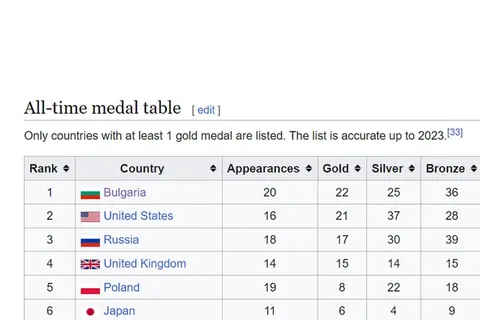
After 20 years of this kind of competition, our team is first. In the ranking published on Wikipedia, this year we overtook the US, and behind our country are also the teams of Russia, China, the United Kingdom…!
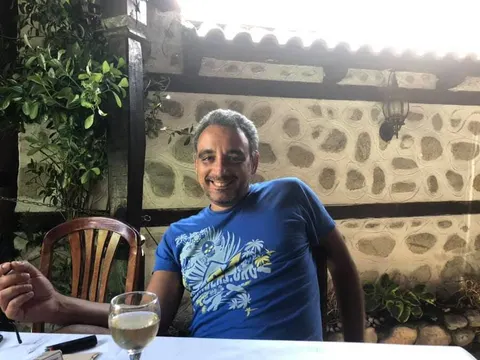
The news echoed across the internet after it was shared by Alexander Velinov—the teacher who has stayed close to the team throughout these two decades. The rest of the time he teaches and works in the software industry.
But how did our team end up in first place?
What exactly are the international linguistics olympiads, and what sets good competitors apart?
How on earth do… wild parties turn out to be one of the big factors behind this incredible success?
Why don't today's successful competitors listen to music, unlike those before them? And how, according to today's guest, does the notorious spelling issue of the full definite article… have an unexpected explanation?
– What do you attribute the fact that Bulgaria ended up in first place after 20 years of international linguistics olympiads to? Good preparation, strong students, tradition?
– It's a combination. I think there are strong students everywhere. We can't say there aren't any in America or China. But
first you have to find them, then you have to fire them up, and finally you have to prepare them for the international level.
So it's a combination. Tradition comes into it too, because to get kids excited about this competition, you need lots of schools of thought. Most of the mathematics high schools and quite a few of the language high schools in Bulgaria have extracurricular work in linguistics.

We have national seminars and competitions. That creates an atmosphere that motivates the teachers. The pay is nothing to write home about, so it's important that there's something else that gives them a kick.
It's the same with the students. They value the chance to get into a good university afterwards, to have their success serve as a recommendation.
The second thing that motivates them is the party.
Making new friends, traveling.
We organize far more interesting events than other olympiads I've attended. Maybe that comes from the fact that my teacher, Prof. Ruslan Mitkov, had another hobby—he was a DJ.
When I started organizing the events, I got in touch with one of his DJ colleagues to invite him, and he snapped: “You linguists will never find a DJ in Bulgaria! You took the best one we had!”
As for the teachers—Ruslan understood very well how important it is to bring such a motley group together. There's no hierarchy, no financial motive; the point is to see your colleagues, to visit interesting places together…

– What won you over to linguistics personally?
– I got hooked in 9th grade at the English Language School in Sofia. My teacher, Prof. Ruslan Mitkov, walked into a math class and gave us a linguistics problem. He said: “Whoever finds this interesting, we're starting a club.”
A few of us went; some stayed, others quickly gave up. Later, as a university student, I decided to start such a club at the English Language School myself, because in the meantime Ruslan had moved to the United Kingdom.
In 1998 there were no competitions at all in Bulgaria. Those were dark years, and education had fallen into complete decline. Three of us teachers got together—from Sofia, Varna and Ruse—and for two or three years we went to competitions on our own.
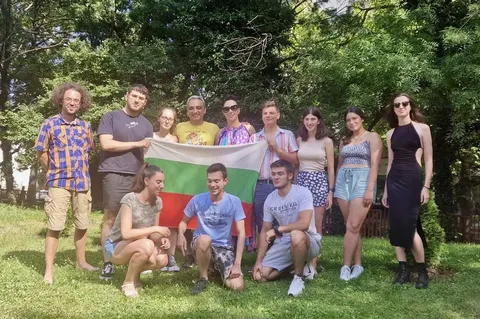
– How did the national team come about?
– In 2003 the first international olympiad was held in Borovets, a ski resort in the Rila Mountains; I wasn't involved in organizing it.
Soon after that we began preparing more competitions and selecting a national team.
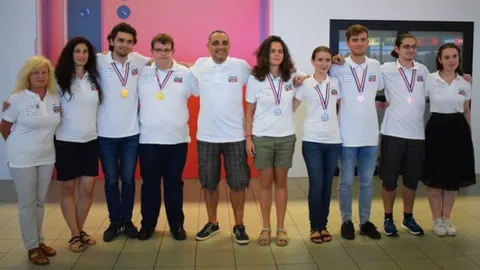
The process hasn't changed to this day. There are two stages—a national competition and an olympiad. The points are added up, then we invite the 16 best students to a two-week camp. At the end we run two tests, add them to the earlier results, and
the top eight become Bulgaria's national team.
In the beginning, the team leaders were the two teachers with the most qualified students. Since I was teaching at the Sofia High School of Mathematics, I was among them almost every year.
Later we decided that the team leader has quite a lot to do—register the country and the language, pay the participation fees, look for sponsors. At the Union of Bulgarian Mathematicians we decided there should be one person who serves a term as leader of the national team, with the second being the teacher with the most students. That's how it is to this day. And I've been elected leader for a third term.
– Why do people often say the competitions are in “mathematical linguistics”? Is that wrong?
– It isn't correct; they're just in linguistics. The “mathematical” part was added for formal reasons.
Linguistics is the science of language. We talk about it when the subject is not a single language—that's called “philology”—but several: the connections between them, their development, language groups and families, similarities and differences, changes.
Mathematical linguistics is just one branch, which was very popular in the second half of the 20th century. With the very first computers and programming languages, two big questions arose: can a computer understand human, natural language, and can it translate?
That's where mathematical linguistics comes in—a discipline that describes linguistic phenomena using mathematical methods.
That model, however, never really worked. The best-known example is from Canada in the 1980s. They developed software that translated a restricted language—only weather forecasts, from French into English.
Today's translation programs don't use mathematical methods; they rely on neural networks. They're fed information and find the patterns on their own.
– What do the problems look like?
– Every olympiad problem is solved through logic; you don't need any math. You get a text in an unfamiliar language—whether it's one longer passage or separate sentences or words—along with a translation into a familiar language, in this case Bulgarian. Based on these translations, the students have to draw conclusions about certain phenomena in the other language and translate new sentences to show they've understood.
No math at all, pure logic!
Usually the problems look for phenomena that don't exist in a language the solver knows. For example, Slovenian has the so-called dual number. In Bulgarian we only have singular and plural, while there they have a form for exactly two objects of a given kind. That can make for a not particularly difficult linguistics problem. To spot it, you don't need any math. You look, you think, you underline, you organize it in a table. And that's it!
– How seriously do the big countries take the competitions? I'd imagine that in any field they set their minds to, they could invest more resources than we do and turn out stronger?
– Every country approaches it differently. The big question is where there's an initiator to push the whole thing forward. Nowhere in the world is linguistics a compulsory school subject—it's there at universities, but not in secondary education.
The question is whether the local organizers manage to make a good selection and go through the whole chain—find, fire up and train the students.
In the US this worked thanks to a Bulgarian who, sadly, passed away a few months ago—Prof. Dragomir Radev.
He built their national team; the US and Canada select their teams together.
Dragomir put an enormous amount of effort, drive, connections, time and a little piece of himself into making it happen. There are people like that in other places, but not everywhere. That's my explanation for why there's no progress in China, for instance—they ought to be beating everyone. Since they do it in math and informatics, if they sent the same students after two weeks of training, they'd crush us, if not the first time, then by the third. And they've been taking part for quite a few years now and don't perform well. Maybe there just aren't enough driven people…
– Even so, it's astonishing that we're first in a field like this. Especially against the backdrop of our education system.
– We're first in one of the rankings. There's no official international ranking; this one is from Wikipedia, but it's accurate—we checked it. By total number of medals, for example, the US has more than us, and also if we count medals relative to participations. In medals per capita, we're indisputably first. It depends which ranking you look at.
– To me it makes sense for this one to be authoritative—after all, that's how countries are ranked at the sporting Olympics too.
– What amazed me was the reaction. When I posted it,
I wouldn't have expected 7,600 shares on Facebook! I didn't believe that was possible.
I don't know how nobody has called to offer me a job as PR for the Council of Ministers or some big company.
– Maybe we need something to be proud of, even though patriotism has lately become a touchy subject. Truly very few posts can collect that many shares—and with a positive charge, at that.
– Our education system really is in a sorry state. But, first, these are students from mathematics and language high schools, which are many times better off than the rest of the system.
And second—the problem lies in the very idea of secondary education in Bulgaria after the end of socialism, in this democracy we supposedly live in… I don't see much democracy, but never mind.
The idea of the Western education we aspire to is not to support outstanding students, but to have a solid foundation without too many holes underneath.
Before that, during the Cold War, every talented child was specially nurtured.
If someone was seen to have talent, the system itself supported and promoted them. There were all kinds of opportunities, an established structure. The Western model doesn't have that, and the reason isn't a bad one. There, too, a gifted child will find support, but it comes from the private sector. If you rely on business, things are less stable. A crisis hits, and the first thing to have its funding cut is initiatives like these.
– Yes, but the system also fails at the basic task you mention—providing a foundation. The proof is the schools where every single graduating student got a flat 2, the failing grade, on the matura, Bulgaria's school-leaving exam.
But there's another divide too, between children for the humanities and children for the sciences. I, for one, had to turn 33 to find out that I could program too. Is it right for such a stereotype to exist, or does a field like yours show there's no basis for it?
– That's quite a complicated question. Splitting students into tracks exists in most countries, and there's a tendency for it to happen ever earlier. The idea is that a student studies more of what's close to them, what interests them, and doesn't waste their time, roughly speaking.
If someone plays the violin perfectly, they can become Mincho Minchev, Bulgaria's great violin virtuoso, without solving quadratic equations.
Whether it's right or not is a very complicated question, because many people, like you, reorient themselves at some point long after they've graduated.
But there's something else where education is breathing its last all over the world—the idea that you learn something and then apply it for 40 years. That's how it worked in 1900, when the world barely changed over those 40 years. Now there isn't a single field where that's true, never mind the IT sector. Medicine? What about cars? What's stayed the same after 40 years? There's a computer inside, nobody lets you touch it, it's full of sensors. Back in the day you could replace everything on your Moskvitch yourself.
The entire education system has to change from the ground up.
– Who does better at linguistics competitions—the “humanities” students or the “tech” students?
– I can't speak to tracks, but the kids from the mathematics high schools definitely stand out.
– What becomes of the competitors afterwards? I assume everyone who's made it onto the national team has no trouble getting into prestigious universities.
– They get into universities, but, to me at least, that's not what becoming of someone means. They're very different. Quite a large share of them work with information technology in one way or another. A few continue with linguistics, but there are some. Their profile is no different from that of successful students from the mathematics high schools.
Not that many leave the country—far more did in the 1990s.
– And how have the generations changed over the 20 years you've been preparing competitors?
– I'm someone who really hates the idea of “Ah, what students we had back in the day, and look at this lot now!” Come on, enough!
But there really are differences. Back then they were much more disciplined and more obedient. They came to the courses; now they come if they want to. Homework—they do it if they want to. However,
that doesn't mean they're not sharper or don't do well. The results show it.
Education has changed too.
Interestingly, their relationship with music has also changed. Today they've had a phone in their hand since primary school; they're never alone. They no longer feel the need to put on some music and listen to it deeply. To have nothing else to do, to have 10 cassettes they can listen to.
They smoke and drink a lot less. Twenty years ago, when you went on a trip or to a competition, the first thing you did was get drunk. It's not like that anymore; all the policies restricting smoking and alcohol apparently do have an effect on young people.
They've become more self-assured, more open in the good sense.
They have opinions and are ready to defend them. Before, of course, they also thought and didn't keep quiet. But now I hear their opinions and arguments far more often than I used to.
– As large language models advance, will the skills from linguistics competitions become more valuable, or will algorithms take over these tasks?
– Ted Malchev, who has just graduated, won a silver medal and is heading to Harvard, took part in a research project on software that solves such problems. That kind of thing can probably be done; the question is who needs it. These problems aren't a real challenge for the science of linguistics;
their purpose is to assess a certain way of thinking in young people.
And I don't think making software that does it for them would have any practical use.
– And what about decoding rare or dead languages? In one of Ted Chiang's stories, aliens arrive and the biggest challenge falls to the linguists, who have to decode their way of communicating.
– Artificial intelligence helps. But can a linguistic problem be solved with a program? It doesn't seem likely to me. Languages fall into two types—those we already know everything about, and those we know almost nothing about. The latter are the ones that had no writing; the language dies, and what we'd need to reconstruct it isn't a computer but a time machine. We try reverse modeling from descendant languages, but there's no guarantee we're right, and that isn't science.
Phenomena in languages don't happen on command; they have their rules, but you can't apply reverse engineering.
Can artificial intelligence decipher some unknown scripts? I doubt it, because there aren't many undeciphered scripts left—and those are the ones with the least data. That kind of technology helps when you have huge volumes of information.
– Where do you think it's heading, the fact that we've all started communicating so much in English? That we've turned it into the global lingua franca…
– Language is a natural phenomenon; it can't be controlled. It changes, it develops. It's alive! We all know how our grandparents spoke—we don't speak that way. Leave aside the foreign borrowings; you won't hear anyone say “кому е нужно” (komu e nuzhno, an archaic “to whom is it needful”). You'll understand it if you've read Bulgarian literature from 150 years ago, but that's as far as it goes.
Another example: how the big differences between dialects, between the speech of Western and Eastern Bulgaria, disappeared.
Our grandmothers, who traveled far less, spoke very differently depending on where they grew up. You can still sense it in young people—some sounds and words are pronounced differently—but the differences are much smaller.
The other example of
how language can't be steered artificially is the full definite article. Nobody has ever spoken that way!
Sofroniy Vrachanski, the 18th-century cleric and writer, invented the completely artificial rule that it should be written after the doer of the action. (In standard Bulgarian, a masculine noun takes the “full” article -ът/-ят when it is the subject and the “short” -а/-я otherwise.) The truth is that in one part of Bulgaria people said “-at,” in another “-yat,” in a third “-ya.” Every country needs to merge its dialects into a standardized language, which is why the norm is what it is. It took hold, but nobody speaks that way! Most people can't even manage to write that way. Students haven't got a clue how to apply it, and I don't blame them. It's so unnatural, downright superfluous.
There are other similar cases in history. French words have such wacky spelling—one sound is written with four or five letters—because monks were paid by the letter. So beaucoup has eight letters and only four sounds.
Is that good or not? We can't stop it. Language develops. There are state norms; in our case they're set by the Institute for Bulgarian Language at the Bulgarian Academy of Sciences.
– These are all important topics for Digital Stories too—our withered word-coining, spelling and the notorious full definite article. Heartfelt thanks, and good luck at the next competitions! I hope you hold on to the lead and extend it!