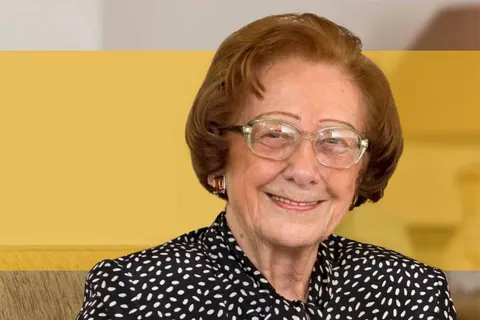
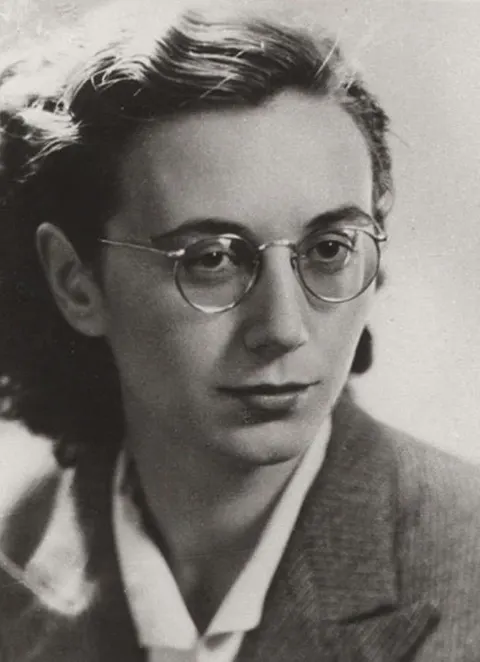
Leda Mileva was a symbolic figure of Bulgaria's 20th century, and this is one of her last interviews, in which I had the good fortune to be the one asking the questions.
The daughter of Geo Milev, the great Bulgarian expressionist poet, author of the famous “Little White Bunny,” she was a writer, translator, journalist, even a politician.
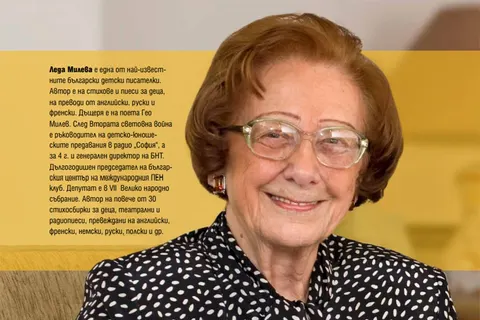
One of the best-known Bulgarian children's writers. After World War II she worked at Radio Sofia, and for four years she was director general of Bulgarian National Television (BNT). For many years she chaired the Bulgarian center of PEN International. She was a member of the Seventh Grand National Assembly, the parliament that drafted Bulgaria's post-communist constitution in 1990–91. She wrote more than 30 poetry collections for children, as well as stage and radio plays, translated into many languages.
Leda Mileva was born on February 5, 1920, and passed away on the same date exactly 93 years later.
The interview was published in issue 9/2010 of 8 Magazine.
– Mrs. Mileva, “Lights and Shadows” is the title of the latest volume of your collected works, the one meant for adults. Which are there more of in life—lights or shadows?
– They go together. Just as in nature there cannot be only light or only shadow, so it is in life. There are, of course, brighter and darker times. To some extent it depends on a person's character, but very often on circumstances and on the upheavals in society. Living in wartime is one thing, living in peace is another. In a rich society the opportunities are one thing, in a poor country like ours they are different.
But that doesn't mean you can't achieve something here too, if you have the character to fight and to search.
Many poor people have become famous and have made a real contribution in the field they worked in.
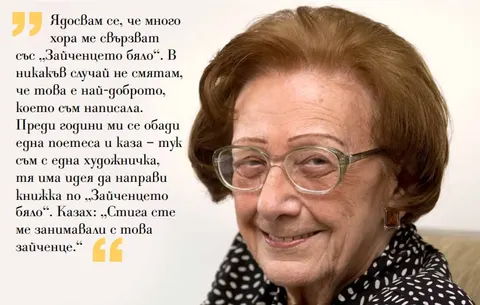
– You recently celebrated your 90th birthday. How can we keep the child within us and not grow old in spirit?
– It doesn't happen on demand. It's probably a matter of disposition and circumstance. You find joy in bringing up children, both while you're doing it and in the recognition you receive years later, and if you do it with your heart, you get enormous satisfaction—you see results.
– Looking back today, from the vantage point of the years, did the legacy of your father, Geo Milev, help you more, or did it place obligations on you?
– It obliged me, rather. From my earliest years I always strove to be worthy of him. That if he were alive, he wouldn't be ashamed of me—my sister and I always had that feeling, consciously or not. His spirit, his presence in our home as an absent father, was very strong.
– Did any of your descendants follow the path of literature?
– They're all philologists. My son teaches Bulgarian language and literature at the university; my daughter graduated in English philology but is a journalist, and her whole career has been at BTA, the Bulgarian News Agency. They're all passionate about literature—we practically have no other professions in the family.
– And did anyone turn to children's literature?
– No… not yet.
– Great poets very often appear in times of great change. These years are like that too, yet the creators seem to be missing. Why is that?
– Perhaps it doesn't happen right away; perhaps they're still small and growing up. Let's hope they appear.
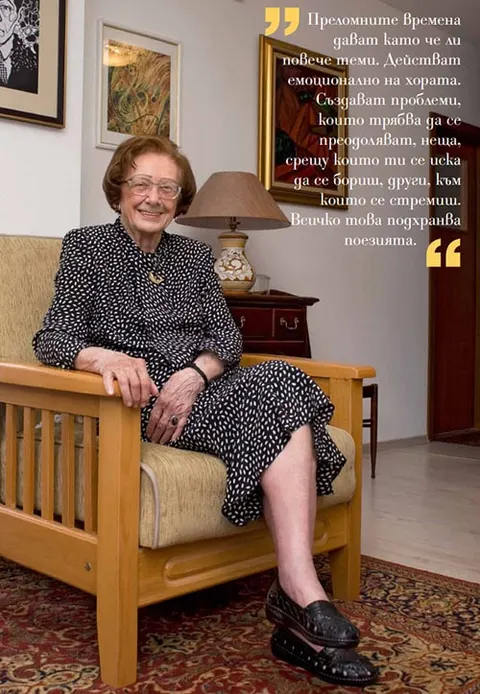
It's true that turning points seem to offer more themes. They affect people emotionally. They create problems that have to be overcome, things you want to fight against, others you aspire to. All of that feeds poetry.
You can't sing only of love; love is more or less the same everywhere.
– Do you work on a computer?
– Sadly, no, but I have a wonderful helper—my son, who has gone off to the seaside with the computer, and I feel as if I've lost my hands. I moved my three typewriters down to the basement long ago, and I don't feel like going down to bring them back up. Every day something has to be written, and I do it by hand. You can no longer live without a computer. That's what life has become—it makes things easier, and connections between people. And editing is easier too.
– Today both children and adults read far less than they did decades ago. Why is that, and is it really a problem?
– In the old days, the main thing that filled people's free time, at least cultured people's, was reading. Access to the world, to poetry—everything came through books. Now there are many media, and they are serious competition, especially for less cultured people and for the young, who aren't used to books and have never felt the sweetness of reading. And that is a great pity as a phenomenon and as a trend, because
reading cannot be replaced, as something that enriches the soul, enters you, leaves a lasting mark, creates taste, and so on.
All the more so when you consider how low-quality much of these now so attractive media are, especially television. It is very important for parents and teachers to give children a taste for books from an early age; later it will be too late.
Little ones connect more easily with a good book than with the fast-moving figures on a screen. They love to study the details, and they gladly go back to the pages. If we know how to give children good books, I don't think there's anything to worry about.
– Are there good Bulgarian authors of children's literature today?
– That's another problem, a matter of the financial crisis, which is hitting publishing very hard. I have firsthand impressions of large publishing houses that haven't turned entirely into commercial distributors of low-grade, kitschy literature. Their situation is very difficult, and however much they want to publish good books, they can't do it on the scale and at the quality of years past. Fees are out of the question, and we don't ask for them anyway. Most authors are happy just to see what they've worked on for so long in the reader's hands.
– But writers themselves aren't turning to children's literature either. I'd struggle to name a well-known Bulgarian author from the younger generation…
– Unfortunately, so would I. The reason is that an author has to be nurtured too, just like a reader.
Young people with a gift for writing want to become famous faster
and turn to genres considered more prestigious. In the old days the conditions were there; there were children's magazines that helped young authors and encouraged them… Sadly, now there are only one or two magazines, with comics, and they don't rely on young writers.
As a child I had the good fortune that Ran Bosilek and Angel Karaliychev, classics of Bulgarian children's literature, visited our school, and later I worked with them in the same editorial office. Ran Bosilek was for many years the editor of the magazine “Druzhinka.” And as a young man he had started with “Detska Radost” (Children's Joy), which did a great deal to bring children's authors into being. It was at his invitation that my father wrote one of his first poems for children.
– Few people know that some of your father Geo Milev's earliest poems were written for the little ones.
– In our family, respect for children and for books runs deep. My grandfather, Milyo Kasabov, a publisher and bookseller, devoted his life to that idea. He sent three of his four daughters to study something new, appearing in Bulgaria for the first time—preschool education. When my father was a student in Germany, he saw that there were many beautiful books for children there and suggested to his father that they order little albums with color pictures. That's how those few albums called “Detski Zhivot” (Children's Life) came about, in which Geo Milev published some of his early works.
– And how did you come to this field?
– When I graduated from the American College of Sofia, I decided it would be prestigious to study law. But it didn't seem interesting to me. My aunt, Penka Kasabova, was by then director of the institute for kindergarten teachers, and she lured me in. She said, “You study your law, but nothing stops you from attending our institute too. Every woman should know something about bringing up children.” I agreed.
She knew how to turn learning into something interesting; she invited cultural figures… And one more thing—she published a magazine, “Parvi Stapki” (First Steps), for parents and teachers. She got me to visit children's writers, to invite them to write, and to write a little something myself. That was my natural path to children's literature.
– “Little White Bunny” is your best-known work…
– Yes, unfortunately… It's one of my first poems, written by chance. At the printing house, when I was putting together “First Steps,” half a page was left empty. I had to come up with something fast, and I wrote this poem on my knee. I didn't think much of it, because it had been brought to me quite by accident, by the wind. And it became so popular… but not so much for its qualities as because Petar Stupel wrote a very beautiful melody for it.
It annoys me, because so many people associate me with exactly that poem. I by no means think it's the best thing I've written. Years ago a poet called me and said, “I'm here with an illustrator, she has an idea to make a little book of ‘Little White Bunny.’” I said:
“Stop pestering me with that bunny!”
That's how my path crossed with the illustrator I've worked with for many years now—Maglena Konstantinova. And I won't surprise you: the other day I was at a publishing house that's making a 90-page book of my selected poems for small children. And they said, “Forgive us, but we're going to call it ‘Little White Bunny.’ That's the most appealing title, it will sell most easily and reach the most children.”
– Have you read the books children and teenagers love today—Harry Potter, Twilight?
– I've read the first volume of Harry Potter. I doubt it would have had such enormous success without that gigantic, worldwide advertising. I don't think it's the book of the century, or a phenomenon like Andersen's fairy tales or Wilhelm Busch's Max and Moritz.
– You were director of BNT. Can television be art?
– It can, when it's done well, by intelligent people. But now chalga, Bulgaria's brash pop-folk, is everywhere—not only in music, but in the tavern, in cinema and on television. Years ago, when I was at the television, it was in its romantic period. Very few technical possibilities, only one channel. We didn't even have color television yet. But we made a miniature with shadow theater set to Saint-Saëns's music—“The Carnival of the Animals.” It turned out so beautifully! It won second prize—the Silver Rose—at the biggest festival of entertainment programs, in Switzerland.
While I was at the television, that rose stood behind me on a shelf. I don't know if it's still there—I hope so, because it's something we can be proud of. I should ask the new director general whether they've kept that tape. Now and then they could show the few awards we've received.