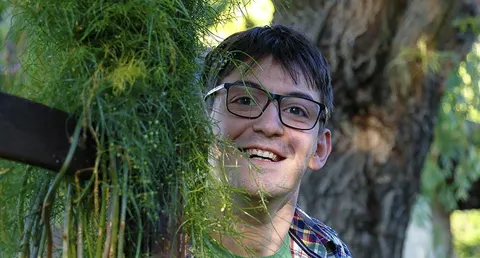
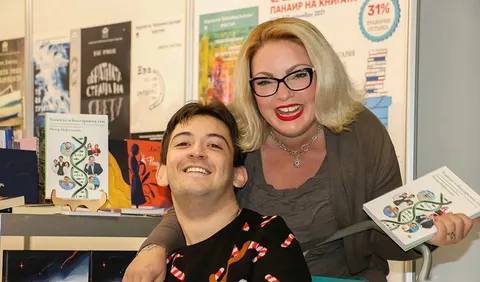
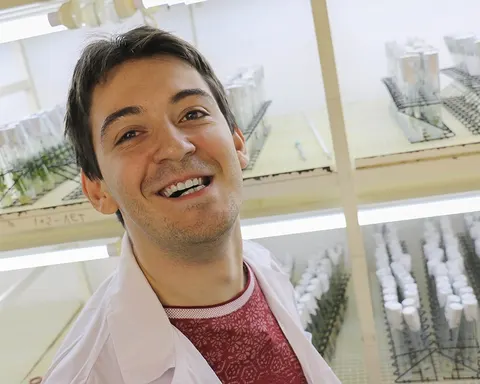
Petar Neftelimov is 26, and strength, zest for life and fighting spirit pour out of him. He recently published his first book, Uspehat v balgarskia gen (Success in the Bulgarian Gene), with the stories and words of 49 successful Bulgarians. He piles up one degree after another and fights for his ventures as an entrepreneur. He has traveled the length of the Danube on a tricycle and run several marathons. For eight years he has been writing a blog on entrepreneurship, marketing and personal growth.
I, for one, don’t know many 26-year-olds who can boast of so many achievements.
In his case they come not in spite of but in defiance of fate’s bitter interventions. So what? We sat down to talk about something else: success in the Bulgarian gene. About the strength to keep running life’s marathon, which is hard for everyone. And about the flowers of the new age, flowers in a test tube, delicate and meaningful.
– What do you think technology gives us, and what does it take away?
– It helps us in that it lets us conquer ever new peaks and reach ever more distant corners of knowledge. But it takes away our living contact with people and with nature.

– I can’t talk about uncomfortable subjects, and I’d really like to learn how. What about you—what can’t you do?
– I can’t sing, and I can’t play an instrument.
– You gathered “the success of the Bulgarian gene” into a book. Is there something that stands out among the stories?
– What all 49 people have in common is that they have found their calling. The reason they wake up in the morning. The thing they pour love, time and their own vision of improvement into.
– When will not just individuals but our nation as a whole be successful?
– When we stop whining and peering into the neighbor’s garden while ours has turned into a jungle. And that is exactly what the news in the conventional media makes us do. A normal person couldn’t care less how many crashes, thefts and murders have happened, or how many plastic surgeries our “stars” have had. That information neither warms him on cold evenings nor feeds his family.
We need to pull ourselves together, take ourselves in hand and start working for our dreams.
Let’s focus on our skills, on our experience, and fix our surroundings that way.
– Where does success hide?
– In the small things… In a helping hand. In making someone smile.
In motivating someone to start working on themselves. In going to bed happy at night.
– And… what is success?
– A herald of happiness.
– Tell me a powerful story that touched you while you were working on the book.
– When I was preparing the interview with Magi Nazer, she was only 23 and had already done so much for our society. For the first time I wasn’t indignant that the first thing someone is introduced by is their age. Unlike in all my other interviews, where I didn’t consider it important to mention the ages of the people I talked to, in this case it really mattered, because Magi is involved in things that can’t fit into a single article. I won’t reveal more about her, because anyone can get to know her in the book.
– What inspires you to keep studying?
– My goal of one day completing a PhD.
– What else would you like to study?
– I’d complete astronaut training and learn what it’s like to be in space, because my greatest dream is to reach Mars one day.

– You’ve had the chance to run a marathon, and not just one. That will hardly ever happen to me. What does it feel like—is it worth it?
– Why shouldn’t it happen to you? In marathons—anything over 21 km—you compete only with yourself.
With every run you get better and surpass your own limits.
You see your progress, and it brings you the satisfaction of having succeeded in this endeavor too.
I challenge you to try the charity run Run2Gether Bulgaria 2022, with a 5 km distance, and then the 10 km race at the Sofia Marathon 2022. And afterward you can tell me yourself whether it’s worth it!
– Hmm, that’s quite an interesting idea. I’ll really try to be there for the first step, we’ll see… And what are your next goals of this kind?
– If they invite me, I’d go on an expedition to Antarctica.

– What was the trip along the Danube like?
– In the summer of 2018, I covered 300 km from Silistra to Nikopol in five days on a special bike, together with five enthusiasts from Balkans Everywhere. The guys’ original motivation was to share the experience of long-distance cycling, with all its particulars, which let you live everything along the way in a far more genuine and direct way. They got in touch with me so we could do the pilot journey together and learn new things. Afterward we made a 20-minute film, “EuroVelo for All,” about our adventure.
– What inspires you?
– The smiles on people’s faces.
– What is happiness, in your view?
– Being with someone you love, no matter where.
– Flower in a Test Tube is your new and very cool initiative. Can you briefly tell us what it is?
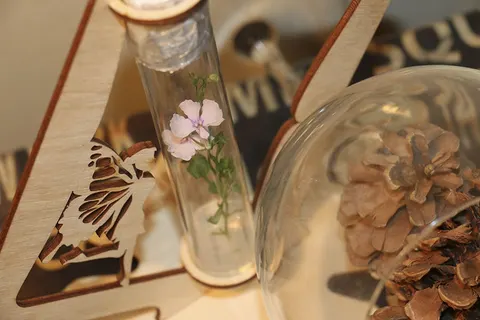
– Flowers in a test tube are a one-of-a-kind jewel for a loved one, living for at least two months without any care—an alternative to bouquets. They are an innovative decorating solution that creates a pleasant atmosphere at home, in restaurants and in hotels.
They are a product of plant biotechnology. They are created under sterile conditions, in a laboratory, so that they are isolated from the outside environment, which is full of microorganisms. Along with the flowers, we put into the test tube a medium we developed ourselves, with all the necessary nutrients, components and hormones, so that they can grow
and bloom in the test tube without needing any care—only light and love.
We say they live like this for at least two months, but in reality it’s much longer. After that they can be planted in a pot and go on living like any other flower.
– What were the biggest difficulties in creating them?
– What we learned along the way is that money can be found; there is investment in young people’s innovative projects. The huge obstacle was finding a laboratory that would be a reliable partner on the road to making our idea real.
We put almost two years into that. Most private and university labs, as well as the research labs of the Bulgarian Academy of Sciences (BAS), turned out to be skeptical. But our persistence, and the drive that comes from knowing we’re doing something meaningful, gave us the strength to keep going. That’s how we arrived at the Institute of Ornamental and Medicinal Plants. They gave us a helping hand and embraced our cause, and we’re very happy to be working together.
No product like this has ever been made for mass, commercial purposes. In other words, flowering has been regarded as an unwanted effect in the test tube and is avoided in laboratory work in plant biotechnology. We’re aiming for exactly the opposite: for the plants to bloom in the test tubes. Now we’re experimenting with different species to find the best ones.
From February 12 we’re launching the second species. It’s called lobelia; it has tiny blossoms and looks very beautiful in a test tube. Look for it on the site.
– What do you think these flowers are a metaphor for?
– We buy huge bouquets of cut flowers that wither in a few days, just for the sake of a fleeting gesture. We don’t realize that there are millions of acres where plants are grown for the sole purpose of having their flowers cut off to make that “precious” bouquet. At the other extreme, millions of people around the world have nothing to feed their families with…
– What is worth more people knowing about biology and biotechnology?
– That’s a very long subject. I’d say “everything,” because I’m horrified by the individuals our education system (and not only ours) produces, and by the munching of banichki, the little cheese pastries Bulgarians eat on the go, during biology class. For years these two things have been creating monsters who are now coming out into the world and leaving millions of years of evolution behind them…
You simply can’t live in harmony with yourself and with others if you don’t know the science of life, of living organisms.
And here I want to point out that we may not see them, but microorganisms are everywhere around us. I don’t know about you, but at school at least, when we learned about prokaryotes and eukaryotes, for example, I thought they were somewhere out there, maybe only in textbooks and on the microscope slides they gave us to look at. I didn’t realize these were our invisible friends, everywhere around us.
Here’s an interesting fact. Household dust is really made up of dust mites’ droppings and their dead cells. Dust mites, close relatives of ticks and spiders, are too small to see without a microscope. They feed on the skin cells people shed and live in warm, humid environments. In most homes, things like bed linen, upholstered furniture and carpets provide an ideal habitat for them.
Biology and biotechnology are full of countless interesting and useful facts like this, and it’s good to know them
so that we can live in a more real world. Without monsters born of ignorance.
– You say that “our cells are little mirrors of ourselves.” What do you mean?
– Over the course of evolution, a division of labor emerged. Just as no organ in the human body can function on its own but depends closely on one or more others to build a working organism. At a level above the species—a group of people with different interests—the working organism might be a new project, a company, even a family.
To have a successful project, company or even family, I think it’s important to study relationships at the most microscopic level. To draw knowledge and experience from them for future projects and to build on what we already have.
So where does the key to success turn out to be? Within ourselves.
We are little mirrors of our tiny cells. They communicate with one another just as we communicate with each other. Let’s start with the smallest things.