What a colorful road our guest today has traveled! She spent 11 years in journalism. Then she turned to tourism, only to become… a hotel manager in the Mariana Islands in the Pacific Ocean. Until she finally dropped anchor in the IT world. She realized that a large share of the tasks in tourism can be done successfully by algorithms, because they are repetitive. That is how she created the chatbot platform UMNI, long before another chatbot drew the world's eyes to how far artificial intelligence has come.
Elitsa Stoilova says that digital literacy should become a national goal if we want to move forward. “Its absence leads to fear of technology = conservatism in adopting and using it = our nation falling behind in many directions. What is the future of illiterate nations?” Elitsa wrote to me through the ideas form, which is waiting for you here too.
But how is it that… she is so optimistic about the road ahead? Our guest believes that if we play our cards right, AI is leading us to a wonderful future. What does playing our cards right depend on? And why is it sometimes worth leaving behind one of the most heavenly corners of the planet in pursuit of your dreams? We look for important and unexpected answers in the lines that follow.
– We've known each other for a long time, but the reason for this conversation is the topic you suggested—that it's time for digital literacy to become a national priority. But why? Every generation is already on one social network or another; they're obviously coping with the digital…
– That isn't digital literacy. There's more than one definition of what it is, but it certainly doesn't just mean having a smartphone and being on Facebook. It means being able to work with information online—to search for it, analyze it, use it, generate it. And, which is extremely important, to understand how much your own safety matters.
That's a fairly broad explanation, but it means you truly have a conscious attitude toward the digital environment. Add to that the arrival of artificial intelligence over the last two years in tools like digital avatars and voice clones, and
a conscious attitude toward consuming and creating digital information comes to the fore.
Being able to understand what is happening around you. Quite a lot of people lack that digital literacy.
– That's true. I've been building this site for four years now precisely because I, too, think that the digital literacy of the individual and of society today is an existential question. But how do you think we can work in that direction? Hardly by forcing people to take some kind of training, or with advertising campaigns. And in the online din, there's no chance it will happen just by creating quality content.
– That's my pain point too, from the perspective of a company offering a digital solution with artificial intelligence. We've been on the chatbot market for eight years, we've been in the ChatGPT era for two, and most people still have no idea what an AI chatbot is. I meet all sorts of people, and everyone has their own idea. Many businesses still don't realize they have a problem, while the market already has plenty of solutions for it.
Here digital literacy comes down not only to your personal level of knowledge but to how it affects the quality of your life and work. AI is already becoming part of functional literacy.
When a person with limited digital literacy makes leadership and management decisions, that affects how entire companies function,
the decisions management makes—how well suited they are to today's environment. In my view, it's no longer a matter of “do I want to learn or not,” “do I want to become literate or not,” but rather that
if you want to be up to the job and still have one in the next five years, you have to start.
I also believe it won't be AI that takes jobs, but the people who understand AI and can manage it. Two months ago the World Economic Forum published a report saying that more than 90 million jobs will be lost in the coming years because of AI being built into companies' business processes, but at the same time twice as many—more than 170 million—will be new jobs, where, however, people will need to be literate enough to work with AI tools.
– Though most analyses still show that the jobs lost will far outnumber the new ones. But how could digital literacy actually happen in practice? It's clear if it comes at a personal level, but people are often passive, skeptical…
– I think through campaigns, even at the state level, that explain in plain language that we need to set out on this path. You have to start somewhere and draw people's attention to the topic calmly, without screaming headlines.
How did smartphones and computers enter our lives? I remember when I worked in a newsroom, computers appeared and gradually the newspaper's prepress work was automated. Several colleagues said: “I'm not learning that, I can't do it, I'll keep using my typewriter.” Well, yes, but then you've dropped out of the process. Like it or not, they sat down and pecked at the keyboard with two fingers, then faster—necessity is the best teacher!—and at some point it turned out everyone could work on a computer.
The same thing happened with smartphones. They turned out to be super fast and convenient, we forgot ordinary phones without noticing, and now we can't imagine life without smartphones. That happened in a very short time compared with other technologies.
I think AI will enter everyone's life in the same way. It's already here; we've long been using AI tools—and daily at that. Some people will realize it's extremely convenient to run their personal tools, to make life easier, to stop dealing with routine tasks they don't want to do anyway and find tedious.
The curiosity born of that convenience will convince these people that they want to do it.
For others it will come because employers demand it. A third group will simply be faced with a choice: “either I do it, or I'm at the unemployment office.” So AI will enter people's lives in different ways, but in the end the result will be the same. We'll have to know how, to be able to.
Yes, there will be people caught with one foot on each side. “Me, learning at 40?!” Although I'm over 50 and I'm doing it. There's no age limit, and applying AI tools isn't complicated—you don't need to learn how to build them.
But what can the state do? In the United States, for example, 95 percent of schools have already added lessons on artificial intelligence to the curriculum.
It's important to invest in the next generations, and this has to be part of the educational process.
– Do you think it can happen in Bulgaria? I don't.
– I think it can, as long as there's the will.
For me, most of society's problems are solved with adequate education.
On a personal level, people and teachers are interested. If the system itself allows it and says it's important, I think it will catch on quite quickly.
Teachers who use AI and experiment together with the children will be more successful. I came across an example where learning AI tools happened through children creating animated pictures and images, as in an art class. They write prompts to draw interesting images, animate them, give them voices. In that playful format they get used to linking AI tools together and using them in their everyday lives.
I work with university and school students, and they tell me that at school and at university they aren't allowed to use ChatGPT. Why? Quite the opposite! Let them test, experiment and apply what they've learned. Let's adapt the learning process so that it allows studying and practicing AI tools. They were created to make us more productive, to help us grow faster.
– But isn't that dangerous too? Because it teaches them the easy way. If we choose to show them AI early, we need to place much more careful emphasis on the fundamental subjects and topics.
– I completely agree. That's why it shouldn't be introduced chaotically but systematically. Like reviewing the whole curriculum and deciding in what formats and when it will come in, so that children also develop a sense of safety in the digital environment. Because, as we said, one of the elements of digital literacy is cybersecurity. These things go hand in hand.
– You, too, (like me) are someone who landed in the IT world from a very different field. What surprised you most about it?
– The fact that
translators are needed so that the IT world and everyone else can talk to each other.
Maybe because of the technicality, the jargon, the terminology, which is very far from the language of the ordinary person. When you stand between clients, employees, partners and anyone who writes code, you sense, to a greater or lesser degree, that they aren't speaking the same language.
These two worlds definitely need translators! Maybe it comes back to people's digital literacy again, that they can't take in the terminology used in the IT world. You have to look for synonyms that make it accessible to everyone else.

– It's not even just the terminology, it's the whole worldview. The same thing surprised me, and that's why I made the site, to try to do that kind of translating. It doesn't happen in society, because it isn't easy for the tech side either.
– Not in any way! The tech world is built logically, mathematically. It's a way of thinking, and when you run into a user trying to say in ordinary, human language what they have in mind, it's often hard to dress that up in IT terminology.
– You've been working with chatbots for eight years. Did you expect that precisely this kind of project—ChatGPT—would unleash the whole AI revolution? There were GPT-2 and GPT-3 before it, but it took the chat for the world to go crazy over it and realize that something big was happening…
– I've always believed chatbots would go a very long way; that's why I took up this direction. I believe in the need for this technology.
I'm on the applied side of AI chatbots for business, and I think there's still enormous room for them. However many different AI tools you have as part of a business's operational setup, there will be a need for some point of contact with the user who talks to these systems. The business AI chatbot is exactly that point—between a business's outer and inner world.
I've always believed in chatbots. When I started with them, they didn't have artificial intelligence yet, they were a bit dumb, but I thought they would develop and become something big. I still think there's much more to come.
Large language models turned out to be the intermediary between humans and the world of AI. That's exactly why ChatGPT exploded the way it did—it's a super accessible, simple, humanly convenient application for communication, and at the same time it's a door to knowing the world and everything in it. It's a chance to step off the little “islands” we live on and look toward expanses we never imagined were within reach.
– It's no accident that we anthropomorphize it so much and call it “he” or “she,” even thank it.
– I even have a name for it; we greet each other. A few months ago it blurted out a compliment to me without my having put it in the prompt—I didn't expect that from it. At first it really surprised me; now I'm used to it. But by now
I can't imagine managing at work without this assistant.
– When will we reach the point where we can't tell who's on the other side—a human or a chatbot?
– We're already there. It's just that these solutions are at a super high level—digital twins of people with a voice, with emotional intelligence, knowledge, a persona. “Digital humans” are very expensive right now, which is why we don't see them every day. But over the next few years they'll become affordable.
I recently signed up for an AI course in the United States, and I get phone calls from the lecturer's digital assistant. It asks me how the lecture went, whether I need help, and it introduces itself first—it's required to say it's a digital assistant. Still, there's a slight delay, which for now is my sign that there isn't a human on the other end.
– In the end there's the barrier that you know. That's why I do a lot of experiments in which people don't know, and then it turns out they can't tell the difference…
– That's right. These tools already exist, and not being able to tell them apart isn't some distant future. It's the present. For digital twins, that same lecturer puts his own copy up next to himself. There it is, speaking with his voice and gestures, the two of them standing side by side. Two peas in a pod!
So these technologies are already here. It's just that in Bulgaria we haven't run into them yet, so we haven't understood, haven't felt that they're here and are even seriously entering business.
– Is there anything that frightens you about technology now being so good at imitating humans?
– No. I'm one of the optimists. Maybe because I've been doing this for seven or eight years now, and it came into my life much earlier than for other people. I've had time to think, to adapt to these tools. I'm among
the people who believe this technology gives us the chance to be better human beings.
To go back to what it means to be human, to our values as a species. For it to give us back the time to practice humanity and everything that comes with it. The things we're strong at. Empathy, creativity. Even creating, which involves far more than creativity. To be able to develop the talents we have.

Do you know how many Michelangelos go to work from 8 to 5
at some machine? And they don't know they're Michelangelo, or Leonardo da Vinci, or Pushkin. They've never had the chance to develop their own talents, because they have to go to a boring job. They're lost human potential!
Each of us is born on this planet with potential, and a huge number of people never reach even a small part of it, because they have to earn a living, feed their families. What if they were given a chance to develop it? To have the time and the opportunity to learn to paint, to create new things.
You can't paint with brush and paints, can't play an instrument? Paint with words, write music! AI makes it possible now: text to image, text to audio, text to video… A time of unlimited possibilities for each of us!
I'm one of those people who firmly believe that if we play our cards right, a wonderful era lies ahead of us.
– So do I. But based on our experience with technology so far, I don't think it's especially likely we'll play our cards well. I don't see the preconditions, because so far I see how inadequately, and without any public conversation, we introduce these things. This way they free up our time, which they then take back, through social networks, for example.
– But we have a chance! And besides… isn't that exactly why we're talking about digital and AI literacy today? About handling the tools of the digital world consciously.
I heard this somewhere and remembered it:
“If we don't control the algorithms, they will control us.”
Let's learn and be the ones in control!

– Let's hope… What are the latest trends in chatbots? What are the newest big steps?
– Very recently we launched the newest AI module for chatbots on our platform, where we give GPT a little more freedom to perform operations. In practice, chatbots still work with their own database, so that the business has control over the information GPT uses. It doesn't search the site or the internet; it uses the facts about services and products selected by the business. But the information is provided in only one language, while GPT answers in the user's language. We support 29 languages—all European languages, including the Balkan ones, plus Chinese.
So right now, being a business and having a multilingual chatbot becomes extremely easy as a process of building and managing it.
On top of that, GPT sees the rest of the content in the chatbot—various forms, information sections and so on—and can judge, based on the history of the conversation with that particular user, what to attach from that other content to the generated answer, for an even more personalized experience.
Communication with chatbots is becoming super personalized and far more useful than just “question and answer.” With the help of AI tools, chatbots today are a multifunctional and flexible tool that helps businesses.
– So in your view there's no business for which having its own chatbot isn't useful, do I understand you correctly?
– We already have them for individuals too; it isn't even just for businesses or organizations. I'm about to make my own chatbot as well, so it can take over some tasks.
You can make a chatbot even for your hobby. Anything with repetitive information, processes that can be automated because they're routine, user data that can trigger task automation—in all of those situations an AI chatbot can be used.
– In the beginning, when advanced AI appeared, many predicted that support and customer service specialists would be the first whose tasks the technology would take over. Did that actually happen?
– Yes, at the first level. I use the example of the Pareto principle to explain to clients how routine communication with users is. Eighty percent of customers ask 20 percent of the questions. Eighty percent of employees' time goes into handling those 20 percent of routine questions and tasks. First-level support deals with exactly those.
At the second level we get to more specific, harder questions, where a human is still needed. AI assistants, chatbots and agents today, if they're well planned and built, are fully ready to take over the first level. Because wherever there's routine, it can be automated.
Over time, by building the right systems and linking more tools together, it will be possible to automate the second level too, where the harder, more specific tasks are. And I don't think it's a matter of decades, by no means. Much sooner.

– Will there always be a third, higher level that can only be work for humans?
– There will. For me it's a must, for several reasons. First, because we're in a time of transition—customers are adapting differently to the change in communication. I see it in our clients' chatbots too. There are users who insist on talking to a chatbot—most often introverts or younger people. Others go into the chatbot to find a way to reach a human. Still others use the forms in the chatbot not to register or buy something, but to describe their case and wait for customer support from a human to get back to them.
In this transitional period, until people start to feel comfortable working with these tools and serving themselves, there will be a need for a human team, but it will be much smaller than it is now.
There will also still be specific situations where automation won't help. Here's an example from a hotel. You can make a reservation automatically through the booking system. You ask about price and availability, the bot gives you the details—you choose and book. But at this stage it can't help you if three generations are traveling, you're bringing a dog, you aren't sure whether you need two rooms or three, one of them has to have a connecting door to the other, but they have to be as low as possible so grandma doesn't have to climb stairs, and so on. The booking system can't help. Here you need a human touch, to know your product and service very well and be able to say: “Aha, for this family the best fit is rooms 101, 103 and 105. Let me see if they're available; if not, I'll do some shuffling.” Here human expertise can't be replaced. At least for now…
– Who knows for how long… Let's finish with something further from technology. So readers understand what these exotic photos are. Many people dream of living on a tropical island, in an endless, exotic summer. You spent a full 17 years as a hotelier on the island of Saipan. How and why does a person leave a place like that to take up technology in Bulgaria?
– It isn't easy, but it was a natural progression. I truly spent exceptional years on those islands, not only in terms of my career, rising to general manager of a hotel and marketing consultant to the local tourism organization, but also in touching the local culture, history and nature.
Saipan is listed in the Guinness Book of Records as the place with the most consistent year-round climate—an average of 27 degrees Celsius, with a fantastic ecosystem, 4,000 km from the nearest mainland.
At home I bathed in rainwater; my house was in the jungle, with a view of the ocean. With mango, papaya, jasmine, macadamia and orchids in the garden.
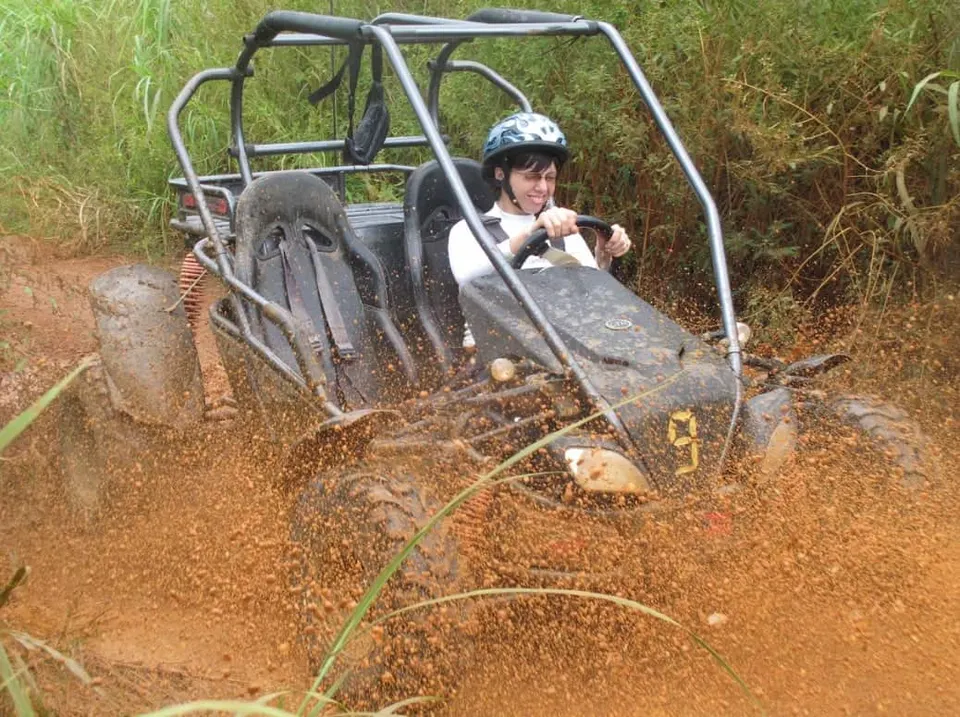
Besides being a hotelier, for a while I was also general manager of a tour operator running adventure tours—buggy rides through the jungle, diving, jungle trekking.
But there came a moment when I realized my development had stopped. My life was flowing against a wonderful backdrop, but I wasn't part of the lives of the people closest to me, and they were in Bulgaria. It took me two years to make the decision to come back.
Then life here quickly showed me that the problems I had faced, especially in business-to-customer communication, and had solved in many ways, were neither island problems nor hotel problems, but ones that exist in every company. From that “Aha!” moment, the next step was easy—if I'm going to start from scratch, let me try to solve them with the help of technology. The rest was… luck, or maybe fate? Umni.bg and chatbots appeared in my life very quickly.

– A real Korekoredut, the storybook tropical island of plenty from Bulgarian childhood! Let me seize the chance, since for the first time I have a longtime resident of the Mariana Islands as my guest… Could you tell us something we would never imagine about a place like that?
– Oof, that's a tough question. I could tell you about the flying foxes and the coconut crab, but I think the most worthy answer to this question is the coconut. What do we know about it here—that you drink its juice, that the flesh is made into coconut flakes and flour, and oil too, that the shell is made into little bowls. And that with two of them and some string we can make a bra.
When I landed on the islands, I learned about coconut sashimi—a fantastic delicacy! While the coconut flesh is still “young”—like a little jelly—it's eaten with wasabi and soy sauce.
Have you heard of the coconut apple? When a coconut starts to sprout—one or two little leaves and a root about 20 cm long—a white ball the size of a tennis ball forms inside it, soft and fluffy like a little cupcake and super tasty. That ball contains everything the coconut needs to grow before the root starts feeding the young tree.
The fibrous husk of the shell is made into sturdy ropes. All in all, it's the universal plant and fruit of the tropics. The ancient navigators, who traveled for weeks in their boats between the islands, took only coconuts on board. I even learned, though I can't guarantee it's true, that during World War II in the area around the islands, the wounded were given coconut juice instead of blood, because there was none, and the juice is extremely nourishing.
Let's not forget coconut tuba—the sweet tropical wine made from coconut…
– And let's stop here, because we'll all start daydreaming, and in our latitudes it's hard to find a coconut like that… Let's hope technology helps, not global warming. Thank you for this conversation!