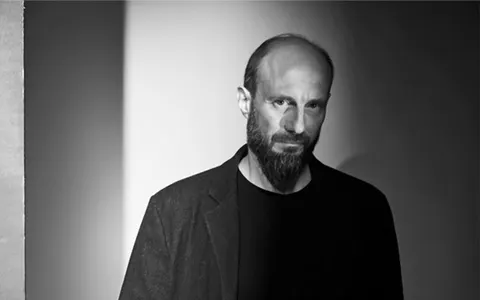
Momchil Nikolov is, in my view, among the most perceptive and original Bulgarian writers. His two latest novels, Poslednata teritoria (The Last Territory) and Chekmo, are among the few real discoveries of recent years in a literary sky crowded with ambitions.
He actually graduated in medicine, but quickly turned to the professions of television screenwriter and writer. He is the author of short story collections, novels and plays, and a screenwriter for successful shows on national television.
In The Last Territory the central theme is dreams as alternative realities, their inexplicable magic and the secrets they still keep. The book brought him the national award for Bulgarian Novel of the Year in 2016.
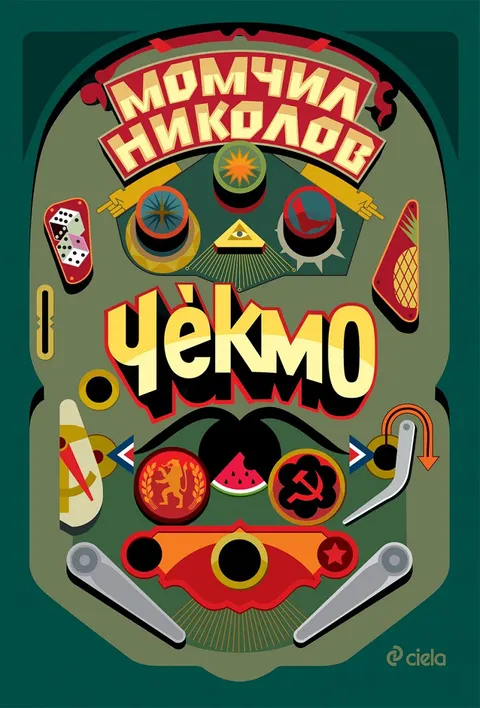
Chekmo, for its part, is an endlessly colorful tale, based on a true story, of the remarkable adventures of its title hero in the first years of the transition, Bulgaria's passage from communism to a market economy after 1989.
We met to talk about colorful lives from the digital and analog worlds. About oddballs and robots. About taking stock and about freedom.
– You manage to offer a view of the past that is neither paradise nor hell, which is how we most often paint it in our minds. How can we learn to look at the future the same way?
– Our idea of the past—our own, personal past—is built on the memories we have of it. And memories, as we well know, are simply an interpretation of facts. For the future—which, at least according to the generally accepted view, hasn't happened yet—we have no facts. We have hopes and fears, all too often, as will probably turn out, unrealistic ones.
When we try to imagine the future, we work with the conceptual tools of the present and the past.
Could prehistoric man, with his ideas about the world, with his experience, have imagined today's future?
Hardly. More likely his optimistic visions involved nicer caves, more food, sturdier and bigger bones with which to crack his enemies' skulls. As for their pessimistic visions, frankly, I don't even want to think about them.
– Has the time come to be afraid of artificial intelligence?
– Honestly, I'm far more afraid of the absence of intelligence. I think stupid, arrogant and ambitious people, of whom there is no shortage, are capable of doing—and do—far greater damage than an intelligent machine, which you can simply unplug from the wall. You can't unplug a fool; his energy reserves are sometimes inexhaustible.
– And could it put writers out of work?
– We writers are tough people, used to surviving in an extremely competitive environment. Millions of new books come out every year. And what about the old ones? And the even older ones? There is no other business in which you compete with people who died several hundred years ago. So an artificial intelligence won't scare us. Besides, I hope this artificial intelligence finds itself some more meaningful occupation.
– Should we feel worry or enthusiasm at the thought of the moment when we put a chip in our brains and become one with the machines?
– There, that very idea is exactly what I'm talking about. Because in recent decades computers—and everything connected with them—have developed so much and taken over our lives, one way or another, we imagine the future as one giant computer controlling everything everywhere.
It might turn out that way, but I
would bet on something we can't imagine at all right now, because our brains hold no idea of it.
So it sounds silly to me to worry or get excited about something that might possibly happen someday. It might also not happen. Every person's life probably holds enough things—perfectly real, personally affecting them, happening here and now—to worry about.
– Did this last crazy year take the bread out of writers' mouths, or did it give them work?
– For me personally, nothing much changed. A writer's work, in any case, involves spending many hours in solitude. Writing is an activity that demands a certain concentration over a certain stretch of time; that's just the nature of the job. It's nothing new for me to deliberately and seriously limit my social contacts; my work, as I said, requires it.
I think at some point, right at the beginning, last year, I felt like someone well trained for what was coming, for what normal people were only now having to learn. Over time, some found out they could easily work from home. Others, that they could easily drink at home. And I've known these things very well for a long time.
– Doctors suddenly came into fashion, and you graduated in medicine. Do you regret not becoming a physician? Are writers the diagnosticians of society?
– I'm more curious what kind of doctor I would have made. Probably not a bad one—I suppose, though of course I can't be sure. I liked studying medicine; it really is an enormous body of knowledge, accumulated and developed over centuries.
I think the writer should be something like a receptor of society, sensitive to even the faintest changes in the world and in people.
When he picks up something alarming and threatening, he must send the necessary danger signal
to the other cells of this giant, shared human organism that all of us make up; and do it in whatever way he can, so that more people understand it, become aware of the problem and deal with it—if they can and want to.
– You allow yourself the courage to write at length, with paragraphs that sometimes run a whole page. Do you think there are still, and will still be, enough people who have time to read? Who aren't in a hurry to learn everything in a second and scroll on?
– Well, as long as books are being written, published, sold and bought, there are obviously people to read them. Unless they buy these books to decorate their homes and take pictures with them for Facebook—there are such cases too, I suppose. Publishing is a serious business, and I don't think it would exist if it made no economic sense. I have some observations of the book market and I can say that
far more books are published now than, say, twenty years ago.
There are many more and much nicer bookstores, more Bulgarian literature is being read, and there are good Bulgarian writers. So let's not rush to declare the end of writing and reading.
– In your new novel, Chekmo, you tell the story of an extraordinary oddball from the early days of the transition. I know his real-life model is still carrying on his adventures today. But are such colorful stories still possible now?
– They're always possible,
as long as you look for them and have the courage to live them.
As far as I know the so-called model, he can't stand a life without adventures. The situation around COVID and being unable to travel the world kept him locked up for months in one place—somewhere in Spain. He did manage to get out, mind you: right now he's in Africa, in Tanzania, having a pretty high-quality good time, without any restrictions whatsoever. And while he's having a good time, by the way, he's touring the gold mines in the region and trying to start some new, large-scale business involving investments in gold ore—I'm not really sure what exactly. At the same time, he's quite wholeheartedly running a charity project too, called Crypto for kids.
– So the real Chekmo carries on with his adventures. “Most people go through their lives without a single adventure, my friend,” says the literary character. Do you agree with him? Is it harder to be different today? Is it harder to stand out from the crowd?
– It has always been hard; people—or most of them—have always chosen security over the unknown. That's just how humans are built, those are their instincts. With Chekmo it's exactly the opposite; his instincts work a bit backward. He has told me that even when he leaves home in the morning—wherever he happens to live at the moment—and has to go somewhere, he never takes the same route he took the day before; he looks for new paths, every day. “But why, Chekmo?” I ask him. “Well, what do you mean why? Because I might see something new, something might happen to me.” You see,
he doesn't wait for adventure; he seeks it out deliberately, every day, every minute.
And, in the end, the adventure turns up.
– Chekmo talks to a clock to help him judge whether he has wasted his life or used it the way he should. Should each of us have such a clock? How often should we ask it?
– Chekmo talks to a clock because he has no one else to talk to: he's in a hospital on the other side of the world, all alone and completely paralyzed from the neck down. I suppose any of us, in such a situation, would prefer to have a loved one by our side rather than a clock.
My point is that if you have the chance,
talk to people, not to clocks;
clocks couldn't tell you anything more than what you already know about yourself. Because talking to a clock is exactly that—talking to yourself.
– What is the last story you heard that moved you?
– I don't know if it's the last one I heard, but it's the first that comes to mind right now. An acquaintance told it to me. Because of some misunderstanding connected with his work, he ended up in a chitalishte, one of Bulgaria's traditional community cultural centers, in the Iztok neighborhood of Sofia. There was a gathering there, about a hundred and fifty people, all of them convinced Nibiru believers and flat-earthers, who expected my unsuspecting acquaintance to give a lecture on the possibility that the Moon is a hologram. And he gave it—what else could he do?
– “The Last Territory—our minds—and the battle for it in the modern world”: I read that you present this topic in schools. What does this battle look like today? Whom are we fighting? Is there any prospect of success?
– This battle is being fought on many fronts. Information channels are now countless, and each of them works out some strategy to reach your mind. Including me: trying to sell a book,
I have to figure out how to reach people's minds and intrigue them.
Everyone advertises their goods; that's the world we live in, and not just since yesterday. And yes, we are becoming ever more aggressive and inventive.
– When is a person free?
– I think it's an entirely personal feeling, tied to whatever makes you feel unfree. Today, for example, many people believe their freedom is seriously restricted because, due to a very partial lockdown, they can't go and get hammered at their favorite bar. Or because, for some reason or other, they've been blocked on Facebook for a month. Can this sense of freedom and unfreedom be compared to the feeling of a slave who knows from birth that he is someone's property, that his life depends entirely not on him but on his owner? I don't think so.