He says himself that most people know him as “Vihren from People.” And indeed, you may never have heard his name—Vihren Georgiev—but it would be strange if his photos on the remarkable pages People of Sofia and Sofia in Details had never moved you.
He is a wonderful photographer of the new, digital age, and his shots are at once art and a chronicle of the day. They win attention without running from the laws of art or chasing easy beauty.
They simply show the people of Sofia as they are.
Let me, in turn, try to present to you, as he is, the man who for almost a decade has been catching them in his lens.
– You often say you're not a professional photographer. So what are you a professional at?
– Nothing, really. It turned out that as a kid I had no way to study—poor parents, I had to earn money, I started working very young, and I never finished university. I've done all kinds of jobs—as a painter in Lyaskovets, a small town in northern Bulgaria
in the early '90s we painted an entire factory.
I've been a security guard, I've sold things in a shop. Then I started at a market, I was there for quite a long time, opened my own shop, then closed it. Now I mostly do People of Sofia.
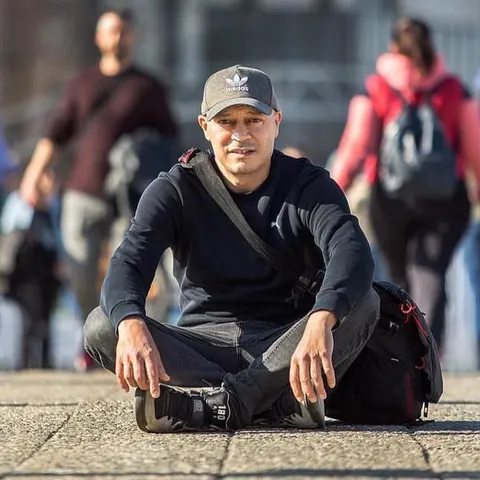
– How did you discover photography?
– I've been interested since I was a schoolboy; I went to a photography club. I think that somewhere back there, in the distant past, the foundations and rules of photography were laid in me, and they surfaced when I began shooting more seriously. Somehow that knowledge was intuitively in my head and things just work. Today, to be a photographer, you don't need to fully master the technical side.
Most cameras shoot by themselves; the algorithms are very good.
The big question is choosing your means of expression. For product photography, say, you need serious equipment. Whereas on the street, if you have the intuition, if you have a feel for composition, for the moment, the rest is easy to learn. But if you don't have them, however good a technician you are, it won't happen.
– It's wonderful that the internet gives photos like these a chance to reach so many people and touch them. Did you find your place… by accident?
– Yes, completely by accident. I've always photographed people wherever I go, purely as an amateur; it's interested me all my life. In 2013 “Humans of New York” took off, the first page of its kind. I already had quite a few photos like that, and one afternoon it occurred to me to make a page. I had a Facebook album called “People,” I pulled out only the photos from Sofia, uploaded them, and the page took off.
Just then a friend was selling a better camera; I also bought a lens I still shoot with—a 70–200—and things got going. A week later the protests against Peevski began—mass street protests against Delyan Peevski, a controversial media mogul and MP appointed to head the national security agency. As someone who's interested in politics, I went every evening, took photos, and people started loving them. I didn't do it to achieve some kind of success, or for likes.
That people like it is, of course, very pleasant for me too.
Everyone wants to hear their opinion; it matters for your self-esteem, and it's a kind of compass for what you do.
But, say, shooting landscapes and postcards isn't my thing. I also have Sofia in Details, but I'm not so active there, because
Sofia is such a boring city to photograph. How many different shots can you take?
I just show what I see. Others choose to make postcards, to daub them with filters and garish colors that make your eyes hurt. That isn't photography.
– But then something has to catch the eye in that endlessly scrolling feed…
– Turning into chalga—Bulgaria's flashy pop-folk—doesn't appeal to me. The problem is that this type of photo does a lot of damage, because it lowers the standards. It passes off as photography something that isn't.
I understand it's fashionable and many people love it, because they don't understand. But
when you do something, isn't the point to build on it, not to lower the bar? Anyone can make postcards.
Apps, filters… even the dumbest photo you take can become one. Little flowers, twinkling lights.
– After so many years, don't you get tired?
– Oh, lately I find it harder and harder to find interesting people, things that provoke me. Like with Sofia in Details—basically you shoot the same thing over and over, it gets a bit tedious, you feel yourself running dry, going in circles. That's why lately I've turned more toward campaign projects, where I meet people, talk with them, and don't just shoot from a distance.
Plus, people have become even more closed. This pandemic has coarsened them, made them nervous, guarded.
When a person is in a tougher spot, they start bringing out things in themselves they never imagined they could. I feel that this limbo, the fear of this pandemic, the worries have begun to bring out negative traits that weren't there before. And I don't like it, but what can we do, such are the times.
Otherwise, I'm not at all
tired of shooting; it's just harder and harder to find interesting people.
– You said Sofia is a boring city. And apparently its inhabitants aren't able to make it more colorful either?
– To me it is. It's very complex. It's partly connected with politics; especially over the last 12 years we've been at a complete standstill. From the economy to culture, there's simply no sphere where you don't feel it. I have the feeling we live in absolute limbo; nothing happens in this stupid country. People themselves stop being alive, being inspired, being gripped by something, developing.
Maybe that's where the fatigue with shooting comes from too; I don't see any drive. And that's the worst thing about those 12 years—
we lost our direction, the idea that we're heading somewhere. We got stuck in one place—highways and little jokes.
Meanwhile the world is boiling, heading toward total change, and in 10 years it will be radically different.
– Have you ever thought about leaving Sofia or Bulgaria in search of inspiration?
– No, I haven't. I'd rather travel, but I've never wanted to settle anywhere else. Maybe by the sea, but that's the eternal complex, a bit like owning a flower shop. You imagine something very beautiful—flowers, elegance. But actually, a flower shop is an exhausting business, with lots of risks. It's the same with the dream of a house by the sea.
– What kind of people do you most love to photograph?
– Interesting ones.
– What makes them interesting?
– People often ask me how I choose who to point the camera at. Well, I don't know; it's some kind of intuition, a feeling.
A certain instant, a combination of an interesting moment, an interesting person, the whole picture.
Otherwise I love photographing old people, because they have so much character, life has imprinted itself on their faces, and they're expressive to look at. Young people too. All sorts of people who are different. So long after communism, where we were all the same, we're still very much the same.
We find it hard to accept people who are different, difference itself. That's the drive, the constant messaging that we should stay put
and be happy with what we have. Not accept anything new or different. And that again ties in with this stagnation, the feeling that we're standing in one place.
– And do you believe that will change?
– Of course! But nowhere in the world where this has changed did it happen
by us waking up one morning with brand-new brains and starting to think in a new way.
– Yes, but there has to be some kind of collective will.
– That takes years. I can see that young people today are much more open, tolerant, global. The world is global and the young are in it, while here politicians and society bombard us with the same faces, 200–300 people we see every day.
– Isn't awakening people in some way the role of art too?
– Yes, of course. I think that in some way a project like mine has already done quite a lot in 9 years.
I decide what to post on this page according to my own understanding.
A few weeks ago a photo came out of the two girls from Deystvie (“Action”), a Bulgarian civic group that fights discrimination in the courts, and I got such a kind message from them—I even blushed when I read it—saying I do so much for society. I don't think that's so, but I do think I set some kind of good example, as far as I'm able. If everyone did it, if they didn't give in to the forces that want us to stay in the last century and not develop, we'd live much better. The resistance to Bulgaria developing is enormous, mainly from Bulgarians themselves.
– What is the role of photography in this?
– Showing different people, different points of view. Different stories. What's the purpose of telling a story? It's not to collect 10,000 or 20,000 likes. For me,
the purpose of every public platform—a media outlet, a site or a project—is to say something that builds on what came before.
Public conversation has to lead somewhere higher. From that point of view, when you tell a story, it has to serve some purpose.
– How do you deal with the hate?
– Oh, very easily! There are “Delete” and “Ban” buttons. I don't even wait for them.
That's also a big problem. An awful lot of pages never read their hate; nobody cleans it up.
– Honestly, I don't always have the strength either.
– You have to have the strength if you want a clean environment. When you present one of your ideas, this interview for example, you've put effort into it, and you can't let 5–10 people ruin it with nonsense, propaganda and lies. It's as if you think your work is worth nothing, and it isn't so.
Freedom of speech? No, that's not it. Everyone has their own wall to share their opinion on as much as they like; nobody's stopping them. But to go somewhere else and spit and insult—who gave them the right?
One year, after I posted a photo from Pride, I sat there hitting “Delete” and “Ban” every second. In my view, one of the reasons for all the hate lies with the administrators of pages and groups.
– Facebook loves the hate too, because it drives engagement.
– It does too. Like most admins, it's happy about the hate because it boosts traffic. I'd rather stay at 150,000 and not have those people on my page. If administrators made sure there were no insults, no propaganda, no antisocial ideas, things would be different. They're even obliged to do it. By becoming an administrator, you accept Facebook's rules. The haters aren't the only ones to blame for the hate.
– And so is everyone who doesn't weed their own little garden. There's a lot of logic in what you're saying.
What do you want to achieve when you make a portrait? Is capturing a person's aura the main goal?
– No.
Photography is a very deceptive art.
You have one five-hundredth of a second, and you've caught something. It may not correspond to reality at all, not even to the action of that moment. From that point of view, I simply capture certain moments that I like. Many of them are accidental; some I only see after I've downloaded the photos to the computer. So I don't have any premeditation.
And when I shoot with a purpose, when there are interviews too, my goal is to show that person in their most natural state. I don't know if I can say that this is who they are. But for me it's certainly their natural state. When I see them and talk with them, I unconsciously start forming an impression, and when I photograph them, I want to recreate exactly that.
– That came out wonderfully with Vu's story. I learned it from your page, before I told it myself…
– The goal isn't to make those great portraits. Sharpened, careworn, dramatic faces.
Yes, they're very powerful, but that's not who I am. I had a shop downtown and could have photographed all the homeless people; there were dumpsters nearby. I knew them—I once even threw out my passport by accident, and a homeless man brought it back to me. But I've never liked using people and their faces for sad things, overexposing those feelings.
Making a person more vulnerable than they are. Making them look weaker than they are.
It isn't ethical, in my opinion. And that's not the goal, at least not mine…