We're off to a match! Who's playing today? Humans versus artificial intelligence, and the game is still level. We've invited a referee with years of experience, and we won't give the annoying VAR a chance.
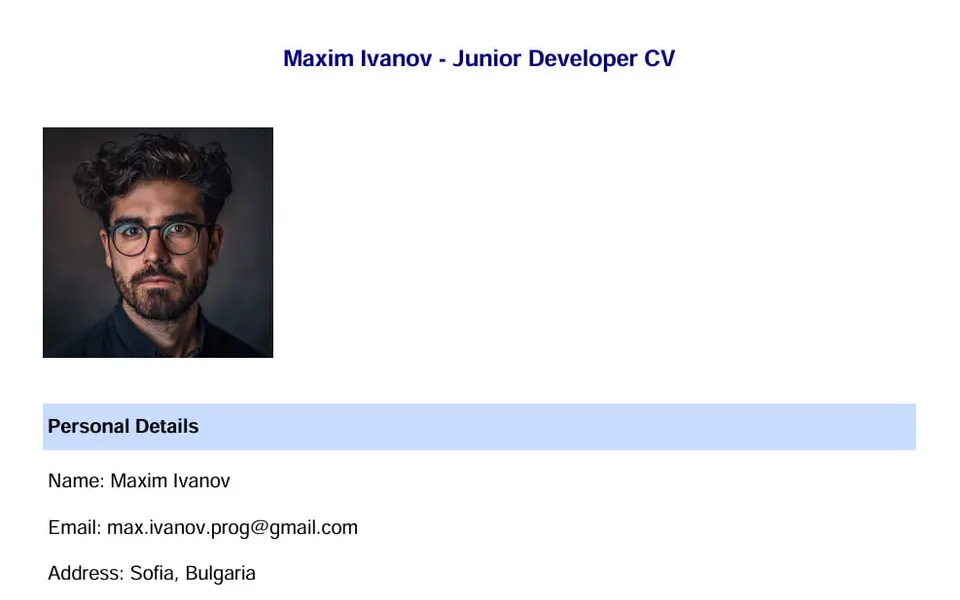
Can an algorithm find a job? I ran this experiment: Maksim Ivanov, a candidate created by ChatGPT, made it to two job interviews and got a few extra chances on top of that. The match is over, and it's time for the post-game analysis.
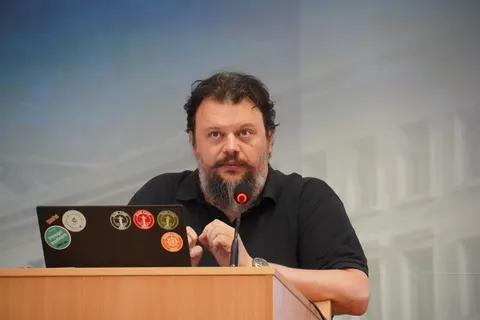
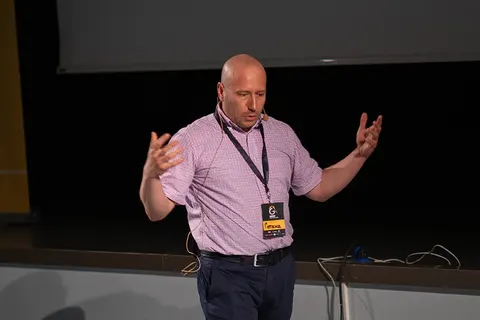
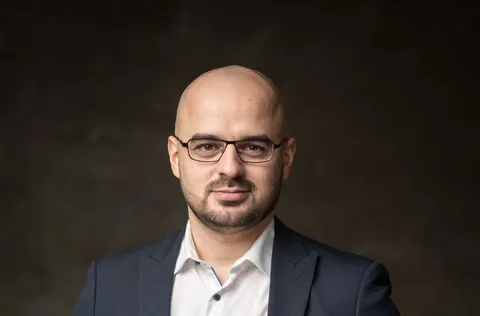
Petar Dzhuganski has worked as an assistant referee in more than 250 professional football matches, among them a Bulgarian Cup final and games involving Bayern, Villarreal and the Spanish national team… Today he is an “HR guy”—a human resources specialist, but also… the opposite. He hosts the podcast NeChoveshki Resursi (Inhuman Resources), which takes on all sorts of colorful topics related to work.
He leads the recruitment team at a large software company, and I tried to trick him by sending the generated CV to one of their job ads as well.
So what happened—did I fool him? And more importantly: what are the prospects today in the ever-tighter match between AI and humans? Is the software industry really no longer letting newcomers in? Have professions started to disappear because of artificial intelligence? Will Bulgaria become an attractive workplace for people from distant countries, and should that frighten us? You'll find out after the final whistle…
– We kick off from the center circle, and I have to confess: I'm offside. I didn't tell you in advance, but I invited you to this interview to discuss an experiment in which I generated a CV entirely with ChatGPT and sent it to 10 ads for junior positions in IT. I picked nine at random and only one on purpose, an ad from your company, to see how you would react. What do you think happened? Did the candidate with the fake CV get an interview?
– I'm 100 percent sure he didn't get an interview. Absolutely no chance.
– Correct answer. A colleague of yours wrote back on the very day the ad went live, asking me for a contact phone number. For obvious reasons, there was no number in the CV. I think that was a very sensible reaction, a way of checking whether the candidate Maksim Ivanov was real.
– Yes, I'm checking right now, and Maksim Ivanov is in the system as a promising candidate. Which is good feedback on the work of the colleague who replied to you. I've learned something nice.
– But in the end “Maksim Ivanov” did get two interviews elsewhere. Does that surprise you?
– Well, looking at the CV now that you've told me, it's obvious the photo is generated.
The CV isn't exactly a junior one. The guy has three years of experience and would certainly have been called for a pre-screening. I can see the notes in the system right now: my colleague has noted that he opened the email but didn't reply with his phone number.
– Do you think all this could go further at some point? That I might take this experiment further, someone might hire a fake person, and then ChatGPT would do his job? How far away is that kind of madness?
– In exactly that form, given the current state of the technology, it should be impossible. But there are all kinds of people and companies, so there's some probability. In quite a few places it has happened, especially with the spread of remote work over the last few years, that people work several jobs at once.
Mostly remotely, since you can't physically be in several places at the same time. In the US there were quite a few cases in which
an experienced programmer supposedly works remotely for several companies, but hires people in China or Eastern Europe to do his job while he takes it easy.
So examples like these, slightly different from the one you gave, happen all the time.

– Do you have stories like that? I do, for example. We go into an interview, the candidate has made it that far with a strong CV, he'd even set up a LinkedIn profile, a Bulgarian… and it all turns out to be fake. An Asian man shows up with a completely made-up story. I don't know what he was hoping for; he was googling everything.
– Exactly the same stories, the same thing happened to me at the previous company I worked for. Right now I'm in charge of all the hiring of software specialists, and we have about 200 open positions. We hire people from all over the world.
Quite often, when I interview people from the Far East, candidates show up who haven't the faintest idea about what they wrote in their CV. At one point it became something of a pandemic, so we started screening them in advance—with tests and tasks.
I'll give you an example. We generally work from the office, but every now and then a position comes up, most often for foreign candidates, that's remote. I post an ad for Europe and in less than 20 hours I get 240 applications. Insane, absolutely insane! I took the ad down immediately; going through 240 applications takes a huge amount of time, and the position isn't a simple one. Well, I went through them.
They say recruiters look at a CV for five seconds. That's a myth.
It only works if you can see from the very first line that the application is completely irrelevant to what you're looking for. Anything else takes at least half a minute: skimming the experience, seeing whether this person fits, whether you can move them on to the next stage.
Then I republished the ad, but this time I added lots of questions for the candidates to answer, restricted the location, introduced more criteria, and the CVs dropped to around 40. About 10 were relevant, I talked to seven or eight of them, and now I have two at the final interview. I hope we'll take at least one of them.
– Right now I'm far from Sofia, in a small village. A little while ago I went to the village center and met an Indian man, a Sikh in traditional clothes, who's helping with construction in the area. What do you think—will the labor market become more and more international?
– For now, globalization looks inevitable. It has been happening very actively over the last 30 to 50 years. Everywhere in the Western world, which we belong to as well, there's a labor shortage.
If we want our economies to keep developing well, to have growth, any growth at all, we're forced to bring in a lot of new workers. But that's a double-edged sword.
It won't always turn out to be a good long-term solution, and we have to be very smart as a people, as a state, about what we want to achieve in 20, 30 or 50 years.
This globalization is happening: many companies in Bulgaria are bringing in foreign workers right now. Last year about 27,000 permits were issued. These aren't IT specialists but people who mostly work in hotels, factories and construction. Our company's office is near Cherni Vrah Boulevard in Sofia, and there's a lot of building going on. When I stand on the terrace, I can see that many of the workers on the new buildings across the street were certainly not born in the Balkans. There will be people like that everywhere.

– And, as you said, I'm not at all sure this is happening by design rather than haphazardly. We started with football analogies, and I can picture us turning into Ludogorets, the Bulgarian champions built largely on foreign players: we invite foreigners, they do a very good job… until there's no room left for Bulgarians. If it's done by design, you find room for foreigners but you also develop your own “players.”
– Of course. We can also go back to the Olympics, where we won many medals, but a large share of those athletes were naturalized, and only in the last few months. It's not a problem that they're foreigners; if they were born here and are the product of our school, of our sports system, that's wonderful.
But when we take ready-made athletes from other countries who, for one reason or another, have fled from somewhere, to me that shouldn't give us quite so much cause for national pride and joy. Yes, it's good, we welcome the others, it's a plus that they fight for Bulgaria and win medals, but it's much better to raise our own athletes—whether they're Bulgarian or not.
– Absolutely. And if we talk about IT, what are our strengths right now? In my view we're no longer a cheap destination, but our mentality is very close to the European one. And, broadly speaking, we're still good specialists.
– Yes, you're completely right about that. The cultural differences between us and the countries of the Far East are big. We're far more European, even compared with countries just slightly to the east of us. That's a plus when working with Westerners.
As for pay, we're definitely not a cheap destination. Last year I took part in a mentoring program aimed at students from Pakistan, Bangladesh and Iran. The salaries programmers get there are really low; they work for $500–1,000.
The quality of some people there really isn't high, but others are at a very good level. When you add that these countries have much bigger populations, it's simply a matter of selection, of proper filtering and judgment, of finding the right people who'll do the job well for next to nothing.
In this competition, we really have to offer a product at a much higher level than just people working for low daily rates.
We can't compete with Mexico, India, Pakistan or Bangladesh, where the populations are much bigger and for $5,000, which is what an experienced programmer earns in Bulgaria, you can hire at least four people.

– In my experiment I got two interviews and one task, two companies wrote that they had found someone better, and only three didn't reply. I think there's now demand for junior positions, which I don't believe was the case a year ago. How does it look to you?
– There isn't a great deal of demand for junior people. Right now we have about eight mid-level QA positions to fill, with at least two or three years of experience. On the whole, it's hard for us to find the right people. There are CVs, there's no shortage of candidates, but screening them takes more time. Especially in professions like QA, where a lot of people have switched careers in recent years.
The interviews we run aren't overly complicated, but many people fail, and we need to hold four or five before we hire someone, whereas before it sometimes took one or two.
– But isn't the system scoring an own goal by not taking on enough junior people? Where will the seniors come from in two or three years at this rate?
– You're partly right. But… juniors still get in. Just not as many as before. If we look at the job ads, there are 114 on dev.bg. Well, that's not so few; there are actually many more than there were years ago.
There are also internships, many companies constantly launch academies, and some of the people who complete them stay on to work.
To be fair, let's also look at Jobs.bg, under IT, entry level / junior. There they also include other kinds of positions around IT, and there are about 500. So there are opportunities for junior people.
They can't always walk straight into the position they want, but it's not as if there are no opportunities. There are fewer than in 2021–2022, but that's due to the economic cycle, which is heading down right now.
– Do you think it's too late now for someone to switch to IT—to become a QA or a programmer?
– No, but it will be harder for them. Companies are definitely becoming much more demanding. I'd rather interview people who graduated from the Technical University of Sofia, from the Faculty of Mathematics and Informatics, or who are coming back from abroad with a technical degree, while those who have only completed an academy will end up somewhere further down the list.

– So I finished my academy just in time, in 2018…
– Yes, really just in time. You caught a much more favorable period.
– And yet… is it only about economic reasons? Do you think artificial intelligence has changed the labor market in any way? There was a lot of talk that it would do so abruptly, but it doesn't seem to be happening.
– I think exactly the same.
AI was used by some companies to scare their employees and justify the layoffs.
I also read a lot on the subject; I'm keenly interested. I use ChatGPT every day, I've tried all sorts of things and keep doing so. But I don't see how this thing is going to take my whole job.
I also use lots of automation tools that aren't AI, although lately everything gets packaged as artificial intelligence. They help me be much more productive and get many times more work done per unit of time.
But still, I have to set them up, go around and talk to people—to the managers, the bosses, the business—about what they want and how they want it. In human resources I also have to go and talk to people about whether they have any problems in the company.
A chatbot can't solve problems like that. It can answer some of the more trivial questions so people don't bother me about how to file their sick leave. But when it comes to getting their money from an insurer who won't pick up the phone, that's where I might step in. The same goes for the interview process. You could pass through automatically: the recruitment system could be built so that, say, you apply, the system evaluates the CV you sent and automatically sends back a reply. You pass the test, it's verified that you didn't use AI—and that does get caught. And then your whole profile comes back to me with a message: “Here, his CV meets the basic criteria and he passed the test. If you like, invite him to an interview.”
I don't believe this particular thing threatens my job right now. It's more that the economic cycle is what it is: the cheap money has run out. When there isn't enough fresh money, it doesn't circulate, the economy isn't doing well and you don't need so many people. And
you can always justify it by saying you've introduced some technology and that's why you're letting people go.
– Tech support was expected to be the first area where far fewer people would be needed. Has that happened?
– Not entirely. At our company we have a huge customer service department and advanced automation technologies, but people are still needed.
Many customers would rather not talk to chatbots at all.
Wherever they can, they look for a human voice, a human touch. They skip every possible option to talk to the chatbot. At certain companies that tried to remove the option of talking to a person, the effect on the user experience was very bad.

– We expected quite a few professions to disappear when GPT came along, and I made predictions like that myself. But, at least so far, not a single one has disappeared. New ones have even appeared, with the whole field of developing and working with artificial intelligence.
– And I don't think the tech support profession will disappear either. There will always be a need for people to serve a business's customers. There will be those who like dealing with real people, who want to talk to someone. It's like going to a shop to pick out clothes and having nobody to exchange a word with. Someone to tell you, “Hey, that looks good on you,” or “Wait, let me suggest something else.” A chatbot can do that too. But will you like it?
– Or will there be more people like me, who don't want comments like that? We see it in the supermarket today—there are plenty of self-checkouts, yet almost everyone still queues. Or with football referees, which is why we now have VAR… I'm joking; that's exactly an example of how hard it is to replace humans.
But do you think a new “sexy” field like IT might appear soon? Like it has been in Bulgaria for the last five or six years—a direction all kinds of people head in search of success? The jokes say it will be renovations, tiling, construction…
– We'll live and see, as they say further east. In my view, many people will keep pursuing careers in IT; that can't just die out.
AI won't take every engineer's job. It may limit opportunities for some people if they don't develop themselves.
But a programmer becoming a welder… I don't believe it. Those are just jokes. Of everyone who has taken up this comfortable work—spending all day in a pleasant office or at home—few will go back to physical labor in the fields or on building sites.
There are lots of jokes about tilers practically earning more than programmers… That work is hard. You're on your feet all day, breathing in adhesives, carrying heavy loads… very few people will decide to do something like that. Others, I think, will make a slight career change. That happened in the US last year and the year before, when there were big layoffs. Almost 700,000 people lost their jobs in eight or nine months.
And they all quickly found new ones! Some of them weren't exactly at IT companies, but they worked for companies that need IT services.
So
as long as the economy hasn't completely ground to a halt, people with an IT specialist's skills will be able to find work.
– I think so too, especially if they don't stop developing. Because things change fast. Say, right now a programmer who has learned to use AI is much more effective than one who hasn't. So what's worth learning now?
– It will always be worth developing our soft skills. However good we are technically at what we do, communicating with people, being able to present our ideas and thoughts well, persuading others that what we want to do is right—that's priceless. Even if you're a wonderful programmer who can do a lot, if I'm your client and you can't sell me the idea that my website should look a certain way, it doesn't matter how good you are. If someone comes along with better promotional skills than yours and manages to charm me into believing his work will be better and do more for me, as a client I'll choose him.
In Bulgaria, one of the things where we limp isn't the technical and engineering side but sales and marketing. I think that's where we're weak. That's changing, of course, but I still maintain that it's easier to find a good programmer than a sales specialist. I stand by those words 100 percent.
– And yet… let's see how the match ends. Bulgarians versus foreigners, algorithms versus people… I'd be happy to continue on neutral ground. Thank you!