Can ChatGPT manage to… land a job? Or at least make it to an interview, perhaps the hardest step when it comes to your first job?
We won't indulge in idle speculation; instead, the way many Digital Stories are born, we'll test it in practice. I'll ask the algorithm to write, all by itself, the résumé of a young programmer looking for work. Then I'll send the CV it creates in response to 10 job ads for beginner programmers.
What will the result be? Will the recruiters invite him to an interview? Will they grow suspicious of the generated CV of this young but highly motivated IT hopeful? Or will they simply ignore him? Let's find out together.
And one more important thing: the results, for me at least, gave me some pretty good ideas about how ChatGPT could help me the next time I need to look for a new job. There are definitely more than a few directions. Here's what it's all about.

No One to Hire
These days it's quite hard to find your first job in IT, demand is lower, the requirements are sky-high, they never call you for an interview… Is that really so? We're about to see
August, as you know, is the afternoon of the year, and also the afternoon of the job hunt. Unlike Maksim Ivanov, though, I have plenty of work, and now I have the chance for this instructive experiment.
Who's Max, you ask? Ask ChatGPT. That, at least, is exactly what I did. I asked it to invent the identity of a young IT specialist looking for work, and to suggest a suitable available email address while it was at it.
The algorithm's very first idea is the Maksim Ivanov in question. Interestingly, he even has a university degree in the field, contrary to the opposite extreme view that it's easier to find a job these days if you've chosen a coding academy (the topic is long and far from today's meeting, but my own experience is from the “other” side).
Maksim holds a degree in Computer Science from Sofia University, as of June 2023, no less. What has he been doing for a whole year—clearly it hasn't been easy for him to find a job? Either way, ChatGPT immediately suggests a suitable email address too, which, by chance or not, actually turns out to be available: [email protected].
Working on Max
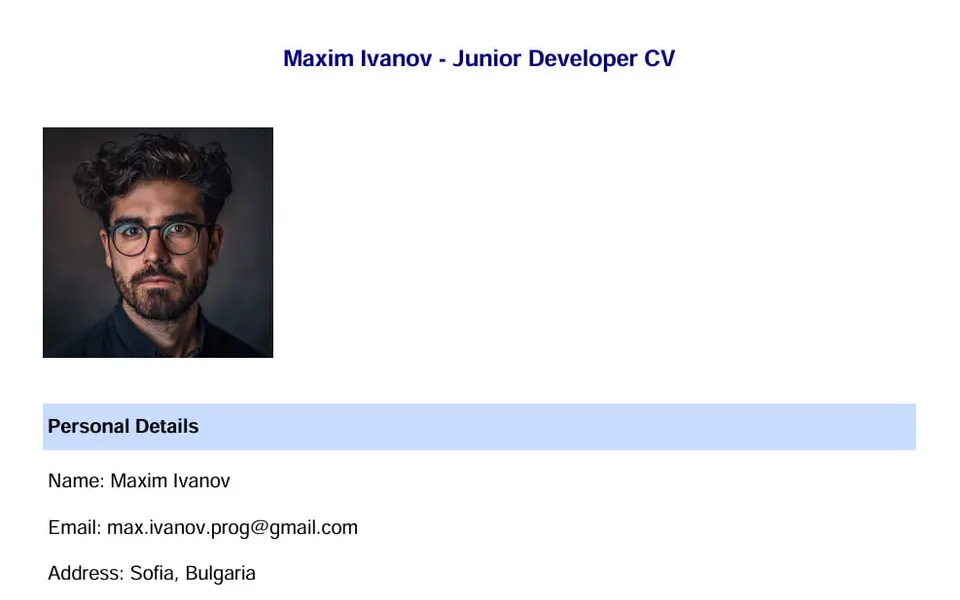
What is Max missing? A photo—how else will he look convincing… Here I allow myself to step in: I let the most popular chatbot write a description, then hand the task over to MidJourney. In the world of today's AI models, it's important to know who would handle what best, and photorealism is definitely not the superstar's strong suit. Soon, though, we have a perfectly real Maksim Ivanov:

I feed the photo back to ChatGPT…
Apparently it won't work on the first try.
This is an important experiment, so a clarification is in order. Whereas, for example, in the creation of EcoElena (who will be back soon!) there was no intervention whatsoever on my part, here some changes are clearly needed. The CV the algorithm gives me has a few obvious mistakes that would keep Max from performing at his max. And we do want our young specialist to find a job, don't we?
First, ChatGPT slightly botches the design, placing one of the dividing lines right across the young man's face. Well, it's not as if I haven't seen even messier CVs, but still, I ask for a little readjustment. I also ask for the phone number to be replaced with mine… then it occurs to me that it's rather ugly to pretend to be someone I'm not, and it seems unjustifiably complicated to look for a way to have the algorithm make the calls itself, so I ask the résumé writer to simply remove the contact phone. I realize that this lowers Maksim's chances of landing a job, but…
I allow myself one more change. His only workplace, as invented by the generator, is a company called Random. That strikes me as a bit too obvious, so I ask ChatGPT to change the name to something else. And so Max's work experience to date turns out to be at Tech Solutions Ltd. Not that such a company exists either, but it sounds convincing.
And that's it—three tiny interventions; everything else is the algorithm's work.
Here's the main version of the résumé—you can take a look at it here.
Time to take on the harder task. Let's find a job for Maksim, the rookie programmer!
No Work Here, Work Over There
But what if… they hire him? What if he somehow gets through the interview and goes further? What if it turns out he can even do the job? Is it really as impossible as we might like it to be?
A lot of questions keep spinning in my head. Including how important it is to be careful when hiring in our software industry, because so much depends on our work…
One example of why came from Miglen Evlogiev, who is in charge of cybersecurity at Payhawk, the first Bulgarian unicorn, in his recent talk at the DEV.BG All in One event. A huge share of online security breaches come precisely from people. People who, by chance or not, ended up in critical positions and decided to show off their access, or who were quite deliberately driven to prove they could bring everything down… Or who ended up in a given company not by chance at all, say, with the help of a direct market rival or a hostile state…
I have that kind of experience too. My colleagues and I go into a job interview; the person on the other side has a brilliant CV, supposedly a Bulgarian with extensive experience in England. I look him up on LinkedIn too, and his profile and connections are remarkable… when the camera on the other end shows a man visibly from distant Asia, who very unconvincingly tries to tell us he's Bulgarian on his father's side and ready for the job.
Never Mind, I'm at Work
Nothing of the sort could happen with our Max. For one thing, he's a good kid; for another, as always, my goal is simply a journalistic experiment. Not to lie or manipulate, but to give food for thought about how far technology has come… or, conversely, how much we've overestimated it.
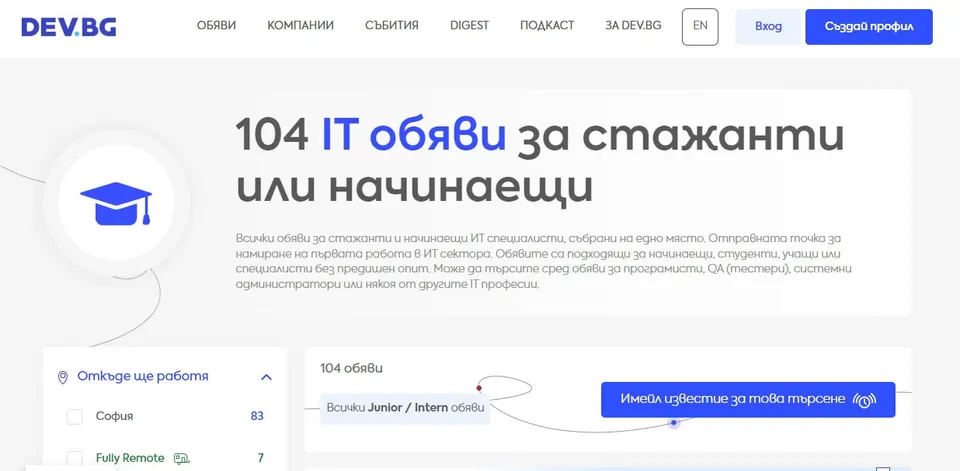
Our hero isn't picky. He picks the first 9 random ads for entry-level specialists, regardless of the specific technology, in the section of my friends at DEV.BG's job listings that is handy for just this purpose. The tenth ad I choose personally—why I make this exception, I'll tell you before we part.
The technologies vary: some ads are for front-end, others for back-end development, still others simply explain that they're looking for enthusiastic future programmers. There are big, world-famous companies and smaller ones; the random selection turns out to be colorful and representative.
For each of the ads, I ask ChatGPT to tweak the résumé slightly as it sees fit. The differences aren't that big, but they're there: here and there, some additional technologies that Max knows have been added; in others, right in the introduction, the young man mentions that he'd be glad to become part of that particular company. All in all, ChatGPT does a wonderful job of creating and “touching up” a CV.
Since I've often had to review documents like these at work, I can tell you with conviction that what it produced is considerably better than most résumés I've seen in terms of readability, design, layout and summary. Maybe artificial intelligence will turn out to be a useful assistant the next time you're looking for a job? Not to make up information, of course, but to help you better present what you can do and what you've done.
Gray CVs
Another important clarification. I won't show you the 10 different versions, because I don't intend to reveal which 10 companies happened to end up in the experiment—that seems unethical to me.
I pick an August Thursday to start, and we'll see what happens over the next three weeks. I send off the CVs… What will the results be?
While I wait, I take the opportunity to discuss the topic with Max's “dad” (would his patronymic be Chatgeepeeteeyev?). I ask which of the 10 companies on his list seems most promising, and he dives into reading online and puts together a rather detailed table. I can choose which technologies Max should favor, and what the pros and cons of each potential workplace are. Here's yet another use of the algorithm in the job hunt that could prove useful.
“If you love working with high tech and want a stable and prestigious position, X may be a suitable choice. If you want to work in an international team and deal with networks, Y may be a better option. If you prefer the fintech industry and working with large transactions, Z is an excellent choice,” says Mr. Chat. “If you're undecided, it's best to think about which technologies and industries attract you most and what matters to you in the long run,” he adds, and I can't help but agree with his conclusions.
Work Will Make Us Free
Day two… I already have two emails—exciting! Ah, quite interesting. Hours after I've sent the applications, recruiters get involved. Both first emails, though in different fields—one looking for a young QA specialist (supposedly the hardest kind to place) and the other for a programmer in robotics—say they're interested in Maksim and would be glad to hear from him by phone to talk a little about him.
So the “filter” worked in this case! Given such a reaction, I decide not to go any further: as I mentioned, from here on we'd be heading toward an outright lie, which is definitely not my aim.
The days go by, and lo and behold, two invitations arrive, proposing a day and time to schedule an interview! Maksim has reached the most important step!
Now that is an undeniable success. Surely no one would waste their time, especially given the number of applications, conducting interviews unless they saw potential in the candidate. One could say that Max would probably be one (or more) interviews away from his dream first job as a programmer!
Somewhere around here, in my view, the experiment becomes a success. So it really is a myth that a beginner programmer can't find a job these days—in just a few days, the interest is impressive! In 20 percent of the attempts, he made it to an interview!
With only one of the responses do I decide to try the next step. As the next stage of the selection process, they invite Max to fill out an English test and solve a few programming tasks online. I'll try letting ChatGPT take the test, simply copying its answers. The main difficulty turns out to be that the app requires the camera to be on so it can monitor who's taking the test. I turn it on against strong backlighting, and it seems to pass. I just stand in the middle, between the tasks and the algorithm…

Clean Young Programmers
The position is for a .NET developer. As a programmer, I know C#, the language the test requires, fairly well, but of course I don't step in to help “Max.” Still, it's clear enough to me that he solves the test practically without a mistake, and in a fraction of the time he's been given.
Alas, either suspicion of exactly that, or my cheap trick with the camera, proves fatal to the performance of our imaginary programmer, who two days later receives an email saying another candidate has been chosen for the position.
The last response comes a full 3 weeks after the application was sent—I assume Max was “in the game,” and it simply turned out there were stronger candidates.
Two more companies reply directly that they've reviewed the application but have either hired someone else or weren't satisfied with Max's CV. This makes a very good impression on me; the culture in this respect is clearly improving—I've often received no feedback at all when applying for a job and reaching a certain stage.

Maximum
Time to take stock. From 10 CVs sent, Max got 2 interviews and 1 assignment as the first step in the hiring process. Two responses asked for his phone number, and if he were human, he would definitely have had a chance to move forward. Another two were rejections. It doesn't surprise me that not a single response said outright that something was off, that the CV or the photo was generated. Only 3 of the companies didn't reply at all.
Still think there's no demand for young specialists in IT? Ask Max…
It remains for me to tell you why I personally chose one of the ads: it was sent to the company Sofia Stars, because I know the head of its recruiting team well. Petar Dzhuganski himself will be our guest in one of the upcoming Digital Stories, to talk about the experiment as well as the future of the job market and of professions.
And the results of the experiment give me, at least, even more food for thought. Not only about the professions AI will change, but also about the way we practice them and the way we find jobs. Is the moment when Max could go further really that far off? Be convincing in a real interview, then… land a job. Do his tasks while I just pocket his salary… Or will he take mine?
One thing is certain. It's time to stop looking at artificial intelligence through clichés and templates and to open our eyes. Because now is the moment for interesting ideas, for unconventional solutions. For getting to know and further developing the new, unexpected assistant we have.
And what do you think about the possibilities of artificial intelligence? Your opinion matters, and I'll be sincerely grateful if you fill out the survey here.
The experiment was carried out based on an idea by Kristina Vlaeva.
If you have interesting ideas that could become the next Digital Stories, suggest them here. A modest reward awaits you!