One day you are an established host on national radio, interviewing politicians, the powerful of the day, favorite guests from any field you could wish for, and the next… you decide to look for a new path and become a teacher of first graders in Fakulteta.
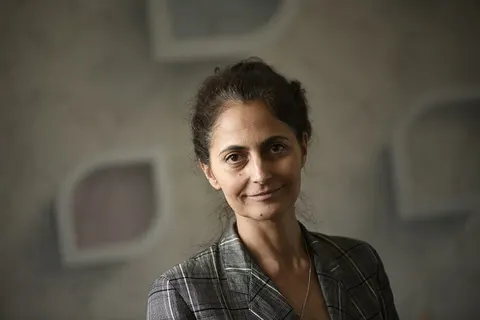
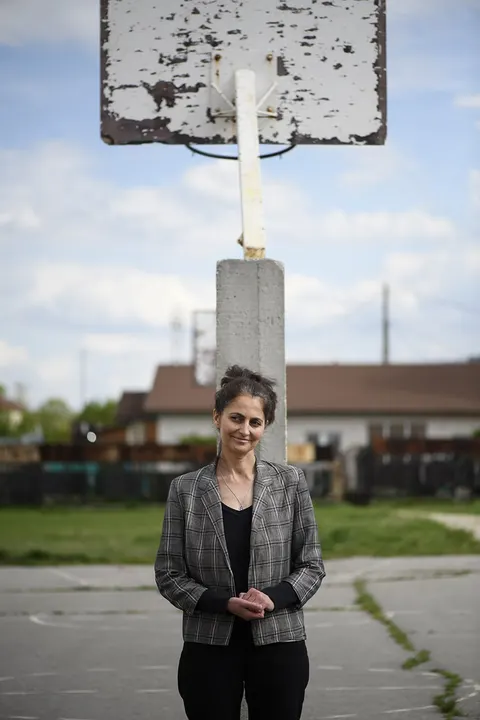
Tanya Velichkova's voice is familiar to every regular listener of Bulgarian National Radio (BNR). For many years she hosted shows like Predi vsichki (Before Everyone) and Nedelya 150 (Sunday 150), and she became deputy editor-in-chief of Horizont, BNR's flagship channel. Then she decided it was time for something different and set about learning herself so that she could teach children. And not just anywhere, but in Sofia's Roma neighborhood.
A few years ago I was her guest at BNR on May 24—the day Bulgaria celebrates the Cyrillic alphabet, education and culture—to talk about the Bulgarian Cyrillic script. Now I believe she is the guest who embodies today, the most beautiful of Bulgarian holidays.
Few people in our lives stay in our memory the way those who taught us our letters in the first grades do. Who taught us to love the written word.
What is it like to find yourself in that role in such an unusual setting? And what might a seasoned journalist turned teacher dream about?
– It isn't easy for someone settled into a routine to suddenly abandon what they have done for so long, with success and recognition at that, and set off on a new path. How did the idea of a professional transformation come to you?
– The need to change careers had been ripening for a while, because in journalism I had reached a stage, both professionally and in terms of my administrative position, where I felt drained. I had the feeling I wasn't growing, that I was no longer useful.
Twenty-five years of following political events left me with the feeling that we were going around in a circle
that didn't lead to any real change. I decided it would be good for me to change my point of view, and to change my professional position as well. I started looking for something in which I could find meaning to keep growing.
– How exactly did you end up in teaching?
– I had no idea I would become a teacher; I was rather looking for what that thing might be that would capture my attention as strongly as journalism had before. Of course, it wasn't an easy decision to make—after all, I had a 25-year career behind me and a firm position at the radio. At that moment I was deputy editor-in-chief of Horizont, and I had the prospect of climbing higher, if the hierarchy counts as any kind of career in journalism.
But that didn't satisfy me, and it wasn't what I was looking for.
I started browsing job ads and came across one from Teach For Bulgaria. It let me apply with my qualifications, since I only had a journalism degree. In other words, I didn't have many chances of finding interesting work outside journalism. But Teach For Bulgaria gives people from different professional fields the opportunity to enter teaching. While practicing in the classroom, they complete the relevant teaching degree, so that they are qualified to teach afterward.
So an opportunity appeared not only to start a change in my life, but also to take quite a big leap in my development. Because at my age—I was 48 then—starting a whole new career is a huge challenge. In fact, what really drew me in, besides the chance to apply, was Teach For Bulgaria's wonderful cause, and the fact that I would feel useful in a place where not everyone dares to go.
– Your choice of school is quite bold. I know Teach For Bulgaria aims to reach everyone, but this is definitely an abrupt transition.
– The choice of school was predetermined in a way. Teach For Bulgaria works with a network of partner schools that need new, motivated teachers. By the time I had to choose where to go, there were two options. At first I applied to Gorna Malina, a village outside Sofia, because I wanted to get away from the noise of the city; I thought I would feel good there. But a class never came together there, and the only option left was School No. 75 in Fakulteta.
At first I was a little taken aback, because I had never been to the neighborhood and felt like an outsider. I sensed I was entering a community unknown to me, and I worried that I didn't understand the situation. But very soon, once I met my colleagues and went to the school, I realized I had no reason to worry. They welcomed us new teachers very warmly, gave us a chance to get to know the environment and helped us feel at home.
So my worry melted away quickly. These three years have been very dynamic—two with Teach For Bulgaria, and the third in which, now as an alumna of the program, I continue working at this school. I didn't have much time to think about how I felt or what worried me, because my work is practically around the clock. And I'm grateful it turned out this way, because I believe this was the best school I could have ended up in.
– Do you miss journalism?
– I wouldn't say so, because
teaching is a very rich profession, a very emotional one. You learn a great deal in it.
I'm still at the stage where I'm hungry to learn everything about this profession. Learning something new and growing in a new field fires me up and recharges me. So I don't feel the absence of something I've left behind. Besides,
journalism always stays with you; it isn't something anyone can take away from you.
I'm still tied to it through certain skills, contacts and knowledge that I can use in my work with the students.
And my colleagues from the radio never let me feel nostalgic for a moment; they're always asking what's happening at the school and actively covering various initiatives. So I don't feel like someone who has broken with the radio.
– Which skills from journalism have turned out to be useful?
– Many. In the classroom we communicate constantly. And what journalism teaches—how to lead a conversation, how to deepen it, how to draw the most valuable meaning out of the topic you're discussing—matters in the classroom. It helped me a lot at the beginning, and I still consider it very important, that
journalism lets you see a very wide picture, take an interest
in the flow of news and find your way through it. That's a really big exclamation mark: finding your way through information.
In the neighborhood, especially for the younger generation, the big challenge isn't getting hold of information, it's not drowning in it. Dealing with fake news, knowing how to sift, how to judge which part of what floods them is truly valuable and important. We journalists know better than anyone how to tell fake news from real news, and the risks involved in working with information.
My students are still too young for me to teach them how to spot fake news, but as far as I can, at every moment I try to teach them how to navigate the ocean of information.
Journalism always gives you a very wide horizon; it never stays locked up in some box,
and widening my students' horizons has been my focus from the very first moment I set foot in the school. Because I saw that the children in my care need to see the whole colorful variety of the world and to learn to be curious. To think beyond the clichés their environment imposes.
– How old are your students?
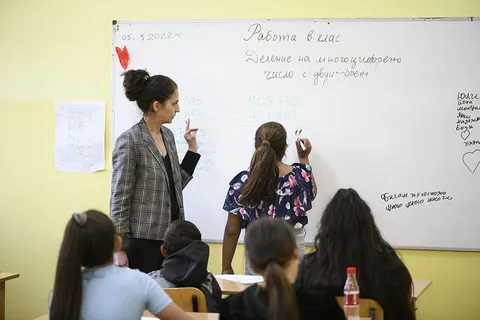
– In my first year I had a third-grade class, I took them through fourth grade, and now they're in middle school with other teachers. And I started over with a first grade.
– How big are the classes?
– My previous class had 21 kids, and the number didn't change much. Now, in first grade, there are 24 children on the register, but far fewer actually come, for various reasons. The long stretches of remote learning—sometimes in the classroom, sometimes out of it—had a terrible effect. It kept a close-knit class from forming, because quite a few of the children can't study remotely. Others were afraid of the testing at school when we returned in person. So half the class is a kind of steady core, and the other half, unfortunately, I lose for long periods of the school year.
– How do the children surprise you?
– With their emotionality. Whatever happens, they're always incredibly positive, very excited about the things we do. They're amazingly open and sincere in their relationships. One of the things that struck me at the beginning was
how much emotion and how much love there is in this profession.
Maybe I had forgotten what it's like to show your feelings the way a child does. After so many years working with grown-ups, working with children made a big impression on me. So emotion is always the brightest thing in my relationship with them. And yes, children are always bursting with creativity; they always have something to invent.
– As someone who has tried both, what do you think: who is harder to win over—a child, to get them to learn, or a prime minister in the studio, to get them to speak honestly?
– Oh, that's a very hard question. But when it comes to honesty, the prime minister is definitely harder.
– Do you believe these children will manage to break out of the cliché? That they'll grow, that they'll study?
– I believe they have tremendous potential, that they want to grow and achieve great things. I also believe many of them will manage to do it. But I also know there are circumstances beyond their control that can trip them up. Still, they're fighters, and the teacher's role is to show them the possibilities, to show them how they can develop their full potential.
They need you to believe in them, and one of the most dangerous things at school is crushing a child's drive,
crushing their belief that anything is possible, because then they stop making an effort.
– That surely happens quite often. Do you think the integration model would be more successful if Roma children were spread out among other schools, rather than the way it is with you?
– Segregation is certainly not a good thing. But everything is connected to the way society functions. Where we are,
in Fakulteta, there is a world completely different from that of the capital, Sofia.
It's a neighborhood that's actually in a fairly central location, yet the state has allowed it to have an entirely Roma population, illegal buildings, poor sewerage and no infrastructure.
We can't expect children from the surrounding neighborhoods to come to our school when there are no roads and a whole host of other things are missing. Otherwise, in terms of the level of education and the training of the teachers, I can safely say we are on a par with all the other schools in the capital.
– It's rather ironic that this is the only neighborhood in Sofia with an academic name—Fakulteta means “the Faculty.”
Which subjects do your students do best in?
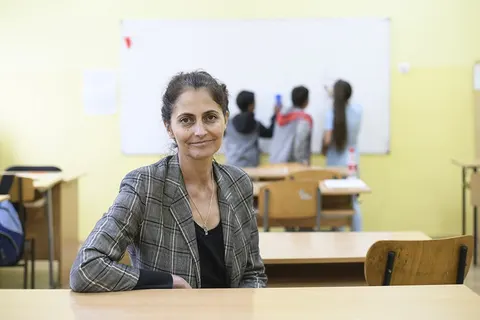
– Math has traditionally been strong for them. Bulgarian is a challenge because their first mother tongue is Romani. Bulgarian should be taught with the fact in mind that these are bilingual children. We try to do that, but it isn't so easy, because we follow the general curriculum. We try to adapt the material in the textbooks when necessary, or use additional resources. Thank God, Teach For Bulgaria and EduArt have developed a primer for bilingual children, and the options in this area are growing.
Our children are also incredibly talented in music. There are amazing sports talents, but unfortunately many of them never fully blossom, again because of financial or other limitations. But just as in every school, different children are interested in different subjects. A lot also depends on how much the teacher “lights a fire” in them in one area or another.
– I find it very strange that no one sees the potential and the hidden resource. You say math is a strength of these children. With the shortage of IT specialists, why hasn't any company thought of investing in education there, which would then pay off many times over?
– I don't know, maybe the reason is the higher level of illiteracy. Someone simply needs to develop it as a serious project and take it on. Because people tell themselves: “They're illiterate over there, they're hardly going to do programming.” Most people find it hard to imagine Roma outside the traditional sectors we're used to seeing them in.
– Are there texts in the Bulgarian curriculum that make an impression on your students?
– They really like the poems. I teach young students, so I can't speak about the literature textbooks and the more serious works.
Amalipe, a Roma rights organization, runs very good courses for all teachers who work with Roma children. They've developed teaching materials with tales from Roma folklore and by Roma authors. I think it's very important for our children to have access at school to their own culture, to authentic, beautiful examples of it.
It's wonderful that at our school we have colleagues from the community, and I learn a lot from them. Some are even from families of teachers going back generations; teaching runs in their blood. And I see what magic happens when a teacher from their own culture, from their own community, stands in front of Roma children.
– What proportion of the teachers at your school are Roma?
– We have about 60 teaching staff; about ten of them are Roma, and a few of those are still teaching assistants. We also have two mediators, who are football coaches, but mainly they help us stay in touch with the parents.
Unlike at other schools, part of our job is visiting our children at home. Sometimes we can't manage it, so the mediators do it for us, or we go together when needed.
The law requires it, and that's one of the things that really needs to change if schools like ours are to be more successful.
Every month we report the children's absences, and if a child has more than 5 unexcused absences, their child benefits are stopped for a year. If a child is absent from school for a long time, we report that the child is at risk. Unfortunately, though, we don't know what happens further down the chain; we have no information about how the other services act or what becomes of that child.
The point is that much of our work as homeroom teachers is more that of social workers than of teachers. We spend a good part of our time going from home to home and filling out reports. If we had stronger support in this respect, teachers would have more time for actual teaching.
– What arguments manage to persuade parents to send their children to school? Are financial ones the main ones?
– It varies from parent to parent. For some it really matters that their child benefits will be stopped, but the mechanism isn't well designed and doesn't work effectively enough. Right now the benefits are stopped for a full school year, and very often parents reconsider and the child starts coming to school. But the benefits aren't restored, and that puts them off again.
Other parents are motivated by the idea that it's for their children's good to grow and develop. But for some of them it's hard to keep track of how regularly the children attend. Most of the working parents leave very early in the morning, at 4 or 5 a.m., because they work in street cleaning. The child has to wake up alone and come to school, which is hard for such young children. Sometimes absence from school also comes down to the fact that parents aren't always able to keep things under control.
My impression is that on the whole
education is a value in this community. I don't have a single parent who says: “I don't want my child to study.”
They all say: “Let my child learn to read and write, that's important for them, to be literate.” Because many of the parents are themselves illiterate and see how it holds them back. Alas, in many cases this value remains just words, and the children don't come to school.
– Do you think politicians should visit neighborhoods like this more often, and not only before elections?
– They should, but only if they come ready to listen, with their eyes and minds open to what they'll be told. When decisions are made specifically about education, it's good to hear from the principals and teachers who work in schools like ours. Yes, when rules are made, the whole national picture is considered, and we're a tiny fraction of all schools. But we need to be heard, and our experience needs to be taken into account when legislation is drafted.
And beyond that,
the reality in these neighborhoods needs to be seen, because it isn't known.
Unfortunately, when politicians come, they come with their entourage, they come with their minds made up, and they usually leave with what they already knew before they came. If they came incognito, without trumpeting their visit, if they really wanted to see and hear, they would discover a picture that is hard to see in the media.
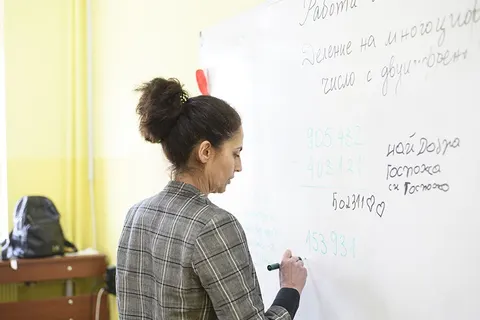
– What does that picture look like?
– It's colorful, not clichéd. What we see in the media is a stereotype. Reports from Roma neighborhoods are so alike that it doesn't matter what year they were filmed, for which election campaign or about which perennial problem.
To see that picture, you have to drop the stereotypes and be able to look an individual person in the face. To see the individual human story, not the prejudices about an entire ethnic group. There are rich people and very poor people; there are families coping with tremendous challenges and performing miracles of courage to care for their children. There are also families who take advantage of certain situations to get by more easily. There's every kind of thing, but these people's lives are very hard. You have to turn to them with your heart to understand what they go through.
– What do you dream of?
– I dream of seeing my students succeed in life. I don't know if it will be possible, but I hope that in 10 or 15 years I'll be able to find out what became of them and see that they've grown into happy, fulfilled people who have realized their potential.
It's no accident that I keep using that word. They truly have tremendous potential, and what I would like is for every one of the children I work with to unfold their own.