“The Superhuman” is a household name on the Bulgarian web. It is the podcast that got ahead of the trend, offering deep, enriching conversations united by the search for inner fulfillment. Long, meaningful audio and video interviews from which every guest stands to gain.
Georgi Nenov’s project is an oasis free of politics, propaganda, hate and division… so much so that it is hard to believe something this meaningful can thrive in our part of the world, and for so long and so successfully at that. In-depth.
But how did Georgi’s seemingly accidental path to “The Superhuman” begin? What gives him the strength to keep finding new superhumans, so that they can inspire still more people to take a different path?
What is the power of a good example and of “the little seed of positive doubt”?
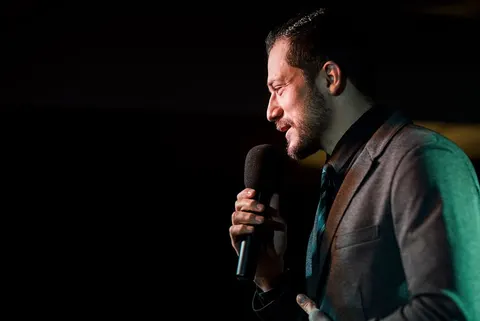
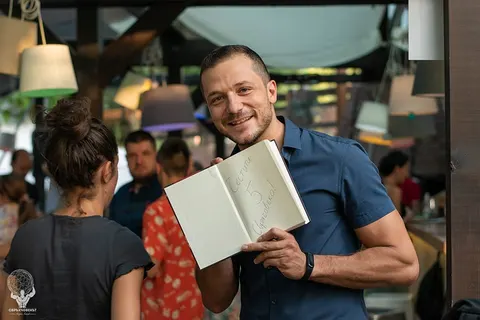
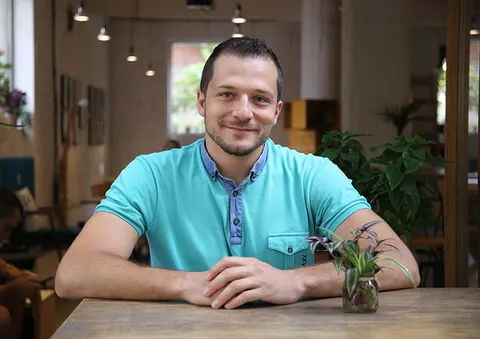
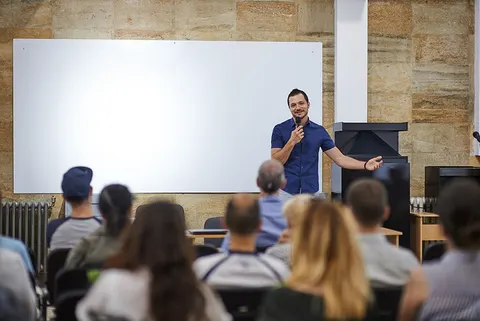
We meet Georgi Nenov, who is just as thoughtful in conversation from the “other side” of the interview.
– The path of Digital Stories began when I stumbled onto a course at SoftUni. I read that the story of “The Superhuman” is also somehow rooted in a similar moment…
– That’s true. I finished the free programming courses at SoftUni, the Software University, one of Bulgaria’s largest coding schools, with a top score, and I could have gone into that profession, because I’m good at math, logical thinking and problem solving. But then I decided I wanted to work with people, and that’s when the idea for “The Superhuman” came to me.
I went to an event where we had to tell strangers what we dreamed of. And I told them: I dream of helping people live better, be happier. That question came back to me with great force and asked me—
what helped me? A podcast. Well, there are no podcasts in Bulgaria, so why don’t I make one…
– Which podcast influenced you like that?
– Addicted2Success. I even have a playlist of my favorite episodes here. They’re a bit old, but just as valuable.
– And then a random idea turned into a years-long collection of stories told in depth…
– I called Rado, a friend of mine who produces music and knows audio editing, to ask his advice on how to do it. I had a tablet I’d won by chance. It became the first device we recorded with. But it was June, and I told myself: fine, I’ll go on vacation and think about it afterward.
On vacation I took a book with me, Stephen Covey’s The 7 Habits of Highly Effective People, and Habit 4 spoke to me. “Always think win-win.” I decided that, at least by my values, this is the perfect foundation for any business. To think about how to make something a win for all sides. For me the word “profit” was never at the core; it was more: is it valuable, does it help, does it bring value? And I decided: okay, I have to test this idea.
– Who were your first guests?
– I went to Lazar Radkov from Caps for the Future, a charity that collects plastic bottle caps to buy incubators for hospitals, and told him: “You’ve helped me a lot, now I want to do this project and I want you to be my first guest.” I went to his place, we sat at the table in the living room and recorded the pilot episode. In just a few days it had 700 listens. I listened to it too, and there were things I didn’t like, and my fiancée told me: “Your diction is appalling.” But I told myself: okay, there’s something here, and there’s room to build on it.
I recorded the second episode in Geo Milev Park with Dani from Iris, which makes software to protect your eyes. Because I was part of SoftUni, I was interested in programmers, so the third was Nakov. After the outdoor recording I had a lot of sound problems, and when I released the episode with Nakov, I noticed how badly an empty room can echo.
After the third episode I realized I really liked doing this, and I saw it had racked up 3,500 listens in about a month. All I had was the Facebook page, SoundCloud, a tablet and Rado the volunteer. That’s when I told myself there was something here and it was worth carrying on. I invited all my Facebook friends to the page, invested 100 euros in a SoundCloud account and decided I would keep recording.
At the time, at the end of 2016, I was working for Lufthansa Technik; I could leave work to record and then make up the missed hours. The feedback poured in, people wrote to me that the idea was really cool. People who had no chance to talk to Lazar or to Nakov could hear them. I started preparing questions and planning how there would be a new episode every Tuesday throughout 2017.

– Then, as far as I know, you moved abroad… How come, when you had just found the thing that gave you fulfillment?
– Yes, back then I went to an interview, they accepted me and invited me to start work in March at the company’s headquarters in Hamburg. I could come home on weekends, and in my head it kept ringing: “How cool will it be if I pull this off!” If someone tells me they have no time to develop their project, I’ll always be able to answer: “I developed mine from Germany; if you don’t have time from Sofia… that’s an excuse.”
Some people told me: “You say Bulgaria is so cool, you showcase great people, and yet you’re running away.” But I knew I wasn’t running away—I was taking a run-up, and those are different things. My plan wasn’t to stay; it was to go and see whether I could handle it.
The man who invited me there was very kind and super supportive, but a few months later he was promoted and went to work in Frankfurt. They assigned me another manager, and that made me rethink how long I wanted to stay. At the beginning of 2018 I handed in my notice. I decided it was time to go “all-in” on “The Superhuman.”
– Which brings us to today, when “The Superhuman” is one of the most recognizable Bulgarian podcasts. What was the decisive step, when did the venture become a professional, well-thought-out project?
– I came back to Bulgaria, and the podcast kept going. In parallel, Lazar and I started a second business, which was trying to help me while I figured out a way to monetize. Since I have no experience and monetization isn’t at the heart of the project for me, I thought it would come in its own time, and I turned out to be right. The Patreon page I created started with one person, then a second, a third… And the more people explained to me that in Bulgaria nobody pays for free content, the more convinced I became that this exists only in people’s minds. The truth is that
there are people who value and respect quality content and want to contribute to it through their support.
The other venture also worked out well, and more opportunities opened up. I had reached 158 episodes when the first real advertiser came along. In 2019 Telus International Europe showed up and said: “We’re not interested in the content, we don’t want to interfere, we just want to support you.” For me it was “wow”—I was still using my tablet. I started thinking: if they want to support me, then there are other companies too. After that Storytel came along, and their product turned out to be a perfect match for my content and audience.
The patrons kept growing in number, and when 2020 began, I felt like king of the world. Everything fell into place with a kind of super calm. I was living the life of my dreams, which was also the slogan of “The Superhuman.” And doing it freely, doing the things I want, meeting great people, creating meaningful, quality content that helps people believe that they can do it too.
That has always been the idea of the podcast: to inspire people that if Vasil Terziev, co-founder of Telerik, Dr. Kalin Vasilev, creator of TarnovoRuns, or
anyone else has done it, they can do it too. That’s all I’m fighting for.
I just have to plant a little seed of positive doubt. And when it sprouts, people say to themselves: “Why shouldn’t I be able to?”
– How do you manage to stay consistent for so long?
– People ask me exactly that a lot. Episodes don’t pile up in a day, but week after week, step by step. I’m not consistent; I just do the thing I love. For me it’s like breathing.
Right now the podcast is sustained by support. A lot of volunteers have come together and made it possible for me to build the website and put the show on video. Without the volunteers, without the patrons and without the partnerships with companies, the podcast could never have reached so many people. And it will reach more and more—on YouTube the audience is only just starting to grow.
People are looking for better content; they’re fed up with cat videos and entertainment.
– Won’t you run out of interesting people to invite?
– If I asked you who inspires you, how many people would you think of? It’s like a pyramid: it starts with one, then two more come, then four. Inspiration works the same way. You go to one person, they tell you about two more… If I got stuck for guests and sent a message to the 280 “superhumans” who have already been on the show asking for just one recommendation each, I’d have content for another five and a half years. They’ll never run out. Young people come too, who have listened to the podcast, been inspired by it and taken some important steps, and to me that’s amazing.
– Tell me one of those stories…
– For example, Boris Madolev lost over 40 kilograms and started his own fitness business after an episode I recorded with Nikola Tomov from “Aesthetic by Science.” A very powerful transformation on a mental and also a physical level.
There are people in the “The Superhuman” group who haven’t been on the show yet. There they find themselves in an environment that supports them, and they start unlocking their potential very quickly, because the toxicity and negativity that otherwise come from everywhere are quite limiting.
– Are there people who turn you down?
– Very few. Literally a handful.
– And people you dream of having as guests, but it’s impossible?
– I regret not getting Boyan Petrov, the mountaineer who vanished in the Himalayas; Kristian Takov, the traveler; Christo, the artist who wrapped the Reichstag. Simply because I didn’t hurry, these people disappear, we lose them, and their stories are valuable and worth telling.
Otherwise, I waited four years for Vasil Terziev, a year and a half for Teodosiy Teodosiev from “Kinetik Automotive,” two and a half years for Hristo Stoyanov from “lifehack.bg.” When I send an invitation, I say: it’s valid until the moment you choose to go into politics; otherwise it has no expiration date.
– Why do you steer clear of politics?
– It’s very important to me to be neutral. I have a position as a citizen, but the podcast as a project has to be apolitical. So that nobody accuses me of being on this side or that. I find these things funny, but I have the feeling that if you hand over a single straw, anyone who wants to will go looking for a calf under the ox, as we say in Bulgaria—they’ll find fault where there is none.
– I, on the other hand, invite politicians to Digital Stories. Oddly, most of them are from exactly the opposite end of the spectrum from my views. It’s just that when someone strikes me as thoughtful and has something to say, the fact that they’re there doesn’t stop me.
– Somehow I have an inner restriction, in that
I don’t want polarization. The goal of the podcast is to offer points of view.
I know a politician can offer those, but politics is also associated with a lot of talking and saying nothing, with people of shoddy morals and values. I hope that changes one day. I can’t verify politicians’ actions, while when I invite guests, I’m very careful about what actions they’ve taken and who they’re tied to; I try to be careful in my selection. I’ve probably made mistakes too, but my sieve is very fine.
– Have you ever studied how to conduct an interview?
– The truth is I learned “in the field,” and I’ve always been able to do it. I’ve always loved talking to people; I’ve been curious about how they reason, how they think. Piling up practice taught me to understand where and why to dig deeper, and how. So that it isn’t invasive, yet I still draw out something useful. I learned everything while doing it.
– Why do you think podcasts are so successful as a genre? Ten or so years ago I would never have believed anyone would sit and listen to recordings.
– For me, one of the most important things that make the podcast a preferred format is
the depth of the conversations. Especially in the context of social networks, where we exchange a few words and no context is given at all.
Take an interview, for example: they ask you what you eat, and you say, “I’m a vegetarian.” But is it for health reasons, or because of your values? When you don’t dig deeper, the context isn’t clear and people don’t have the full picture. A podcast gives us the chance to dig into what made you stop eating animal products, and it turns out, for example, that you have some intolerance. That’s just an example, taken out of context, but the chance to reveal the context around important and difficult decisions, in my view, builds trust, builds authenticity.
Recently I had a conversation with Mira Dobreva, who told the story of how she literally got from a village to Bulgarian National Television (BNT). People come in and write: “I had a completely different idea of her.” How could it be otherwise, when you’ve never had the context to understand where she came from and what she went through. And that is precisely the power of the podcast: to get inside the context, to create it.
The other strength is obvious, but it doesn’t apply to my format. It’s the chance to present some information briefly, in a way that’s easy to take in while you’re doing something else—running in the park, working out or walking the dog. Time when you’re sometimes rather lonely and need some company.
– Which do you prefer—getting to know the person in advance, researching them, watching their interviews, or being surprised?
– I prefer to be surprised. If it’s Vasil Terziev, I’ll go and read a few interviews so I can dig into the topics that matter to me. But with Mira Dobreva, for example, I preferred to simply let her surprise me. I sort of sense it. I love to improvise and be curious.
Given my personal values, I wouldn’t prepare a heap of questions; I even gave that as advice recently. If you have questions, let there be four or five, for when you’re completely stuck and have nothing to ask, to help you out—and grab onto the things people say. At the heart of my conversation, the goal is for the energy to climb progressively, not to reach a certain point and then, after a new question, start again from a much lower level. I can dive into a topic that takes me 40 minutes, and we can talk about books, about health or anything else that has become important and interesting at that moment.
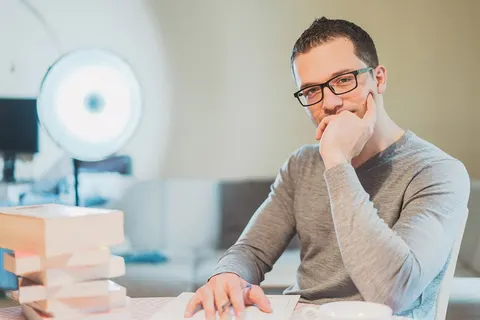
– I too have carried those lists of questions all my life and have practically never used them. But sometimes you expect to face someone who is a brick wall, terse, or simply nervous.
– That’s why it’s important to me that people get to know me. I want to tell them about the project first, to ask whether there’s anything important they want to mention. To tell them there are no paid appearances in this format. To build trust in me and in what I do.
Many guests tell me they feel at home, and that’s the goal.
If you don’t feel safe, but rather in some place you’ve come to be crucified, then I haven’t done my job well. Although I never use the word “job” for “The Superhuman”—but then I haven’t prepared you well enough, I haven’t “warmed you up” so that you sit down, we start the conversation, we talk sincerely and look each other in the eye. Not staring at the wall while we talk, but really communicating—that’s the true conversation between two people.
– And that’s another plus of podcasts, because in the media you get nervous, it can’t be otherwise, even if the host takes care of you the way you do. It’s no accident that even Musk chooses to tell all the important things on Joe Rogan’s show.
– That’s exactly what I say before we start: “Don’t worry. If you say something wrong, we’ll cut it, just repeat it.” That breaks the ice for the whole conversation; people calm down.
– Is what you do journalism, in your view?
– In theory it probably is, but in practice I wouldn’t call myself a journalist. In fact, at the beginning that was one of the things that gave me an advantage. I’d walk into the meeting and say: “I’m not a journalist; I make a podcast because I love talking to people.” That opened doors for me, because the politicians and all the paid-for media left a huge stain on journalism. It’s very hard to tell good journalism from bad.
I have friends who work in the media; I believe in what they write and I know why they write it, but they’re the exception. I know that even if they had a vested interest, they wouldn’t cross the line of journalistic standards and ethics, unlike other media. But that’s because I know them personally.
I’m a member of the Association of European Journalists; I support their cause and believe they do meaningful things. But I wouldn’t call myself a journalist, even though I have a press card.
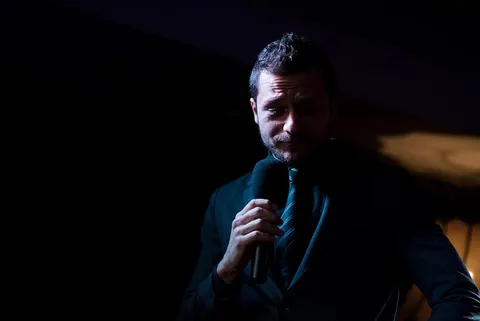
– I don’t have one, but for the same reasons I introduce myself as a retired journalist. What do you think is the way for journalism to get out of this swamp? Little by little, to start valuing information and its sources…
– I don’t know if I’m the right person. I can only tell you why “The Superhuman” has people’s trust—
because it’s transparent, because it’s made with heart, and because the people I invite are vetted.
That’s my formula, but I don’t know whether it would apply elsewhere. Journalism has to win people over and give them information. In that order: win them over first. Whereas today, perhaps, we put delivering information before persuasion. It’s very easy to throw dirt into clean water and muddy absolutely everything.
– Who are your idols, whom do you admire?
– I admire people who think of others and give. Vasil Terziev is one such example—he built something very successful, and instead of buying himself an island and a yacht, he started investing. He mentors various companies, some of which are now valued at over $1 billion. He creates opportunities for those who come next to grow.
Or Lazar—he’s done things for fitness, for charity, and he tries to give to people. That giving is super important to me. People who have reached a standard of living that’s okay for them, who are happy, but know that for society and the country to develop, they have to give more. Those are the people who inspire me.
– What do you dream of? Has it changed over these years?
– My dream is still the same.
The goal of the podcast is to make people’s lives better and to make them happier.
I don’t want to see people in the street who are terribly downcast and barely making ends meet. I want to see people who talk about books, about art. To talk about art, you have to be well fed, have your bills paid, have a roof over your head. I want the economic level to be such that survival is on the edge for no one. So that people can focus on being better parents, being better educated, helping others, taking care of the communities around them, of the little garden in front of their apartment block.
– Plenty of people wait for their dreams to come true, while you work on yours. When does a human become a superhuman?
– When they believe that they, too, are capable. The superhuman is an ordinary
person who has come to believe they’re capable, that it depends on them, and has taken on the responsibility. Not the blame.
We all want to change people, and the only way is to change their way of thinking so that they themselves want to change. For me, a personal example is the story of person X: he’s from the same town, he took these steps, he got here. If he did it, so can you, and in the direction you yourself choose. The door to change opens only and exclusively from the inside.