How can we be happier as a society? How can we take Bulgaria’s IT sector to the next level?
Two programmers sat down to talk about our broken public conversation, about division, about the road to success. It sounds like the start of a joke, but it turned into a serious, thought-provoking interview on the DEV.BG podcast. The words we exchanged struck me as so important that I want to share them with you here too.
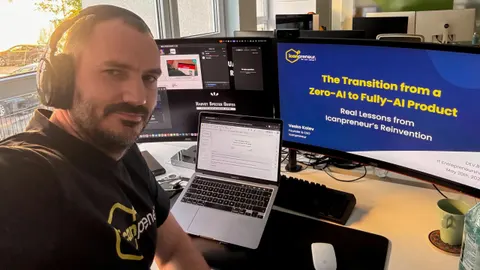
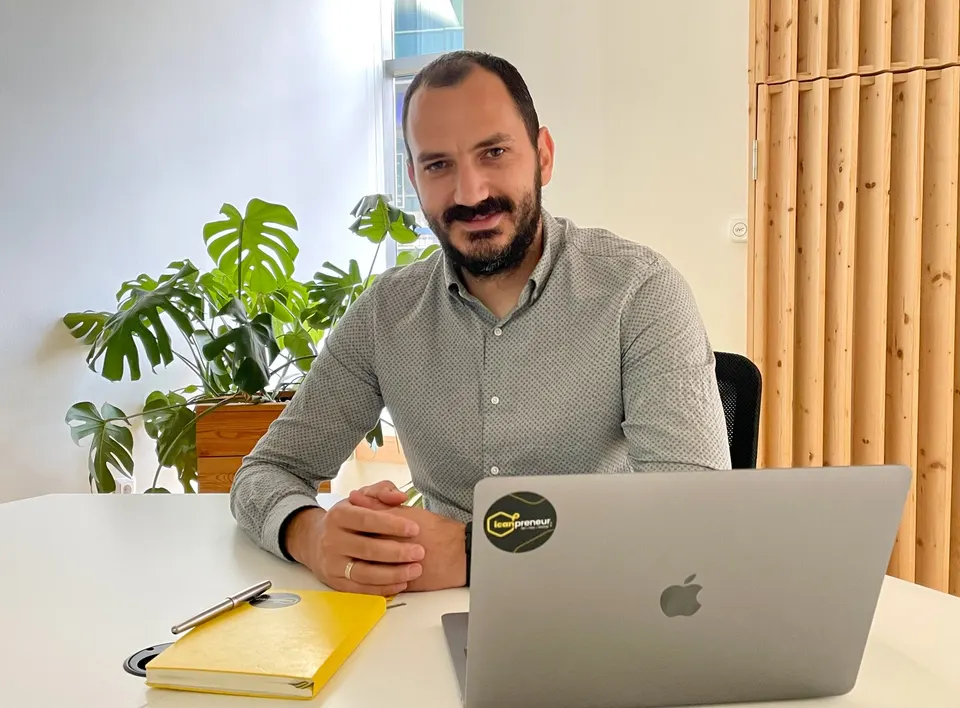
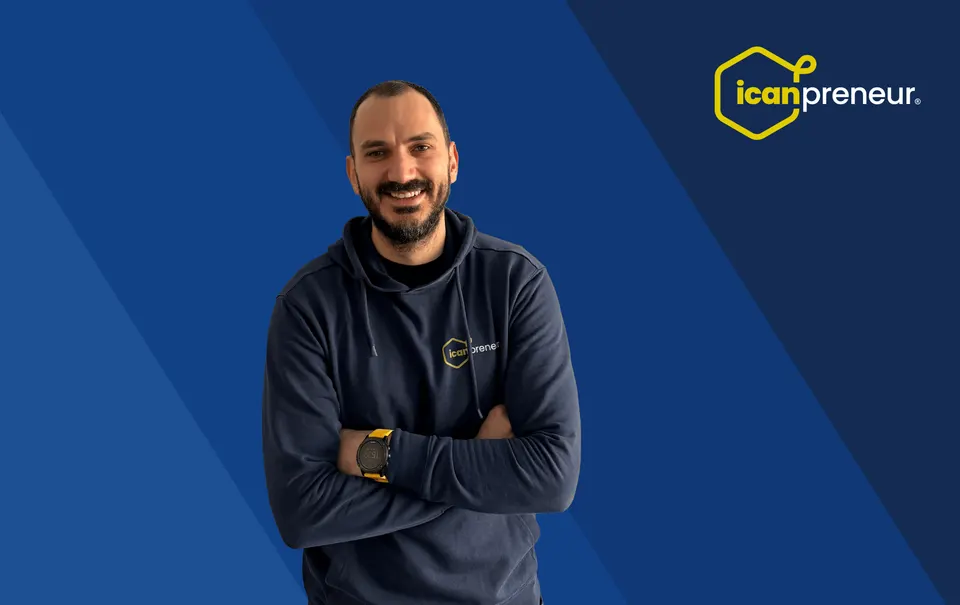
Vesko Kolev heads Icanpreneur, a startup that helps more IT companies build a product that works. He has rich experience in the software world and some particularly interesting observations, which we will get to today.
Why is it time to start not only listening to each other again but also talking, even when the argument of the day divides us—and how do we do it? Why is stepping on the rake, again and again, something that builds us and gives us meaning, and why is it worth being glad when our child gets a bad grade? What do we need as a society to move forward together, and in the age of advanced artificial intelligence at that?
– You wanted to become a footballer before you turned to the software world. I see a lot of parallels between an IT team and a football team: the teamwork, the division of roles, the key role of the manager. Are they really alike?
– Yes, definitely. Sport has taught me an awful lot in that respect. For example, I still play amateur football on a full-size pitch, nine-a-side. There are two captains, they split the players into two teams so that the balance is as good as possible, and then each captain decides who plays where and runs the game like a coach.
When I end up as captain, my style is to support each other as much as possible, not to yell, “Hey, how could you miss that!”
Most of the time the mistakes are obvious, and my goal is never to win at any cost. It’s more to play against a solid opponent, to have a hard time of it, and to grow that way.
The analogy with a team holds completely. For me it’s very important that everyone understands what the others need in order to show their best. The focus should be on how to shape the circumstances so that everyone can bring their best “game” at work, too.
– What’s your favorite position in football?
– I usually play right midfield, and I’ve never asked myself why. But now I think it’s a position that both builds up the play and brings it to a climax. On the one hand you can score, but at many other moments you get to deliver the final pass.
– When did you realize you wanted to earn your living by programming?
– The moment I felt that doing things with a computer, building things, gave me satisfaction.
Programmers have a force invisible to the outside world—why are they so drawn to what they do?
I’ve thought about it a lot, and the answer is fairly obvious if you’ve done it for a long time: there is a very fast satisfaction loop. I compare it to what craftsmen feel when they build a bathroom, say. You see it right away—you’ve taken some steps and there’s a result. Which is very different from working on things that take 20 years to happen.
– I can only imagine how hard it was to get into the profession at the end of the last century… Is it too easy today, now that we have artificial intelligence?
– I don’t think so. We say that “back then there wasn’t so much access to information,” but right now the pendulum has swung to the other extreme.
There is far too much information, and when you want to learn something, too much choice creates difficulties of its own.
Maybe from the perspective of the past it looks that way, but
what today’s technology makes possible also raises the bar for the end result.
– Another challenge today is learning to let things be hard. Stepping on rakes, as you and I have discussed, turns out to be an important pursuit, one for which, supposedly, there’s no longer much time or appetite.
– It’s a very important element of how we perceive the world in general. If a person doesn’t have the right attitude toward failure, very bad consequences follow. If we don’t have the mindset that it’s okay, and we don’t keep the right to make mistakes, what’s the result?
The only way not to make mistakes is to do nothing, but then you’re still making a mistake, because you’re wasting everything.
In my view the right mindset is this: you allow yourself to make mistakes; you try not to make the same mistake twice, so next time it’s something different, something else breaks, and then you have a chance to move forward, to develop.
For me, when you have a goal and know what you want to achieve, studying is very important, but so is building practical experience. That combination, I think, is the optimal path. A person can develop far more understanding of what it takes and what people go through, far more empathy, when they carry the scars of such experiences.
– I think part of that mistake comes from us, the people who tell stories. Because very often the success story looks easy, glamorous and shiny. Not long ago I read Bill Gates’s autobiography. Well, it wasn’t easy at all for this man, whom we imagine to have hit some fantastic stroke of luck. No, there is no easy road to success, insofar as there is a “road” and a “success” at all.
– I’ll make a football analogy. If we imagine all the possible outcomes of a football game, what I love most is winning the hard way. Then losing the hard way. Then losing easily, and…
what I hate most is winning easily.
The surest way for me personally to lose interest is when there’s no challenge. If the road to success is hard, that’s the moment.
If we value not what lies ahead but what is happening to us, with all its good and not-so-good moments, then we can find great satisfaction.
Recently I heard an example from Hristo Popov: if you climb Everest slowly, with a team, the way it’s done, and you have the alternative of being lowered down by helicopter, which will be more satisfying? The answer is clear. In other words,
the concept of quick and easy success is, in my view, meaningless.
If there’s something we can achieve easily, that means we have far greater potential and should set ourselves higher goals.
– It’s very hard to learn to lose gracefully, and I immediately found my own parallels. My hobby is taking part in TV quiz shows and winning them, but I’d rather lose gracefully than win ugly. That isn’t the point. Then again, I’ve noticed with my own children how hard it is to teach someone this. Instinctively we don’t like losing, that’s clear. How do you develop this quality?
– That’s a very important question. Having the right attitude to losing, and to mistakes in general, is something you’re brought up with. It isn’t something that just comes to you. “He’s been very competitive since he was little, he can’t stand losing.” That’s a function of our actions as parents and of the ways we speak to our children.
For example, if my child gets a bad grade or a reprimand at school, I’m really glad.
For most parents that isn’t the case. “But how can my child have a low grade?” I’m glad, because it’s a chance for my child to get used to the idea that when a mistake happens, it isn’t the end of the world. My approach in these situations is: “Look, no problem. You got this result. Go talk to the teacher. Make sure you understand the mistake. What went wrong, and what will you do so it doesn’t happen next time?”
That’s the concept of continuous improvement. This way, after going through a few such moments and seeing it isn’t the end of the world, the child will get used to it.
Another thing we have to teach children at some point is that if someone hits you, you won’t die. Someone comes up, slaps you, you cry, it’s the end of the world. No, it isn’t. Yes, it hurts, you cry, but you won’t die. It’s the same with mistakes.
– Which naturally leads to other developmental problems, especially when we’re talking about more intelligent children who stand out in some way. That overambition doesn’t help. Not long ago I talked about this with Mensa’s national psychologist; they now accept children with exactly this idea in mind. To help parents get used to the fact that a 4 (a mere “good” on Bulgaria’s six-point grading scale) won’t leave their child without a career. And it’s precisely these children who need to develop even more socially and emotionally.
– Life isn’t something that just happens to you, like Real Madrid and Barcelona walking out and forming a guard of honor for you. No,
life is a string of situations in which you have to fight your way through somehow.
With yourself, with competition, with all sorts of things that happen. In my view we cannot and should not teach our children, or ourselves, to see the world that way.
– A huge part of your professional experience is tied to Telerik. How do you explain the success of that company, which was an important step in the development of our IT industry as a whole?
– For me the main thing is the company culture. When I started, one of the founders sat in our room; that was the practice whenever a new team was formed. He helped us make sure we had the right mindset, supported us, took an interest in what we were doing. And that creates a sense of belonging.
Something else played a very good role in Telerik’s development: absolutely everyone in the company, no matter what they worked on, had access to the customers. On the one hand, you see how the thing you’re working on needs to change to get better. On the other, you get to see the positive effect of your work, which makes you endlessly connected to what you do.
The third thing is the enormous vision the founders had and passed on to everyone in the company: that what matters isn’t only what we do in our own context. Their goal was never to make some money so they could have yachts and cars, but for us to be an example, and for that example to then lead to something more.
Telerik was never an end in itself. One of the future founders of one of the very successful companies comes along, say, and tells them: “Look, we worked really well together, but now we want to start our own company, and I very much hope this won’t spoil our relationship.” Not only does it not spoil the relationship, the founders of Telerik become some of the first investors and help them succeed.
Telerik became proof that it’s possible to have product companies from Bulgaria. For me that’s the way forward for the software industry.
Enough with this outsourcing! It did a lot of good work, but now we have to move to the next level of added value.
This is where the concept of “pay it forward” comes in. That mentality that you shouldn’t think only of yourself, and not even only of the people you work with. You have to think of your customers too, and of the environment you live in. Help where you can, and in the right way. Not give someone a fish, but teach them how to fish.
– I think it would be wonderful if all of this applied to our whole society. If that kind of mentality, the need to pay it forward, were more common in every field, in our daily lives, even in how we treat people, we would live better.
– I completely agree. I constantly come across incredibly good people who, for one reason or another, because of what has happened to them, the way they see the world and so on, end up clashing with each other.
The most basic example: in the building where I live, there were some bikes chained to a radiator in the stairwell. They stay there a day or two, and then an angry note appears at the entrance: “Please remove the bicycles immediately, this is not legal.” It sounds harsh, and I wonder who wrote it; we’re a building of four or five floors, not 18,000 people.
Then it turned into a row. What turned out? The people who wrote the note had once lived in a building where a fire broke out and they barely got out. What’s more, they had even come up with an alternative place for the bikes, so they wouldn’t be in the way: there’s a small storeroom, you just have to clear out three sacks and that’s it.
The thing is, though,
the dialogue doesn’t revolve around “Let’s find a solution and look for the constructive side.” Instead we look at the negative and start talking about how bad things are.
The conclusions I want to draw attention to are, first, that laws have to be obeyed. Whether I like the bikes being there or not makes no difference at all. There are laws.
The second is to focus on finding solutions and not give in to that inner emotion that surfaces and tells us, “These people are deliberately trying to do something bad.” If we look at each other not as enemies but as people who can and should have common goals, and we seek that dialogue, things will work out for us. So I appeal to you, please:
every time you think something bad about someone else, ask yourself the simple question: “What evidence is there for this?”
– I think all of this is part of the larger context of our broken public conversation. That’s one of the big reasons I created this site. To a great extent, technology brought us the division. Because a large part of the public conversation moved to social media, where it’s much easier to confirm your own point of view, to stop respecting the legitimate arguments of the other side, to grow bitter, to turn against someone, to split apart. And in the tech world I often see this division from everyone else, too. That’s also a conversation that’s getting lost. The question is: can we change it?
– The first question is “Should we?” and the answer is “Absolutely!” And can we? In my view, 100 percent.
But first let’s answer the question of why. In my view there isn’t a person in this country who doesn’t want it to prosper. For me, we first have to realize that we have common goals to strive toward.
The second step is the moment we answer the question: “Can we do it without everyone doing their part?” No.
The third thing I think we need to change in our mindset is the expectation that someone will do it for us. Oh, the state, oh, the mayor, the politicians.
For me the truth is that
we need to remind ourselves what democracy actually means.
First: the majority decides. When more people share one opinion, the rest have to go along with it.
Second, we need to know our role. We can’t sit on the couch, just posting on Facebook and complaining about this and that, as if someone owes us something. No one does. If each of us takes a civic stand, not only in words but in actions, and takes small steps toward what we all dream of, I believe it will work.
– I envy your optimism, because behind that there would have to be some almost magical change, which social media alone wouldn’t allow.
– The easiest thing a person can do, instead of wondering whom to pick a fight with on Facebook, is to check whether there are two crooked paving stones in front of their apartment block. Fix one—don’t overexert yourself—and the next day the second.
I observe a phenomenon, including among my own relatives, who say, for example: “There’s a little patch of grass here. It isn’t looked after properly.” And I ask: “Okay, why don’t you go and fix it? You have the means, the time, it’s an hour’s work.”
What comes back is some feeling that someone will take you for a sucker. And I sit there and can’t answer the question:
Since when did work become something unworthy of respect, something bad?
When did putting in effort, doing something good, go out of fashion?
Big things, and I say this on the basis of my modest experience, always happen because a huge number of small steps have been taken. For me that’s a big part of the key to developing our society.
The other thing is to be aware of what you defined very well: that when we open Facebook, it’s very easy to become embittered. People need a slightly clearer idea of why that happens.
It’s also about a technological understanding of how things work. During COVID a friend came to me and said: “My wife is turning against me because she thinks I’m the only person in the world who is for vaccines.” She had started reading things connected with the anti-vaccine position, and everything online was nudging her to stick to that view.
– That’s another of the big reasons this site exists. These topics are extremely important, but I don’t know how they can reach more people. I think we owe a debt here, those of us from the tech world, because we don’t explain it enough, and the platforms themselves have no incentive to give access to that explanation.
But let’s change the angle. Today you head a company that helps other startups.
– I had long seen that for me
challenges with a good, meaningful goal give meaning to everyday working life.
That’s when I decided I wanted to start a company. The question was in which direction, and that I had to learn what it means to build a business, which is so multifaceted. For a long time I’d had an inner dialogue about what my personal mission should be.
At first you want to do well in your career, to get into the industry. Then to be good at what you do. Then comes the desire to raise the level of your contribution. And then, once you’ve beaten that game, you arrive at the fundamental question of life, the universe and everything: “Why do I exist?” What is it that I need to add?
I realized I wanted to make it possible for more people to do what I had, in some way, seen as success at Telerik. I want Bulgaria and other places around the world to be able to prosper.
For more people to say: “Hey, on Monday I’m at work and I can’t wait to go!”
I often see how we define the problem: “I really hate going to work.” But instead of looking for a solution, we look for compensation. For example, I’ll buy an expensive car, I’ll go on an awesome vacation. But on Monday you’re back at a lousy job you don’t like.
I’ve read more books on psychology and entrepreneurship than on programming, and those are not few at all. Everyone has moments in their career when they feel something like depression, and they usually associate it with something bad. For me the reason each time has been that I had reached a point where my role was becoming redundant.
– What does the work at Icanpreneur look like today? How many startups do you work with, and what kind?
– From the very beginning the goal was to help more people become entrepreneurs. Our appetite is for helping companies that are more product-oriented. We started four years ago, took off very strongly, built a team, raised investment, the product got off to a good start. But then
ChatGPT came along and flipped the table.
Every company in the world acquired a very powerful, brand-new competitor. We had to answer, very quickly but also smartly, the question of what this meant for us. Both as competition and as a technology we could use.
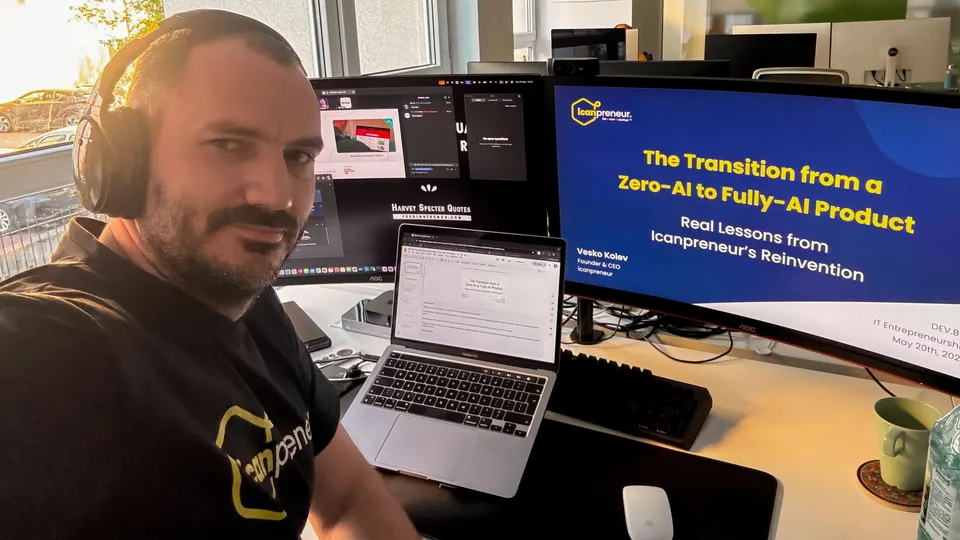
The last 12 months have been about how to pivot from a traditional product company toward AI. We have now built a pretty good foundation for anyone who wants to pursue entrepreneurship. At the center of our platform, we enable teams to gather information about their future customers through interviews, so that they understand them better than the customers understand themselves.
On the one hand we’re building the software side, on the other we’re completing the changes based on artificial intelligence.
Right now we’re working very actively on partnerships with all kinds of players in the ecosystems, both in Bulgaria and around the world, so that we can join forces.
Because what’s happening? There are accelerators, entrepreneur communities, investors. But in our view there isn’t a good enough connection between them for these pieces to work together from the users’ point of view. We want to build a global network, to provide the backbone of the entrepreneurial journey, so that all the players come in at the right moment, us included. To partner in such a way that at every step each entrepreneur gets what they need, without having to reinvent the wheel.
Entrepreneurship isn’t a new science; it has existed since the world began. But today entrepreneurs’ success rate is tragically low:
nine out of ten fail, and the reason is usually that they rely too much on instinct, on gut feeling.
Yes, those matter, but it’s like the difference between noise and music. You know that to write a story it’s good to follow some structure, because there are rules. People came up with them long ago, and you have freedom within that structure, which is why an infinite number of stories can be written.
Entrepreneurship, in my view, was left for too long to playing without knowing what the musical instrument is, without knowing the basic rules of music.
– I’ve heard from other interviewees, too, how good it would be for our environment to have more product companies, but how do we do it? At a time when Sam Altman says the next unicorns will be the work of a single person.
– Why do big companies find it hard to innovate? The answer has to do with how success is measured. All the metrics we look at are short-term: revenue, growth, share price. No one can assess how an innovation will play out in five years.
As the management of a Bulgarian service company, you face the question: these ten people I have—do I put them on making money from our best clients, or on doing something with a very small chance of success? That dilemma tips toward the first option extremely quickly.
Alas, at some point we won’t have a choice; we are becoming less and less competitive in our positioning for outsourcing. There are much cheaper destinations, and with artificial intelligence, even where we’ve had an advantage as professionals, we’ll lose it in some respects.
As I see it, circumstances are heading in a direction where we won’t have a choice. Either we’ll have to transform, or we’ll have to do other things.
Selling a service and creating products, though, are two different games. In the first, you offer something right away, the market wants it, and it grows linearly, based on headcount.
Whereas if you have a product company, you have to invest. At first you’ll lose money. So far we have invested over 1 million euros in what we do. At some point, though, little by little you start making money, and then you have the potential for exponential growth.
This game is different; it requires a different kind of thinking, a different kind of people.
This shift in mentality, in the metrics we follow, requires completely different processes. We can do it when all the service companies realize that, in the long run, this business has no future in Bulgaria. If one such company invests in 10–15 new products this year and another 10–15 the next, successful projects will multiply.
And this is where what Altman says comes in. We’ll be able to create more product companies with fewer resources. Because paying salaries to 20 people is one thing, and paying three is another.
– So right now is the time for good ideas!
– We have to learn to look at the world in a way that lets us see the unsolved problems. AI will take away a lot of work, but in my view it won’t remove the need for us to move to the next level of work.
There is a huge need for all sorts of software that isn’t being made simply because we can’t keep up. Well, that won’t be the case anymore. And
what will set successful people and companies apart is whether they solve meaningful problems.
Whether they use AI in a way that doesn’t look bolted on but unlocks additional value. A few weeks ago Satya Nadella said: “All the progress in AI is great, but we still don’t see the economic return.”
For me the key is more and more vertical software—software that solves a particular problem very well, using AI.
We have to—people!—find a way so that when we hear someone express an opinion that doesn’t match ours, it doesn’t mean we immediately cross them out with a thick marker. Dialogue doesn’t mean talking about things we agree on 100 percent. We have to find a way to learn to listen, to understand where the other person’s position comes from.
Let’s stop hating each other. One supports one team, the other supports the other, so we won’t talk. Let’s learn to talk and to appreciate where different points of view come from. Let’s seek out the different point of view. Because
there are very few cases in which the two views are truly diametrically opposed and there is no common way forward.
I’ve worked with people from all over the world. I can say that we lag behind in nothing. And if we keep working heart and soul, if we give it our all and, most importantly, come together, I think we are in a very good position to succeed.
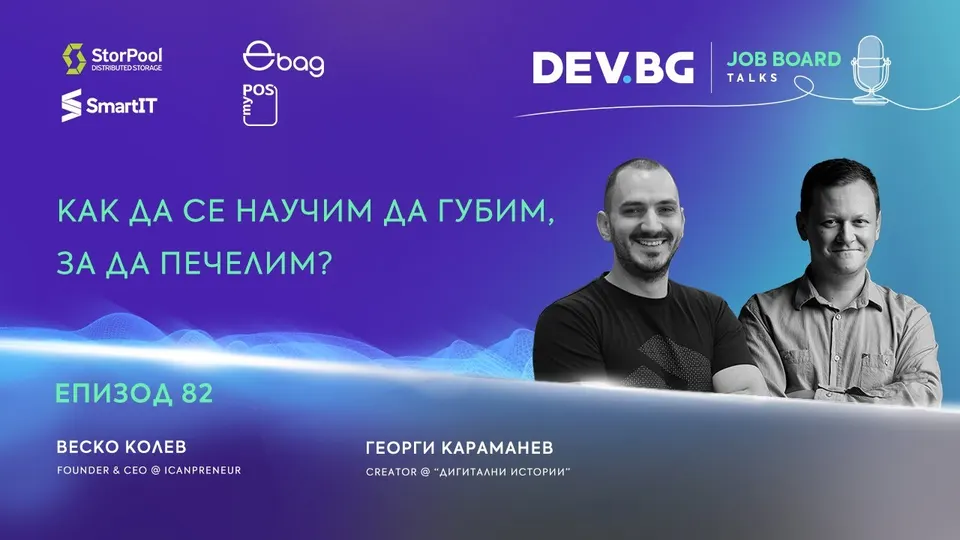
You can hear more about Vesko Kolev’s story and professional path in episode 82 of the DEV.BG Job Board Talks podcast: