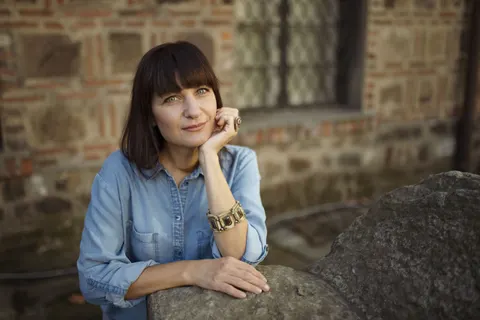
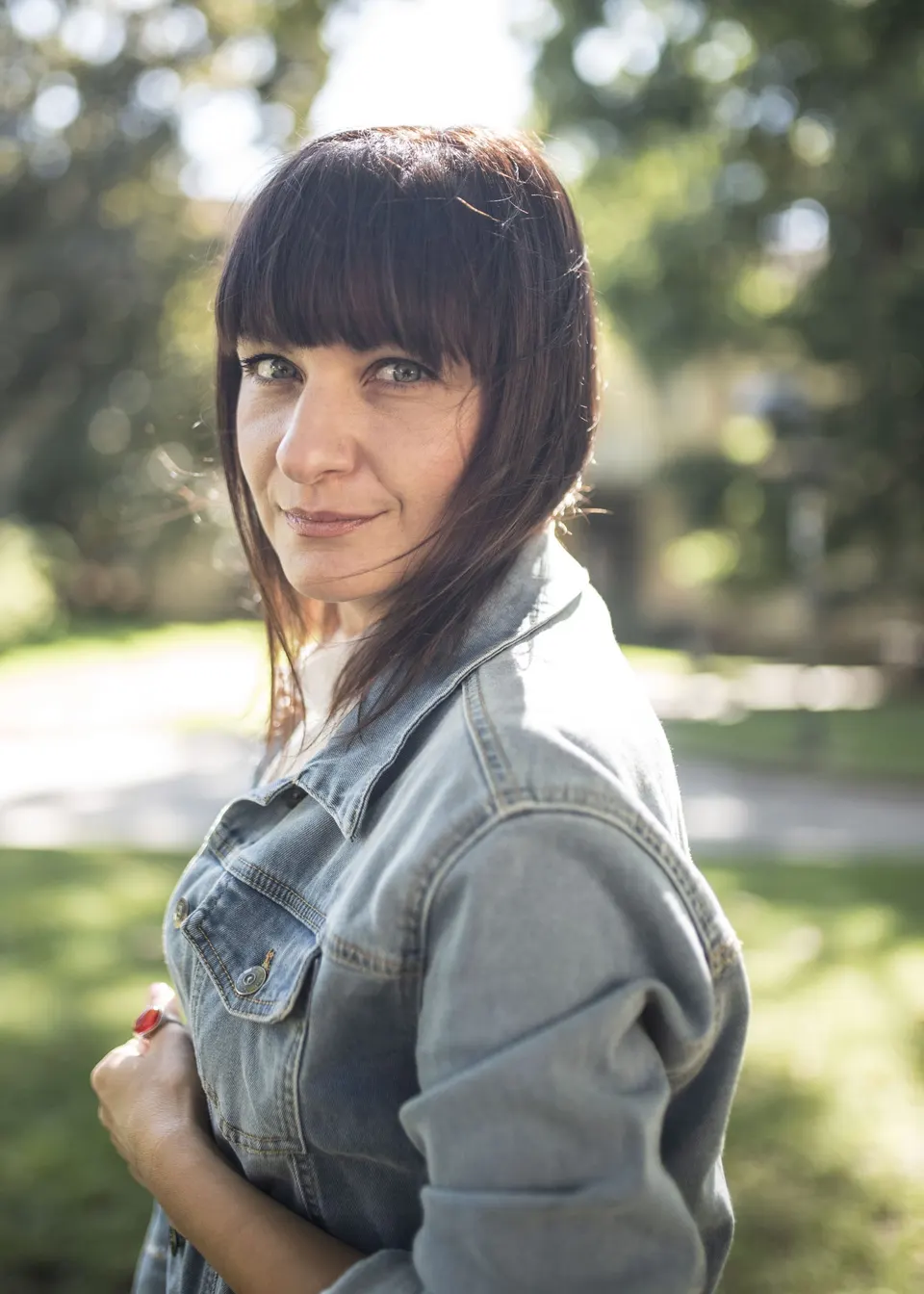
This Digital Story begins with a blog that was first called Words do Worlds. Viktoria Beshliyska created it to write about travel. But on her birthday, November 1, she asked her guests to share an old or dialect word with her, and their answers set her thinking. They gave her the idea to set off “On the Trail of Words.” And so she began collecting beautiful old Bulgarian words and capturing their magic in her posts.
Two years later she has a rich collection of words and tens of thousands of followers. Somehow it led naturally to her novel Glina (Clay), which tells, in a melodious, old-time Bulgarian, a beautiful old story about the once-famous master potters of Busintsi, a village in the Tran region of western Bulgaria. The book became a literary event. Six months after its release, Clay has already had four reprints and refuses to leave the top of the bestseller charts.
We meet Viktoria to talk about the life of words and their role on the internet. About the hard choice of words and the refuge they offer us. About how new words are born and where the ones we have abandoned go.
– Over the past year we switched drastically to online communication… can it be warm and cozy?
– It can, yes. It all depends on the words you put into it. I remember that the first lockdown last year was a time when I communicated a great deal with my friends, my family, my colleagues—we were all shut away in our homes. Those were the moments when I laughed the most and cried the most. And all of it came through technology, but also through words.
I believe it can be warm and cozy if we set ourselves that goal, or if we ourselves carry something like that inside. Unfortunately, there is a terrible amount of aggression on social networks, a lot of boorishness. Frankly, I keep away from groups where these things rage and are the norm, because I believe that
taking care of yourself runs, to a great extent, through language.
What you think, what you say, somehow reflects you and the way you feel. At the same time, words can bring about certain states of mind. Caring for language is also caring for yourself.
– It seems that change is happening. Until ten years ago we all wrote in shlyokavitsa, Bulgarian typed in Latin letters, and gradually we started paying attention to spelling; some people even remember the correct use of the definite article. Maybe we will get to the nuances, too…
– These things happen in small steps, and with people you share common thoughts with.
– Is our language more colorful now, or poorer, compared to the pre-digital era?
– It isn't more colorful. It travels faster, it does its job of reaching the addressee faster.
It has been made much easier, but I don't think it's more colorful. It's just more convenient, more functional.
– Along with technology came so many foreign words, something that has never happened to this extent…
– It really does seem to me that the extent is great; there is a kind of threat that the language will grow poorer and we will slip into the channel of “fast” language.
The kind we rely on to be understood by everyone.
– …at the expense of nuance.
– Exactly. That, for me, is the dramatic part. There is no way to resist time and the development of the world, nor to push back against technology. And there's no need to: technical progress is part of progress as a whole. But I'd like us not to lose the balance of the scales, and that is what I strive for in my blog. Alongside these words, to open ourselves to the old ones, too, which somehow connect us to our family, personal, ancestral roots. And from there, to the land, to the place where we are.
I think we simply need to broaden our horizons from within.
Without stopping the one, not to forget the other, and to take care of it.
– You are a philologist by training, and by vocation, too. What kind of language is Bulgarian, in your view?
– A very rich one, a language with a lot of history, and I think that is its greatest value. It comes from the history of the Bulgarian people as a whole, of our lands, from contact with other peoples and cultures. These encounters enriched our language greatly and gave it the chance not only to take from others, but also to give its own meanings to what it took. We adopted many words ready-made from Turkish, Greek, Albanian, Romanian, but only in some of their meanings. And then we enriched them.
One such word is “нишан” (nishan); it came through Turkish from Persian and means “sign, mark.” But if you dig deeper, the word has acquired many more meanings, drawn from our way of life, our culture, our customs. A fiancé leaves a nishan for his fiancée, and vice versa. In some Balkan dialects it means to give an object that is a kind of promise. There are a great many examples like this, so if I had to describe Bulgarian in one word, it would be “rich.”
– I have come across comparisons, say with English, showing that our vocabulary is considerably smaller, several times smaller, in fact.
– At present? Possibly. But I don't think it's a matter of counting words; counting meanings seems more appropriate to me. Our way of life, our national character and our soul have given a lot of meaning to words.
They have given them more space, more soul, more life in some form.
Last week I posted the word “палампỳк” (palampuk), which means “poppy” and is used that way in the Pleven region. Underneath, a lady wrote me about 30 words for poppy that we have in Bulgarian from different parts of the country. One of them is “божо око” (bozho oko, God's eye), which struck me as terribly beautiful.
– How do you explain the great interest online in old words?
– People are tired of the pace. They are oversaturated with this constant living of other people's lives that floods us through social networks. I have the feeling that
we have all fallen into a kind of flatness,
and at the same time the pressure and the pace of everyday life are crushing us. And if we don't find some inner islands where we can stay and hold our ground, we very quickly end up in burnout, in everything turning mundane.
I explain this interest with every person's inner need to connect with things from their own past. To find yourself, even briefly, in a state of timelessness is very healing, and sometimes everyone needs it.
– I read that the whole venture started this way for you, too. At a bad moment, when you didn't know what to do with yourself, the idea for the blog came to you.
– Yes, absolutely. After my second maternity leave, I suddenly and abruptly had to go back to work. I didn't want to; I'd have preferred to stay home a little longer. In a
different kind of living, one that isn't measured only by work, by rushing and scurrying
between a thousand things. That was when I felt the need to make a place of my own, where I knew I could escape from the madhouse of everyday life.
Many of the first posts were written on the way to work, on public transport, in that stretch of time when nobody wants anything from you yet. You've dropped off the child, and before you get to the office you have 30 to 40 minutes to use for something of your own.
– One can put depth and meaning into modern words, into technological terms. Are you thinking of adding words like that?
– No, I haven't done it so far. I feel as if I've made a promise that this would be a place for old words and that I wouldn't show something everyone already knows or something new.
The idea of the blog is also to shift our inner borders a little, to turn toward dialects as well. In recent decades dialects have been looked down on; there's a kind of shame about where you're from, who you are, how you speak. For me dialects are a great treasure; they carry color, soul. They give a very strong sense of identity, and using them should not be considered ugly or incorrect. Beyond a certain social code we have to follow, of course, in the everyday rhythm of work, I think it's good to carry our dialects with us and preserve them.
I enjoy sharing words that are still used in some dialects but are unknown in other parts of the country. Whenever you say what something is called in northwestern Bulgaria, someone will chime in to say what they call it in Burgas, in the Ruse region… That, too, is a reason for people to communicate, to look for similarities and differences, which there always are between us.
– And are there ugly words?
– There are. The ones you use to insult, the ones you aim at people in order to hurt them.
– You don't post those?
– I don't want to. I want the blog to remain a warm little island you can go to and recharge in a positive way, however clichéd that sounds. Where you can recognize your own experience through something pleasant.
– How many words have you collected so far?
– On the blog they're approaching 500. Beyond that, I've collected thousands as comments, as lists people send me, as books from different parts of Bulgaria. Some people insist I publish a dictionary. But how do you publish a dictionary—there has to be a criterion, doesn't there? With the blog the criterion is purely personal; it runs through my own story. I have thought, though, about a book of words organized by theme. Say, words for each season, a word for every day. Those are my ideas for the future.
– I'd be glad to have them, too; you really do have a feel for words. It just occurred to me that “blog” is a perfect example of a word that came into Bulgarian without any meaning.
– Well, yes. We could invent a Bulgarian one, but it wouldn't be as easy to communicate with. There's no need for that; those are extremes.
– Where do dead words go?
– Into dictionaries. Some of them
stay tucked away in the objects they were meant for.
Others are buried in the crumbling houses of Bulgaria. Still others simply sink into the archives of museums we never think of visiting.
– But that isn't irreversible. Hebrew, after all, didn't exist as a spoken language for a long time; it is an entirely revived language. People can resurrect a whole language out of nothing. Never mind words. All it takes is someone like you who wants it badly enough and brings them back to life…
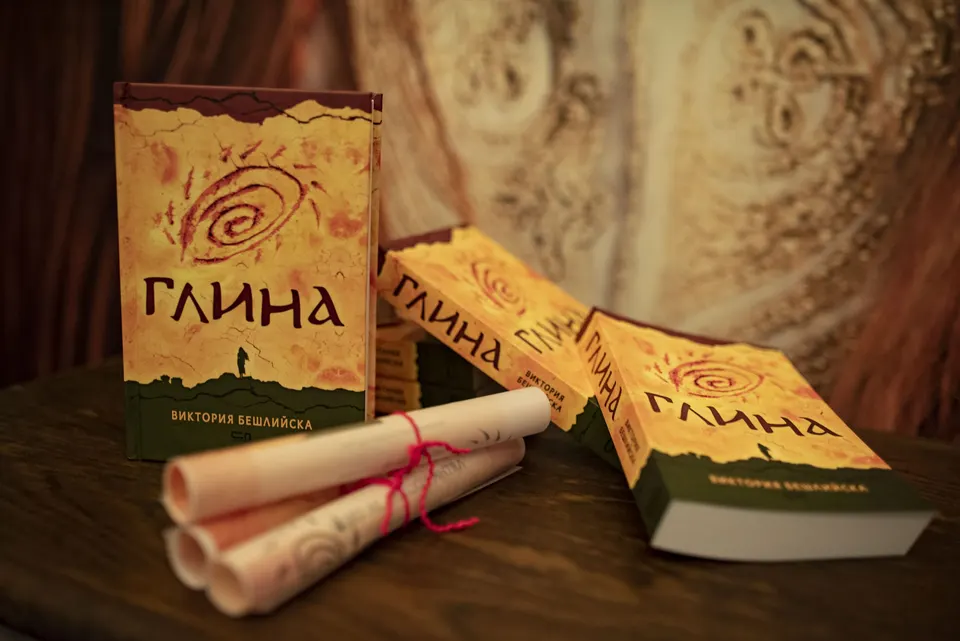
– There is certainly a way back. I'm very glad that people are now flocking to Busintsi. Until six months ago, the village was known mainly to people from Tran and to the older generation, who had heard of Busintsi pottery. And now, thanks to my book Clay, interest has awakened. People visit the museum, explore the surroundings. My goal was to bring five people there, and I “brought” many more. So there is a way back, and it runs through passing on knowledge, words, spirit.
– Through words, through stories…
– Yes. Anyone can be a conduit for many things, so that they reach more people.
– What did you want the language of your book to be like?
– Warm and homely. The kind I've inherited in my family, and which I think people know, too. I believe this is one of the main functions of language—to offer a kind of refuge. That's the role of literature as a whole. It should always move you toward something else, toward a better place. To where you want to be, so you can set yourself apart from the here and now. All literature and all art have this purpose—to carry us across to the beyond. And I always imagine my “beyond” as a warm and cozy place.
– You have two daughters. What matters most in awakening children's love for language?
– First of all, that our homes are full of books. When they ask us a question, we should show them that we can answer it and look for the answer not only online—that we can check an encyclopedia, a map, a guidebook.
Books, in my view, are what first awaken a love for language.
And, of course, our personal contact with children. Because every child's first language teachers are their parents and grandparents. What they say, the way they tell stories—those are the primary recordings that stay with every person forever and shape their relationship with language.
– How are writing and shaping clay alike?
– Both require craftsmanship. In both, what you make actually reveals your connection with yourself. To shape a vessel, you don't simply sit at the wheel and spin it; there's a very long process before you get there. It lies in sifting the material, in preparing it, in kneading it. In all that knowledge of how to turn it into a good lump of clay that you can then shape.
The craft isn't only in the moment of shaping; it doesn't show only on the wheel, but along the whole road leading there. It's the same with writing. When you sit down, you're not writing only here and now. You draw out and re-create things that have piled up over time. Because of them, what comes out is truly a matter of your inner content. Of the soul you carry, of knowledge, of your general culture. In both cases a person reveals first of all their connection with themselves, and then their attitude toward the world outside.
– Do people from abroad get in touch with you to remind you of words we've forgotten here?
– Yes, they are among my favorite followers. People who have lived abroad for a decade or more, raising their children and speaking to them in an incredibly pure, beautiful Bulgarian, with all the dialects they packed in their suitcases and took with them. And their children know very well what it means “да кандисаш” (kandisash, to give in) and what it means “да кандърдисваш” (kandardisvash, to talk someone round).
When I was in Luxembourg, visiting the Bulgarian cultural community, I was struck by the incredible Bulgarian spoken by the people who had invited me… It warmed my heart, and I realized how important the people abroad are to us. Because
language has no borders anyway. And the spirit has no borders.
There are many Bulgarians living abroad. And most of them are in the prime of life, raising children right now. Their responsibility is enormous. If they manage to preserve those little seeds and roots over there, I think there is hope for us as a people…