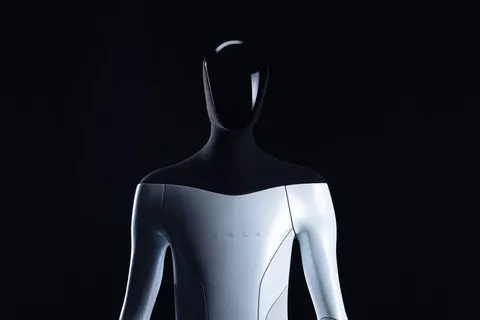
“A robotic assistant bakes moussaka in the oven while hanging out the laundry from the washing machine…”
Doesn’t sound bad at all. While we were still getting used to the idea that a vacuum cleaner could be a cute, round robot… it has been roaming our homes for years, mapping the rooms and saving us from the dust. Might the same thing happen with the next everyday innovations?
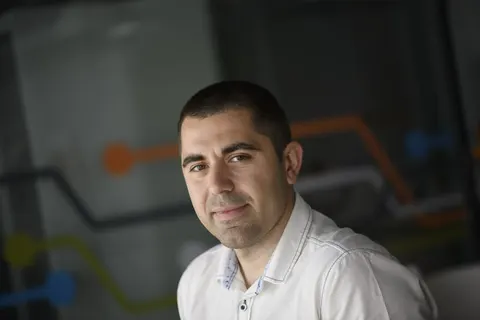
Very soon, on August 26, software engineer Zhivko Petrov will show us “firsthand” why a robotic assistant may arrive sooner than we expect. He is one of the speakers at the annual DEV.BG All in One event, which brings the IT community together with guests who sketch out the big topics.
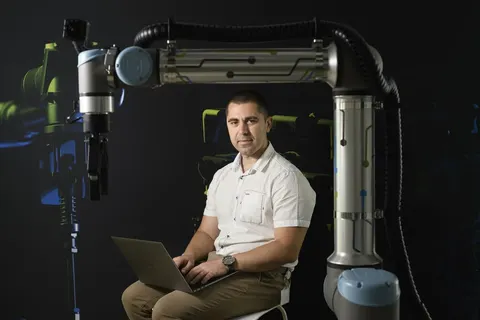
Zhivko will be there shoulder to shoulder with Mara the robot. Before that, it is time for a few important questions about the future of robotics. For Zhivko, and for the mechanical lady he is bringing along…
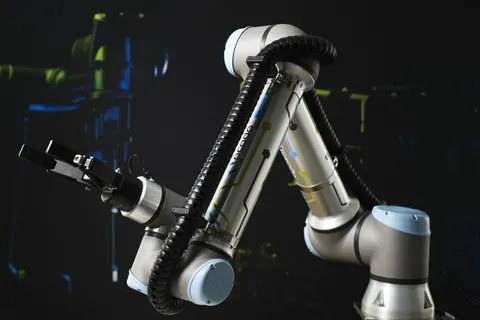
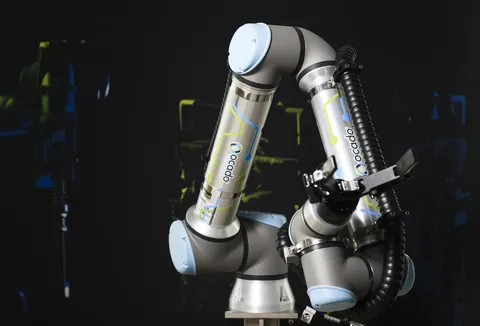
– I read that you will soon introduce us to the future of robotics, and it is definitely exciting. Could you introduce Mara, the arm we can see here?
– Of course. Robotics, its varieties and its applications make up a very broad field. Take an area like car manufacturing, where mostly industrial robots are used. They are
big, fast, precise and extremely productive, but also dangerous.
That is why they are fenced off in cages that people cannot enter—otherwise the robot could hurt them.
Mara, on the other hand, made by the company Universal Robots, is something like the Mercedes of so-called “collaborative robots,” or “cobots.” An industrial robot, but one designed to work alongside people. It carries out its task, and I can safely be right next to it, working on mine. We can also help each other—collaborate, which is where the name comes from.
It is equipped with precise touch sensors. Set up properly, if it touches you, it stops immediately so that it cannot hurt you. To make it completely harmless, a collaborative robot is often combined with additional safety sensors. They detect whether a person is entering its work zone and send a signal that automatically switches it into slow mode.
– What is Mara capable of?
– She is an industrial “arm” with 6 degrees of freedom, achieved through 6 rotors, also called “joints.” Each of them can rotate 360 degrees in both directions. The joints can work in remarkable unison, guaranteeing smooth and even elegant movement.
The robot imitates, more or less, the human limb from the shoulder, through the elbow, to the wrist. Just as you can reach the same point with your arm in many different ways, so can she. You can go around obstacles and reach hard-to-access places.
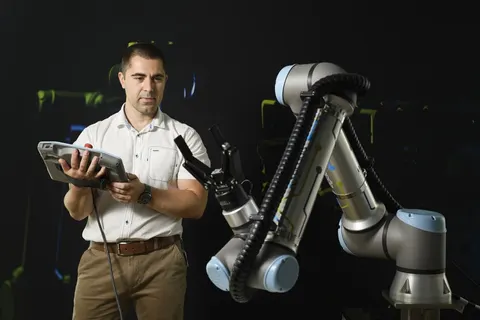
Mara has an interactive tablet with one single hardware button, and it is red. All robots, this one included, have one, and it serves the same function: emergency stop. If something unexpected happens, it literally pulls her plug.
Simple, predictable, repeatable tasks can be programmed directly through the robot’s tablet. For more complex tasks, in a dynamic and unpredictable environment, and for integration with other systems, you switch to a different, special mode of external program control.
This robot is relatively affordable—it costs around 30,000 to 40,000 euros. It is not something a person would buy for their living room… but the price makes it usable for small and medium-sized businesses. It has been calculated that the investment pays for itself in six months on average, as long as you find a use for it. An extremely interesting “toy.” With literally 50 lines of code you can make it perform all kinds of tasks.
The possibilities are practically unlimited!

– What is the hardest part of learning to control robots like this?
– Definitely movement in space. People and robots perceive the world differently. We use a Cartesian coordinate system—move something 20 centimeters to the left and 50 centimeters up. Robots use a so-called joint system—what degree of rotation each joint has to take in order to reach the required pose. The conversion between the two systems is done through mathematical techniques.
Reaching the final pose, however, is far from everything. We have to take into account the acceleration, the maximum speed and the specific trajectory the robot is to follow. Add a dynamic environment—moving obstacles—and the situation quickly becomes challenging.
Does Mara know where she needs to go? Add cameras and sensors to navigate her.
Of course, robotics is a subject that can be learned with the right approach, materials and hardware. In the winter of 2022, my colleagues and I organized a free course in software control of robots, which we called Robotics Accelerator. It gave participants the chance to learn and experiment both in simulation and on a real collaborative robot—Mara. Those who took part included a high school student, university students, professionals, even the director of a tech company and a university lecturer. The experiments were endlessly interesting, and it very quickly became clear how many different tasks can be dreamed up.
– The company you work for, Ocado Technology, builds solutions for warehouses that run with minimal human intervention. How automated are the processes?
– The company’s core technology product is the Ocado Smart Platform, an online commerce platform. We develop automation and robotics technologies that did not exist before.
Imagine 1,000,000 items of more than 50,000 different types, processed in a single day—and with 99 percent accuracy!
How automated are the processes? Imagine 2,000 robots moving simultaneously at 4 m/s and passing each other at a distance of 5 mm! They transport products across the entire warehouse floor and “carry” them to the
robotic arm that fills the customers’ bags. Human intervention is mainly in maintenance, and the goal is for the warehouses to become ever more automated.

– Tell us about other interesting applications of this kind of technology…
– Robots like Mara can be mounted on mobile platforms, and from there the applications are endless.
It doesn’t have to be about business. Robots of this kind are already reaching homes, helping with more and more household chores. Yes, they are still mostly with people who are adventurous and want to try something different. But there are already home assistants on the market that can gather clothes, carry them to the washing machine, water the plants and who knows what else.
Many people imagine having a humanoid robot assistant that cooks and does the laundry.
Solutions like that already exist, but they are still limited in use and quite expensive. For a technology to be widely adopted, it first has to solve a problem and second, it has to be affordable. I think that is the future of robotics.
– Forgive the banal question, but… whose jobs are the next generations of cobots most likely to take?
– I am a civil engineer by training, and 10 years ago, before I became a programmer, I worked as a road designer. There, for example, before computers and CAD systems became widespread, there was a lot of drafting work. A huge share of the specialists designing a road were draftsmen. Today, thanks to technology and automation, a handful of specialists can do the work that 100 people used to do, and the drawings are printed on industrial printers—plotters.
The purpose and role of robots is to help people carry out repetitive activities, freeing up their time for other tasks into which they can put creativity and strategic thinking.
Robots do not only tedious work, but also work that is dangerous for humans!
For example, where there are toxic materials or sharp objects, or when lifting heavy loads.
It is also important that they are predictable. A robot doesn’t eat, doesn’t sleep, can work nonstop—24/7—and is precise to fractions of a millimeter. That is good because it guarantees the process is carried out in full. And it is a huge factor when it comes to safety. A robot specifically programmed to do the same thing guarantees that the activity will always be performed to standard, identical to the specification down to fractions of a millimeter.
To sum up: in my view, roles change over time. People are good at intellectual and creative activities, while robots carry out repetitive tasks and heavy, dangerous work. People will “pilot” fleets of robots and take on supervisory roles.
– What do you think of Optimus, Musk’s idea of a robot that is with us every day and is affordable? According to him, it will be a business even bigger than Tesla…
– I really like that Musk is ambitious, that he takes on such interesting projects that raise the bar for entire industries. The idea of a completely autonomous robot sounds extremely difficult to pull off. I am following the project’s progress with curiosity.
– Artificial intelligence is making its way into programming more and more. How do things stand when it comes to controlling robots?
– Robotics is one of the fields where, for now, artificial intelligence either can’t cope or produces unsatisfactory results.
The difficulties come from the wide range of systems that have to be taken into account—software, hardware, safety, the environment. All of that is hard to fit into a framework.
For a specific, partial, clearly defined scenario, artificial intelligence is of course a good candidate.
As robotics specialists, though, we are often innovators. We have no specification, no correct answer, no place to copy from.
– What do you see as the biggest challenges robotics faces right now?
– Definitely real-time decision-making. Let me take as an example a robotic autonomous system such as self-driving cars. They collect input from all sorts of hardware sensors—lidar, multiple cameras, pressure sensors, load sensors and so on.
All that information has to be processed within a very small time window, often a few milliseconds, and the right reactions have to be taken. What’s more, all the hardware has to be industrial-grade and, ideally, passively cooled, meaning it can operate 24/7.
Computing power is often limited because the customer wants a low final price, which makes the task even harder.
Setting the hardware requirements aside, writing reliable software for robotic systems is no easy task either, especially when it has to meet high safety standards.
– We have been saying for 60 years that there will be robots everywhere. What is changing now that could make this more widespread? In recent years, have there been hardware breakthroughs, or is it rather the software that is advancing?
– The big breakthrough is that these robots have managed to cut their price dramatically. One of the reasons is that parts can now be made with 3D printing. For example, the company Haddington Dynamics, which was recently acquired by Ocado Technology, prints entire robots! In theory, you could print a robot, then have it make another one… and end up with a whole fleet.
Software is also constantly evolving. For years, the standard in the world of robotics was the Robot Operating System, or ROS—a grand ecosystem of tools covering most of the challenges a software developer in robotics runs into. Over the past few years, ROS has been replaced by ROS2, which successfully integrates all the new trends in programming and makes robotics far more accessible.
– When does it make sense to develop humanoid robots like Ai-Da or Sophia?
– I haven’t followed those particular models. I am more excited by Boston Dynamics’ Atlas robot, which even does backflips in the air—that is a huge challenge in itself! But even projects like that are very far from something that would actually be useful to us in everyday life…