A technological revolution or a shot in the dark?
Optimus is the robot that Musk promised will take over all the tedious and dangerous physical tasks people perform. And very soon, too—the pilot version is expected to be ready in September. And, as always when it comes to the plans of this adventurer, the ambitions are enormous.
But what lies behind the idea? Should certain professions fear for their jobs? And how does the project fit in with his other revolutionary ventures, such as Neuralink, the brain-implant company?
Optimus is coming, and it is shaping up to be one of those remarkable technologies that arrive much earlier than we would have thought possible.
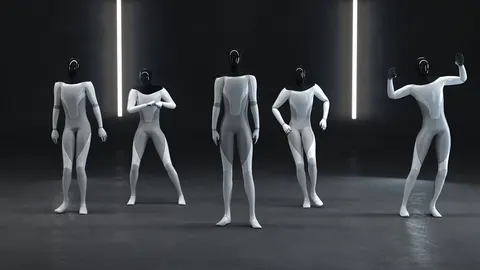
Trick or Treat?
That is what we ask ourselves every time Musk announces his latest grand project. Without question the biggest tech personality of our time, he alternates astonishing successes with obvious bluffs. On one side, it is enough to mention the launch of the American spacecraft awaited for decades and the mobility revolution that is Tesla; on the other, the long-proclaimed underground tunnel networks that will save us from traffic jams, and the trip to Mars that should have happened long ago.
In recent years, market speculation has also become one of the factors in how to “read” the news coming from him. The man who, in the small hours, could challenge presidents to a duel can lift or sink stocks with a single word. And he plays with the price of Twitter like a little boy with a puppy.
Optimus, however, may turn out to be something rather more important, given how little attention it has received from a media swallowed up by so much breaking world news.
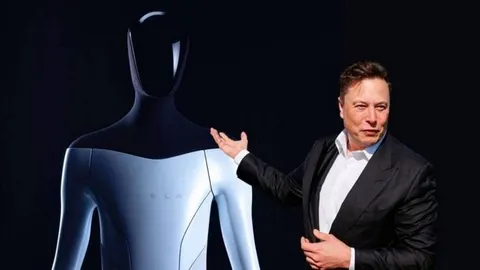
Employee of the Month
“I was surprised that people did not realize the magnitude and importance of this program,” Musk said in April this year, shortly after more details about the project were announced.
And the latest news—that the prototype will be ready before the end of September this year—coincided with another Musk statement: that because of the poor economic climate he plans to cut 10 percent of Tesla's employees. Considering that it is today the most highly capitalized car company in the world… that is quite a lot of people. It is also strange against the backdrop of his constant claims that there are not enough people, that more specialists are always being sought.
That our general problem as a civilization is the low birth rate…
The connection between the two is obvious; it was stated as far back as the first information about the creation of Optimus.
When its creation was first announced—in August 2021—it was supposed to be called the Tesla Bot. Then it received its far more personal current name, and suddenly the project turned out to be a huge priority.
Nice to Meet You, Optimus!
“Very soon, physical work will be a matter of choice. You will still be able to do it, but only if you want to,” Musk insists. And this will happen precisely thanks to projects like Optimus, whose goal is to take over the thankless part of human tasks. That is exactly why the humanoid form was chosen.
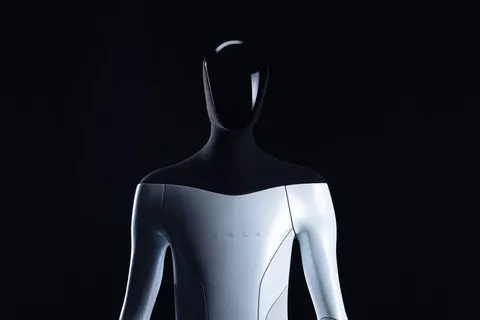
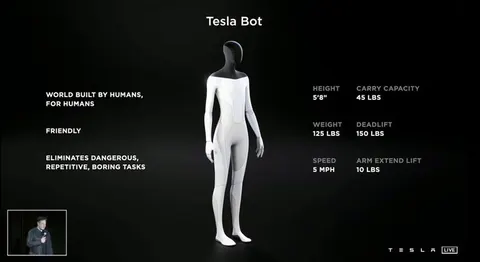
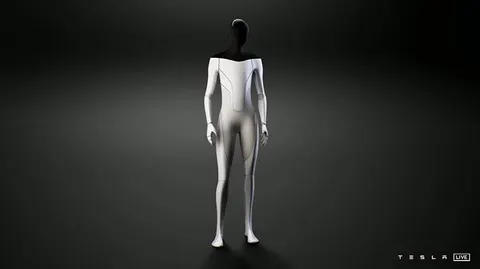
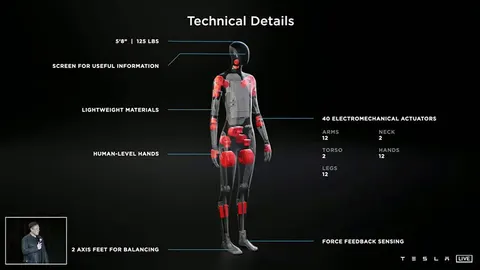
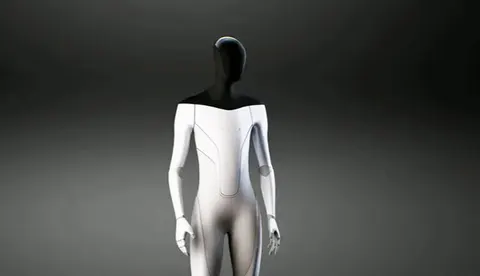
Our future friend will stand 173 centimeters tall and weigh 57 kilograms. Rather skinny for his average height, clearly not prone to putting on weight. He will be built from the lightest possible materials.
He will be able to carry a payload of 20 kilograms, lift 60 kilograms, and move at an almost walking pace of 8 km/h.
On his “face” there will be a display showing all sorts of useful information.
I am sure you are already wondering: and what will be going on where the brain is? What autonomy, what attempts to imitate human behavior are on the horizon?
For now, the ambitions point in a completely different direction. The artificial intelligence that will control Optimus will only help it find its way in space and carry out the purely physical tasks it is given, nothing more. It will be able to assemble parts, carry things, arrange them.
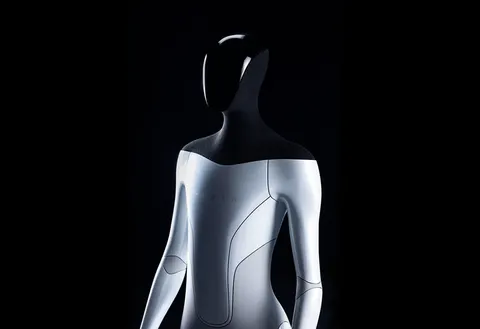
An Optimistic Theory
“Anyone who is more observant and listens carefully will appreciate that Optimus has the potential to one day surpass the vehicle business,” says Musk. Let us recall that this is the same business that made him not just the richest person on Earth, but the richest who has ever lived. For the first quarter of 2022, the company had revenues of $16.9 billion. In other words: the ambitions tied to Optimus and its successors are serious.
Another telling sign that the robot is becoming a priority is the decision to speed up its development at the cost of delaying another long-proclaimed project—the autonomous Cybertruck.
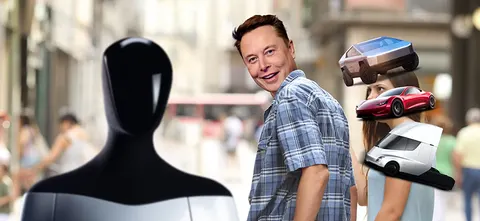
“Tesla is arguably already the biggest robotics company in the world,” says Musk. “Our cars are essentially semi-sentient robots on wheels.”
Optimizations
And there is a good deal of logic in that. The company develops its own innovative chips, as well as artificial intelligence, used in its cars. According to their creator, they can easily be reworked to control a humanoid robot too.
Plus a supercomputer called Dojo, whose job is to train the deep neural networks behind fully autonomous driving. And look, they have already found it another, rather important task.
If the richest man's predictions come true, Tesla really does have the potential to become not merely a colossal company, but a giant the likes of which has never existed.
Of course, as mentioned, it is always worth keeping a little caution in reserve when it comes to the still youthful optimism of the 50-year-old Musk. He is often inclined to announce unrealistic goals, but just as often inclined to deliver on grand promises in incredible ways.
Ironclad
Just how good Optimus is, we will find out very soon. “A robot by people, for people,” the marketing materials call it.
“For now, there is nothing to fear,” Musk promises. “At a mechanical level, you can outrun Optimus, and most likely, for now, you will also be stronger than it.”
Of course, if we go back just five years, we can hear the same hero saying that “AI is the biggest risk we face as a civilization. The greatest danger to human existence, in a way that car crashes, plane crashes and bad food are not.”
“Optimus is designed to be friendly, to navigate through a world built for humans,” its “daddy” assures us.
The first versions will be limited to performing one task each, and the idea is for them to join the workflow of Tesla's factories right away. Then development will continue, so that every Optimus can perform all sorts of different tasks. Accordingly, almost any company would be happy to have as many Optimuses as it needs to do human work. As usual, one of the goals is a low price. Musk does not commit to specific sums, but promises that the humanoid “will cost less than a car.”
We Can Carry It
“These robots are not coming to push us out of ordinary human professions,” Musk promises. “They will take on only the most boring tasks, the activities that are repetitive, monotonous or dangerous. And the more interesting ones will be left to us…” As you can see for yourselves, this definition is rather loose.
So what, is this the end of the ads for “student movers”? Of the classic Bulgarian handyman notices promising to “demolish, clean, haul away”? What a boring future!
“Yes, we need to be ready for this moment and think about some form of universal basic income,” Musk believes as well. “But there is no need to hurry, because the robot does not work yet.”
In 2023, the richest man on Earth promises we will already have a version of Optimus “that does something useful,” with the real boom coming within the following two years.
How will all this change the labor market? When, for more and more human tasks, we have a working “hand” that does not get tired, does not get sick, and has no union demands? At least in the developed countries, serious turbulence really does seem to be on the way.
The Handy Hands Club
“Of course, we have to be careful that all this doesn't degenerate into a dystopia,” Musk admits. “I think one of the important things is for the robot to have a local central chip whose software cannot be updated over the air. We also need a clear built-in command—whenever someone says ‘Stop!’, it must be certain that the robot will stop, no matter what it is doing at the moment.”
I suppose you know that one should beware of Greeks bearing gifts. Well, the same goes for the excessively rich, and Musk is a textbook example. No one can dispute his enormous contribution to more and more fields. But neither can anyone dispute his desire to decide on behalf of all of us what is important and how it should be done. Even when it comes to existential questions that shape our future.
Still, let us greet Optimus with optimism. Personally, I would be grateful if it saved us from washing dishes, windows and other undeniably tedious chores. Or if we could teach it to chop salad. While the other big questions of the future keep coming, with it or without it…