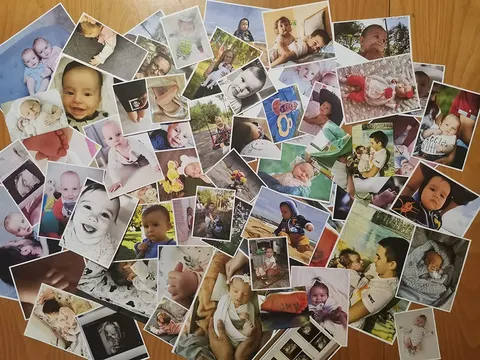
“Life is stronger!” Stronger than everything that piles up on us every day, than the coronavirus, than the measures against it, than the battles against the measures… than everything. Because while we wander between the extremes of a confused present, while we work ourselves up and turn bitter against one another… life simply goes on. The next children arrive, and they will know much more than any of us, as Louis Armstrong used to sing.
It is easy to forget that life is stronger in our confused present. Here is a digital idea to remind us of that eternal truth.
Doors Without Frames
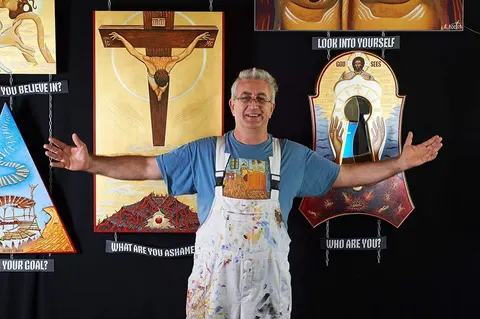
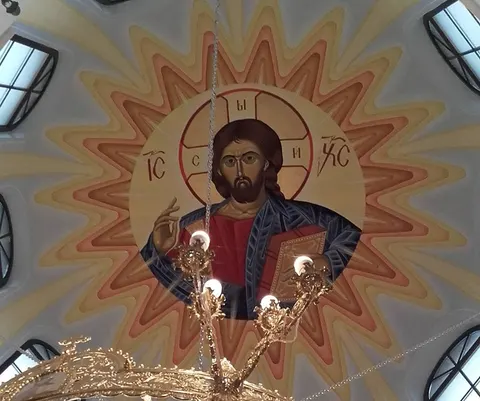
Dian Kostov is a professional icon painter. In “modern” language we would probably call him a UX iconic artist or a UI mural designer, but in fact he practices an art that has been alive for 2,000 years.
Even at first glance, though, it is clear that his icons are not like the others we know. “They really do look quite different, because I want them to. Otherwise, in this art everything we see is one and the same,” says Dian. “Right now, and not only in Bulgaria, we just keep repeating. I believe that a contemporary zograf, an icon and church painter, has to keep pace with his time, and not only in icon painting but in every field.”
That is exactly how it was through the centuries, which is why icons from different periods are so easy to tell apart. The tradition was broken in the last century, and it is very hard to revive today. That is precisely our interlocutor’s ambition: to create the images of the saints while weaving his own vision into them. As the art critic Rayna Damyani says of his works, they are “a spiritual destination with a starting point—the journey to oneself. They lead to doors without frames, without limits of time and space.”
Spirit Through Material Means
Unusual symbols are often woven into his canonical images. The mirror, for instance, is typical of him, something we would hardly see on other icons. “The idea is that we all look at ourselves, but we also need a mirror for the soul, a kind of keyhole into ourselves,” the zograf explains. “I love weaving in symbols, because our task as zografs is to recreate the spirit through material means. The symbol is one of the ways we can show that it is about something more.”
Is there a place for icons in the digital world too? “I’m convinced there is, because this art is bound up with faith, and faith cannot be without a future—it is eternal,” says the zograf.
A Fashion Icon
He actually ended up in this rather rare and unusual profession by chance. After finishing art school in Plovdiv, he went to Veliko Tarnovo and enrolled in the very first class in iconography. The plan was to switch to painting after the first year, but he found it endlessly interesting, and the plan changed.
He divides his time equally between iconography and mural painting. Unfortunately, he rarely gets the chance to paint entire churches. The place he is proud of is the new church of the St. Mina Monastery, very close to Sofia. He devoted four years to the murals there and another year and a half to the icons.
“In Bulgaria today there are very few of us zografs, and what’s even sadder is that our clergy have started putting wallpaper up in churches,” says Dian.
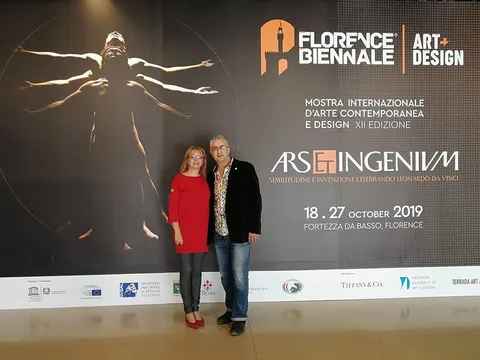
His art has been noticed, though—perhaps more abroad. In 2019 he was selected for the international biennale in Florence with his installation “Who Are You?”. Soon after, it was supposed to be shown in Dubai and Vienna too, but… then came the coronavirus, and things changed.
And so, by mentioning the pandemic, we arrive at the digital side of this story, at the beautiful venture of Dian and his like-minded friends, which wants to remind us that “Life Is Stronger.”
Coming into the World
The idea was born at the end of last summer, when the second wave of the virus washed over us. After the initial shock and the time of “locked” parks came the summer’s relaxation. And then it became clear that things were evidently going to drag on.
Dian and his wife, Milena Tashkova, a psychologist, were determined to do something positive that could lift people’s spirits in a gray moment. That is how their idea of “Life Is Stronger” was born.
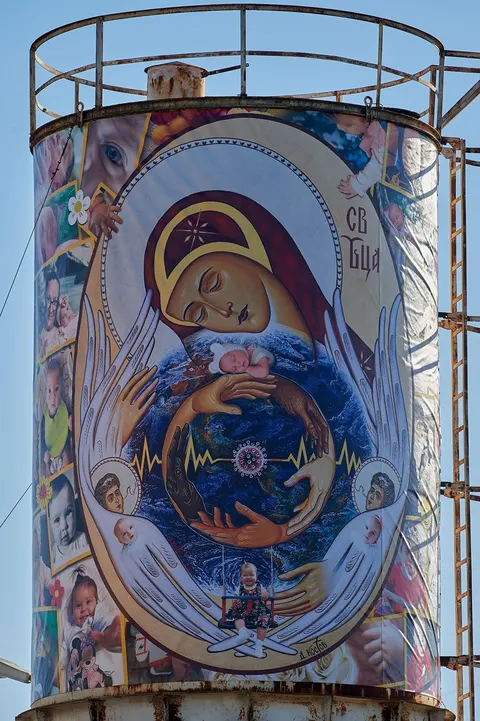
The two decided to collect photos of children born in the notorious year 2020 as a symbol of sorts. To complement them with an icon of the Mother of God created specially by Dian, and to show the work somewhere more people would see it. And to make people reflect that today there may be a certain number of people infected and killed by the disease, but there is also a number of new lives just beginning their earthly adventure.
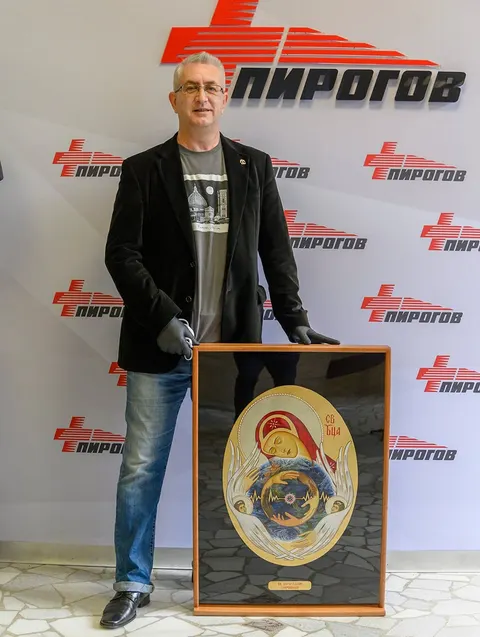
“We came to the conclusion that there is no better image than the Holy Mother of God to embody our idea, because she is the supreme symbol both of motherhood and of miraculous healing. She is venerated all over the world, and we wanted the venture to reach beyond Bulgaria’s borders, to be meaningful for all people,” the icon painter says.
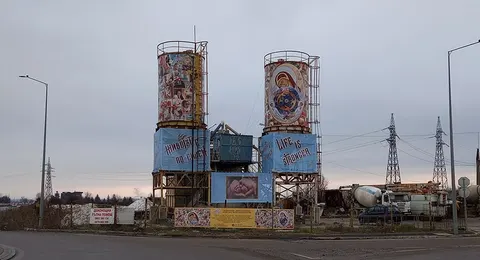
Quite a few symbols are woven in here as well. “The Mother of God the Protectress embraces the Earth, and inside there is a circle with five hands, a symbol of the five continents where people live. Inside it is the coronavirus. When the rhythm of the heart passes through it, it stops, and when it continues on toward the five hands, it appears again. The message is that when we humans are together, we will beat this virus one way or another, and everything else bad that happens to us,” says Dian.
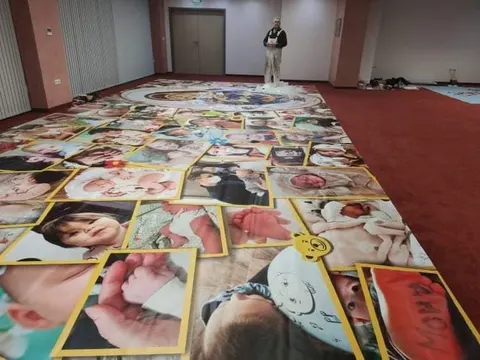
The venture quickly grew, and 25 people from all sorts of fields joined in creating the panel. Parents liked the idea too—by mid-November 2021, the deadline, mothers and fathers had sent in 323 photos of their children born during the pandemic.
A Breath of Air
Along with the photos came their beautiful stories. Some of the babies arrived after years of struggling with infertility, others after painful losses. Still others overcame illnesses. A mother sick with COVID gave birth to a child with a heart malformation… which vanished by the very next checkup. “Miracles happen all the time; the question is whether we have the eyes to see them,” says Dian.
And the photos speak for themselves. More than 150 little lives meet digitally to give birth to a collective symbol and a powerful message.
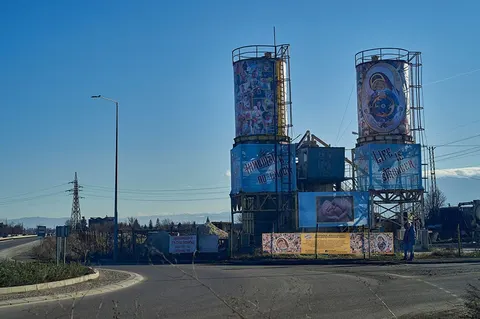
The first place Dian liked for the installation was the silos of a concrete plant very close to Sofia, on the road to Vidin, just before Kostinbrod. Quite unexpectedly, the owner immediately agreed to let the project with the babies appear on the 14-meter concrete columns in the middle of the empty, gray field.
Mounting it was a huge challenge, because up at that height the wind blows terribly hard, and Dian and his team were determined to be ready before this past Christmas.
In the end they managed, and the symbol can now be seen by anyone. It will stay in place a good deal longer, and not just until the beginning of spring, as originally planned.
“For these two years, websites have published the number of infected and dead every day. And now in quite a few places they have started writing how many little ones were born that day too. We decided to turn our gaze toward the good—that was the idea. And to some extent I think we succeeded,” Dian adds.
Messages reach people most easily and most deeply through art. And in this case it is an interesting, unconventional and original art two millennia old. It is definitely worth reminding ourselves more often. Whatever happens, after all, always… “life is stronger.”