“Poetry written with the help of artificial intelligence.” What is that? Does AI write it alone? Does it depend on the task the human sets? Or do the two find a way to go on together, so that they create something next, something different? The way it has always been until now…
I believe as many people as possible should be asking these questions. And looking for their own answers. Because the better version of the future runs through this conversation and nowhere else.
Can new, different, unexpected, beautiful poems be born this way? Does it depend on the human, or on the algorithm?
Update: The results of the first contest of its kind in Bulgaria for poetry and AI are now in, the poetry collection has been published, and the conclusions are extremely important and revealing—read here.
Mechanically
Prizes await, and the best poems will be published by Scribens. The selection is a serious and responsible one, because some impressive names agreed to sit on the jury: Petar Chuhov, Boyko Lambovski, Violeta Kuneva, Georgi Gavrilov.
But… why do we need to test how good an author (or partner) the algorithm can be in a field like poetry, of all things?
Maybe, if you believe quite a few of the people who saw the contest announcement, we don’t? Quite the opposite, in fact:
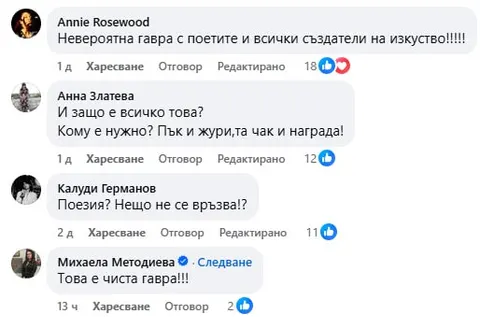
Active as a Machine
My aim has always been to lead the conversation, not to steer it. Yes, it is clear by now: it cannot be a coincidence that AI-generated poems made the top 10 of two consecutive leading Bulgarian poetry contests.
So what? Many people are completely against letting AI anywhere near poetry. Poetry is supposed to be human, untouched, cut off from technology…
What does it take to prosper?
Be active as a machine!
Let nothing frighten you!
Beware only of your mind!
The mind trips up all efficiency.
Sometimes it makes it impossible.
Beware of the mind!
Don’t let it get in your way!
How else could you be infallible?
Dobri Zhotev
Back in the good old year of 1969, the Bulgarian poet Dobri Zhotev painted the figure of Kibernet. I was lucky enough to learn about him precisely through the conversations I hold on my site. And here it is: so many of today’s big topics were anticipated that precisely and that long ago.
“Cybernetics specialists once again spoke of the possibility of creating a machine-creator, while literary figures protested fiercely against it…”
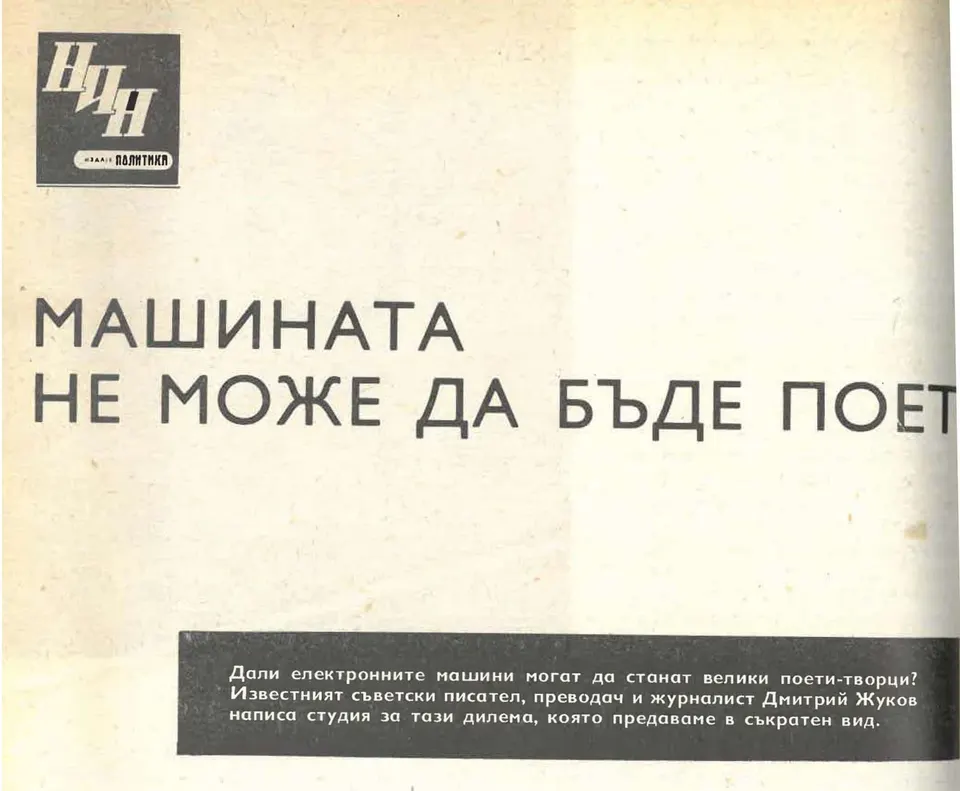
Yes, the topics are supposedly familiar, the path well trodden. And still—must we keep creativity and technology at arm’s length?
Why all this whining?
Why do people sigh
for some romance
grown cold?
Romance today is in the engines
_that sing_

 _beneath the blue sky._
Nikola Vaptsarov
Yes, starting tomorrow we will declare that artificial intelligence was not used in creating the poems a poet enters in a given contest, or weaves into their latest collection.
Po-ethics
Except we already live in a time when it cannot be proven whether a text was written by a human or by an algorithm. What’s more, every one of us already reads generated texts every single day without realizing it.
Can we really solve the whole problem with bans and regulations? By pretending nothing has changed and simply walking around the unobtrusive elephant in the room, convinced it is just a statue?
The hands of the wind
stretch out my branches—
inward to the sky,
outward to the dreams.
There, where
fate leafs open our dreams,
I wait for you—
child of the wind.
Yes, the juries of two consecutive poetry contests could not have been fooled by accident. Especially juries so different in their makeup and their requirements.
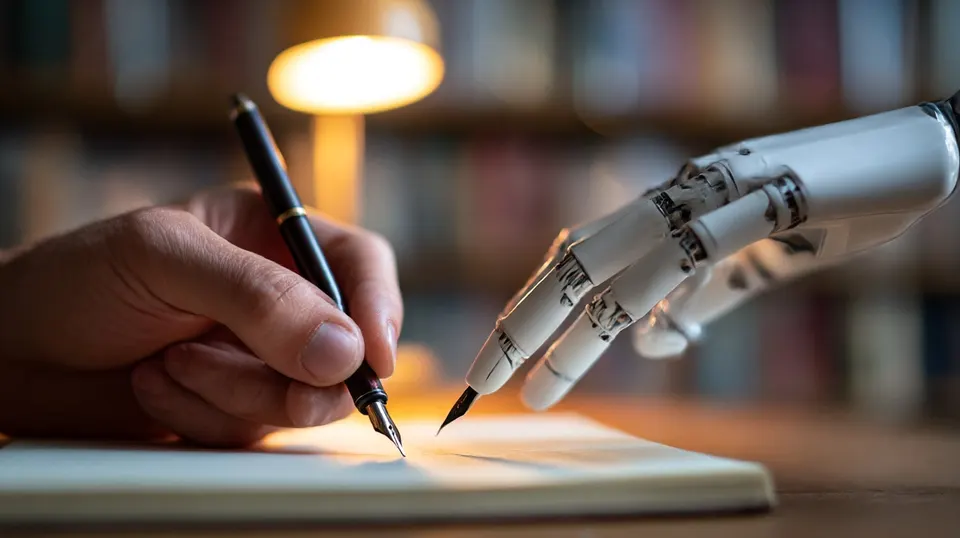
Do You Respect Me?
And how exactly can we still be sure who the author is? And really, who is the author if AI and the human work together? Is it art?
How can we judge how good algorithms really are at creating poetry if we don’t challenge them?
How can we preserve our creative impulse, which, as experience so far has shown, easily falls victim to the comforts technology brings us?
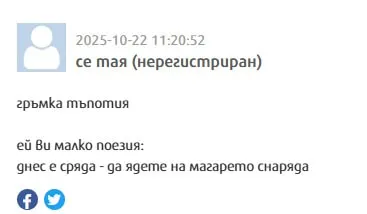
“I wouldn’t take part, because I don’t approve of using AI in poetry.” That was the argument with which a poet turned me down when I invited her onto the jury (everyone else accepted, and once again, thank you from the bottom of my heart!). I got exactly the same words from a fellow journalist who did not want to write about the project. A well-known publishing house refused to support it because it was in “severe dissonance” with its views.
And yet, whether we approve of it or not, AI is here to stay, and we cannot pretend it doesn’t exist. And in order to be able to make sense of it, use it in the best possible way, or ban it, we first need to get to know it.
Why a contest, of all things? Should we encourage people to use this technology, or is it better to be afraid and keep away from it?
“(I am a man of flesh and blood,
there’s not an ounce of iron in me;
whatever in my life I make,
death will peck away without pity;
I’m going far, and I’m alone…),
I leave behind these verses.”
François Villon, translated by Vasil Sotirov
Poetry contests are at the root of our modern views of this art, Boyko Lambovski, a well-known poet, journalist and member of the Apollo ex machina jury, reminded me.
In 1458, François Villon took part in a poetry contest held at the court of Duke Charles d’Orléans in the castle of Blois. The theme was set by the duke himself: “I die of thirst beside the fountain.” An unusual influencer by today’s standards, Villon entered the competition alongside a dozen or so court poets, and it helped him reach a wider readership for the first time.
Time of Parting
1860, Athens. Grigor Parlichev, a Bulgarian poet and teacher from Ohrid, won first place at the annual Athens poetry contest with his epic poem “Ο Ἀρματωλός” (“The Serdar” or “The Voivode”). He received a laurel wreath and a cash prize, and it is no exaggeration to say this was also the first great poetic triumph of a Bulgarian.

Parlichev was given the title of laureate, and the Greek government granted him a small lifelong pension and offered him citizenship and a scholarship to study at a prestigious foreign university—there was even talk of Oxford. He, however, turned down every honor. He declared that he was above all a Bulgarian, and that his goal had been to show the world what the Bulgarian people were capable of.
“We affirm that the world’s magnificence has been enriched by a new beauty: the beauty of speed.”
Filippo Tommaso Marinetti, The Futurist Manifesto
Quite a few years passed after Parlichev, the internet arrived, and poetry was one of its very first guests. At first it lived in the forums; I wrote in one of them too, and we even published a few anthologies. I was in high school and believed poems would help me succeed with girls (well, they didn’t). Then I started reading poetry and becoming convinced of how great this art is.
Today, more than ever, as a lover of poetry, I believe it can help us make sense of the world we have found ourselves in. In the search for answers to those enormous questions that are the reason Digital Stories exists. If with the help of the machine we can create something better, more beautiful, more thrilling, should we ban it? If it can give us the next ideas, forms, directions, genres? If it is itself capable of creating better poems, should we forbid it to?
I don’t know about you, but all my favorite poets are brave people. The kind who were not afraid of the status quo, of the censorship of spirit and thought, of the inhibitions of their time, style or genre. Of borders and artificial limits.
Programmed Harmony
“I like to think (and the sooner the better!)
of a cybernetic meadow
where mammals and computers
live together in mutually programming harmony
like pure water touching clear sky.”
Richard Brautigan (I couldn’t find a Bulgarian translation, so this version is by the two of us, ChatGPT and me.)
In the contest we are organizing with the Scribens publishing house, the restrictions are minimal. We expect everyone who feels provoked to enter with up to three poems. There are no limits on genre or form, nor on exactly how you use artificial intelligence—as a full-fledged author, as an editor, as an assistant. The winner will receive a cash prize, the runners-up books, and the best poems will be published in an anthology.
Where is poetry today? Can it reinvent itself, can it help us make sense of the world we live in?
I don’t know. But I am sure that the jury of Bulgaria’s first contest for generated poetry is made up of people who can show us the way to the answer.
Let’s look for it together. Will you be the one to create, with the help of AI, poems that move people?
No one knows who will turn out to be Apollo ex machina.
Update: The results of the first contest of its kind in Bulgaria for poetry and AI are now in, the poetry collection has been published, and the conclusions are extremely important and revealing—read here.